Showing posts with label Cardiff Castle. Show all posts

Saturday, 21 July 2012

ST PHILIP EVANS S J

St Philip Evans and St John Lloyd were two Welsh priests who shared a cell in Cardiff Castle in 1678/79.  They were executed on the same day, 22nd July 1679, at Gallows Field, Cardiff.  Most accounts of St Philip Evans and St John Lloyd are joint accounts but, although they shared so much, I think that each man’s story deserves a separate telling.  As the 333rd anniversary of their martyrdom approaches I will endeavour to do just that.  Of course there will be similarities and cross overs but I will do my best to give a brief account of their individual stories.  (LINK HERE)
The Parish Church at Llangattock Vibon Avel which contains monuments
to members of the Evans family
PHILIP EVANS was born at Monmouthshire in 1645.  He was the son of Winifred Morgan of Llanvihangel Crucorney and William Evans of Llangattock Vibon Avel, near Monmouth.  Philip was educated at St Omer and he entered the Jesuit Novitiate at Watten on 7th September 1665.  When he completed his training he was ordained at Liege in 1675 and sent upon the English Mission.

17th century chalice believed to have 
belonged to St Philip Evans
Back in Wales, Fr Philip Evans S J worked diligently for four years, saying Mass, administering the Sacraments and preaching in Welsh and English.  It is known that the young Jesuit, along with Fr David Lewis, regularly stayed at the home of Thomas Gunter of Cross Street in Abergavenny.  Here he celebrated Mass and tended to the needs of the Catholics of the area.  The Catholic Church at Abergavenny has in its possession a small travelling chalice which is thought to have been owned by Fr Evans.  He also stayed at the homes of Charles Prodger of Wernddu and of Christopher Turberville of Sker House and cared for the Catholics in these locations.

During the wave of persecution generated by the Popish Plot, friends advised Fr Evans to go into hiding.  However, he refused and bravely continued his work.  On 4th December 1678, the priest was arrested at Sker House, betrayed by the owner’s younger brother, Edward Turberville, a lapsed Catholic.  Philip Evans was imprisoned in Cardiff Castle Gaol and kept in solitary confinement in the dungeon.  After several weeks he and another Welsh priest, Fr John Lloyd, were permitted to share a cell. Fr Lloyd, a secular priest, had been arrested in November.

The following May, Fr Philip Evans was tried at Cardiff Assizes, found guilty of the treasonable offence of being a Catholic priest, and sentenced to death.  The execution was delayed for some time and Fr Evans was even allowed out of prison for recreation!  Eventually, on 21st July 1679, orders arrived that his execution was to take place the following day.  At that time he was playing tennis on the court near St John’s Church.  When the gaoler went to the tennis court to tell the priest the news and to return him to prison, Fr Evans remarked, “What haste is there?  Let me first play out my game.”   This he did!

St Philip Evans S J,
with his harp
Fr Evans had a sister, Sister Barbara Catherine, who was a Blue Nun in Paris.  When he returned to his cell after his game of tennis, he wrote to her. He told her of his approaching death and insisted that she should not mourn for him but be joyful.  He asked her to pray for him and promised that he would pray for her. 

Philip was a skilled harpist and when the officials came the next morning to lead him to his execution they found the priest joyfully playing the harp.  His legs had been bound with heavy chains.  They were so tight that the struggle to remove them lasted more than an hour and caused the poor priest indescribable agony.

Fr Philip Evans was then taken to the place of martyrdom.   When he mounted the scaffold Fr Evans said; “This is the best pulpit a man can have to preach in, therefore, I cannot forbear to tell you again that I die for God and for Religion’s sake.”  He addressed the crowd in English and in Welsh, then turning to Fr Lloyd, who stood waiting his own turn, he said, “Adieu, Mr Lloyd!  Though only for a little time, for we shall soon meet again.”

On 22nd July 1679, thirty-four year old Fr Philip Evans S J was hanged, drawn and quartered at Gallows Field (the northern end of Richmond Road) Cardiff.   He was beatified in 1929 and canonised in 1970.  St Philip Evans is one of the Forty Martyrs of England and Wales.

Monday, 28 December 2009

330TH ANNIVERSARY (PART 1)


2009 marks the 330th Anniversary of the martyrdom of four priests who were executed for “High Treason”. Philip Evans, John Lloyd, John Kemble and David Lewis were Catholic priests and to be a Catholic priest was considered treason. At the trial of Fr David Lewis, the judge, Sir Robert Atkins, made that abundantly clear when he said;

“It is enough that you have exercised the functions of a priest in copes and vestments used in your Church, and that you shall have read Mass
and taken Confessions.
He that uses to read Mass commits treason.”

Now, in the dying days of 2009, it is fitting to remember these four holy martyrs, two Jesuit priests and two secular priests.

FR PHILIP EVANS S J
Philip Evans, the son of William Evans and Winifred Morgan, was born at Monmouth in 1645. He was educated at St Omer and entered the Jesuit Novitiate at Watten on 7th
September 1665. Having completed his training, he was ordained at Liege in 1675 and sent upon the English Mission. Back in Wales, he worked diligently for four years, saying Mass, administering the Sacraments and preaching in Welsh and English. It is recorded that he ministered to large congregations at the home of Thomas Gunter in Abergavenny, at the home of Charles Prodger at Wernddu, and at Sker House, the home of Christopher Turberville.

During the wave of persecution generated by the Popish Plot, friends advised Fr Evans to go into hiding. However, he refused and bravely continued his work. On 4th December 1678, the priest was arrested at Sker House, betrayed by the owner’s younger brother, Edward Turberville, a lapsed Catholic. He was imprisoned in Cardiff Castle Gaol and kept in solitary confinement in the dungeon. After about three weeks, the governor was persuaded to allow Fr Evans and Fr John Lloyd, who had been arrested in late November, to share a cell.

The following May, Fr Evans was tried at Cardiff Assizes, found guilty of the treason of priesthood, and sentenced to death. The execution was delayed for some time and Fr Evans and Fr Lloyd were even allowed out of prison for recreation! Eventually, on 21st July, orders arrived that the execution was to take place the following day. At that time, the priest was playing tennis on the court near St John’s Church. (Lest we become self-righteous, this was near the spot where, a century earlier, Rawlins White, a Protestant, was burnt at the stake for his beliefs under Catholic Queen Mary.) When the gaoler went to the tennis court to tell the priest the news and to return him to prison, Fr Evans remarked,
“What haste is there? Let me first play out my game.”

Philip was a skilled harpist and when the officials came the next morning to lead him to his execution, they found him joyfully playing the harp. On 22nd July 1679, the Jesuit priest, Fr Philip Evans, was hanged, drawn and quartered at Gallows Field, Cardiff. He was 34 years old. His friend and cellmate, Fr John Lloyd, looked on, knowing he would be next.

FR JOHN LLOYD
John Lloyd, the son of Walter Lloyd, was born in Brecon around 1630. In 1649, John Lloyd entered the English College at Valladolid and was ordained there on 7th Jun
e 1653. In April 1654, he left for his homeland where he spent the next 24 years labouring among the Catholics of Glamorgan and Monmouthshire.

On 20th November 1678, Fr John Lloyd was arrested at the home of John Turberville at Penllyn. Fr Lloyd was taken to Cardiff castle Gaol where he was imprisoned, probably in the Black Tower. For a time, he was kept in solitary confinement until the Jesuit, Fr Philip Evans, who had been arrested in early December, joined him.

On 9th May 1679, the Assizes opened in the Shire Hall, within the grounds of the Castle. Fr Lloyd was indicted as a Catholic priest and therefore a traitor. He was found guilty and sentenced to be hanged, drawn and quartered. On 22nd July 1679, the gruesome sentence was carried out. Fr Lloyd had to watch as the younger priest, Fr Philip Evans was executed. Then he too was subjected to the same brutal martyrdom. Fr John Lloyd was 49 years old.

Fr John Lloyd was not the only member of his family to suffer because of the Popish Plot. His brother, Fr William Lloyd, who had been head of the secular clergy in South Wales, was arrested at the height of the Plot and imprisoned in Brecon Gaol. Sentenced to be hanged, drawn and quartered, he died in prison just days before his scheduled execution.
(TO BE CONTINUED)
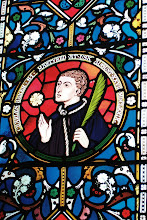
(The pictures of St Philip Evans and St John Lloyd are taken from a stained glass window in the Catholic Church in Tenby, South Wales.)
Related Posts with Thumbnails