Showing posts with label St John Roberts. Show all posts

Thursday, 25 October 2012

HYMN IN HONOUR OF THE SIX WELSH MARTYRS

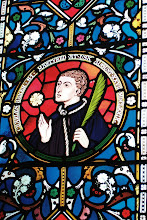
ST STEPHEN & THREE WELSH MARTYRS DEPICTED IN A STAINED
GLASS WINDOW IN THE CATHOLIC  CHURCH, TENBY


Today we celebrate the Feast of The Six Welsh Martyrs of the Reformation.  The Six Welsh Martyrs, who were canonised by Pope Paul VI on 25th October 1970, are:
 
St Richard Gwyn was born about 1537 in Llanidloes, Montgomeryshire. He was a teacher and a married man. He and his wife, Catherine, had six children. He was executed at Wrexham on 15th October 1584. St Richard Gwyn is the protomartyr of Wales.
 
St John Jones O F M was born at Clynog Fawr, Caernarvonshire around the year 1530. He entered the Franciscan Convent at Greenwich and, at its dissolution in 1559, he went to the Continent and was professed at Pontoise, France. He died for the Faith at Southwark on 12th July 1598. At his execution, he had to wait an hour because the hangman had forgotten to bring the rope!

 
St John Roberts O S B born at Trawsfynydd, Merionethshire, was the first prior of St Gregory’s, Douai. He was sent upon the English Mission in December 1602, arriving in England in April 1603. He was probably the first monastic to enter England since the Reformation. He was executed at Tyburn on 10th December 1610.
 

St Philip Evans S J was born in Monmouth in 1645. He entered the Society of Jesus on 7th September 1665. He was ordained at Liege and sent upon the English Mission in 1675. He diligently and joyfully served the area of South Wales for four years before his arrest at the house of Christopher Turberville at Sker, Glamorganshire on 4th December 1678. He was martyred at Cardiff on 22nd July 1679. He was thirty-four years old.
 
St John Lloyd was Brecon born and studied at Ghent and Valladolid. He was ordained a priest at Valladolid in 1653. He returned to Wales and laboured in Brecon and Monmouthshire for 24 years. In November of 1678, he was captured at a house at Penllyn, Glamorganshire. He and St Philip Evans shared a cell at Cardiff Castle until their martyrdom at Cardiff on 22nd July 1679.

St David Lewis S J was born in 1616 at Abergavenny, Monmouthshire. He attended the local Grammar school where his father, Morgan Lewis, was headmaster. Ordained in 1642, David entered the Jesuit novitiate in 1645. He returned to Wales and, based at the Cwm, he served the Catholics of the area for 34 years. He was arrested at Llantarnam on 17th November 1678 and martyred at Usk on 27th August 1679. St David Lewis was the last Welsh martyr.

HYMN OF THE WELSH REFORMATION MARTYRS

(Tune Hyfrydol or Blaenwern)
Came a time upon our nation
when the faith of Rome was banned.
Christians found their hearts were broken,
torn apart throughout our land.
Thus a traitor to the nation
anyone who loved the Pope.
Christians stood in condemnation.
Who could bring them any hope?
 
Men who trained  as priests for Cymru
came from Europe’s shores ere long.
Traversed far and wide our nation,
come to keep the Old Faith strong.
Saying Mass and heard confession,
priests of God , their only crime
was that laws of England’s kingdom
made such treason, at that time.
 
David Lewis, priest of Monmouth
gladly in Usk met his end.
As at Cardiff, Philip Evans
with John Lloyd, his holy friend.
From the north did Saint John Roberts
die for Christ, a Martyr true,
and Franciscan, Saint John Jones,
from the noose to heaven flew.
 
With these priests, to Rome so loyal,
one more Saint of Wales did die.
Richard Gwyn, the edict Royal
did at first its ways comply.
But this man, of Wales a teacher,
taught us now the better way.
He renounced the Royal churches,
chose with Rome alone to pray.
 
Time hath passed upon our nation,
the Old Faith no longer banned.
Other Christians, once oppressive,
now as friends beside us stand.
*This is not a day for gloating,
Or for raising ancient wrong,
but a day for celebrating
loyal Saints whose faith proved strong.*


Sunday, 15 April 2012

SIX OF THE FORTY

The Forty Martyrs of England and Wales were selected from among the hundreds of Catholics who gave their lives for the faith during the dark days of persecution in England. The Forty were canonised by Pope Paul VI on 25th October 1970. Six of the Forty were Welsh. They were a married man, a Franciscan, a Benedictine, two Jesuits and a secular priest.

St Richard
Gwyn was born about 1537 in Llanidloes, Montgomeryshire. He was a teacher and a married man. He and his wife, Catherine, had six children. He was executed at Wrexham on 15th October 1584. St Richard Gwyn is the Protomartyr of Wales.

St John Jones O F M was born at Clynog Fawr, Caernarvonshire around the year 1530. He entered the Franciscan Convent at Greenwich and, at its dissolution in 1559, he went to the Continent and was professed at Pontoise, France. He died for the Faith at Southwark on 12th July 1598. At his execution, he had to wait an hour because the hangman had forgotten to bring the rope!

St John Roberts O S B, born at Trawsfynydd, Merionethshire, was the first prior of St Gregory’s, Douai. He was sent upon the English Mission in December 1602, arriving in England in April 1603. He was probably the first monastic to enter England since the Reformation. He was executed at Tyburn on 10th December 1610.

St Philip Evans S J was born in Monmouth in 1645. He ent
ered the Society of Jesus on 7th September 1665. He was ordained at Liege and sent upon the English Mission in 1675. He diligently and joyfully served the area of South Wales for four years before his arrest at the house of Christopher Turberville at Sker, Glamorganshire on 4th December 1678. He was martyred at Cardiff on 22nd July 1679. He was thirty-four years old.

St John Lloyd was Brecon born and studied at Ghent and Valladolid. He was ordained a priest at Valladolid in 1653. He returned to Wales and laboured in Brecon and Monmouthshire for 24 years. In November of 1678, he was captured at a house at Penllyn, Glamorganshire. He and St Philip Evans shared a cell at Cardiff Castle until their martyrdom at Cardiff on 22nd July 1679.

St David Lewis was born in 1616 at Abergavenny, Monmouthshire. He attended the local Grammar school where his father, Morgan Lewis, was headmaster. Ordained in 1642, David entered the Jesuit novitiate in 1645. He returned to Wales and, based at the Cwm, he served the Catholics of the area for 34 years. He was arrested at Llantarnam on 17th November 1678 and martyred at Usk on 27th August 1679. St David Lewis was the last Welsh martyr.

Sunday, 11 September 2011

A VISIT TO TYBURN

The first recorded execution took place at Tyburn field, near the present day Marble Arch, in 1196. In 1571 the Tyburn Tree replaced the original gallows. The Tree was a horizontal wooden triangle supported on three legs. It was designed thus to accommodate multiple hangings at the same time. Although it was done only once, 24 prisoners could be executed simultaneously. The first victim of the Tyburn Tree was Dr John Story, a Catholic who refused to recognise Queen Elizabeth I as head of the church. Thousands had been executed at Tyburn before John Austin, a highwayman, was hanged there in November 1783. That was the last time the Tyburn Tree was used.

Between 1535 and 1681, almost 400 Catholics were executed at Tyburn. The last Catholic Tyburn Martyr was St Oliver Plunkett, executed in July 1681. The Vatican has officially recognised 105 of these as Martyrs and many of them have been canonised.

At the beginning of the last century the Benedictine Adorers of the Sacred Heart of Jesus set up home at Tyburn Convent, just yards from the site of the old gallows. The Sisters pray night and day before the exposed Blessed Sacrament. In recognition of the men and women who gave their lives for the faith, the Sisters maintain the Martyrs’ Shrine. Here are preserved relics of some of the martyrs, and a replica of the three cornered gallows, the Tyburn Tree, forms part of the altar.

Last month Cwmbran based Friends of Saint David Lewis visited Tyburn Convent. At 8 o’clock in the morning our group of 42 pilgrims left Cwmbran and headed up the motorway for London. Several hours later our genial coach driver, Terry from Tryline Travel, deposited us near Tyburn Convent. By now it was almost lunch time so, of course, we set off in search of food! There are restaurants aplenty in that area, Marble Arch, so pretty soon we were all happily catering to the inner man. That taken care of, we made our way down the road to Tyburn Convent.

Our tour was scheduled for 2 o’clock so we had some time to spare. This gave us the welcome opportunity to spend time in the chapel where the Blessed Sacrament is exposed night and day. What a great privilege!

Just before 2 o’clock, a smiling Mother Lioba arrived to escort us to the Martyrs’ Shrine in the crypt. Our parish priest had accompanied us on our pilgrimage and, as he vested for Holy Mass, Mother welcomed the group and briefly outlined the history of the Convent. Then, wearing red vestments, Father celebrated the Mass of the Martyrs. We were privileged to attend Holy Mass where, in days gone by, priests had died for celebrating Mass and for being Catholic priests. Father brought this home to us in his very apt homily.

When Mass was concluded, Mother Lioba recounted the story of the many Catholic martyrs who had been executed at Tyburn for their faith. Although our patron, St David Lewis, did not suffer at Tyburn – he was martyred at Usk – Welshmen, including St John Roberts and Blessed Philip Powell, were among the victims of Tyburn. Mother Lioba held us spellbound with her animated accounts of the lives and deaths of the martyrs. Mother’s knowledge of the martyrs was extensive, her enthusiasm palpable, and her devotion clear to all.

After Mother Lioba’s talk, there was time to wander around the crypt at leisure and to view the many treasured relics housed there. Mother was on hand to answer any questions or just to chat.

Our visit to Tyburn Convent was not over yet. We were directed to an adjoining room where pretty young Novices served refreshments to the pilgrims. Alas, it was time to leave. Mother Lioba, still smiling, saw us off with a handshake and a “God bless you”. Then it was back down the M4 to Wales.

It had been a memorable day and a happy yet humbled and thoughtful group arrived back in Cwmbran. All marvelled at the courage and faith of those holy men and women who had died for their faith. The experience certainly gave us food for thought and, hopefully, a greater appreciation of our Catholic faith and of the freedom we have to practise it. Remember, there are still countries in which Christians are dying for their faith.

PRAYER FOR PERSECUTED CHRISTIANS
Father, in your mysterious providence, your Church is called to share in the sufferings of Christ, your Son. Give the spirit of endurance and love to those who are persecuted for their faith in You. May they always be true and faithful witnesses to your promise of eternal life. This we ask in Jesus’ name. Amen.

Related Posts with Thumbnails