Showing posts with label St John Kemble. Show all posts

Monday, 29 July 2019

ANOTHER DATE FOR YOUR DIARY!

John Kemble (link here) son of John Kemble and Anne Morgan, was born at Rhydicar Farm, St Weonards, Herefordshire in 1599.  He was ordained priest in 1625 and for 54 years he laboured for the persecuted Catholics of Monmouthshire and Herefordshire.  In 1678 Fr Kemble became another innocent victim of the sordid and fabricated Popish Plot (link here)  The 80 year old priest was arrested at Pembridge Castle and confined to Hereford Gaol.  He was tried for the treason of being a Catholic priest, found guilty  and sentenced to be hung, drawn and quartered.
The execution of Fr John Kemble
(Photo J D Smith)
On 22nd August 1679 the gentle old priest was executed on Widemarsh Common. His nephew removed the Martyr's body to the church at Welsh Newton and buried him beside the churchyard cross.  
The grave of St John Kemble, Welsh Newton
(Photo J D Smith)

Fr John Kemble is one of the Forty Martyrs of England and Wales (link here) canonised by Pope Paul VI in 1970.  There is an annual pilgrimage to the Saint's grave and this year's pilgrimage will take place on Sunday, 18th August 2019 at 3 pm at Welsh Newton.

Friday, 7 August 2015

ST DAVID LEWIS: PILGRIMAGE 2015

THE ANNUAL PILGRIMAGE IN HONOUR OF ST DAVID LEWIS WILL TAKE PLACE ON SUNDAY, 30th AUGUST 2015.  THE CEREMONY WILL COMMENCE AT 3:00 pm WITH BENEDICTION AT THE CHURCH OF SS FRANCIS XAVIER AND DAVID LEWIS, PORTH-Y-CARNE ST, USK.  PILGRIMS WILL THEN PROCESS TO THE MARTYR’S GRAVE AT ST MARY’S PRIORY CHURCH, USK, FOR A SHORT SERVICE. FOLLOWING THIS SERVICE, ALL ARE INVITED TO RETURN TO THE PARISH HALL FOR LIGHT REFRESHMENTS.


The Church of SS Francis Xavier and David Lewis,
Porth-Y-Carne St, Usk

St David Lewis was a Jesuit priest who was falsely accused of taking part in the Popish Plot.  The Popish Plot was spawned in the disordered brain of one Titus Oates.  Although the so called plot was a figment of the imagination of the despicable Oates, terror and suspicion swept the country and many innocent people suffered and died.  Among those executed for their faith was Abergavenny born Fr David Lewis S J, (alias Charles Baker).

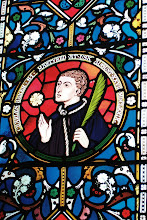
St David Lewis depicted in a stained glass window in the
Catholic Church at Abergavenny
Fr David Lewis laboured on the Hereford-Monmouth border for more than 30 years.  His kindness to all merited him the designation “Father of the Poor”.  Amidst the mayhem of the Oates Plot, he was arrested as he prepared to offer Holy Mass at Llantarnam, Cwmbran on 17th November 1678.  At that time, the law of the land deemed it High Treason to be a Catholic Priest and to say Mass in the country.   Having been found guilty of High Treason, Fr Lewis was condemned to be hanged, drawn and quartered, the usual punishment meted out to those convicted of the crime of High Treason.  On 27th August 1679 he was taken from his cell in Usk Gaol and dragged on a hurdle to a place knows as the Coniger and there executed for his faith, his priesthood, and for the Mass.  The site of the Saint’s execution is near the Catholic Church in Porth-Y-Carne St.
 
The plaque marking the site of the execution of St David Lewis
The martyred Jesuit was given a decent burial, an indication of the esteem in which the priest was held by all classes.  His butchered remains were reverently carried in procession to the Priory Church of St Mary, Usk, where the incumbent was Phineas Rogers, and interred in the Churchyard, just outside the west porch.  Fr David Lewis S J was the Last Welsh Martyr.
 
The grave of St David Lewis, just outside the west
porch of the Priory Church of St Mary, Usk
In October 1970, Fr David Lewis, along with his kinsman, Fr John Kemble, and thirty-eight others, was canonised by Pope Paul VI.  Collectively, this group of men and women, who gave their all for their faith, is known as THE FORTY MARTYRS OF ENGLAND AND WALES.   

The Forty Martyrs of England and Wales

Tuesday, 6 August 2013

ANNUAL PILGRIMAGE IN HONOUR OF ST DAVID LEWIS

St John Kemble and St David Lewis were kinsmen.   David Lewis was a Jesuit priest and John Kemble a secular priest.   Both priests served the Welsh Mission in a time when to be a Catholic was to risk much but to be a Catholic priest was to risk all!   During the Titus Oates Plot the cousins were arrested, tried and convicted of High Treason. To be a Catholic priest and to say Mass was considered High Treason! They were sentenced to the usual punishment for High Treason, to be hanged, drawn and quartered.   On 22nd August 1679 eighty year old Fr John Kemble was executed at Widemarsh Common, Hereford. Just five days later, on 27th August 1679 David Lewis was executed at Usk. He is the LAST WELSH MARTYR. 
 
On 25th October 1970, Pope Paul VI canonised John Kemble and David Lewis along with thirty-eight other Martyrs. Collectively they are known as The Forty Martyrs of England and Wales.


This year, the Annual pilgrimage in honour of ST DAVID LEWIS will take place on SUNDAY 25th AUGUST 2013.
3:00 p m: Benediction of the Blessed Sacrament at Catholic Church of St Francis Xavier and St David Lewis, Porth-y-Carne Street, Usk.  Following Benediction, pilgrims will process from the Church to the grave of St David Lewis in the churchyard of St Mary's Priory Church, Usk.

Wednesday, 31 July 2013

ANNUAL PILGRIMAGE IN HONOUR OF ST JOHN KEMBLE, 2013


ANNUAL PILGRIMAGE IN HONOUR OF ST JOHN KEMBLE – 2013
 
 
The Martyrdom of St John Kemble
 
This year, the Annual Pilgrimage in honour of St John Kemble will take place on SUNDAY 18th AUGUST 2013.  The pilgrimage begins with pilgrims setting off from St Mary’s Catholic Church, Monmouth after the 9 a m Mass at approximately 10 a m.   If you are planning to join this part of the Pilgrimage, be sure to take a packed lunch and suitable clothing!
Meet at 3 p m for readings and prayers at the Martyr’s grave in the churchyard at Welsh Newton.
Return to St Mary’s Church, Monmouth for Benediction at 4:15 p m.  Refreshments will be served in the garden following Benediction.
It is not compulsory to complete all stages of the pilgrimage and you are welcome to join the pilgrimage at either event.

Wednesday, 22 August 2012

ST JOHN KEMBLE


THE EXECUTION OF ST JOHN KEMBLE

John Kemble, alias Holland, was born at Rhydicar Farm, St Weonard’s, Herefordshire in 1599. He was the son of John Kemble and Anne Morgan. He and St David Lewis were cousins. John Kemble’s mother, Anne Morgan, was a relative of David Lewis’s father, Morgan Lewis. John was ordained a priest at Douai on 23rd February 1625 and, on 4th June, was sent upon the English Mission. He spent the next 54 years labouring for the people of Herefordshire and Monmouthshire. He was greatly loved by his own people and respected throughout the area because, it was said, “he gave offence to none”.


In 1678, Fr John Kemble became another innocent victim of the non-existent Popish Plot. A lapsed Catholic, Captain John Scudamore of Kentchurch, was sent to arrest Fr Kemble at Pembridge Castle, where the aged priest was staying with his relatives. When urged to flee, the 80-year-old priest said, “According to the course of nature I have but a few years to live. It will be an advantage to suffer for my religion and therefore I will not abscond.” After three months in Hereford Gaol, he endured an agonizing journey to London where he and Fr David Lewis were lodged in Newgate Prison. They were interrogated by Oates and his fellow plotters but, since no evidence of involvement in any plot could be found, he was sent back to Hereford. In accordance with Statute 27 of Elizabeth I, he was tried for treason, i.e., for being a Catholic priest and saying Mass. He was found guilty and condemned to be hanged, drawn and quartered.


On the morning of his execution, Fr Kemble made his devotions as usual. He then drank a cup of sack and smoked a pipe of tobacco with the undersheriff, Mr Digges, and the prison governor. (This is the origin of the Herefordshire custom of calling a parting drink or smoke a “Kemble Cup” or a “Kemble Pipe”.) Before his execution on Widemarsh Common, the good priest forgave those who had conspired against him and asked forgiveness of any whom he may have offended. He consoled the distraught hangman thus, “Honest Anthony, my friend Anthony, be not afraid; do thy office. I forgive thee with all my heart. Thou wilt do me a greater kindness than discourtesy.” He prayed silently for a few minutes then commended himself to God. The cart was drawn away and he was hanged. Such was the affection for Fr Kemble that he was allowed to die upon the gallows before being beheaded. He was also spared the grisly ritual of drawing and quartering. It was said, even by his persecutors, that they never saw one die so like a gentleman and so like a Christian. 


When the Martyr’s body was cut down from the scaffold, he fell with his hand beneath his head.  When he was beheaded, the hand was also cut off.  A devout woman in the crowd picked up the hand and carried it home in her apron.  For many years the hand was preserved in a small red wood box.  Eventually, it was given to the Catholic Church of St Francis Xavier, Hereford.    Near the end of the nineteenth century, a Mr Monteith of Carstairs presented the parish with a magnificent jewel- studded silver reliquary in which the hand now lies.  It can be seen today to the right of the High Altar.     
The Martyr's severed hand

 The martyr’s nephew, Captain Richard Kemble, who had saved the life of King Charles II at the Battle of Worcester, took the mutilated body to the church at Welsh Newton and buried it beside the churchyard cross. The gravestone is inscribed “J K Dyed the 22 of August Anno Do 1679”. There is a pilgrimage to the Saint’s grave every year on the Sunday nearest to 22nd August.


On 25th October 1970, St John Kemble and thirty-nine others were canonised by Pope Paul VI as the Forty Martyrs of England and Wales.

Tuesday, 7 August 2012

PILGRIMAGE TO THE GRAVE OF ST JOHN KEMBLE


THE GRAVE OF ST JOHN KEMBLE AT WELSH NEWTON
The Annual Pilgrimage to the grave of St John Kemble at Welsh Newton will take place on Sunday 19th August 2012. His Grace Archbishop George Stack will be in attendance. The programme is as follows:

10 a m: MONMOUTH
The walk begins from St Mary’s Church, Monmouth. Pilgrims are advised to bring a packed lunch.

3 p m: WELSH NEWTON
Rosary, Readings and prayers at the grave of St John Kemble in the churchyard of St Mary the Virgin, Welsh Newton, Herefordshire.

4:15 p m: MONMOUTH
Benediction at St Mary's Church, Monmouth. Following Benediction, tea will be served in the garden. 

Sunday, 3 April 2011

NOT LACKING IN MEN OF THE CLOTH

Morgan Lewis and his wife, Margaret Pritchard, were the parents of nine children, four girls and five boys. Margaret was a Catholic and she reared eight of the children as Catholics. Morgan, a Protestant, saw to it that their youngest child, David, was brought up in the Protestant religion.


David Henry Lewis was born in late 1616, at Abergavenny, Monmouthshire. He attended King Henry VIII Grammar School where his father was headmaster. When he was sixteen, David went to London to study law. It would appear that the boy’s heart was not in it for he soon availed of an opportunity to visit Paris. It was while he was in Paris that David was received into the Catholic Church. In 1636 David returned to Abergavenny and lived with his parents until their deaths in 1638. Deciding to become a priest, David then entered the English College in Rome. This was made possible by the financial assistance of Fr Charles Gwynne (alias Brown), the Superior of the Jesuit College of St Francis Xavier at the Cwm. After ordination, David Lewis joined the Jesuits. He was sent to work among the beleaguered Catholics of his homeland. With the exception of one year in Rome, Fr Lewis spent the rest of his life labouring among his countrymen in Wales. During the mad frenzy fomented by the Titus Oates Plot, Fr David Lewis was arrested at Llantarnam in 1678. In March 1679 he was tried and convicted of the crime of being a Catholic priest and of saying Mass. High Treason! Although the Titus Oates Plot was the impetus for his arrest, David was never implicated in the Plot and he was executed solely for his religion. This was made abundantly clear when, at the trial the Presiding Judge, Robert Atkins, stated, “He that uses to read Mass commits treason”. On 27th August 1679, Fr David Lewis S J was executed at Usk. Beatified in 1929, he was canonised in 1970.

From just a cursory look at the family of St David Lewis one can see that his was a family not lacking in men of the cloth.


David’s Great-great-grandfather was Lewis ap John (Wallis) who was Vicar of Abergavenny and Llandeilo Bertholau. Lewis ap John was Vicar of St Mary’s Priory Church where the tomb of his son, Dr David Lewis, can be seen today. Since Morgan Lewis had his son David brought up in the Established Church, David would have been baptised in the Priory Church where once his great-great-grandfather had been the vicar.


Lewis ap John’s grandson, David Baker, became a Benedictine. As Dom Augustine Baker, David Baker is famous as a mystic and writer. He was also instrumental in re-establishing the Benedictines in England. Dom Augustine Baker O S B was the great uncle of St David Lewis and the Benedictine and the future Jesuit Martyr would have met on the Benedictine’s last visit to Abergavenny in 1620. On his last visit to his hometown, Augustine Baker stayed with his sister, Margaret (Baker) Pritchard. Margaret Pritchard was the grandmother of St David Lewis.


As well as being the sister of a priest, Dom Augustine Baker, Margaret Pritchard was also the mother of a priest. Her son John became a Jesuit and, being just six year older than his sister’s son David, may have been the stimulus for his nephew’s decision to join the Jesuits. David Lewis himself states that he numbered among his closest friends his uncle, Fr John Pritchard who was a Jesuit. Dom Augustine Baker maintained at Douai a nephew who later became a Jesuit. It is widely held that this nephew was indeed Fr John Pritchard S J (alias Lewis).

A nephew of St David Lewis became a priest. His nephew, also named David Lewis, was the son of the Saint’s brother, Richard. Born in Monmouth, Richard’s son was educated at St Omer and entered the English College in Rome in 1690. The young man followed in the footsteps of his uncle, St David Lewis, and his great uncle, Fr John Pritchard and, in 1707, he was professed as a member of the Society of Jesus. This Fr David Lewis S J lived and worked in Rome where he died in 1741.


Although Morgan Lewis was a Protestant, he was from an old Catholic family and a relative of the Morgans of Skenfrith. St John Kemble’s mother, Anne, was one of the Skenfrith Morgans, thus through Morgan Lewis and Anne Kemble, the two Saints were cousins. Anne Morgan and her husband, John Kemble, were the parents of at least two priests.

Not a lot is known about their elder son, William Walter Kemble. We do know that he was born in Herefordshire and studied at Douai. He entered the Benedictine Order in 1619 and was professed on 1st October 1620. After ordination he was sent to the south of England to work. On 23rd October 1633 he died at Fownhope, Herefordshire.


More is known about Anne and John’s other priest son, St John Kemble. John was born at Rhydicar Farm, St Weonard’s, Herefordshire in 1599. Following his brother, William Walter, he began training for the priesthood. He went to Douai, adopted the alias of “Holland”, and was ordained on 23rd February 1625. Later that year, on 4th June, he was sent on the English Mission. For 54 years this humble and good man laboured for the people of Herefordshire and Monmouthshire. He was loved and respected by all. It was said of him that “He gave offence to none”. However, in 1678 the poisonous tentacles of the Oates Plot wrapped themselves around Fr John Kemble. He was arrested at Pembridge Castle, the home of his relatives, and on 22nd August 1679, the eighty year old secular priest was martyred at Widemarsh Common, Hereford.

As well as the same bloodline, Fr David Lewis and Fr John Kemble shared the same fate. They were executed within days of each other and both were beatified in 1929. In 1970, Pope Paul VI canonised the Forty Martyrs of England and Wales. Among the Forty were the cousins, St David Lewis and St John Kemble.

Sunday, 25 October 2009

ST JOHN KEMBLE


John Kemble, alias Holland, was born at Rhydicar Farm, St Weonard’s, Herefordshire in 1599. He was the son of John Kemble and Anne Morgan. He and St David Lewis were cousins. John Kemble’s mother, Anne Morgan, was a relative of David Lewis’s father, Morgan Lewis. John was ordained a priest at Douai on 23rd February 1625 and, on 4th June, was sent upon the English Mission. He spent the next 54 years labouring for the people of Herefordshire and Monmouthshire. He was greatly loved by his own people and respected throughout the area because, it was said, he gave offence to none.

In 1678, Fr John Kemble became another innocent victim of the non-existent Popish Plot. A lapsed Catholic, Captain John Scudamore of Kentchurch, was sent to arrest Fr Kemble at Pembridge Castle, where the aged priest was staying with his relatives. When urged to flee, the 80-year-old priest said, “According to the course of nature I have but a few years to live. It will be an advantage to suffer for my religion and therefore I will not abscond.” After three months in Hereford Gaol, he endured an agonizing journey to London where he and Fr David Lewis were lodged in Newgate Prison. They were interrogated by Oates and his fellow plotters but, since no evidence of involvement in any plot could be found, he was sent back to Hereford. In accordance with Statute 27 of Elizabeth I, he was tried for treason, i.e., for being a Catholic priest and saying Mass. He was found guilty and condemned to be hanged, drawn and quartered.

On the morning of his execution, Fr Kemble made his devotions as usual. He then drank a cup of sack and smoked a pipe of tobacco with the undersheriff and the prison governor. (This is the origin of the Herefordshire custom of calling a parting drink or smoke a “Kemble Cup” or a “Kemble Pipe”.) Before his execution on Widemarsh Common, the good priest forgave those who had conspired against him and asked forgiveness of any whom he may have offended. He consoled the distraught hangman thus, “Honest Anthony, my friend Anthony, be not afraid; do thy office. I forgive thee with all my heart. Thou wilt do me a greater kindness than discourtesy.” He prayed silently for a few minutes then commended himself to God. The cart was drawn away and he was hanged. Such was the affection for Fr Kemble that he was allowed to die upon the gallows before being beheaded. He was also spared the grisly ritual of drawing and quartering. It was said, even by his persecutors, that they never saw one die so like a gentleman and so like a Christian.

The martyr’s nephew, Captain Richard Kemble, who had saved the life of King Charles II at the Battle of Worcester, took the body to the church at Welsh Newton and buried it beside the churchyard cross. The gravestone is inscribed J K Dyed the 22 of August Anno Do 1679. There is a pilgrimage to the Saint’s grave every year on the Sunday nearest to 22nd August.

St John Kemble and St David Lewis shared more than family ties. They shared the same fate as well! Fr John Kemble was martyred on 22nd August 1679 and less than a week later, on 27th August 1679, his kinsman, Fr David Lewis was martyred. On 25th October 1970, the cousins were among the Forty Martyrs of England and Wales canonised by Pope Paul VI.

Sunday, 11 October 2009

THE FORTY MARTYRS OF ENGLAND AND WALES

On 25th October 1970, Pope Paul VI canonised the Forty Martyrs of England and Wales, “to the glory of the holy and undivided Trinity, for the honour of the universal faith and the advancement of Christian life”. The forty were chosen from among the hundreds of Catholics who, in the dark days of persecution, had died for their faith.

LITANY OF THE FORTY MARTYRS OF ENGLAND AND WALES
(A prayer for private use)
Lord have mercy on us, Christ have mercy on us. Lord have mercy on us. Christ hear us.
Christ graciously hear us.
God the Father, Have mercy on us.
God the Son, Redeemer of the world, Have mercy on us.
God the Holy Spirit, Have mercy on us.
Mary, Queen of Apostles, Pray for us.
Mary, Queen of Martyrs, Pray for us.
St John Houghton, Pray for us.
St Richard Reynolds, Pray for us.
St Augustine Webster, Pray for us.
St Robert Lawrence, Pray for us.
St John Stone, Pray for us.
St Cuthbert Mayne, Pray for us.

St Edmund Campion, Pray for us.
St Ralph Sherwin, Pray for us.
St Alexander Briant, Pray for us.
St John Payne, Pray for us.
St Luke Kirby, Pray for us.
St Richard Gwyn, Pray for us.
St Margaret Clitherow, Pray for us.

St Margaret Ward, Pray for us.
St Edmund Gennings, Pray for us.
St Swithun Wells, Pray for us.
St Polydore Plasden, Pray for us.
St Eustace White, Pray for us.
St John Boste, Pray for us.

St Robert Southwell, Pray for us.
St Henry Walpole, Pray for us.
St Philip Howard, Pray for us.
St John Jones, Pray for us.
St John Rigby, Pray for us.
St Anne Line, Pray for us.
St Nicholas Owen, Pray for us.
St Thomas Garnet, Pray for us.
St John Roberts, Pray for us.
St John Almond, Pray for us.
St Edmund Arrowsmith, Pray for us.
St Ambrose Barlow, Pray for us.
St Alban Roe, Pray for us.
St Henry Morse, Pray for us.
St John Southworth, Pray for us.
St John Plessington, Pray for us.
St Philip Evans, Pray for us.
St John Lloyd, Pray for us.
St John Wall, Pray for us.
St John Kemble, Pray for us.
St David Lewis, Pray for us.
Let us pray. Oh God, in whom there is no change or shadow of alteration, you gave courage to the Holy Martyrs. Grant unto us, we beseech you, through their intercession, the grace to always value the Holy Mass. May we be strengthened to serve you in imitation of the courage of these Holy Martyrs. We ask this through Jesus Christ, Your Son, who lives and reigns with You in the unity of the Holy Spirit, forever. Amen.

Monday, 5 October 2009

THE FAMILY OF ST DAVID LEWIS


St David Lewis, SJ, was born in Abergavenny in 1616. His family was prominent and, although not too much is known about most of them, it is possible to piece together a picture of just who some of them were and the part they played in the life and times of the area, particularly Abergavenny.
DAVID HENRY LEWIS, (Alias Charles Baker) was born in Abergavenny in 1616, one of nine children. David was the only one of the nine to be brought up in the Protestant religion.
Father, MORGAN LEWIS, a kinsman of the Morgans of Skenfrith, one of whom was the mother of St John Kemble. Morgan Lewis was the headmaster of King Henry VIII Grammar School in the town. He was a Protestant and he brought up his son, David, in that religion. About 1636, Morgan Lewis was reconciled to the Catholic Church. He died of fever in 1638.
Mother, MARGARET PRITCHARD, a devout Catholic who brought up her other eight children, four sons and four daughters, as Catholics. By 1638, only David, who, as a young man, had converted to Catholicism, and two of Margaret’s daughters remained Catholic. Margaret died of a fever in 1638.
Brother, RICHARD LEWIS, father of the Saint’s Jesuit nephew and namesake, Fr David Lewis S J.
Sister, MARY, wife of Thomas Gunter Senior and mother of Thomas Gunter Junior who kept Frs Philip Evans and David Lewis at his house in Cross Street. (It is believed that under James II, the Franciscans opened a mission in Abergavenny, financed by Thomas Gunter’s daughter.)
Uncle, FR JOHN PRITCHARD, S J, (alias Lewis) the Saint’s mother’s brother, was only six years older than David and he numbered him among his closest friends.
Aunt, LADY FRANCES MORGAN of Llantarnam Abbey
Grandfather, HENRY PRITCHARD, Gentleman, was the father of Margaret Lewis.
Grandmother, MARGARET BAKER, granddaughter of Lewis Wallis, Vicar of Abergavenny, was fined for recusancy in 1608. She was the mother of Margaret Lewis and the niece of Dr David Lewis.
Great Grandfather, WILLIAM BAKER, Steward to Lord Abergavenny, was the grandfather of David Lewis's mother.
Great Grandmother, MAUD LEWIS, daughter of Lewis Wallis, Vicar of Abergavenny
Great Great Grandfather, LEWIS WALLIS, Vicar of Abergavenny
Great Great Grandmother, LUCY, daughter of Llewelyn Thomas Lloyd of Bedwellty
Great Uncle, DAVID BAKER, who became famous as the great Benedictine mystic and writer, DOM AUGUSTINE BAKER. On his last visit to Abergavenny in 1620, he stayed with his sister, Margaret Pritchard, and it is more than probable that he would have seen her young grandson, the son of Margaret and Morgan Lewis, the future priest and martyr, St David Lewis.
Great Uncle, RICHARD BAKER, (possibly a lawyer), was the eldest son of William Baker, brother of Dom Augustine Baker and of David's grandmother, Margaret Pritchard.
Great Great Uncle, DR DAVID LEWIS, was the eldest son of Lewis Wallis, and brother of Maud Baker, great grandmother of St David Lewis. Dr David Lewis was the first Principal of Jesus College, Oxford.
Nephew, FR DAVID LEWIS, S J, son of Richard Lewis, was born in Monmouth and educated at St Omer. He entered the English College in Rome in 1690. In 1707 he was professed as a member of the Society of Jesus. He lived and worked in Rome where he died in 1741.
Nephew, THOMAS GUNTER JUNIOR, an attorney and Justice of the Peace, was the son of Mary, daughter of Morgan Lewis of Abergavenny. He had a secret Catholic chapel in his house on Cross Street, Abergavenny.
Relative, ST JOHN KEMBLE, possibly a cousin as Morgan Lewis was a relative of John Kemble’s mother.
Relative, NATHANIEL PRITCHARD, a wealthy haberdasher and hat seller and a prominent citizen of Abergavenny. He was fined for recusancy in 1624 and, under the Commonwealth, his estate was confiscated for recusancy.

As in most, if not all, families, a bad apple or two finds its way onto the family tree. The family of the last Welsh Martyr, St David Lewis, also sprouted at least one piece of rotten fruit - MAYNE TROTT. Fortunately, it was only a tenuous link! It is said that Mayne Trott had married a relative of David Lewis and, after her death, he went to London. He found a position at Court but he was eventually dismissed for bad conduct.
Related Posts with Thumbnails