Showing posts with label Jesuit. Show all posts

Sunday, 17 November 2013

BETRAYAL AND ARREST AT LLANTARNAM, CWMBRAN


On this day 335 years ago a good and innocent man was betrayed by so called friends.  This act of treachery was perpetrated on the Welsh Jesuit, Fr David Lewis, as he prepared to celebrate holy Mass at Llantarnam, Cwmbran.  In those sad and turbulent times it was against the law to practise the Catholic Religion in the country.  It was deemed high treason to be a Catholic priest, to remain in the country and to celebrate Mass.  However, Fr Lewis, along with many other courageous priests, remained and tended to the needs of the harassed Catholics the length and breadth of the poor benighted country. 

The Church of St Michael and All Angels, Llantarnam, Cwmbran.  This ancient church is opposite the spot where St David Lewis was arrested on 17th  November 1678.  The Public Footpath which runs beside the church is believed to have been in use for hundreds of years.  If this is correct, then it is quite possible that St David Lewis tread this path on his visits to Llantarnam Abbey where he lived for a time with his relatives, the Morgans, and said Mass in their private chapel for the Catholics of the surrounding area.

 
John Arnold of Llanvihangel Court was a Justice of the Peace and a Member of Parliament.  Although he was a staunch adherent of the new State Religion and an avid priest hunter, Arnold had always shown friendship towards David Lewis and the Jesuit seems to have trusted the man and believed the friendship to be genuine.  Sadly, John Arnold was not to be trusted and on Sunday, 17th November 1678, the perfidious Arnold sent his goons to arrest the hapless priest.  The following is an account of the arrest, written by Fr Lewis himself:
 
“After my full thirty years poor missionary labours in South Wales, on Sunday morning, a little before day, being the 17th November 1678, I was taken by six armed men sent by Mr John Arnold and Mr Charles Price, until then my two very good friends and acquaintances. I was taken in a little house in the parish of St Michael-Llantarnam in the County of Monmouth. From thence by the soldiers, together with such church stuff of mine they there found, carried I was to the house of Mr Charles Price in Llanfoist”


This plaque at the Old Post Office (now a private house) was erected in 2007.  
The plaque marks the site where St David Lewis was
arrested on 17th November 1678.

 
On 27th August 1679, after a fixed trial and nine months of incarceration, Fr David Lewis was slaughtered at Usk.  His only crime was to be a Catholic priest who said Mass.  History records for us that the charge against the priest was “David Lewis pro Sacerd Roman”, that is “David Lewis for being a Roman Priest”.   We also have the words of Judge Atkins, the trial judge, who stated; “It is enough that you have exercised the functions of a priest in copes and vestments used in your Church, and that you shall have read Mass and taken Confessions.   HE THAT USES TO READ MASS COMMITS TREASON!”
 
In October 1970, Pope Paul VI canonised the Forty Martyrs of England and Wales.  The Welsh Jesuit, Fr David Lewis, was among them.  Today, on this 335th anniversary of the arrest of St David Lewis at Llantarnam, let us be inspired by his heroism, bravery and faithfulness and pray for our Christian brethren in various parts of the world who are still suffering persecution for the sake of their Christian faith.

Saturday, 30 March 2013

“PRO SACERD ROMAN”


Site of the arrest of St David Lewis
Fr David Lewis S J had been arrested at Llantarnam on 17th November 1678 and imprisoned in Monmouth gaol.  On 13th January 1679 he was transferred to the gaol at Usk.  On 28th March he was again back in Monmouth to be tried at the spring assizes which was presided over by Sir Robert Atkins. 

The Monnow Bridge
 
Fr Lewis was indicted under Statute 27 Elizabeth which deemed it a capital crime to be ordained abroad and return to England for more than forty days.  The charge against him was “David Lewis pro Sacerd Roman”, that is “David Lewis for being a Roman Priest”!  The charge against the priest was read by the Clerk of the Assizes; “Here thou standest indicted of High Treason by the name of David Lewis, for thou being a natural subject of the King of England, hast passed beyond the seas and taken Orders from the Church and See of Rome”.

Fr Lewis pointed out that it was necessary for the prosecution to prove him guilty of the charge of being ordained overseas and taken Orders from the See of Rome.  Judge Atkins responded to this with a curt rebuff but his words made it clear for all time exactly why the priest was condemned.  “What do you expect?  Shall we search the records at Rome, or bring persons to prove that they saw you ordained?  It is enough that you have exercised the functions of a priest in copes and vestments used in your Church, and that you shall have read Mass and taken Confessions.  HE THAT USES TO READ MASS COMMITS TREASON!”
 
The priest hunter, John Arnold, was allowed to sit next to the Judge and permitted to challenge the jurors one by one until he had achieved his goal – a jury that was anything but impartial and certain to convict the priest! This manipulation of the jury did not go unnoticed and the High Sheriff of Monmouthshire protested that Arnold was guilty of “packing the jury”.  His protestations came to naught when Judge Atkins reprimanded him for being “saucy”.  John Arnold was now secure in the knowledge that his handpicked jury would seal the fate of the hapless Fr David Lewis.
 
At about 10 o’clock the following morning, 29th March 1679, the trial of Fr David Lewis began.  Several witnesses were called who swore that they had seen him celebrate Mass.  Chief among them were William and Dorothy James.  However, two of the Crown’s other witnesses heroically refused to give evidence against Fr Lewis.  The defendant challenged the character of some of the witnesses brought against him and exposed the sheer malice of Dorothy James.   With John Arnold’s influence, there was no chance of the accused getting anything even resembling a fair trial and the verdict was a foregone conclusion.  It was sufficient that Dorothy and William James had sworn they had seen the Jesuit say Mass and on this evidence the jury was directed that “If you believe what the witnesses swore you must find the prisoner guilty”.  As expected, the jury found him guilty of treason!


Usk Gaol where St David Lewis awaited his execution

Judge Atkins then put on his cap and pronounced the sentence:  “David Lewis, thou shalt be led from this place to a place whence thou camest, and shalt be put upon a hurdle and drawn with thy heels forward to the place of execution where thou shalt be hanged by the neck and be cut down alive; thy body to be ripped open and thy bowels plucked out; thou shalt be dismembered and thy members burnt before thy face.  So the Lord have mercy on thy soul.”
 
Upon hearing the sentence Fr Lewis made a low bow toward the judge and was led away.  He was returned to Usk Gaol where he was to await his gruesome fate.  On 27th August 1679 Fr David Lewis, the last Welsh martyr, was executed for the crime of being a Catholic Priest and saying Mass.  


St David Lewis was martyred near this site


Sunday, 25 December 2011

HURON CAROL

This lovely Christmas Carol was written, in the Huron language, by the French Jesuit, St Jean de Brebeuf who was martyred in Canada in 1649. This version is sung in English by the Canadian Tenors.

I WISH YOU ALL A VERY HAPPY CHRISTMAS

& MANY BLESSINGS IN 2012.

Sunday, 6 November 2011

THE CWM JESUIT LIBRARY AT HEREFORD CATHEDRAL

Well, just as I thought I could get back to some regular blogging my computer decided to go on strike. Fortunately it is still under guarantee so that was a bit of good luck! Anyway, it was taken away for repair or replacement and joy oh joy, it came back late yesterday! In celebration of its return, I am doing this small but important post.


There is a brilliant new blog that I think all readers of LAST WELSH MARTYR will be very interested in. This great blog is called The Cwm Jesuit Library at Hereford Cathedral and you will find it by clicking on the link.


Go ahead, pay Hannah a visit and treat yourself to some excellent reading!

Sunday, 7 November 2010

THE PERJURER TITUS OATES AND EIGHT JESUITS (PART 9)

ST DAVID LEWIS S J
One of nine children of a Protestant Headmaster and his Catholic wife, David Henry Lewis was born in 1616 at Abergavenny. David’s father, Morgan Lewis, saw to it that David was brought up in the Protestant religion although his other children were brought up Catholics. The young David attended King Henry VIII Grammar School, where his father was Headmaster, and then went on to London to study Law. David went on a trip to Paris and, while there, he converted to Catholicism. In 1636 he returned to Abergavenny and lived with his parents for two years. Whether Morgan Lewis was a Protestant through conviction or expediency one cannot say but about that time, 1636, Morgan Lewis also converted to the Catholic Faith.

In 1638, Morgan and Margaret (Pritchard) Lewis died of fever. David decided to beco
me a priest and, after his parent’s death and with the financial assistance of Fr Charles Gwynne (alias Brown), he entered the English College in Rome. Fr Gwynne, Rector of the Jesuit College at the Cwm, had obtained from his uncle, Hugh Owen, funds for maintaining a Welsh Scholar at Rome. David Lewis was ordained priest in July 1642 and in April of 1645 he entered the Jesuit Novitiate at Sant’ Andrea. Fr Lewis was sent to Wales in 1647 but was soon recalled to Rome to become Spiritual Director at the College there. However, in 1648 he returned to his homeland and the College of St Francis Xavier at the Cwm. For more than thirty years Fr David Lewis laboured for the people of Monmouthshire and the Welsh Marches. He served two terms as Rector of the College, commonly known as ‘The Cwm’.

Under the anti-Catholic laws of the time, being a Catholic was dangerous and being a Catholic priest was even more dangerous! The Welsh were, for the most part, tolerant of their Catholic neighbours, friends, and, in many cases, family members, who tenaciously clung to ‘the Old Faith’. The Catholics were commonly known by the lovely name of the ‘plant Mair’, that is ‘children of Mary’. However, there were those who, harbouring fierce hatred of Catholics, sought to eradicate them entirely. Consequently, the priests had to be very careful so as not to bring suffering on themselves or those who aided them. For this reason, Fr Lewis was in the habit of making dangerous journeys in the dead of night in order to care for his flock. The compassion and goodness of Fr David Lewis was not limited to Catholics only and his great kindness to all earned for him the name ‘Tad y Tlodion’, ‘Father of the Poor’.

For many generations the wealthy Morgans of Llantarnam were loyal Catholics. They were instrumental in the establishment of the Jesuit College at the Cwm and, as recusants, regularly paid heavy fines for themselves and others of their household who were fined for non-attendance at Protestant Services. They also maintained a Catholic Chapel in their home. Lady Frances Morgan was an aunt of Fr David Lewis and for a time he lived with the family at Llantarnam. From this base he brought the comfort of religion to the careworn Catholics of the area and regularly celebrated Holy Mass for them in the Morgan Chapel.

The Popish Plot was first brought to the attention of the King, Charles II, on 13th August 1678. The Popish Plot, also known as the Oates Plot, was the invention of a reprobate, the convicted perjurer Titus Oates. Charles did not believe a word of the so called ‘plot’ but certain politicians seized upon this opportunity to enforce the anti-Catholic Statutes and Laws which were still in force but not always acted upon. Considering the excommunication of Queen Elizabeth I, ill-advised Papal involvement with planned attacks upon England, and the failed Catholic plots of recent memory, it was not difficult for Oates and his partners in crime to convince the populace that King, country and the Protestant religion were endangered. It was easy to convince them that Catholics, led by the Jesuits, were plotting to kill the Protestant King and replace him with his Catholic brother, James. The Government offered a reward of £50 for the apprehension of any Catholic priest. By autumn 1668 the terror had begun. It spread throughout England and its foul fingers soon clutched at the ‘plant Mair’ in Wales.

Perceiving the danger in which he placed the Morgans, Fr Lewis moved out of their home to a cottage nearby. It was at this cottage at Llantarnam that Fr Lewis was arrested on 17th November 1678. It was a Sunday morning and the priest had been preparing to say Mass. He was arrested by armed dragoons, sent by the uncompromising and fanatical hater of Catholics and persecutor of priests, John Arnold of Llanvihangel Crucorney. Arnold, a Member of Parliament and Justice of the Peace, offered his own reward of £200 for the capture of any priest. Arnold had always shown friendship to Fr Lewis and right up to his imprisonment, the Jesuit believed Arnold to be a friend. Sadly, bigotry is without honour.

Fr David Lewis was imprisoned at Monmouth until January 1679. He was then moved to the new County Gaol at Usk. After a fixed trial at Monmouth Assizes, David Lewis was found guilty of being a Catholic priest and of saying Mass. He was condemned to be hanged, drawn and quartered. This was the usual sentence meted out to traitors and to be a Catholic priest was considered High Treason. In the spring, Fr Lewis, along with several other priests, was ordered to London to be examined by the despicable Oates and his equally despicable co-conspirators. No evidence could be found to implicate Fr Lewis in the imaginary plot so he was sent back to Usk to await his execution.

On 27th August 1679, Fr David Lewis was taken from Usk Gaol, tied to a hurdle, head towards the ground, and dragged along the river path to the place of execution. Fr Lewis was hanged but, mercifully, allowed to die before he was cut down and his body mutilated and decapitated. He was not quartered. It is an indication of the love the people had for the martyred priest that the authorities permitted his remains to be reverently carried to the churchyard of the Priory Church of St Mary. Here he was interred near the door of the west porch of the church.

The Popish Plot resulted in the deaths of many innocent Catholics, both priests and lay people. Some were executed, some died in prison and some died on the run, hunted like animals in the bitter winter weather. The eighth and final Jesuit to be executed as a direct consequence of the warped and evil mind of Titus Oates, Fr David Lewis S J, was beatified in 1929. On 25th October 1970 he was canonised by Pope Paul VI as one of the Forty Martyrs of England and Wales. An annual pilgrimage to the grave of St David Lewis, the Last Welsh Martyr, takes place on the Sunday nearest to 27th August.

LINKS TO THIS POST: The Perjurer Titus Oates and Eight Jesuits (Part 1); (Part 2); (Part 3); (Part 4); (Part 5); (Part 6); (Part 7); (Part 8)

Sunday, 19 September 2010

THE PERJURER TITUS OATES AND EIGHT JESUITS (PART 6)

THE FIFTH VICTIM, BLESSED ANTHONY TURNER S J (ALIAS ASHBY)
Anthony Turner was born in Leicestershire in 1628, during the reign of King Charles I. He was born into a staunch Protestant family, his father being a Protestant minister. Anthony, along with his mother and brother, Edward, began to seriously question the Protestant religion. This, understandably, infuriated his father. Anthony went to study at Cambridge University and while there he converted to Catholicism, despite his father’s rage. Edward also converted to the Catholic faith. The two brothers then went to Rome to study at the English College.

The Government’s objective was to eradicate Catholicism in the land. Therefore, laws and statutes were introduced which imposed dire penalties on any who had the audacity to practise their Catholic Faith. Of course without priests, there could be no Mass, no Sacraments and no help for those who still clung to the Old Faith. There were no longer any seminaries in England. In an effort to redress this problem, Cardinal William Allen established seminaries on the Continent specifically to train priests for England and Wales. These brave men went in secret to the seminaries and, after ordination, they returned, again in secret, to minister to their persecuted countrymen. Cardinal Allen established the English College in Rome in 1579.

In 1653, Anthony left the English College in Rome and travelled to Flanders where he entered the Jesuit Novitiate. He was ordained in 1659 and two years later, in 1661, he returned to England where he spent the next eighteen years ministering in Worcestershire.

When the terror of the phoney Oates/Popish Plot spread its poisonous tentacles over the country, Fr Anthony Turner was more than willing to give his life for the Faith which was so dear to him. However, his superiors insisted he leave the country. In January 1679, Fr Turner reluctantly made his way to London. He hoped to find a Jesuit who would provide him with sufficient funds to escape to the Continent. The search proved fruitless so the priest gave what little money he possessed to a beggar. He then turned himself over to the authorities. He was promptly arrested and thrown into Newgate Prison where several other Jesuits were awaiting trial.
On 13th June 1679 Anthony Turner was brought for trial at the Old Bailey. The witnesses against him were the convicted perjurers and embezzlers, Titus Oates, William Bedloe and Stephen Dugdale. One of the trial rules was that ‘no Catholic could be believed in court’ so the false testimony of the miscreants was taken over that of credible witnesses. As was the custom, the jury was instructed to find the defendant guilty and this they obediently did. Anthony Turner was sentenced to be hanged, drawn and quartered.

A week later, on 20th June 1679, Fr Turner was taken to Tyburn where the sentence was to be carried out. At the last minute, which also appears to be the custom, a messenger arrived from the King offering a pardon. All the priest had to do was to admit his guilt and tell all he knew of the plot. Fr Turner replied that no plot existed. He could not disclose details of a plot that existed only in the putrid mind of the perjurer, Titus Oates. The Jesuit was not willing to lie to save his life. In a speech from the gallows, he told the spectators: “I am bound in conscience to do myself that justice as to declare upon oath my innocence from the horrid crime of treason with which I am falsely accused. I am as free from the treason I am accused of as a child that is just born. I die a Roman Catholic and humbly beg the prayers of such for my happy passage into a better life”. He prayed privately for a few minutes then the cart was pulled away.

After the gruesome sentence was carried out, the brutalised remains of Fr Turner were taken away by friends who buried them in the churchyard of St Giles in the Fields. In December 1929 Pope Pius XI beatified Jesuit Martyr, Fr Anthony Turner.

LINKS TO THIS POST:

THE PERJURER TITUS OATES AND EIGHT JESUITS (PART 1)

Tuesday, 31 August 2010

THE PERJURER TITUS OATES AND EIGHT JESUITS (PART 4)

BLESSED THOMAS WHITBREAD S J

In the 16th and 17th centuries, harsh laws were in force against Catholics and, according to Statute 27 Elizabeth, 1585, it was high treason to be a Catholic priest and to celebrate Mass. Of course, there were many who abandoned Catholicism for the new, Established Religion. However, there were also many who clung steadfastly to their Catholic Faith. Those Catholics remained loyal to their Sovereign but, in matters of religion, would not accept the Supremacy of the Crown.

For those who kept the Old Faith this meant practising their religion covertly. Priests were needed to minister to the Catholics so seminaries were established in various places on the Continent to train English boys and men for the priesthood. Knowing the grave dangers they faced, they returned as priests to their homeland to tend to the needs of their persecuted countrymen.

The Popish Plot, also known as the Oates Plot, was no plot at all. It was the product of the fertile and evil imagination of a known criminal, the convicted perjurer, Titus Oates. In August 1678, Oates alleged that there was a Catholic plot, inspired and led by the Jesuits, to murder the King, Charles II. The objective of this so called plot was to re-establish Catholicism in the country by replacing the Protestant Charles with his Catholic brother, James, Duke of York. Hatred and mistrust of Catholics was rife and memories of plots such as the Gunpowder Plot were still fresh. So it was an easy thing for Oates, with the connivance of certain politicians, to spread panic and fear throughout the country. His calamitous deception cost the lives of many innocent people, including eight Jesuit priests. Thomas Whitbread was one.

Thomas Whitbread was born in Essex in 1618. He studied at St Omer in Flanders and on 7th September 1635 he entered the Jesuit Novitiate. Ordained in 1645, Fr Thomas Whitbread (alias Thomas Harcourt) embarked upon the English Mission in 1647. In 1678, Fr Whitbread became the Jesuit Provincial and in this capacity he encountered Titus Oates at St Omer. Oates, after a very chequered and dubious past, had converted to Catholicism and applied to enter the Jesuits. Whitbread, exhibiting great perspicacity, refused him and had him expelled from the college. Titus Oates later declared that his conversion to Catholicism was feigned in order to infiltrate the Jesuits and learn their secrets! Oates returned to London where he met an old acquaintance, Israel Tonge. Tonge had long harboured hatred and suspicion of Catholics and, with his encouragement, Oates let loose the surge of persecution that enveloped the country.

Before dawn on 29th September 1678, Parliamentary soldiers, led by Oates, arrested Fr Whitbread and Fr Edward Mico. Both priests were suffering from plague and were too ill to be moved. By December Fr Mico had died but the Provincial was now well enough to be taken to Newgate Prison. Here he joined two other Jesuits, Frs William Ireland and John Fenwick. Fr Ireland and Fr Fenwick had been arrested by Oates the previous night.

On 17th December 1678, Fr Whitbread, Fr Ireland and Fr Fenwick were brought to trial at the Old Bailey. Fr Ireland was found guilty and sentenced to be hanged, drawn and quartered but the evidence against Fr Whitbread and Fr Fenwick was insufficient and they were remanded in prison.

Fr Whitbread again appeared at the Old Bailey on 13th June 1679. Lord Chief Justice Scroggs presided and Titus Oates and other criminals, liars and lowlife, were the witnesses for the prosecution. Scroggs ordered the jury to find the defendant guilty, which, needless to say, they did. The punishment for High Treason was to be hanged, drawn and quartered. At Tyburn, the 61 year old Jesuit suffered this barbarous execution on Friday, 20th June 1679. Before he was hanged, Fr Whitbread affirmed his innocence, forgave those whose lies had condemned him and then prayed silently until the cart was pulled away. Although Fr Whitbread’s body was cut down and quartered, some loyal and brave friends claimed his remains and buried them in the churchyard of St Giles in the Fields.

The Martyred Jesuit Provincial, Fr Thomas Whitbread, was beatified by Pope Pius XI on 15th December 1929.
LINKS TO THIS POST:

Tuesday, 24 August 2010

THE PERJURER TITUS OATES AND EIGHT JESUITS (PART 3)

BLESSED JOHN FENWICK John Fenwick was born in Durham, England, in 1628. Fenwick, whose real surname was Caldwell, was disowned by his Protestant parents when he converted to Catholicism. In 1654 he went to St Omer and, on 28th September 1656, he entered the Jesuit novitiate at Watten. He was ordained priest in 1664 and, returning to St Omer, he was made procurator of the College. In 1674, Fr Fenwick was sent upon the English Mission to work in the London area.

On the night of 28th September 1678, armed soldiers, led by that convicted perjurer, Titus Oates, entered his lodgings and arrested Fr Fenwick. Another Jesuit, Fr William Ireland, and an assistant, John Grove, were also taken prisoner. The three were incarcerated at Newgate Prison where they received harsh treatment. John Fenwick suffered so much from his chains and bolts that amputation of one of his legs was considered. This was decided against because the authorities were certain he would soon be convicted and executed anyway!

On 17th December 1678, Fr John Fenwick appeared at the Old Bailey and was tried for High Treason. Being a Catholic priest and saying Mass constituted High Treason! Because there was insufficient evidence to find the Jesuit guilty, he was sent back to prison. Witnesses had already testified but justice was not meant for Catholics, especially Catholic priests. Under the Penal Laws the only objective was to find priests guilty and execute them so the trial was postponed to a later date!

On 13th June 1679, Fr Fenwick again appeared at the Old Bailey for trial. Titus Oates and the equally corrupt Stephen Dugdale were witnesses against him. Lord Chief Justice William Scroggs instructed the jury to find the priest guilty. As expected, the jury complied and John Fenwick was found guilty of high Treason and sentenced to be hanged, drawn and quartered.

One week later, on Friday, 20th June 1679, Fr John Fenwick was taken to Tyburn in London. As he stood awaiting his fate, a messenger arrived shouting “A pardon, a pardon.” He delivered to the sheriff a document stating that the condemned man would be pardoned if he admitted his guilt and told all about the plot. The steadfast Fr Fenwick replied that he could acknowledge no guilt for a non-existent plot and would not lie to gain a pardon. The barbaric execution was carried out and the martyred priest’s remains were claimed by friends who buried them in the churchyard of St Giles in the Fields.

Jesuit martyr, Fr John Fenwick, was beatified by Pope Pius XI on 15th December 1929.
LINKS TO THIS POST:
THE ANNUAL PILGRIMAGE IN HONOUR OF ST DAVID LEWIS WILL TAKE PLACE ON SUNDAY 29TH AUGUST 2010. HOLY MASS WILL BE CELEBRATED AT THE CATHOLIC CHURCH, PORTH-Y-CARNE STREET, USK, AT 3 P M. MASS WILL BE FOLLOWED BY A PROCESSION TO THE MARTYR'S GRAVE WHERE A SHORT SERVICE WILL BE HELD. REFRESHMENTS WILL THEN BE SERVED IN THE PARISH HALL. ALL ARE WELCOME!

Tuesday, 17 August 2010

THE PERJURER TITUS OATES AND EIGHT JESUITS (PART 2)

THE FIRST JESUIT VICTIM, BLESSED WILLIAM IRELAND

William Ireland (alias Ironmonger) was born in Lincolnshire in 1636. In 1655, at the age of 19, he entered the Jesuit Novitiate and was ordained in 1667. In June 1677, Fr William Ireland was sent upon the English Mission, taking up work in London. Little more than a year later, 28th September 1678, he, Fr John Fenwick, and their assistant, John Grove, were arrested by a group led by the evil Titus Oates. The perjurer Oates was the instigator of the fabricated but deadly, Popish Plot. The two Jesuits and the layman, John Grove, were imprisoned in Newgate Prison where they were bound in heavy chains.

The three came to trial on 17th December 1678. At the trial, Titus Oates testified that in April the Jesuits had held a meeting to make plans to assassinate King Charles and place his Catholic brother, James, Duke of York, on the throne. Oates claimed to have been present at this meeting and that Frs Ireland and Fenwick and Mr Grove were also present. Fr Ireland, stated Oates, had been seen loitering about the royal residence during August. Fr Ireland had witnesses to prove that, at the time he was supposed to have been around the royal residence, he was actually in North Wales and the Midlands. Absurdly, the word of a convicted perjurer was taken over the word of reliable witnesses. Fr Ireland, John Grove and a Benedictine brother, Thomas Pickering, were found guilty of high treason and sentenced to be hanged, drawn and quartered.

The King, Charles II, never believed in the claims of Titus Oates and he postponed the execution. However, popular opinion, whipped up by certain politicians, was in agreement with Oates. Perhaps remembering his own father’s fate, the King allowed the executions to take place. On 24th January 1679, amid the taunts and insults of the people of London, Fr William Ireland was dragged to Tyburn. There he was hanged then cut down to be drawn and quartered.

The diabolical fabrication of the vile Titus Oates had claimed its first Jesuit martyr. Fr William Ireland was the first Jesuit to die during the frenzy generated by the Oates Plot but before it ended, seven more Jesuits, including St David Lewis, would be executed.

Fr William Ireland S J was beatified by Pope Pius XI in 1929.
LINKS TO THIS POST:

Friday, 16 July 2010

FATHER CHARLES PRITCHARD, S J

(THE CWM AS IT IS TODAY)

When the poison of the Oates Plot spewed over the country in 1678, Fr Charles Pritchard was one of the Jesuits at the College of St Francis Xavier at a place called the Cwm, near Llanrothal in Monmouthshire. This priest of “meekness and simplicity” was soon to be engulfed in a terrifying ordeal.

Sir Edmund Berry Godfrey was the London magistrate appointed to investigate the Oates Plot and when he was found dead in mysterious circumstances, Catholics came under suspicion. A reward of £500 was offered for the discovery of the murderer /murderers. It was then that the professional criminal and perjurer, William Bedloe, inspired by the reward of £500, came on the scene. In November, Bedloe appeared before the Lords and announced that Godfrey had been murdered by three Jesuits. One of the Jesuits, claimed Bedloe, was Fr Charles Pritchard. Since, as confirmed by the Jesuit Provincial letter for 1680, Fr Pritchard had been on the English mission for sixteen years and in all that time, he had never left South Wales, he could not have played a part in Godfrey’s murder in London. Bedloe, purporting to be a trusted emissary of the Jesuits, also declared that Fr Prichard was his informant! Of course, this was all fantasy, for why would the Jesuits, who carried out their ministry at great risk to themselves, trust a known felon and perjurer? However, with Oates and Bedloe avidly spreading their vicious lies and certain politicians using them to their own advantage, the ashes of anti Catholicism were soon fanned into a raging inferno.

Intoxicated with the celebrity status he was now enjoying and the success of his fabrications so far, Bedloe went on to dizzying heights of fictional accusations. He asserted that he had learned of plans for uprisings all over Wales and that every noteworthy Catholic in the country was aware of the plot. Some of this information, fanaticised Bedloe, had come from the Rector of the Cwm, Fr David Lewis. Fr Charles Pritchard, according to Bedloe, was to murder the Duke of Buckingham and Bedloe himself had been offered £4,000 to commit a murder!

The son of James and Elizabeth Pritchard, Charles Pritchard was born in 1637 at Blaen Llymman, Monmouthshire. He became a Jesuit in 1663 and around 1667 he embarked upon the English mission. He spent the remainder of his life ministering in the South Wales area, particularly Monmouth.

In light of the Oates Plot and Beldoe’s preposterous accusations, Fr Lewis grasped the gravity of the situation and decided to evacuate the Cwm, and the priests were dispersed. Some were sheltered by Catholic families but some had to take to hiding in woods and countryside.

Fr Pritchard now had a price on his head. A reward of 80 gold Crowns was offered for his capture and conviction. Despite this, for six months the priest was sheltered in the home of an unidentified faithful friend in the area of Monmouth. By day he remained hidden but at night Fr Pritchard emerged to attend to the needs of Catholic families in the area. Under such conditions, Fr Pritchard’s health suffered greatly and one dark night, whilst engaged in the visitation of his flock, he suffered a fall. As a result of this fall, the courageous Jesuit died in his friend’s house on 14th March 1680. He was buried secretly in the garden. At 43 years of age, Fr Charles Pritchard, S J, had given his life in the service of the oppressed Catholics of South Wales.

*FOR RELATED POSTS, SEE

http://lastwelshmartyr.blogspot.com/2010/07/jesuit-college-at-cwm.html

http://lastwelshmartyr.blogspot.com/2010/01/father-ignatius-price-s-j.html

Friday, 25 June 2010

CAN ANYONE SOLVE THE MYSTERY?

This interesting fragment of stone bears the inscription "DAVID LEWIS 1679". It was found in the churchyard of the Catholic Church in Usk but no one seems to know anything about its history. Knowledge of its age, origin, etc, seems to be lost in the mists of time. The stone, which has a small cross embedded in it, appears to be the remains of some sort of memorial to the martyred Welsh Jesuit. This stone may or may not be of any significance but, since the only purpose of this blog is to make St David Lewis better known, anything that has even a remote connection to our wonderful Saint is worth investigating, in so far as we are able. Not being professional historians or archaeologists, we are at a decided disadvantage. However, we are devoted to St David Lewis so we do our best with our limited talents. Whatever this curious artifact is, it must have a story and, important or not, it would be nice to know that story. Therefore, I am asking if anyone out there in Blog land has any knowledge of this object? I would be more than delighted to hear from you if you do. (FOR A BETTER VIEW OF THE STONE, CLICK ON THE PICTURE TO ENLARGE IT.)

Sunday, 13 June 2010

WHY THEY DIED (PART 1)

The Reformation saw much blood spilled (Protestant as well as Catholic) as many brave men and women were martyred for their faith. The purpose of this Blog, LAST WELSH MARTYR, is to promote devotion to the martyred Welsh Jesuit, St David Lewis. In attempting to achieve this aim, we have posted much about St David Lewis, some of his fellow martyrs, and the circumstances of their lives and deaths. We have never really looked at WHY they died so I will endeavour to show briefly the laws and regulations which placed Catholics in such danger. We will begin with the "Marian Priests" and in a future post, move on to the "Seminary Priests", of which St David Lewis was one.

The term, "Marian Priests", is applied to those English priests who were ordained in or before the reign of Queen Mary (1553-1558) and who survived into the reign of Queen Elizabeth I. The term is used to distinguish them from "Seminary Priests”, that is, priests ordained at Douai, Rome, or other English seminaries abroad. Shortly after Elizabeth's accession, ordinations ceased altogether in England because of the imprisonment of the surviving bishops. Without the Seminary Priests to take the place of the older priests who were dying off, the Catholic Priesthood would have become extinct in England. Without priests there would be no Mass and eventually, it was planned, the Catholic Faith would die out entirely in England.

There was an important difference between the Marian priests and the Seminary priests in the fact that the Penal legislation of the brutal statute 27 Eliz. c. 2 only applied to the Seminary Priests, who were forbidden to enter or remain in the realm under pain of high treason. The Marian priests came under the earlier statutes, e.g. 1 Elizabeth c. 1, which inflicted penalties on all who maintained the spiritual or ecclesiastical authority of any foreign prelate, or
5 Eliz. c. 1, which made it high treason to maintain the authority of the Bishop of Rome, or to refuse the Oath of Supremacy.

Many Marian Priests accepted, all be it unwillingly, the new state of things under Elizabeth, and some of them were in the habit of celebrating Mass early and then conducting the Church of England service later on Sunday morning. But the number of Marian priests who refused outright to conform was very large.

As years went on, death reduced the number of these faithful priests. However, as late as 1596, there were about fifty of them still working on the English mission. Because of their marginally less severe legal position, they escaped some of the bloody persecution endured by the Seminary priests. Only one Marian Priest, Blessed James Bell, is known to have suffered martyrdom.

Thursday, 15 April 2010

ST JEAN DE BREBEUF

The first thing I would like to do is say a very big THANK YOU to all of you lovely people who have left messages of support and prayers since I have been away. I am still with my family and will be until about the middle of May. Today, I have a touch of the sniffles so I thought it unwise to visit the sick in case I add to their problems. That brought me to my brother’s computer and the thought of (since I am in Canada) posting on Canadian Martyrs. As it turns out, the Canadian Martyrs, Jean de Brebeuf, Antoine Daniel, Gabriel Lalemant, Charles Garnier, and Noel Chabanel, like St David Lewis, were Jesuits and very brave and faithful men. Like all our Holy Martyrs, their stories are worth the telling. Here, briefly, is the story of one of those martyrs.

Saint Jean de Brébeuf (March 25, 1593 – March 16, 1649) was a Jesuit missionary, martyred in Canada on March 16, 1649. He was born in Normandy, France, studied at Caen and became a Jesuit in 1617. In 1623 he was ordained and in 1625 he sailed to Canada as a missionary, arriving on June 19, and lived with the Huron natives near Lake Huron, learning their customs and language, of which he became an expert (it is said that he wrote the first dictionary of the Huron language). Because of war between France and England, Fr Brébeuf returned to France but when the peace was signed, he returned to the Hurons in 1634, travelling 800 miles from Quebec via the Ottawa River. Fr Brébeuf told many of his experiences in Canada in the "Jesuit Relations", which are an invaluable source of early Canadian history. He was head of the Huron mission until 1638 when he relinquished the position to Fr Jérôme Lalemant. The Jesuits were frequently blamed for disasters like epidemics, battle defeats, and crop failures so his success as a missionary was very slow and it was only in 1637 that he made his first converts. However, by 1647 there were thousands of converted Huron.

The Iroquois , at war with the Huron, destroyed a large Huron village in 1648 and on March 16, 1649, 1,200 Iroquois captured the mission of St. Ignace and then a few hours later captured another Huron village where they seized Fr Brébeuf and his fellow Jesuit, Gabriel Lallemant, and brought them back to St. Ignace. There they were fastened to stakes and tortured to death by scalping, mock baptism with boiling water, fire, necklaces of red hot hatchets and mutilation. Fr Brébeuf made no outcry while being tortured and he astounded the Iroquois, who later cut out his heart and ate it in hopes of gaining his courage. The remains of fifty-five year old Fr Jean de Brébeuf were buried with Fr Lalemant's in one coffin, and today rest in the Church of St. Joseph at the reconstructed Jesuit mission of Sainte-Marie among the Hurons, near Midland, Ontario.

Jean de Brébeuf was said to have been massive in body, hugely strong, yet gentle in character. He was known as "The Apostle of the Hurons". The Natives called him "Echon", pronounced like "Ekon" – meaning "Healing Tree", because of how much he had helped the Hurons and of the medicines he brought them from Europe. Fr Jean de Brébeuf was canonized in 1930 with seven other missionaries, known as the Canadian Martyrs. His feast day in Canada is celebrated on September 26, while in the United States it is celebrated on October 19.

Wednesday, 17 February 2010

ST DAVID LEWIS AT ABERGAVENNY


As we continue our blogging trip in the footsteps of St David Lewis we come to Abergavenny. A pretty little market town, Abergavenny is the birthplace of St David Lewis and it has many associations with him. Today we will visit just a few of them and leave the rest until we can make a return blogging visit.


St David Lewis was born in Abergavenny in 1616. He was the son of a Catholic mother, Margaret Pritchard, and a Protestant father, Morgan Lewis. Whether through expediency or religious conviction, Morgan made certain that his son, David, was brought up as a Protestant. Strangely, Margaret and Morgan’s other eight children were brought up as Catholics! David, as a Protestant, would have been baptised in St Mary’s Priory Church and attended services there. The beautiful font in the Priory Church is thought to be the one in which David would have been baptised. While the base is more recent, the bowl, with its rope design decoration, dates from the 12th century. During restoration of the church in the late 1800s, this bowl was found buried in the churchyard. It is believed that it was buried there between 1649 and 1660. During those years, the Commonwealth period, neither the adherents of the Old Faith nor those who followed the new Established religion were having an easy time, nor was infant baptism permitted. As a young man, David spent some time in Paris. While there he converted to Catholicism. Around 1636, Morgan Lewis also converted to Catholicism.

David went to the English College in Rome, the training-ground of so many martyrs, and was ordained priest there on 20th July 1642. Following ordination, he decided to join the Society of Jesus. Eventually, Fr David Lewis S J, returned to his native Wales. Apart from a brief period in Rome, he spent the rest of his life ministering to the people of Monmouthshire. He would have traversed the Welsh hills and valleys on foot, and mostly under cover of darkness, to tend to the needs of the persecuted Catholics of the area. One of the places Fr Lewis was known to say Mass was at the home of Thomas Gunter, of Cross Street, Abergavenny, the Jesuit’s home town. Thomas Gunter and Fr David Lewis were relatives and Gunter had a secret chapel in his home. It was reported that more people attended Mass there in Gunter’s Chapel than went to the services at the Established church. In the early 1900s, during work on an old house in Cross Street, workmen discovered a secret room in the attic. On the walls were paintings and religious symbols, notably the Jesuit symbol, and an amazing fresco of the adoration of the Magi. The astonished workmen had stumbled upon Thomas Gunter’s secret attic chapel! The fresco was removed and, although in private hands for a number of years, it is now on display at Abergavenny Museum. The former Gunter Mansion, now a row of shops, is marked by a blue plaque stating that the Martyred Jesuit, St David Lewis, celebrated Mass in the secret chapel there.


During the anti-Catholic frenzy generated by the Popish Plot, fabricated by the lying Titus Oates, Catholics in general and Catholic priests in particular, were in even greater danger than usual. On 17th November 1678, armed dragoons arrived to arrest Fr David Lewis at Llantarnam. It was early on Sunday morning and the priest was preparing to celebrate Mass. He had been pursued by a false friend, John Arnold, and betrayed by a lapsed Catholic and former servant, William James. Fr Lewis was imprisoned in Monmouth Gaol until January 1679. He was then transferred to the new county Gaol at Usk. On 27th August 1679, Fr David Lewis was taken from Usk Gaol and executed for the crime of being a Catholic priest and saying Mass! He was canonised in October 1970 by Pope Paul VI.


The Catholic Church in Abergavenny possesses a small chalice which belonged to St David Lewis. They also have a fine collection of medieval vestments, some of which are thought to have been worn by the martyr.
ST DAVID LEWIS, PRAY FOR US.

Saturday, 30 January 2010

STAINED GLASS WINDOWS

Now that the snow has gone (we hope) and everyone is able to get out and about again, I thought I would do some posts on places associated with St David Lewis. If you are in the area, you might like to visit the sites and see them for yourself. If that isn't possible, then I hope you will enjoy seeing them in photographs. I will start with some lovely stained glass windows which commemorate St David Lewis.
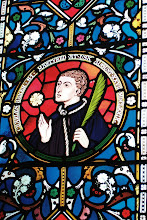
This beautiful window is in the Catholic Church of Our Ladye and St Michael, Abergavenny. In the window, St David Lewis is referred to as 'Charles Baker S J'. In those extremely dangerous times, it was the prudent custom of Catholic priests to work under an alias. 'Charles Baker' was the alias used by Fr David Lewis. St David Lewis was born in Abergavenny in 1616. He was the son of Morgan Lewis and Margaret (Pritchard) Lewis.
This colourful window is in the Baptistry of the Catholic Church in Usk. In 1679, St David Lewis was executed on or near the site of this church. He was canonised by Pope Paul VI in 1970. The church was originally dedicated to St Francis Xavier but in 1974 it was rededicated and it now bears the name of 'St David Lewis and St Francis Xavier'. This beautiful window honours these two Jesuit Saints.
This window is in the Catholic Church in Tenby. As well as honouring St David Lewis, it also commemorates two other Welsh priests, Fr John Lloyd and Fr Philip Evans, who were martyred as a consequence of the fabricated Popish Plot. The fourth person depicted is St Stephen, the very first Christian Martyr.

(TO BETTER APPRECIATE THE THREE PHOTOS, ENLARGE THEM BY CLICKING ON EACH ONE.)


Friday, 6 November 2009

TEN WERE JESUITS (CONCLUDED)

Of the Forty Martyrs of England and Wales canonised on 25th October 1970 by Pope Paul VI, ten were Jesuits. The first of the ten to die was St Edmund Campion in 1581. Almost 100 years later, in 1679, the last of the ten, and the Last Welsh Martyr, St David Lewis, was executed. (SEE PREVIOUS POSTS FOR PARTS 1-4)


9) ST PHILIP EVANS, the son of William Evans and Winifred Morgan, was born at Monmouth in 1645. He was educated at St Omer and entered the Jesuit Novitiate at Watten on 7th September 1665. Having completed his training, he was ordained at Liege in 1675 and sent upon the English Mission. Back in Wales, he worked diligently for four years, saying Mass, administering the Sacraments and preaching in Welsh and English. It is known that he ministered to large congregations at the home of Thomas Gunter in Abergavenny, at the home of Charles Prodger at Wernddu, and at Sker House, the home of Christopher Turberville. During the wave of persecution generated by the Popish Plot, friends advised Fr Evans to go into hiding. However, he refused and bravely continued his work. On 4th December 1678, the priest was arrested at Sker House, betrayed by the owner’s younger brother, Edward Turberville, a lapsed Catholic. He was imprisoned in Cardiff Castle Gaol and kept in solitary confinement in the dungeon. After several weeks, he and another Welsh priest, Fr John Lloyd, who had been arrested in November, were permitted to share a cell. The following May, Fr Philip Evans was tried at Cardiff Assizes, found guilty of the treason of priesthood, and sentenced to death. The execution was delayed for some time and Fr Evans was even allowed out of prison for recreation! Eventually, on 21st July, orders arrived that his execution was to take place the following day. At that time, he was playing tennis on the court near St John’s Church. When the gaoler went to the tennis court to tell the priest the news and to return him to prison, Fr Evans remarked, “What haste is there? Let me first play out my game.” This he did! Sister Barbara Catherine, the sister of Fr Philip Evans, was a Blue Nun in Paris. The day before his execution Philip wrote to her. He told her of his situation and urged her to be joyful instead of mourning for him. Promising to pray for her, he asked that she pray for him. Philip was a skilled harpist and when the officials came next morning to lead him to his execution, they found the priest joyfully playing the harp. Philip’s legs had been bound with heavy chains. They were so tight that the struggle to remove them lasted more than an hour and caused the poor priest indescribable agony. Taken to the place of execution, Fr Evans addressed the crowd in both Welsh and English. To Fr Lloyd, who had to watch his friend’s martyrdom, he said, “Adieu, Mr Lloyd! Though only for a little time, for we shall soon meet again”. On 22nd July 1679, 34 year old Fr Philip Evans S J, was hanged, drawn and quartered at Gallows Field (the northern end of Richmond Road) Cardiff.

10) ST DAVID LEWIS, (alias Charles Baker) was born in Abergavenny in 1616, the son of Margaret Pritchard and Morgan Lewis. His father was headmaster of Abergavenny Grammar School. It is not certain if Morgan Lewis was a Protestant or a Church Papist, but, to all appearances, he was a Protestant. Margaret was a staunch Catholic and eight of their nine children were brought up as Catholics. However, Morgan raised David in the Protestant religion. As a young man David spent some time in Paris and while there he converted to Catholicism. He went to study at the English College in Rome where, in 1642, he was ordained as a Catholic priest. Following the example of his uncle, Fr John Pritchard, Fr Lewis decided to join the Society of Jesus and entered the Jesuit Novitiate at Sant’ Andrea. Upon completion of his novitiate, Father David Lewis returned to his native Wales but after about a year, he was recalled to Rome. A year later he was sent back to Wales where he spent his remaining 31 years labouring for the people of Monmouthshire and area. He was greatly loved and, for his kindness to all, he was known as ‘Tad y Tlodion’, ‘Father of the Poor’. Father Lewis became a victim of the evil Titus Oates and the fictitious Popish Plot. On 17th November 1678, as he prepared to celebrate Mass, he was arrested at Llantarnam, Cwmbran. The Jesuit was brought for trial at the Lenten Assizes in Monmouth on 16th March 1679. He was brought to the bar on a charge of High Treason, that is, for having become a Catholic priest and remaining in the country. He pleaded not guilty to the charge of being an accessory to the Popish Plot but several witnesses claimed they had seen him say Mass. For this he was found guilty and the judge, Sir Robert Atkins, sentenced him to death. The condemned priest was brought to London and lodged in Newgate Prison. Oates, William Bedloe, Dugdale and Price questioned Fr Lewis about the “plot” but were unable to prove anything against him. Lord Shaftsbury tried to bribe him, telling him that if he gave evidence about the “plot” or renounced his Catholic faith, his life would be spared and he would be handsomely rewarded. The heroic priest could not be swayed. David Lewis said in his dying discourse, “discover the plot I could not, as I knew of none; and conform I would not, for it was against my conscience”. He was brought back to Usk Gaol to await his execution, which came on 27th August 1679. He was taken from his cell in Usk Gaol and carried on a hurdle along the river path to a place known as the Coniger. After addressing the gathering and praying, the condemned man was hanged. A Protestant man held the priest’s hand, ensuring that he was dead before the rest of the barbaric sentence could be carried out. Although the greatly loved priest was drawn and decapitated, he was not quartered. His body was taken in procession to the churchyard of the Priory Church and there it was reverently buried near the main door of the church. St David Lewis was the last Welsh Martyr to suffer for the Catholic faith. He was also one of the ten Jesuit martyrs to be canonised among the Forty Martyrs of England and Wales.


Thursday, 22 October 2009

"ON A FINE DAY IN AUGUST" (PART 1)


This is from a booklet by the late Canon J B Davies, D D. I believe this little gem is now out of print and its age (printed 1960) can be guessed by its title “Blessed David Lewis”, and its price, 4d! The piece I wish to quote is fairly long, but it is so beautiful it has to be shared. I will do it in two posts so be sure to look in again tomorrow for part two.

“On a fine day in August, 1679, they hanged David Lewis in Usk for being a Roman Catholic priest. There was some difference of opinion at the
time between Catholics and Protestants as to whether a man ought to be hanged for being a Catholic priest, but at any rate they both agreed that this was why he was being hanged. It is true that his enemies, including the Lord Bishop of Hereford, had published a story of his having defrauded a “poor woman” of some moneys, but hardly anyone except the Bishop seems to have believed it. One thing is certain; while David Lewis lived no one ever accused him of any political plotting or treason, neither the Protestant Bishop who slandered him, nor the prosecution who charged him, nor the judge who sentenced him. Even that arrant liar, Dorothy James, who boasted she would “wash her hands in Fr Lewis’s heart’s blood” never, suggested he was guilty of treason. Let no one, therefore, suggest it today.

And yet as they led him out of Usk gaol to tie him on the hurdle on which he had to be dragged to the place of execution, his manner
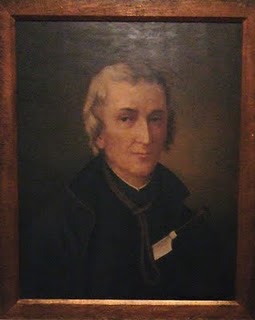
showed plainly enough that he was anxious. Brother Foley would have us picture him setting out on his last journey calm, unmoved and completely detached from this world; any less heroic and more human attitude towards martyrdom was hardly conceivable in the 19th century. But this is not quite borne out by the evidence. The portrait we fortunately possess of David Lewis shows a slender, intellectual face, unmistakably Welsh with its long nose, mobile mouth and short upper lip, a face suggesting either the artist or the mystic, but certainly revealing a temperament of extreme sensibility. And his last speech shows clearly enough what his thoughts really were as he came out of the gaol, his quick, intelligent eyes eagerly scanning the people lining the street to watch his execution – would they be friendly? Or had they been deceived by that scurrilous pamphlet of the Bishop’s into thinking him a thief and a hypocrite?

If this is not quite the exalted mood we expect of a martyr going out to die for Christ, let us remember that Fr Lewis was not only a holy Jesuit priest, but also a Welsh gentleman, belonging to a class whose pride in long lineage and gentle manners, though often derided, stems from the Christian ideal inherent in the tribal solidarity of mediaeval Wales. After all, these were his own people watching him walk out to a most ungentlemanly death. He had spent almost his whole life among them; he was related to some of their oldest families; by a life of heroic charity he had won the love of the Catholics and the respect of the Protestants – was all this to be thrown away because a woman could tell lies and a Bishop confirm them? St Peter’s words kept running through his mind: “Let none of you suffer as a murderer or a thief; but if as a Christian, let him not be ashamed.” It was so important that they should understand why he was being put to death; what became of his testimony to Christ if they thought he was being hanged for a thief?”
(TO BE CONTINUED)
Related Posts with Thumbnails