Showing posts with label Hereford. Show all posts

Wednesday, 26 December 2012

CHRISTMAS 1678


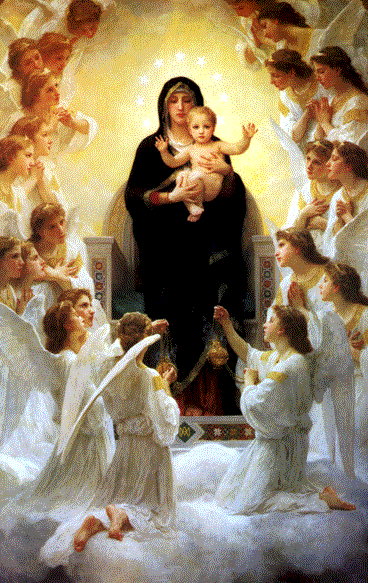
17th century icon, Madonna and Child
 
Christmas of 1678 couldn’t have been a joyful one for Fr David Lewis S J.  Details of that Christmas are scant but we do know for certain that it was the priest’s last Christmas on earth!  As he prepared to celebrate Mass on Sunday morning, 17th November, Fr Lewis was arrested at Llantarnam.  He was incarcerated in Monmouth Gaol.  The Justice of the Peace, John Arnold, who had feigned friendship with Fr Lewis, promised that he would not allow him to be treated with “any incivility or severity”.  Alas, the promise proved to be as false as the friendship.  That very same day, the perfidious Arnold had ordered that a strict watch should be kept over the prisoner, who was guilty of high treason, i.e., he was a Catholic priest!

Christmas found Fr Lewis in Monmouth Gaol, where a friend of the Jesuit had paid 14/ a week to provide him with a good lower room, a bed, linen, fire and a candle.  Officially, Fr Lewis was in Solitary Confinement but the Under keeper of the Gaol allowed friends to visit him in his cell by day.

Early in December, the Lords ordered an investigation of the Jesuit College of St Francis Xavier at the Cwm, where Fr Lewis had been Superior.  Just before Christmas, the Bishop of Hereford, Herbert Croft, led a raid on the Cwm.  He had the enthusiastic help of John Arnold, John Scudamore and Charles Price.  The buildings were ransacked and all books, papers and property confiscated.  Some of the books stolen from the Cwm are today in the library of Hereford Cathedral.  Croft reported that he had found “two horse-loads of books in an adjoining Pig Cot covered with straw, also a great store of divinity books (but they are not yet brought to me, it being Christmas holy days, but they remain in a safe hand) many whereof are written by the principal learned Jesuits”.

On 4th December, Fr Philip Evans, the youngest of the Jesuit missioners in South Wales, was arrested.  He was imprisoned in Cardiff Castle where he was kept in Solitary Confinement for three weeks.  After this time, the Governor was persuaded to allow Fr Evans and a secular priest, Fr John Lloyd, to share a cell.  Other priests had been arrested and some had died of hardship and exposure. 

All of this distressing news would have been conveyed to Fr Lewis by the friends who visited him in Monmouth Gaol.

On the Sunday morning of Christmas week, Fr Lewis was visited in his cell by several magistrates who questioned him about William Bedloe’s allegation that he had supplied information about the Marquis of Worcester’s Agent’s complicity in the Popish Plot.  Fr Lewis deposed that he had neither spoken to nor corresponded with the informer.  He further testified that he had never even heard of the Plot until it became common knowledge throughout the land.  His deposition was sent to London but no more was heard of it.

So passed what was to be the last Christmas of Fr David Lewis.  Early in 1679, the new High Sheriff, James Herbert, decided to move the County Gaol from Monmouth to Usk.  On 13th January, a bitterly cold and miserable day, Fr Lewis was transferred to Usk Gaol to await his fate.  Later that year, in the lovely month of August, Fr David Lewis was martyred at Usk.  On 25thOctober 1970 he was canonised by Pope Paul VI  as one of the Forty Martyrs of England and Wales .

Wednesday, 22 August 2012

ST JOHN KEMBLE


THE EXECUTION OF ST JOHN KEMBLE

John Kemble, alias Holland, was born at Rhydicar Farm, St Weonard’s, Herefordshire in 1599. He was the son of John Kemble and Anne Morgan. He and St David Lewis were cousins. John Kemble’s mother, Anne Morgan, was a relative of David Lewis’s father, Morgan Lewis. John was ordained a priest at Douai on 23rd February 1625 and, on 4th June, was sent upon the English Mission. He spent the next 54 years labouring for the people of Herefordshire and Monmouthshire. He was greatly loved by his own people and respected throughout the area because, it was said, “he gave offence to none”.


In 1678, Fr John Kemble became another innocent victim of the non-existent Popish Plot. A lapsed Catholic, Captain John Scudamore of Kentchurch, was sent to arrest Fr Kemble at Pembridge Castle, where the aged priest was staying with his relatives. When urged to flee, the 80-year-old priest said, “According to the course of nature I have but a few years to live. It will be an advantage to suffer for my religion and therefore I will not abscond.” After three months in Hereford Gaol, he endured an agonizing journey to London where he and Fr David Lewis were lodged in Newgate Prison. They were interrogated by Oates and his fellow plotters but, since no evidence of involvement in any plot could be found, he was sent back to Hereford. In accordance with Statute 27 of Elizabeth I, he was tried for treason, i.e., for being a Catholic priest and saying Mass. He was found guilty and condemned to be hanged, drawn and quartered.


On the morning of his execution, Fr Kemble made his devotions as usual. He then drank a cup of sack and smoked a pipe of tobacco with the undersheriff, Mr Digges, and the prison governor. (This is the origin of the Herefordshire custom of calling a parting drink or smoke a “Kemble Cup” or a “Kemble Pipe”.) Before his execution on Widemarsh Common, the good priest forgave those who had conspired against him and asked forgiveness of any whom he may have offended. He consoled the distraught hangman thus, “Honest Anthony, my friend Anthony, be not afraid; do thy office. I forgive thee with all my heart. Thou wilt do me a greater kindness than discourtesy.” He prayed silently for a few minutes then commended himself to God. The cart was drawn away and he was hanged. Such was the affection for Fr Kemble that he was allowed to die upon the gallows before being beheaded. He was also spared the grisly ritual of drawing and quartering. It was said, even by his persecutors, that they never saw one die so like a gentleman and so like a Christian. 


When the Martyr’s body was cut down from the scaffold, he fell with his hand beneath his head.  When he was beheaded, the hand was also cut off.  A devout woman in the crowd picked up the hand and carried it home in her apron.  For many years the hand was preserved in a small red wood box.  Eventually, it was given to the Catholic Church of St Francis Xavier, Hereford.    Near the end of the nineteenth century, a Mr Monteith of Carstairs presented the parish with a magnificent jewel- studded silver reliquary in which the hand now lies.  It can be seen today to the right of the High Altar.     
The Martyr's severed hand

 The martyr’s nephew, Captain Richard Kemble, who had saved the life of King Charles II at the Battle of Worcester, took the mutilated body to the church at Welsh Newton and buried it beside the churchyard cross. The gravestone is inscribed “J K Dyed the 22 of August Anno Do 1679”. There is a pilgrimage to the Saint’s grave every year on the Sunday nearest to 22nd August.


On 25th October 1970, St John Kemble and thirty-nine others were canonised by Pope Paul VI as the Forty Martyrs of England and Wales.

Thursday, 22 October 2009

"ON A FINE DAY IN AUGUST" (PART 1)


This is from a booklet by the late Canon J B Davies, D D. I believe this little gem is now out of print and its age (printed 1960) can be guessed by its title “Blessed David Lewis”, and its price, 4d! The piece I wish to quote is fairly long, but it is so beautiful it has to be shared. I will do it in two posts so be sure to look in again tomorrow for part two.

“On a fine day in August, 1679, they hanged David Lewis in Usk for being a Roman Catholic priest. There was some difference of opinion at the
time between Catholics and Protestants as to whether a man ought to be hanged for being a Catholic priest, but at any rate they both agreed that this was why he was being hanged. It is true that his enemies, including the Lord Bishop of Hereford, had published a story of his having defrauded a “poor woman” of some moneys, but hardly anyone except the Bishop seems to have believed it. One thing is certain; while David Lewis lived no one ever accused him of any political plotting or treason, neither the Protestant Bishop who slandered him, nor the prosecution who charged him, nor the judge who sentenced him. Even that arrant liar, Dorothy James, who boasted she would “wash her hands in Fr Lewis’s heart’s blood” never, suggested he was guilty of treason. Let no one, therefore, suggest it today.

And yet as they led him out of Usk gaol to tie him on the hurdle on which he had to be dragged to the place of execution, his manner
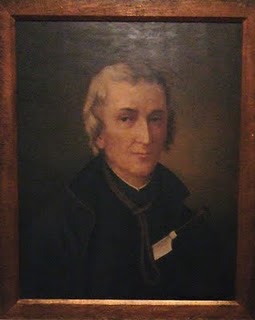
showed plainly enough that he was anxious. Brother Foley would have us picture him setting out on his last journey calm, unmoved and completely detached from this world; any less heroic and more human attitude towards martyrdom was hardly conceivable in the 19th century. But this is not quite borne out by the evidence. The portrait we fortunately possess of David Lewis shows a slender, intellectual face, unmistakably Welsh with its long nose, mobile mouth and short upper lip, a face suggesting either the artist or the mystic, but certainly revealing a temperament of extreme sensibility. And his last speech shows clearly enough what his thoughts really were as he came out of the gaol, his quick, intelligent eyes eagerly scanning the people lining the street to watch his execution – would they be friendly? Or had they been deceived by that scurrilous pamphlet of the Bishop’s into thinking him a thief and a hypocrite?

If this is not quite the exalted mood we expect of a martyr going out to die for Christ, let us remember that Fr Lewis was not only a holy Jesuit priest, but also a Welsh gentleman, belonging to a class whose pride in long lineage and gentle manners, though often derided, stems from the Christian ideal inherent in the tribal solidarity of mediaeval Wales. After all, these were his own people watching him walk out to a most ungentlemanly death. He had spent almost his whole life among them; he was related to some of their oldest families; by a life of heroic charity he had won the love of the Catholics and the respect of the Protestants – was all this to be thrown away because a woman could tell lies and a Bishop confirm them? St Peter’s words kept running through his mind: “Let none of you suffer as a murderer or a thief; but if as a Christian, let him not be ashamed.” It was so important that they should understand why he was being put to death; what became of his testimony to Christ if they thought he was being hanged for a thief?”
(TO BE CONTINUED)
Related Posts with Thumbnails