Showing posts with label John Arnold. Show all posts

Saturday, 19 December 2020

ON THIS DAY, 342 YEARS AGO

On 19 December 1678, 342 years ago today, the Jesuit College of St Francis Xavier at the Cwm, on the Monmouthshire Hereford border, was raided .  An order had been sent from the House of Lords on 7 December to Bishop Herbert Croft of Hereford to “find out the truth of the matter of fact concerning the said place called Combe, and to give this house a full account.”

THE SITE OF THE CWM
Bishop Croft organized the raid which was carried out by Captain John Scudamore. Captain Scudamore was energetically assisted by fanatical anti-Catholics, John Arnold and Charles Price.

ST DAVID LEWIS
Fr David Lewis was Superior of the Cwm and realizing the danger, he had the College evacuated and the priests had removed or hidden as much property as possible.  The community was dispersed and the priests found shelter where they could.  Some were sheltered in the homes of local Catholics while others had to fend for themselves, sheltering in woods, barns or even pig stys.

They were dark days indeed and, for the priests of the Cwm, they were about to become darker.

THE SACK OF THE JESUIT COLLEGE

Tuesday, 7 August 2018

ST DAVID LEWIS AND LLANVIHANGEL COURT

This year marks the 339th anniversary of  the martyrdom of St David Lewis. Abergavenny born David Lewis was a Jesuit priest who risked life and limb ministering to the embattled Catholics of Monmouthshire and surrounding areas during the dreadful days of Penal Laws against Catholics.  It was against the law to be a Catholic and those who chose to stubbornly stay loyal to the "Old Faith" did so at great financial as well as  personal risk.  To be a Catholic Priest was considered High Treason and, if found guilty, the punishment was to be hanged, drawn and quartered.
 St David Lewis, Llantarnam Abbey (Photo J D Smith)
To be fair, in most places, the local authorities were usually hesitant in applying the laws and many turned a blind eye to the religious practises of their neighbours, friends, and even family members who still clung to their Catholic faith. In Wales Catholics were know by that beautiful name of "Plant Mair"  which means "Children of Mary".  How lovely is that? 

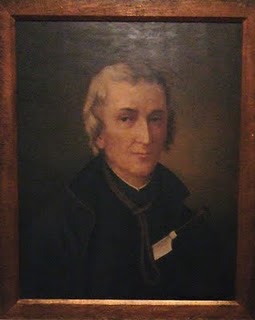
Monmouthshire Member of Parliament, John Arnold, was certainly not one of those tolerant men.  Indeed, he was a fanatical anti-Catholic and rabid priest hunter.  He was determined to root out Catholicism from every corner of the country.  

Although Arnold feigned friendship with Fr David Lewis, he played the main part in the downfall of the priest.  Unlike Arnold, Fr Lewis was a kind and gentle man who was greatly loved.  For his kindness to all, he was  know as "Tad y Tlodion", "Father of the poor".

On Sunday morning, 29th  November 1678, as Fr Lewis prepared to celebrate Mass, Arnold's lackeys arrested him. (For more on his arrest, click here) He was first taken to Abergavenny and then to Arnold's home, Llanvihangel Court, Llanvihangel Crucorney,  about 5 miles from Abergavenny.  Here David Lewis spent his first night in captivity before being taken to Monmouth Gaol where he was incarcerated.  
Llanvihangel Court (Photo J D Smith)
In 1679, on a cold and utterly miserable January day, The good priest was moved to Usk Gaol. Eventually, on 27th August 1679, Father David Lewis S J, was executed at Usk. It is a testimony to the high esteem in which he was held that he was given a respectful burial in the churchyard of the Anglican Priory of St Mary, Usk. David Lewis was canonised in October 1970 by Pope Paul VI. It is true that we give glory to God by honouring His saints and, even today, many people visit this saint's grave to pay homage to his courage and steadfast faith and to ask his prayers for their own needs.
The Saint's grave (Photo J D Smith)
If you are in the Abergavenny area, you might like to avail of the opportunity of visiting what was once John Arnold's home.  It is a private home but Llanvihangel Court is open to the public at certain times of the year.  This year, you can visit this historic Tudor house between the hours of 2:30 and 5:30 from 10th to 15th August.  Entrance fee includes a guided tour of the house and access to the beautiful gardens. 

When we visited several years ago there wasn't much said of John Arnold's nefarious deeds.  St David Lewis wasn't spoken of at all. As I said, it is a few years since we visited and it might be different now. We did ask questions about St David Lewis and the night he spent there so perhaps he now gets a mention.  You never know!

I am not touting for business for Llanvihangel Court but it is an awesome feeling, as well as a great privilege, to find yourself in a house where once a holy man, who gave his life for the Catholic faith and the Mass, was briefly lodged.  
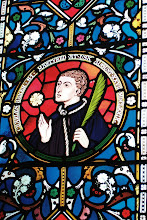
The Becket Window, Christ Church, Oxford (Photo J D Smith)
"For wherever a saint has dwelt, wherever a martyr has given his blood for the blood of Christ, there is holy ground, and the sanctity shall not depart from it though armies trample over it, though sightseers come with guidebooks looking over it."  (T S Eliot, "Murder in the Cathedral")

Saturday, 30 March 2013

“PRO SACERD ROMAN”


Site of the arrest of St David Lewis
Fr David Lewis S J had been arrested at Llantarnam on 17th November 1678 and imprisoned in Monmouth gaol.  On 13th January 1679 he was transferred to the gaol at Usk.  On 28th March he was again back in Monmouth to be tried at the spring assizes which was presided over by Sir Robert Atkins. 

The Monnow Bridge
 
Fr Lewis was indicted under Statute 27 Elizabeth which deemed it a capital crime to be ordained abroad and return to England for more than forty days.  The charge against him was “David Lewis pro Sacerd Roman”, that is “David Lewis for being a Roman Priest”!  The charge against the priest was read by the Clerk of the Assizes; “Here thou standest indicted of High Treason by the name of David Lewis, for thou being a natural subject of the King of England, hast passed beyond the seas and taken Orders from the Church and See of Rome”.

Fr Lewis pointed out that it was necessary for the prosecution to prove him guilty of the charge of being ordained overseas and taken Orders from the See of Rome.  Judge Atkins responded to this with a curt rebuff but his words made it clear for all time exactly why the priest was condemned.  “What do you expect?  Shall we search the records at Rome, or bring persons to prove that they saw you ordained?  It is enough that you have exercised the functions of a priest in copes and vestments used in your Church, and that you shall have read Mass and taken Confessions.  HE THAT USES TO READ MASS COMMITS TREASON!”
 
The priest hunter, John Arnold, was allowed to sit next to the Judge and permitted to challenge the jurors one by one until he had achieved his goal – a jury that was anything but impartial and certain to convict the priest! This manipulation of the jury did not go unnoticed and the High Sheriff of Monmouthshire protested that Arnold was guilty of “packing the jury”.  His protestations came to naught when Judge Atkins reprimanded him for being “saucy”.  John Arnold was now secure in the knowledge that his handpicked jury would seal the fate of the hapless Fr David Lewis.
 
At about 10 o’clock the following morning, 29th March 1679, the trial of Fr David Lewis began.  Several witnesses were called who swore that they had seen him celebrate Mass.  Chief among them were William and Dorothy James.  However, two of the Crown’s other witnesses heroically refused to give evidence against Fr Lewis.  The defendant challenged the character of some of the witnesses brought against him and exposed the sheer malice of Dorothy James.   With John Arnold’s influence, there was no chance of the accused getting anything even resembling a fair trial and the verdict was a foregone conclusion.  It was sufficient that Dorothy and William James had sworn they had seen the Jesuit say Mass and on this evidence the jury was directed that “If you believe what the witnesses swore you must find the prisoner guilty”.  As expected, the jury found him guilty of treason!


Usk Gaol where St David Lewis awaited his execution

Judge Atkins then put on his cap and pronounced the sentence:  “David Lewis, thou shalt be led from this place to a place whence thou camest, and shalt be put upon a hurdle and drawn with thy heels forward to the place of execution where thou shalt be hanged by the neck and be cut down alive; thy body to be ripped open and thy bowels plucked out; thou shalt be dismembered and thy members burnt before thy face.  So the Lord have mercy on thy soul.”
 
Upon hearing the sentence Fr Lewis made a low bow toward the judge and was led away.  He was returned to Usk Gaol where he was to await his gruesome fate.  On 27th August 1679 Fr David Lewis, the last Welsh martyr, was executed for the crime of being a Catholic Priest and saying Mass.  


St David Lewis was martyred near this site


Sunday, 13 January 2013

TRANSFERRED TO USK GAOL


On Monday, 18th November 1678, Fr David Lewis, a Jesuit priest, was incarcerated in Monmouth Gaol.  His false friend, John Arnold, who was a Justice of the Peace and  Member of Parliament, had promised that he would not allow him to be treated with “any incivility or severity” but had secretly ordered that a strict watch be kept on the priest.  Hence, Fr Lewis was kept a close prisoner and not allowed to leave his cell.   However, the Under Keeper, a more reasonable man, allowed friends to visit the priest during the day.  Through these visits the priest learned of the fate of his friends and fellow priests.  He would also have learned of the sacking of the Jesuit College of St Francis Xavier at a place called the Cwm.  Fr Lewis had served as Superior of the College and would feel great distress at its devastation.

Monmouth's Ancient Bridge
In the New Year, the new High Sheriff, James Herbert, decided to move the County Gaol from Monmouth to Usk.  So it was that on 13th January 1679, the Deputy Sheriff and the Head Gaoler rode with Fr David Lewis to Usk.   The weather was atrocious, bitterly cold and snowing.  When the group reached Raglan they stopped at an Inn to warm themselves.  While there a messenger arrived with sad news for Fr Lewis.  A friend and colleague from the Cwm, Fr Ignatius Price, lay dying in a barn about half a mile away.  The dying priest wished to see Fr Lewis.  As he was himself a prisoner in the custody of the Deputy Sheriff and the Head Gaoler, Fr Lewis was unable to comply with this heart-rending request.    Fr Lewis wrote; “Whilst I was in Raglan, a messenger came to the door of the Inn, desiring to speak with me on urgent business.  A very good friend of mine, one Mr Ignatius (alias Walter) Price, lay dying about half a mile away.  He had undergone much hardship from hunger and cold and lay dying.  He desired to see me.  But I was quite unable to perform the friendly duty, as I was under the actual custody of the officers.  So I only sent him my true and best wishes for his soul’s happy passage out of this turbulent world to an eternity of rest.”  Three days later, Fr Lewis learned of the death of his friend.
Site of Usk Gaol where St David Lewis was imprisoned

Usk Gaol, also known as the House of Correction or Old Bridewell, was situated on the north side of Bridge Street.  The Gaol, at 28 Bridge St, had originally been a Friary, a house of the Grey Friars. It became a House of Correction in the mid 1600s and served until Usk Prison was built about 1842.  When Fr David Lewis was imprisoned there it was crowded with Catholics who had refused to take the Oaths of Allegiance and Supremacy.  One prisoner was a widow, Jane Harris, who had given refuge to a priest.  She was betrayed by her butcher when he noticed her buying extra meat!  Fr Lewis would have known most, if not all, of these people for he had spent his priestly life toiling among the persecuted Catholics of the area, travelling mostly at night and probably on foot, to bring them what help and comfort he could.

St David Lewis was martyred on or near this spot in 1679

On 27th August 1679, this good man whose kindness had earned him the name of “Father of the Poor” was taken from Usk Gaol and dragged on a hurdle to a place known as the Coniger where he was executed for the “crime” of being a Catholic Priest.  The actual site of his death is believed to be within the grounds of Porth-Y-Carne House, opposite the Catholic Church of St Francis Xavier and St David Lewis.  The martyred Fr David Lewis was permitted a decent burial.  Reverently carried in procession to the Priory Church of St Mary, he was interred in the Churchyard.   The grave of St David Lewis is the nearest one to the main entrance of the church and every year on the Sunday nearest to 27th August pilgrims flock to this holy site to pay their respects to the Last Welsh Martyr.  
The Grave of St David Lewis
 

Wednesday, 26 December 2012

CHRISTMAS 1678


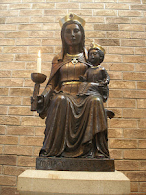
17th century icon, Madonna and Child
 
Christmas of 1678 couldn’t have been a joyful one for Fr David Lewis S J.  Details of that Christmas are scant but we do know for certain that it was the priest’s last Christmas on earth!  As he prepared to celebrate Mass on Sunday morning, 17th November, Fr Lewis was arrested at Llantarnam.  He was incarcerated in Monmouth Gaol.  The Justice of the Peace, John Arnold, who had feigned friendship with Fr Lewis, promised that he would not allow him to be treated with “any incivility or severity”.  Alas, the promise proved to be as false as the friendship.  That very same day, the perfidious Arnold had ordered that a strict watch should be kept over the prisoner, who was guilty of high treason, i.e., he was a Catholic priest!

Christmas found Fr Lewis in Monmouth Gaol, where a friend of the Jesuit had paid 14/ a week to provide him with a good lower room, a bed, linen, fire and a candle.  Officially, Fr Lewis was in Solitary Confinement but the Under keeper of the Gaol allowed friends to visit him in his cell by day.

Early in December, the Lords ordered an investigation of the Jesuit College of St Francis Xavier at the Cwm, where Fr Lewis had been Superior.  Just before Christmas, the Bishop of Hereford, Herbert Croft, led a raid on the Cwm.  He had the enthusiastic help of John Arnold, John Scudamore and Charles Price.  The buildings were ransacked and all books, papers and property confiscated.  Some of the books stolen from the Cwm are today in the library of Hereford Cathedral.  Croft reported that he had found “two horse-loads of books in an adjoining Pig Cot covered with straw, also a great store of divinity books (but they are not yet brought to me, it being Christmas holy days, but they remain in a safe hand) many whereof are written by the principal learned Jesuits”.

On 4th December, Fr Philip Evans, the youngest of the Jesuit missioners in South Wales, was arrested.  He was imprisoned in Cardiff Castle where he was kept in Solitary Confinement for three weeks.  After this time, the Governor was persuaded to allow Fr Evans and a secular priest, Fr John Lloyd, to share a cell.  Other priests had been arrested and some had died of hardship and exposure. 

All of this distressing news would have been conveyed to Fr Lewis by the friends who visited him in Monmouth Gaol.

On the Sunday morning of Christmas week, Fr Lewis was visited in his cell by several magistrates who questioned him about William Bedloe’s allegation that he had supplied information about the Marquis of Worcester’s Agent’s complicity in the Popish Plot.  Fr Lewis deposed that he had neither spoken to nor corresponded with the informer.  He further testified that he had never even heard of the Plot until it became common knowledge throughout the land.  His deposition was sent to London but no more was heard of it.

So passed what was to be the last Christmas of Fr David Lewis.  Early in 1679, the new High Sheriff, James Herbert, decided to move the County Gaol from Monmouth to Usk.  On 13th January, a bitterly cold and miserable day, Fr Lewis was transferred to Usk Gaol to await his fate.  Later that year, in the lovely month of August, Fr David Lewis was martyred at Usk.  On 25thOctober 1970 he was canonised by Pope Paul VI  as one of the Forty Martyrs of England and Wales .

Saturday, 17 November 2012

THE POPISH PLOT AND THE ARREST OF ST DAVID LEWIS


In the summer of 1678, the contemptible Titus Oates and his friend Israel Tonge hatched the fictitious Popish Plot.  Near the end of September, Sir Edmund Berry Godfrey (sometimes spelled Edmundbury Godfrey) became involved when he took the depositions of the two plotters.  On 17th October Godfrey was found face down in a ditch on Primrose Hill.  He was impaled on his own sword.  Marks on his body indicated foul play.   But, was it murder or was it suicide?  At the time, two committees investigated Godfrey’s death, and many theories have since been expounded, but the mystery has never been solved.  Godfrey’s mysterious death was a boon to the anti-Catholic faction who immediately put the blame on Catholic conspirators.  As Macaulay wrote; “The capital and the whole nation went mad with hatred and fear.  The Penal Laws, which had begun to lose something of their edge, were sharpened anew.  Everywhere, Justices were busied in searching houses and seizing papers.  All the gaols were filled with Papists.  London had the aspect of a city in a state of siege”. 
 
Sir Edmund Berry Godfrey
It wasn’t long before the venomous tentacles of the Plot reached into Wales.  The Government had offered a reward of £20 for information leading to the apprehension of any priest.  To this sum John Arnold of Llanvihangel Court added a reward of £200 for information regarding any priest in Herefordshire or Monmouthshire.
 
John Arnold was born in 1634.  A Justice of the Peace and Member of Parliament, Arnold was also a zealous priest hunter and foremost in enforcing the full weight of the Penal Laws against Catholics.  In 1670, John Arnold and John Scudamore informed the House of Lords that “at Llantarnam, an eminent papist’s house in Monmouthshire, there is a room fitted up chapel wise for saying Mass where Fr David Lewis, a popish priest, hath said Mass for many years past” and that there were still six Jesuit priests at the Cwm which “had been a shelter for such popish priests near forty years”.   In 1678 they placed new information before Parliament of “several popish priests and the persons that do countenance them in the county of Monmouth”.   On 20th November 1668 King Charles II, under pressure from Parliament, reluctantly issued a proclamation for the immediate arrest of all priests and Jesuits, who were to be imprisoned “in order to their trial”.
 
Fr David Lewis, alias Charles Baker, was an Abergavenny born Jesuit.  He was Superior of the Jesuit College of St Francis Xavier at the Cwm on the border of Herefordshire and Monmouthshire.  He spent more than thirty years ministering to the harassed Catholics of the area.  As was the practice in such dangerous times, priests often found shelter in the homes of Catholic recusants and from such safe houses they celebrated Mass and the Sacraments and tended to the many needs of their fellow Catholics.   It is well documented that Fr Lewis stayed in the home of Thomas Gunter of Abergavenny and also at the home of his aunt, Lady Frances Morgan, at Llantarnam.

 
For some time, Fr David Lewis had stayed with his relatives, the Morgans, at what is now Llantarnam Abbey.   When the storm of the Oates Plot broke, the priest, not wishing to endanger the Morgans, moved into a nearby cottage at Llantarnam.   This cottage, adjoining the blacksmith’s, was opposite the Parish Church of St Michael and All Angels. 
Parish Church of St Michael and All Angels, Llantarnam
Early on Sunday morning, 17th November 1678, Fr Lewis was preparing to celebrate Mass when a party of six armed dragoons burst in.  They were led to the priest by William James, a Catholic who had formerly worked for him.  For this foul act of betrayal, James received the grand sum of £220, the Government reward of £20 plus the additional £200 offered by John Arnold.   It was a cruel betrayal indeed for Fr Lewis considered John Arnold a close friend because Arnold had always feigned friendship for the priest.  Of his arrest, Fr Lewis wrote; “After my full thirty years poor missionary labours in South Wales, on Sunday morning, a little before day, being the 17th November 1678, I was taken by six armed men sent by Mr John Arnold and Mr Charles Price, until then my two very good friends and acquaintances.  I was taken in a little house in the parish of St Michael-Llantarnam in the County of Monmouth.  From thence by the soldiers, together with such church stuff of mine they there found, carried I was to the house of Mr Charles Price in Llanfoist”.
 
Plaque at the site of the arrest of St David Lewis at Llantarnam
Three Justices of the Peace, Charles Price, John Arnold and Thomas Lewis awaited Fr Lewis at Llanfoist.  The priest was to be taken to Monmouth Gaol and at about 2 o’clock that afternoon, he was led away from Llanfoist by Arnold and his henchmen.   Guarded by twelve armed men, Fr Lewis was taken to his hometown, Abergavenny.  The contingent entered the Golden Lion on Frogmore Street where, in a guarded upper room, Fr David Lewis was examined by the Recorder of Abergavenny, William Jones.   William James swore that he had seen Fr Lewis say Mass at least twenty times.   Asked if he had played any part in the Titus Oates Plot, the priest swore on oath that he had no knowledge of or part in any plot.  Arnold, showing his contempt for all things Catholic, sarcastically remarked that with Catholics it was no oath to swear on the Bible.   
 
The Site of the Golden Lion, Abergavenny
The little group adjourned to the dining room where they had supper together.  Fr Lewis, committed on a charge of Treason, was given the choice of spending the night in a guarded room at the Golden Lion or of being the guest of Arnold at his home in Llanvihangel.  Arnold assured the priest that he would be “most civilly entertained”.   Fr Lewis left the decision to the others and it was arranged that he should spend the night at Llanvihangel Court.  It was a moonlit night when the party left the Golden Lion at about 10 o’clock.  It would have been between 11 o’clock and midnight when they reached Llanvihangel Court, a fine Elizabethan mansion that had been home to several generations of Arnolds.   The defenceless priest spent the night in a room guarded by two “strong men”. 

The next morning, Fr Lewis arose at 7 o’clock and Arnold paid him a short visit in his room where the two exchanged a few civil words.  When he had finished his breakfast, Fr Lewis came downstairs to find the Magistrate and several constables loading guns in the Great Hall.  Then they set out on the final leg of their journey to Monmouth Gaol. 
John Arnold's Home, Llanvihangel Court
 Upon reaching Monmouth, Fr David Lewis was incarcerated in the town’s gaol.  A friend paid 14/ a week for Fr Lewis to have a good room with a fire, candle, bed and linen!  That morning John Arnold had assured Fr Lewis that he would not allow the gaoler to subject him to “any incivility or severity”.  It must have been a sad shattering of all illusion regarding Arnold’s friendship for him when the gaoler showed Fr Lewis a letter written that very day by Arnold.  The letter, dated 18th November, ordered that a strict watch be kept on the prisoner who was guilty of High Treason!

 
Fr Lewis was kept a close prisoner and his confinement was so strict that he never left his cell.  However, the Under Keeper allowed friends to visit him during the day.  For almost two months, Fr Lewis was a prisoner in Monmouth Gaol.  On 13th January 1679 he was transferred to the new County Gaol at Usk.  Here, in the Gaol on Bridge Street, this kind and gentle Jesuit awaited his martyrdom.   

Monday, 27 August 2012

ST DAVID LEWIS, SUPERIOR OF THE CWM


Three hundred and thirty-three years ago today a Welsh Jesuit priest, Fr David Lewis, was executed at Usk.  His crime was to be a Catholic priest in a time when it was deemed High Treason to be a Catholic priest and to celebrate Mass in England. 
 
Plaque marking site of execution of St David Lewis
David Henry Lewis was a Monmouthshire man, born in Abergavenny in 1616.  He was the youngest of the nine children of Morgan Lewis and Margaret Pritchard.  Although David's Catholic mother brought up eight of the children in the Catholic Faith, David's Protestant father had David brought up in the Established Religion.
 
David attended the local grammar school of which his father was headmaster.   Later he went to London to study law.  He travelled to Paris as tutor to a young nobleman and while in Paris David converted to Catholicism.
 
After the deaths of his parents in 1638 David entered the English College in Rome to study for the priesthood.  He was ordained there in 1642.  Later, following in the footsteps of his Jesuit uncle, David entered the Jesuit Novitiate of Sant Andrea in Rome.  
 
After profession as a Jesuit, Fr Lewis was sent on the English Mission.  After only a year he was recalled to Rome to take up a position in his old college.  However, he soon returned to Wales and here he laboured among his own people for the remainder of his life.
 
He was twice Superior of the Jesuit College of St Francis Xavier at the Cwm, on the Monmouthshire-Herefordshire border.  According to a pamphlet published in London in 1679, the Cwm consisted of spacious houses with several entrances and secret passages between some of the rooms.  Underneath the buildings there were extensive cellars, accessible both from inside and outside the houses - useful strongrooms where valuables could be hidden.  From one room a tunnel ran out into the neighbouring woods, in which there were many caves.  Remote and secluded, the Cwm was an ideal meeting place for Catholics on both sides of the Anglo-Welsh border.


The site of the Jesuit College, The Cwm
The Cwm had been known to the government authorities since as early as 1660 and possibly earlier.  However it was not until December 1678 that the Lords ordered an investigation by the Bishop of Hereford, Herbert Croft.  Croft had the enthusiastic support and assistance of John Arnold, John Scudamore and Charles Price. 
 
By this time, all the priests had been evacuated from the Cwm.  In fact, the Superior, Fr David Lewis, was a prisoner in Monmouth Gaol and had been since his arrest at Llantarnam on 17th November 1678.  Some priests found shelter with recusant families, others, including Fr Philip Evans were imprisoned, and others, hunted like wild beasts, sheltered in caves or woods.
 
While the raid did not turn up any hidden priests, it did yield a store of church plate, vestments and books.  Bishop Croft added many of the stolen books to his Cathedral Library. 
 
 
Viewing some of the Cwm books in Hereford Cathedral Library
Recently we had the very great privilege of being permitted to view some of the confiscated books from the Cwm Library.   Dr Rosemary Firman, librarian of Hereford Cathedral, showed us several books which are known to have come from the Jesuit Library at the Cwm.  One of the books was inscribed with the name of Thomas Gunter.  Thomas Gunter had a secret chapel in his mansion on Cross St in Abergavenny where Frs David Lewis and Philip Evans said Mass and administered the Sacraments to the Catholics who crowded into the attic chapel.  Dr Firman imparted many interesting facts about the books and, quite honestly, we were more than a little awed to be looking at books which had very likely been held, consulted or  read by St David Lewis over three hundred years ago.
 
For some very interesting information about the Jesuit Library at the Cwm visit Hannah's excellent blog here
 
Fr David Lewis was executed at Usk on 27 August 1679.  He was beatified in 1929 and Canonised as one of the Forty Martyrs of England and Wales in 1970.

Sunday, 24 June 2012

THE FEAST OF ST JOHN THE BAPTIST

In writing about St John the Baptist, E LeJoly said:

“John the Baptist points to God, a signpost on the way of life, for men to see and obey.  John the Baptist comes as a witness.  Filled with love for God, he has one thought, one concern, one purpose: to direct men’s minds and hearts to the Saviour who comes, to the Light of men, that they may turn to Him and believe in Him.”

In St John’s Gospel we read that John the Baptist “Came to bear witness to the Light.”  LeJoly tells us that John bears witness through his mode of life and through his preaching.  “There is no greater calling than to witness to the Light, that men may believe in Jesus.  The Father sent John to be the herald announcing His Son.  The Holy Spirit inspired him as he inspired the older prophets and the apostles and saints of the New Testament.  They witnessed by their personality, their speech, their life, even unto the shedding of their blood.  They witnessed to Christ under the lash, on the gridiron, chained in prison.  They proclaimed Him the Lord when stoned, bound to crosses, thrown to wild beasts.”

St David Lewis bore witness to Christ by his personality and his mode of life.   He studied at the English College in Rome and an entry in the College Diary describes him as “Vir prudens et pius”, that is “a wise and holy man”.  Later, in his ministry in Wales, he travelled the countryside, usually at night, on foot or on horseback to care for the persecuted Catholics.  But no person, Catholic or otherwise, was outside his love and concern and his kindness to all earned for him the affectionate appellation of “Tad y Tlodion” or “Father of the Poor”.

Like St John the Baptist and the saints and martyrs of the New Testament, St David Lewis bore witness to the Light by the shedding of his blood.  As he prepared to celebrate Mass on Sunday, 17th November 1678, Fr David Lewis was arrested at Llantarnam.  Betrayed by his so called friend, John Arnold, he was conveyed to Monmouth Gaol where he was incarcerated for several months.  Then, on a bitterly cold day in the dead of winter, 13th January 1679, he was moved to Usk Gaol.  At the March Assizes in Monmouth, David Lewis was condemned as a Catholic priest who said Mass.  In passing sentence, Judge Atkins said, “He that uses to read Mass commits treason”.  Convicted of High Treason, Fr Lewis was sentenced to be hanged, drawn and quartered, the usual punishment for High Treason.  He was returned to Usk Gaol.

In April of 1679, Fr David Lewis, Fr John Kemble, Fr Roger Hanslip and Fr John Wall were ordered to London to be questioned by the odious Titus Oates and his fellow perjurers, William Bedloe and Stephen Dugdale.  The four priests were lodged in vile conditions in Newgate Prison.  Although they were rigorously interrogated by the trio, no evidence of involvement in any plot could be found against them.  Indeed, there was no evidence of a plot at all!  The priests were offered freedom and wealth if they would perjure themselves with details of a nonexistent plot or renounce their faith.  All four priests unequivocally refused.  They were sent back to their respective prisons to await their fate.

For Fr David Lewis S J this came on 27th August 1679.  On that summer day David Lewis gave witness by his holy manner and the courageous way in which he willingly shed his blood for Christ.  The name of St David Lewis was added to the Church’s list of Martyred Saints on 25th October 1970 when he and 39 others were canonised by Pope Paul VI in Rome.  Collectively they are known as the Forty Martyrs of England and Wales.

From the beginnings of Christianity the followers of Jesus have been persecuted.  Right down to the present day, Christians are bearing witness to Christ through persecution and death.  On this feast of St John the Baptist, let us be mindful of the sufferings of our fellow Christians around the world and keep them in our prayers.

Let us also be mindful of our great blessing of freedom of worship.  Never take it for granted! 

Tuesday, 14 December 2010

THE SACK OF THE JESUIT COLLEGE

Early in the 17th century, with the financial backing of the Somersets of Raglan Castle and the Morgans of Llantarnam, the Jesuit College of St Francis Xavier was established at a place called the Cwm, on the Monmouth/Hereford Border. The selfless and heroic priests there ministered to the Catholics in that area and for many years, despite the severe anti-Catholic Laws, went about their work unmolested. For the most part, the authorities were content to turn a blind eye to the practices of their Catholic neighbours, the “plant Mair” as they were sometimes called. There were, however, some who harboured such fierce hatred of Catholics that they would stop at nothing in their efforts to eradicate every last vestige of the Old Faith. One such was John Arnold of Llanvihangel Court. Arnold was a Justice of the Peace and Member of Parliament whose main ambition in life appears to be the rooting out and elimination of all things Catholic. In this ambition Arnold was wholeheartedly supported by John Scudamore of Kentchurch and Charles Price of Llanfoist.

John Arnold and a number of like minded Protestants presented to Parliament a detailed account of Catholic activities in Monmouth and Hereford. They claimed to be alarmed at the growing strength of popery in the region. Arnold and Scudamore appeared before the House of Commons to expound their already wide-ranging account of Catholic activities. Of course, the Cwm was mentioned but there was no suggestion of any political activity there. Then Titus Oates and his Popish Plot burst onto the scene!
Originally, Fr David Lewis was the only Jesuit at the Cwm who was mentioned in the Plot. Later, when Chepstow born William Bedloe was inspired by monetary gain to throw in his lot with the perjurer Oates, Fr Charles Pritchard was accused of being one of the murderers of Sir Edmund Berry Godfrey. Things became very dangerous for the priests at the Cwm so Fr Lewis, who was the Superior, decided to evacuate the College. The priests hurriedly hid books, altar plate, vestments, and anything relating to Catholic service and practice. Then they dispersed, some to the homes of loyal friends but most to battle with the rough terrain and pitiless weather conditions.

In December 1678 the Lords ordered an investigation of the Jesuit College. The Bishop of Hereford, Herbert Croft, was appointed to head this investigation and he was enthusiastically assisted by John Arnold, John Scudamore and Charles Price. By this time, apart from a few servants, the College was deserted. The miscreants gleefully went about their work, removing books and papers from a room which had a hidden entrance. The Government ordered that all Catholic books were to be burnt and, should any be retained, these were to be catalogued. Many books disappeared but more than a hundred still survive in the library of Hereford Cathedral. These stolen books had been taken there by Bishop Croft to replenish the Cathedral’s own depleted library.

A collection of altar plate seized in the raid came into the hands of Charles Price. Despite orders to the contrary, he refused to hand over the ill-gotten loot. The Privy Council commanded that all title deeds to Jesuit property should be sent immediately to Whitehall. However, nothing was forthcoming and Bishop Croft was ordered to appoint someone to administer the Cwm in the interest of the Crown.

The lease on the premises did not expire until 1737 but tragically the Cwm was never again occupied by a Jesuit presence. Most of the original College was demolished and, in 1830, the present house was built. Some oh so appropriate lines of T S Eliot’s “Murder in the Cathedral” come to mind; “From such ground springs that which forever renews the earth though it is forever denied.”

Wednesday, 17 November 2010

THE HORROR BEGINS!


In 1678, the Popish Plot, also known as the Oates Plot, was spawned in the perverted mind of Titus Oates, who was encouraged and spurred on by his friend, Israel Tonge. It wasn’t long before the country was engulfed in the tide of anti-Catholic passion which it engendered.

The Superior of the Jesuit College of St Francis Xavier at the Cwm, Fr David Lewis (alias Charles Baker), had been living with relatives, the Morgans, at what is now Llantarnam Abbey. From here Fr Lewis ministered to the needs of the people, celebrating Mass in the Morgan’s chapel and administering the sacraments. Realising the danger of the Plot and fearing to put the family in jeopardy, the priest moved out of their home and into a cottage nearby. The cottage was adjoining the blacksmith’s forge opposite the Parish Church of Llanfihangel Llantarnam.

The Government offered a reward of £50 for the apprehension of any priest and to this John Arnold of Llanvihangel Crucorney added his own reward of £200. Arnold, a Justice of the Peace and Member of Parliament, was a fanatical priest hunter but he had always feigned friendship for Fr Lewis. Three hundred and thirty-two years ago today, 17th November 1678, Arnold’s true nature was revealed and Fr David Lewis S J took his first steps on the road to martyrdom.

It was a Sunday morning, about daybreak, and the Jesuit was preparing to celebrate Holy Mass. Six armed dragoons, sent by John Arnold, burst into the little cottage and arrested Fr Lewis. They confiscated all the altar furnishings and anything which they considered ‘popish’. With the prisoner, they set out for Monmouth, stopping first at the house of Charles Price at Llanfoist, where Price, John Arnold and Thomas Lewis, another J P, awaited their arrival.

Of his arrest Fr Lewis wrote: “After my full thirty years poor missionary labours in South Wales, on Sunday morning, a little before day, being the 17th November 1678, I was taken by six armed men sent by Mr John Arnold and Mr Charles Price, until then my two very good friends and acquaintances. I was taken in a little house in the parish of St Michael-Llantarnam in the County of Monmouth. From thence by the soldiers, together with such church stuff of mine they there found, carried I was to the house of Mr Charles Price in Llanfoist”


At about two o’clock in the afternoon Arnold and his clique led the priest away. Guarded by twelve armed men, Fr David Lewis was taken to Abergavenny and then on to Arnold’s house, Llanvihangel Court. Here they spent the night. Early the next morning Fr Lewis was taken, again under armed guard, to Monmouth Gaol where he was incarcerated.

The horror was just beginning!

Sunday, 7 November 2010

THE PERJURER TITUS OATES AND EIGHT JESUITS (PART 9)

ST DAVID LEWIS S J
One of nine children of a Protestant Headmaster and his Catholic wife, David Henry Lewis was born in 1616 at Abergavenny. David’s father, Morgan Lewis, saw to it that David was brought up in the Protestant religion although his other children were brought up Catholics. The young David attended King Henry VIII Grammar School, where his father was Headmaster, and then went on to London to study Law. David went on a trip to Paris and, while there, he converted to Catholicism. In 1636 he returned to Abergavenny and lived with his parents for two years. Whether Morgan Lewis was a Protestant through conviction or expediency one cannot say but about that time, 1636, Morgan Lewis also converted to the Catholic Faith.

In 1638, Morgan and Margaret (Pritchard) Lewis died of fever. David decided to beco
me a priest and, after his parent’s death and with the financial assistance of Fr Charles Gwynne (alias Brown), he entered the English College in Rome. Fr Gwynne, Rector of the Jesuit College at the Cwm, had obtained from his uncle, Hugh Owen, funds for maintaining a Welsh Scholar at Rome. David Lewis was ordained priest in July 1642 and in April of 1645 he entered the Jesuit Novitiate at Sant’ Andrea. Fr Lewis was sent to Wales in 1647 but was soon recalled to Rome to become Spiritual Director at the College there. However, in 1648 he returned to his homeland and the College of St Francis Xavier at the Cwm. For more than thirty years Fr David Lewis laboured for the people of Monmouthshire and the Welsh Marches. He served two terms as Rector of the College, commonly known as ‘The Cwm’.

Under the anti-Catholic laws of the time, being a Catholic was dangerous and being a Catholic priest was even more dangerous! The Welsh were, for the most part, tolerant of their Catholic neighbours, friends, and, in many cases, family members, who tenaciously clung to ‘the Old Faith’. The Catholics were commonly known by the lovely name of the ‘plant Mair’, that is ‘children of Mary’. However, there were those who, harbouring fierce hatred of Catholics, sought to eradicate them entirely. Consequently, the priests had to be very careful so as not to bring suffering on themselves or those who aided them. For this reason, Fr Lewis was in the habit of making dangerous journeys in the dead of night in order to care for his flock. The compassion and goodness of Fr David Lewis was not limited to Catholics only and his great kindness to all earned for him the name ‘Tad y Tlodion’, ‘Father of the Poor’.

For many generations the wealthy Morgans of Llantarnam were loyal Catholics. They were instrumental in the establishment of the Jesuit College at the Cwm and, as recusants, regularly paid heavy fines for themselves and others of their household who were fined for non-attendance at Protestant Services. They also maintained a Catholic Chapel in their home. Lady Frances Morgan was an aunt of Fr David Lewis and for a time he lived with the family at Llantarnam. From this base he brought the comfort of religion to the careworn Catholics of the area and regularly celebrated Holy Mass for them in the Morgan Chapel.

The Popish Plot was first brought to the attention of the King, Charles II, on 13th August 1678. The Popish Plot, also known as the Oates Plot, was the invention of a reprobate, the convicted perjurer Titus Oates. Charles did not believe a word of the so called ‘plot’ but certain politicians seized upon this opportunity to enforce the anti-Catholic Statutes and Laws which were still in force but not always acted upon. Considering the excommunication of Queen Elizabeth I, ill-advised Papal involvement with planned attacks upon England, and the failed Catholic plots of recent memory, it was not difficult for Oates and his partners in crime to convince the populace that King, country and the Protestant religion were endangered. It was easy to convince them that Catholics, led by the Jesuits, were plotting to kill the Protestant King and replace him with his Catholic brother, James. The Government offered a reward of £50 for the apprehension of any Catholic priest. By autumn 1668 the terror had begun. It spread throughout England and its foul fingers soon clutched at the ‘plant Mair’ in Wales.

Perceiving the danger in which he placed the Morgans, Fr Lewis moved out of their home to a cottage nearby. It was at this cottage at Llantarnam that Fr Lewis was arrested on 17th November 1678. It was a Sunday morning and the priest had been preparing to say Mass. He was arrested by armed dragoons, sent by the uncompromising and fanatical hater of Catholics and persecutor of priests, John Arnold of Llanvihangel Crucorney. Arnold, a Member of Parliament and Justice of the Peace, offered his own reward of £200 for the capture of any priest. Arnold had always shown friendship to Fr Lewis and right up to his imprisonment, the Jesuit believed Arnold to be a friend. Sadly, bigotry is without honour.

Fr David Lewis was imprisoned at Monmouth until January 1679. He was then moved to the new County Gaol at Usk. After a fixed trial at Monmouth Assizes, David Lewis was found guilty of being a Catholic priest and of saying Mass. He was condemned to be hanged, drawn and quartered. This was the usual sentence meted out to traitors and to be a Catholic priest was considered High Treason. In the spring, Fr Lewis, along with several other priests, was ordered to London to be examined by the despicable Oates and his equally despicable co-conspirators. No evidence could be found to implicate Fr Lewis in the imaginary plot so he was sent back to Usk to await his execution.

On 27th August 1679, Fr David Lewis was taken from Usk Gaol, tied to a hurdle, head towards the ground, and dragged along the river path to the place of execution. Fr Lewis was hanged but, mercifully, allowed to die before he was cut down and his body mutilated and decapitated. He was not quartered. It is an indication of the love the people had for the martyred priest that the authorities permitted his remains to be reverently carried to the churchyard of the Priory Church of St Mary. Here he was interred near the door of the west porch of the church.

The Popish Plot resulted in the deaths of many innocent Catholics, both priests and lay people. Some were executed, some died in prison and some died on the run, hunted like animals in the bitter winter weather. The eighth and final Jesuit to be executed as a direct consequence of the warped and evil mind of Titus Oates, Fr David Lewis S J, was beatified in 1929. On 25th October 1970 he was canonised by Pope Paul VI as one of the Forty Martyrs of England and Wales. An annual pilgrimage to the grave of St David Lewis, the Last Welsh Martyr, takes place on the Sunday nearest to 27th August.

LINKS TO THIS POST: The Perjurer Titus Oates and Eight Jesuits (Part 1); (Part 2); (Part 3); (Part 4); (Part 5); (Part 6); (Part 7); (Part 8)

Related Posts with Thumbnails