

Showing posts with label Catholic Church. Show all posts
Showing posts with label Catholic Church. Show all posts
Wednesday, 31 July 2013


Thursday, 29 December 2011
THE ENGLISH COLLEGE, ROME, (Concluded)
THE MARTYRS’ PAINTING
 The second of the two English Martyrs depicted in Durante Alberti’s painting is St Thomas Becket whose feast is kept today, 29th December.
Becket, portrayed in the left side of the painting, was the son of a wealthy Norman merchant. Thomas was born in London in 1118. He became acquainted with the young King, Henry II, and the two became close friends.
The King appointed his friend as Chancellor and, upon the death of Theobald, Archbishop of Canterbury in 1161, Henry pressed him to accept the bishopric. Thomas was not in favour and strongly argued against it but, nevertheless, the King appointed him Archbishop of Canterbury. It has been suggested that the King’s reason for appointing his friend was to have a ‘yes-man’ at Canterbury. If this was the case, Henry had sadly misjudged his friend for Becket was nobody’s flunky! Thomas was genuinely devout and, knowing the King’s mind, warned him; “I know your plans for the Church and that you will put forth claims which I, as Archbishop of Canterbury, must necessarily oppose”.
To be free of all civil ties, Thomas displeased the King further by insisting on resigning his chancellorship. This led to open hostility between the former friends. Because of the Archbishop’s resistance to the “Constitutions of Clarendon”, the King implemented a policy of financial persecution, imposing upon the See of Canterbury huge monetary fines. Realizing the danger he was in, Becket fled to France. All of the Archbishop’s property was confiscated and his family and friends persecuted or exiled.
In 1170, King and Archbishop seemed to have been reconciled and Thomas Becket returned to England. It wasn’t very long before Becket realized that he was in mortal danger. We don’t know the exact words of the infuriated King but Shakespeare’s are the ones most often quoted; “Who will rid me of this turbulent priest?” Whatever the rash words uttered by Henry, four of his knights, perhaps hoping to curry favour with their King, hastened to England to kill Becket. They found him in the cathedral and murdered him at the foot of the altar steps. As the Archbishop lay on the floor and the assassins carried out their foul deed, Becket was heard to say “For the name of Jesus and the defence of the Church, I am ready to embrace death.” The four, Reginald FitzUrs, William de Tracy, Richard le Breton and Hugh de Moreville, fled north to Knaresborough Castle, which was held by de Moreville, where they remained for about a year.
The despicable act was met with shock and outrage. The martyr’s shrine became a place of popular pilgrimage. On 21st February 1173, Thomas Becket was canonised by Pope Alexander III. In 1538, on the orders of King Henry VIII, the shrine was destroyed and the Saint’s relics scattered. A simple candle marks the place where it once stood and a modern memorial marks the place where he was martyred. St Thomas Becket is venerated in both the Catholic and Anglican Churches and - the pilgrims still come!
LINKS TO THIS POST:
Tuesday, 29 June 2010
VIRTUAL PILGRIMAGE
Usk, in South East Wales, is a pretty and historic little market town of about 2,500 people. As the sunshine encourages us to head off on holidays or day trips, a visit to Usk would definitely prove to be enjoyable. For the pilgrim, in this 40th Anniversary year of the canonisation of St David Lewis, a visit to the places associated with the martyred Welsh Jesuit should be seriously considered. But for you bloggers who are unable to do this in person, come with me on a virtual pilgrimage in the final footsteps of the Last Welsh Martyr, St David Lewis. (MOST OF THE PHOTOS WILL ENLARGE IF YOU CLICK ON THEM.)

On 13th January 1679, Jesuit priest, Fr David Lewis (alias Charles Baker) was transferred from Monmouth Gaol to the Gaol at Usk, ‘The Old Bridewell’ or ‘House of Correction’. This was on the north side of Bridge Street and, at that time, many of the Catholics to whom Fr Lewis ministered were also incarcerated at Usk for refusing the Oaths of Allegiance and Supremacy. Ironically, this Old Bridewell had originally been a Friary, a house of the Grey Friars. The first two photos show the site of the old Gaol.


On 27th August 1679, Fr David Lewis was taken from Usk Gaol and bound to a hurdle, feet uppermost and his head to the ground. He was carried along the path by the river to the place of execution, the Island or the Coniger. The photos are of the river path today and of a sign along the path which directs one to the plaque marking the place of execution.


Fr David Lewis had the love and respect of many and it was a Protestant man who prevented the priest from being mutilated while still alive. On or near this spot, the priest was hanged but this unnamed Protestant held his hand until he was dead, thus ensuring that Fr Lewis was not cut down while still alive to suffer the agony of disembowelling. The body was decapitated and mutilated but not quartered. The plaque in this photo is in the grounds of Porth-Y-Carne House. Porth-Y-Carne House is a private residence but the plaque is visible from the roadway beside it.

This group of photographs shows:
1) The Catholic Church of St David Lewis and St Francis Xavier which is opposite Porth-Y-Carne House. The church was originally dedicated to St Francis Xavier but in 1974 it was rededicated and now honours the Jesuit who was martyred near the spot in 1679.
2 & 3) The broken and cracked gravestone, believed to be the original, which was removed from the Saint’s grave at Usk Priory Church. This old stone is outside and to the right of the Catholic Church.
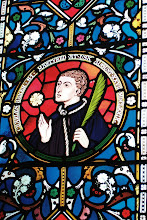
4, 5 & 6) Inside the Catholic Church, an explanatory notice, the Martyr’s Shrine and the colourful, modern stained glass window depicting the church’s two Jesuit patrons, St Francis Xavier and St David Lewis.


The Jesuit’s body was taken in procession to Usk’s Priory Church of St Mary and respectfully buried in the churchyard. His grave is the one nearest the door of the west porch and just to the left of the path as you approach the church. The stone marking the grave is relatively new, having been placed there after the canonisation of St David Lewis. It replaces an old and broken stone generally believed to be the original gravestone. The Priory Church West porch and the Martyr’s gravestone are in the next photographs.

 In Penal Times, Mass was celebrated whenever and wherever possible. This could mean in a private house, an inn, a barn, in a field, or in the woods. After the execution of Fr David Lewis in 1679, a house in Usk where he used to say Mass was confiscated. The popular Pub, Cross Keys, is thought to be that house. It is located on Bridge Street, not far from the site of the former Usk Gaol.
  Fr David Lewis was beatified in 1929 and on 25th October 1970, he was canonised by Pope Paul VI as one of the Forty Martyrs of England and Wales. His feast day is kept on 27th August. Every year on the Sunday nearest to the 27th August, there is a pilgrimage to the grave of St David Lewis.
  ST DAVID LEWIS, PRAY FOR US
Friday, 25 June 2010
CAN ANYONE SOLVE THE MYSTERY?
 This interesting fragment of stone bears the inscription "DAVID LEWIS 1679". It was found in the churchyard of the Catholic Church in Usk but no one seems to know anything about its history. Knowledge of its age, origin, etc, seems to be lost in the mists of time. The stone, which has a small cross embedded in it, appears to be the remains of some sort of memorial to the martyred Welsh Jesuit. This stone may or may not be of any significance but, since the only purpose of this blog is to make St David Lewis better known, anything that has even a remote connection to our wonderful Saint is worth investigating, in so far as we are able. Not being professional historians or archaeologists, we are at a decided disadvantage. However, we are devoted to St David Lewis so we do our best with our limited talents. Whatever this curious artifact is, it must have a story and, important or not, it would be nice to know that story. Therefore, I am asking if anyone out there in Blog land has any knowledge of this object? I would be more than delighted to hear from you if you do. (FOR A BETTER VIEW OF THE STONE, CLICK ON THE PICTURE TO ENLARGE IT.)
Thursday, 11 March 2010
CONFISCATED PLATE

This post was prompted by a comment from Pedro at Pedro The Fisherman Blog. The Catholic Church in Abergavenny is in possession of some plate, including a chalice, which was used by St David Lewis. Other than that, the following is all that I can discover about the whereabouts of the confiscated plate of Fr David Lewis.
On Sunday morning, 17th November 1678, Fr David Lewis S J, was preparing to celebrate Holy Mass. Just before daybreak, six of John Arnold’s dragoons arrived at his cottage in Llantarnam. The dragoons were led by Roger Seys, William Bedloe and William James, and they had been sent by the arch priest hunter, Arnold, to arrest the priest. The ultimate destination was Monmouth Gaol but first the party was to stop at the house of Charles Price of Llanfoist. Price was another Justice of the Peace and one of Arnold’s henchmen.
When Fr Lewis was taken from his cottage, those who had arrested him also took away all the altar furnishings, vestments, and anything considered “popish”! A report sent to the Privy Council asked for instructions as to what should be done with “all his robes, crucifixes, wafers, books and several other things”. The reply was that they should proceed according to the law, and all objects were to be burnt, “if they shall find the same to be popish or superstitious.”
The following is a list of items confiscated and kept by Charles Price of Llanfoist;
One large silver and gilt chalice and paten,
One pair of small silver flower pots,
One small thurible and cover,
One small silver plate for cruets,
One silver cruet,
One silver bell for the altar,
One small pair of silver candlesticks,
Several small pieces of silver belonging to a crucifix,
One picture of the Virgin Mary, with a silver and gilt inner frame
Charles Price was a rapacious man, hungry for power and wealth. Despite orders from the Privy Council, he was very loath to part with the plate taken from the home of Fr Lewis. In April 1860, the Treasury ordered Thomas Morgan, the Sheriff of Monmouth, to take delivery of this collection of plate from Price and give it to the constables as a reward for their diligence in priest hunting! However, Price still clung to his booty and, when an enquiry into the matter was conducted after the accession of King James II in 1685, the stolen articles were still in the possession of Charles Price.
The following is a list of items confiscated and kept by Charles Price of Llanfoist;
One large silver and gilt chalice and paten,
One pair of small silver flower pots,
One small thurible and cover,
One small silver plate for cruets,
One silver cruet,
One silver bell for the altar,
One small pair of silver candlesticks,
Several small pieces of silver belonging to a crucifix,
One picture of the Virgin Mary, with a silver and gilt inner frame
Charles Price was a rapacious man, hungry for power and wealth. Despite orders from the Privy Council, he was very loath to part with the plate taken from the home of Fr Lewis. In April 1860, the Treasury ordered Thomas Morgan, the Sheriff of Monmouth, to take delivery of this collection of plate from Price and give it to the constables as a reward for their diligence in priest hunting! However, Price still clung to his booty and, when an enquiry into the matter was conducted after the accession of King James II in 1685, the stolen articles were still in the possession of Charles Price.
Sunday, 7 March 2010
THY WILL BE DONE
This is a lovely song from Sister Miriam Therese Winter and The Medical Mission Sisters. They were in the forefront of the new style of music that became popular in the Catholic Church in the 1960s. This is a very lovely song and appropriate for this Lenten season.
Chorus:
Is there a song to ease our sorrow
to lead us along into tomorrow
to show us how, to live in our now
Father Thy Will be done
Father Thy Will be done
What have you done for my friends
how have you called, how have you lived
how have you died, how did you give
how have you tried
Chorus
What have you done for my Son
have you been called, have you received
have you been right, have you believed
have you been tried
Friday, 13 November 2009
FROM USK TO LONDON AND BACK AGAIN
Fr David Lewis was taken to Usk Gaol on a cold and snowy January day in 1679. He was committed to the Monmouth Assizes in March. Although the Titus Oates Plot had been the catalyst in the Jesuit’s arrest, the official Calendar of Assizes listed the charge against him as “David Lewis pro Sacred Roman”, in other words, “David Lewis for being a Roman priest”. Also, at Fr Lewis’s trial the Judge, Sir Robert Atkins, explicitly stated, “It is enough that you have exercised the functions of a priest in copes and vestments used in your Church, and that you have read Mass and taken Confession. He that uses to read Mass commits treason.” In any case, the accused was found guilty and sentenced to the usual punishment for treason – to be hanged, drawn and quartered. However, he was not to die just yet.

In May, along with his cousin and fellow priest, eighty year old Fr John Kemble, Fr Lewis was taken to London. Here he was examined by Titus Oates and other anti-Catholics including Lord Shaftesbury. Lord Shaftesbury offered the priest his life and rich rewards if he would tell them about the plot or conform to the Protestant religion. The good priest said he was unable to tell anything about the plot because he knew of no plot. Neither would he conform because, he said, it was against his conscience. He was sent back to Usk to await execution.

Three months later, on 27th August 1679, the condemned priest was taken from the Gaol on Bridge Street. He was tied to a hurdle, feet foremost, and drawn along the river path to the place of execution. This was in the grounds of what is now Porth-y-Carne House. (Less than a week earlier, on 22nd August, the aged Fr John Kemble had been martyred at Hereford.) In the 1800s, a Catholic Church, dedicated to St Francis Xavier, was built opposite the site of the martyrdom of St David Lewis. Fr David Lewis was canonised by Pope Paul VI on 25th October 1970. In 1974, the Church of St Francis Xavier was rededicated and, in honour of the martyred priest, it is now known as the Church of St David Lewis and St Francis Xavier.
Subscribe to:
Posts (Atom)




.JPG)

.JPG)


