Showing posts with label Irish. Show all posts

Saturday, 17 March 2012

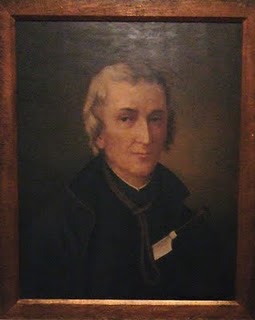
BLESSED WILLIAM TIRRY

This being St Patrick's Day, I will post on another Irish Martyr, Blessed William Tirry. I am indebted to kee at LITTLE HARE for introducing me to this faithful and brave Irish Augustinian. Thanks, kee, and a Happy St Patrick's Day to you & yours. (I am also indebted to the site, Augustinians of the Midwest. I hope they will forgive me for borrowing from them. I think it is important to spread the word about this great Irish Augustinian Martyr, Blessed William Tirry.)

William Tirry (1608-1654) was martyred because he chose loya
lty to God and Church over obedience to civil authority.
William Tirry was born in Cork, Ireland in 1608. His uncle was Bishop of Cork-Cloyne.
William entered the Augustinian Order in Cork. He must have been a promising student, as he was sent for studies in Valladolid, Spain and Paris, France. Following completion of his courses in Paris, he spend five years (1636-1641) in Brussels, Belgium.
He returned to Ireland in 1641. A few years later, when hostilities broke out in Ireland, Augustinian community life became impossible. William went to serve for a time on the staff of his uncle, the Bishop. He was later named Secretary of his Augustinian province.
He was chosen in 1649 as Prior (local superior) of the Augustinian house in Skreen. However, Oliver Cromwell's troops would not permit him to live there.
A law enacted January 6, 1653 declared that any Roman Catholic priest in Ireland was guilty of treason. William and other priests were forced into hiding. Three men betrayed William in return for money. He was arrested March 25, 1654, Holy Thursday, as he was preparing to celebrate Holy Mass.
While awaiting trial, William was imprisoned at Clonmel. Here, his spirit of prayer and penance helped to inspire the other priests who were also incarcerated there.
At his trial, William readily proclaimed his loyalty to the government in civil matters. But, in matters of religion, he declared that he was bound to obey only his conscience, his Augustinian superiors and the Pope. He was found guilty of treason and sentenced to death by hanging.
William was executed May 12, 1654. He was 45. An account told by another friar who had been tried with William gives some details of that day: William, wearing his Augustinian habit, was led to the gallows praying the rosary. He blessed the crowd which had gathered, pardoned his betrayers and affirmed his faith. It was a moving moment for Catholics and Protestants alike.
The body of William was buried on the grounds of the destroyed Augustinian friary at Fethard. His grave was not marked, however, and its exact location is unknown. He, along with 16 other Irish martyrs, was declared Blessed in 1992 by Pope John Paul II.

LINKS TO THIS POST

IRISH MARTYR, ST OLIVER PLUNKETT

AN IRISH FRANCISCAN MARTYR

Thursday, 17 March 2011

AN IRISH FRANCISCAN MARTYR


Last St Patrick’s Day I wrote about St Oliver Plunkett, Archbishop of Armagh, who was executed at Tyburn in 1681. Another innocent victim of the Oates Plot, Oliver Plunkett was the last Catholic executed for his faith in this country.

On this St Patrick’s Day, let’s remember a kinsman of St Oliver Plunkett, Blessed Charles Mahoney. This Irish Franciscan was another victim of the evil Titus Oates.

Charles Mahoney (alias Meehan) was born in Ireland around 1639/40. He and his three brothers, James, Terence and Christopher, were educated by their uncle, Fr Bonaventure O S F, who was guardian of St Anthony’s College in Louvain. Three of the boys, Charles, Terrence and James, followed in their uncle’s footsteps and became priests.

In 1674, several years after his ordination, Charles was sent to Germany to study theology. He remained there for two years then spent another two years in Rome, preaching and teaching at the Irish Franciscan College of St Isadore. Then, in 1678, Charles was sent back to Ireland. Charles was aboard a ship heading for home when disaster struck. In a raging storm his ship was wrecked off the coast of Wales. With some of his belongings, he managed to swim ashore near Milford Haven in West Wales.

The plucky Franciscan decided to travel North, on foot, in the hope of finding a ship bound for Ireland. Unfortunately, Charles didn’t get very far. In June 1678 he was arrested not far from Denbigh and imprisoned in Denbigh Gaol. In the spring of 1679, Charles Mahoney was tried, found guilty of being a Catholic priest, which was considered treason, and sentenced to be hanged, drawn and quartered, the usual punishment for treason.

On 12th August 1679, Fr Charles Mahoney was taken from his prison, tied to a horse-drawn hurdle and dragged to a spot outside the town. Here the awful sentence was carried out.

The months of July and August 1679 were busy ones for the anti-Catholic authorities. Titus Oates and his fellow perjurers must have been smugly satisfied too. Executions of Catholic priests were being carried out in various parts of England and Wales. In Wales, Fr Philip Evans S J and a secular priest, Fr John Lloyd, were barbarously executed in Cardiff on 22nd July. Just over the border, in Hereford, eighty year old Fr John Kemble, another secular priest, met his fate on 22nd August. Fr Kemble, a cousin of St David Lewis, had spent fifty-four years ministering to the Catholics of Herefordshire and Monmouth. On that same day Fr John Wall, a Franciscan, was executed at Red Hill, Worcester. Fr Wall, who ministered mainly in the Worcester area, was a classmate and friend of our Last Welsh Martyr, St David Lewis. Fr David Lewis S J followed his friends and fellow priests to martyrdom on 27th August at Usk. All five were canonised in 1970 when Pope Paul VI canonised the Forty Martyrs of England and Wales.


The British Museum is in possession of a one page document entitled “The Last Speeches of Three Priests that were executed for Religion, Anno Domini 1679”. The document reads; “An Account of the words spoken by Mr Charles Mahony, an Irish priest of the holy Order of St Francis, who was executed in his Habit at Ruthin in North Wales, August 12, 1679. Now God Almighty is pleased I should suffer Martyrdom, His Holy Name be praised, since I dye for my religion. But you have no right to put me to death in this country, though I confessed myself to be a priest, for you seized me as I was going to my native country, Ireland, being driven at Sea on this coast, for I never used my Function in England before I was taken, however, God forgive you, as I do and shall always pray for you, especially for those that were so good to me in my distress. I pray God bless our King, and defend him from his enemies, and convert him to the Holy Catholick Faith. Amen. His age was under forty. He was tryed and condemned at Denby confessing himself to be a priest.”

With 129 other martyrs of England and Wales, Charles Mahoney/Meehan was beatified by Pope John Paul II on 22nd November 1987.
LINKS TO THIS POST:

Wednesday, 5 May 2010

PENAL LAWS IN ENGLISH CANADA

IT IS TIME I DID ANOTHER POST SO, SINCE I AM STILL IN NEWFOUNDLAND, I THOUGHT YOU MIGHT BE INTERESTED IN THE EARLY DAYS OF CATHOLICISM IN ENGLISH CANADA, PARTICULARLY IN NEWFOUNDLAND. THERE WERE NO MARTYRS BUT CERTAINLY PLENTY OF HARDSHIP!

Catholics who settled in Newfoundland suffered under the harsh Penal Laws, that body of discriminatory and oppressive legislation focused chiefly against Roman Catholics, but also against Protestant nonconformists.

Followers of Catholicism in English Canada faced great adversities in their efforts to establish their faith in the new country. This was partly due to the religious disdain of the English majority towards those who refused to conform to the tenets of the Protestant Reformation but also from animosity towards the ethnicity of those who professed Catholicism, particularly to the Irish. This antagonism was most intensely found in Newfoundland where, unlike in Canada, the Penal Laws were strictly applied. However, in spite of the influence the Irish had in English-speaking Canada, it is in Newfoundland that Irish Catholic mores run deepest.

Newfoundland’s rich resources of fish needed people to work in the expanding industry. In the seventeenth century, people from many parts of Ireland, especially Waterford, Wexford, Kilkenny and Tipperary, rose to the challenge and became seasonal visitors to the Island, working in the fisheries during the summer and returning home at the end of the fishing season in the Autumn. The English Merchants, who reaped the immense profits of the Newfoundland fishery, seldom paid these Irish workers so their financial lot was not improved. However, the fishery did provide them with cheap passage to America and the opportunity of eventually migrating to the American Colonies, where they hoped to find better conditions! Nonetheless, many Irish stayed and created a large and permanent Catholic presence in the Colony of Newfoundland. Under the Penal Laws, the Irish settlers stood little or no chance of either justice or mercy when accused of a crime. Irish Catholics were denied a defence counsel and had no way of knowing an indictment until it was read in court.

In Newfoundland at that time, the Catholic Church was an illegal institution and had great difficulty assisting the Irish in the Colony. Since it operated as an underground organization, its spiritual and religious role was restricted. Under the English Penal Laws, enacted from the reign of Queen Elizabeth I to that of King George III, when they were repealed in 1783, it was hoped to eliminate "Popery" by rendering it impossible for a Catholic to exist, except in the most degraded conditions imaginable. Catholics were barred from holding public office, from operating schools or sitting in parliament. Neither could they own property nor own a horse worth more than $5 and the practice of their religion was forbidden. As well as the Penal Laws, local orders were applied. Catholics could not bury their dead; only an Anglican minister was permitted to read the service of burial and collect a fee for doing so.

Rome was not unaware of its responsibility to the Catholic population and from 1535 to 1784, Newfoundland was under the administration of the Bishop of Rouen, then the Bishop of Quebec and then under the Vicariate of London. A number of itinerant priests were sent to Newfoundland and, at considerable risk, they traversed the rough terrain, covertly said Mass, and then moved on. Aware that Catholics were practising their religion by stealth, the local authorities hunted the itinerant priests who came to the Island disguised as fishermen. These priests hid, said Mass and fled. Punishment for participation in the Mass was severe. One account refers to a Michael Keating of Harbour Main who, in 1755, was fined $50 for allowing Mass to be celebrated in his fish store; his house was demolished, his goods were seized, and he was deported from the Colony. These men were under the constant threat of surveillance by Protestants who felt obliged to report their activities. One example, documented in 1755, stated: “ I am informed that a Roman Catholic priest is at this time at Harbour Grace, and that he publicly read mass which is contrary to the law and against the peace of our sovereign Lord, the King.”

Conditions for Newfoundland's Catholics, predominantly Irish, gradually improved as the laws changed. In 1784, "liberty of conscience" was proclaimed in Newfoundland, the first Catholic chapel was built, and an Irish Franciscan, James Louis O'Donel, was appointed the first Roman Catholic Bishop of St. John's, Newfoundland. More priests came from Ireland and, in 1833, the Presentation Sisters arrived from Galway. The Presentation Sisters were followed by The Sisters of Mercy in 1842 and the Irish Christian Brothers in 1857. Advantages were gained when Catholics received the vote and were able to sit in the assembly and on the Legislative Council. For these early Catholic settlers to the Colony of Newfoundland, the struggle to obtain their religious rights was long and difficult. Be that as it may, the Newfoundland Irish expressed a unique culture in various dialects, crafts, and traditions which are still identifiable. The Irish language was commonly spoken among the Newfoundland Irish until the beginning of the nineteenth century, creating an Irish pattern of speech and vocabulary that is evident even today in Newfoundland English. The Catholic Faith, which was sown in suffering, perseverance and faithfulness, flourishes today and the many churches built with the pennies and free labour of poor Irish fishermen are their memorials.

Sunday, 14 March 2010

"A MOTHER'S LOVE IS A BLESSING"

This post is a little out of the ordinary for this blog but , on this Mothering Sunday, I wanted to post something especially for mothers. This lovely Irish song, sung by the equally lovely Bridie Gallagher, really says it all - "A MOTHER'S LOVE IS A BLESSING". To all mothers, thank you and a very Happy Mothering Sunday.

Friday, 22 January 2010

"BE THOU MY VISION" ALWAYS!

This old Irish Hymn is a favourite of mine. It is also a beautiful prayer. Our Patron, St David Lewis, may never even have heard of the hymn. By laying down his life for his faith and the Mass, the martyr showed that Christ certainly was his vision and Lord of his heart. There are many versions of this lovely hymn. Some are beautiful and some not so beautiful. It took me ages to choose from the many nice ones available so I hope you approve of my choice. May Christ be our vision, always and in all ways!


Related Posts with Thumbnails