Showing posts with label Protomartyr. Show all posts

Saturday, 6 June 2020

THE PROTOMARTYR

In the month of June several martyrs are commemorated.  Over the next few weeks it might be good to take a look at some of them. So far, this blog has dealt only with Reformation Martyrs, mainly St David Lewis, but the beginning is usually the best place to start! So we will start with St Alban, thought to be the first Briton to shed his blood for the faith, and as such, the Protomartyr.  
The martyrdom of St Alban
Alban was a pagan who lived in Verulamium circa third/fourth century.  A Christian priest, possibly named Amphibalus, was fleeing persecution and Alban gave him shelter. Alban was impressed by the priest's holiness and experienced a conversion. Consequently he sought instruction in the faith from the priest.

Discovering where the priest was hiding, the authorities sent soldiers to apprehend him. They found Alban, dressed in the priest's cloak, and thinking him to be Amphibalus, they arrested him.  Alban was brought before a judge who became furious when he realised that this man was not the priest.  He ordered that Alban should receive the punishment that the priest would have been given unless he worshipped pagan gods.  Alban replied that he would never again worship such false gods and said, "If you want to know the truth about my religion, know that I am a Christian, and carry out Christian rites". The judge demanded to know to what family Alban belonged but Alban bravely replied "My parents named me Alban, and I worship and adore the living and true God, who crated all things".  The judge had Alban flogged, tortured, and  beheaded.  On the way to the place of execution, Alban converted the soldier who was to be his executioner and another had to be found to carry out the beheading.  

According to St Bede, the martyrdom took place on 22nd June but the year is uncertain.  St Alban's feast is celebrated on 20th June. 

Thursday, 15 October 2015

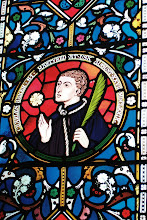
ST RICHARD GWYN


On this day in 1584 Richard Gwyn became the protomartyr of Wales. 
ST RICHARD GWYN

Richard Gwyn (White in English) was born in Llanidloes in Montgomeryshire, Wales, about 1537.  Richard studied at both Oxford and Cambridge and eventually returned to Wales and became a schoolmaster in Wrexham and then in Flintshire.

Richard and his wife Catherine had six children.   Richard was a church papist i.e., outwardly conforming to the Protestant religion while secretly holding to the Catholic Faith.  His minimal attendance at Protestant services was noted by the Bishop of Chester who urged him to conform more wholeheartedly.  The  pressure grew and Richard eventually gave in.

One day as Richard emerged from a Protestant service he was attacked by a murder of crows.  He was so shaken by this event that he returned to the Catholic faith and ceased all attendance at the Established Church.

Of course it was soon noticed that Richard was no longer attending the services which were demanded by law.  In 1580, he was arrested and committed to Ruthin Gaol by Justice Pilson.  For three months he was held there in chains.  At the next assizes he was brought to the bar and offered the chance to have his crime forgiven if he would attend just one Protestant service.  Richard refused and he was returned to prison.

After being tried and remanded several times, Richard was brought to trial in Wrexham on 9th October 1584.   Witnesses testified falsely against him and Judge Bromley ordered the jury to find him guilty.  He was found guilty and condemned to death. 

Two days before his execution, Richard was offered his freedom if he would conform to the State Religion.  He refused!  Thus, on 15th October 1584, Richard Gwyn was hanged, cut down while still alive, disemboweled, beheaded and quartered. His head and one of his quarters were displayed atop of Denbigh Castle.  The other quarters were displayed in Wrexham, Howlet and Ruthin.

THE MARTYRS' BANNER

Pope Paul VI, on 25th October 1970, canonised Richard Gwyn and thirty-nine other martyrs.  They are known collectively as the Forty Martyrs of England and Wales.

Saturday, 18 February 2012

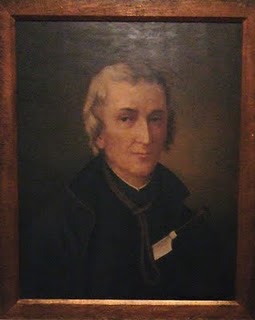
THE PROTOMARTYR, ST JOHN HOUGHTON

St John Houghton, the protomartyr of the English Reformation, was born in Essex in 1487. It is believed that he graduated from Cambridge University with degrees in civil and Canon Law. His minor gentry parents had arranged a very good marriage for him but John felt drawn to the priesthood. Because of their opposition to his choice, John had to go into hiding to pursue his vocation. He was prepared for ordination by a pious priest with whom he took lodging.

After ordination John served as a parish priest for several years then he entered the Carthusian novitiate in London. About 1516 he was professed at the Charterhouse in London. For a short time John was prior of Beauvale Charterhouse in Northampton and then prior of the London Charterhouse.

Storm clouds gathered when, in 1534, King and Parliament decreed that all had to take an oath upholding the King’s marriage to Anne Boleyn and swearing that his marriage to Catherine of Aragon had been invalid. This was known as the Act of Succession because it obliged the oath-taker to acknowledge that Anne’s children would be the rightful and sole heirs to the throne. John Houghton refused to take the oath and he was arrested and imprisoned in the Tower of London. When the words “so far as it is lawful” were added to the decree, John felt able to take the oath, though still with some misgivings.

The situation worsened in 1535 when King Henry and Parliament introduced the Oath of Supremacy, which declared Henry to be the Supreme Head of the Church in England. Not to take the oath was deemed High Treason! For various reasons, (mostly terror of the tyrant King) some other orders and clergy acquiesced to this demand. Augustine Webster and Robert Lawrence, the Carthusian Priors of Axholme and Beauvale Charterhouses, travelled to London to discuss this state of affairs with John. Following three days of prayer, they contacted one of the King’s toadies, Thomas Cromwell, seeking exclusion, for themselves and the monks under them, from having to take the oath. The three were ordered to take the oath but they refused outright. On 20th April 1535 they were arrested and conveyed to the Tower, via Traitors’ Gate.

Under interrogation by Thomas Cromwell, John Houghton and his companions said that they were ready to consent to all that the law of God would permit. Cromwell, wanting total submission, declared; “I admit no exception. Whether the law of God permits it or no, you shall take the oath without any reserve whatsoever, and you shall observe it too.”

When the Carthusians pointed out that the Act was contrary to what the Catholic Church taught, Cromwell replied; “I care nothing for what the Church has held or taught. I will that you testify by solemn oath that you believe and firmly hold what we propose to you to profess; that the king is Head of the English Church.” The fate of the faithful monks was sealed!

The priests came to trial and twice the jury refused to condemn them, despite threats that if they failed to find in favour of the king they would suffer the same fate as the priests. It was only when Cromwell himself came in person and intimidated them that, for fear of their own lives, the cowed jury returned a guilty verdict against John Houghton and his companions. They were sentenced to be hanged, drawn, and quartered, the usual sentence for those convicted of High Treason.

On Tuesday, 4th May 1535, the condemned priests were dragged to Tyburn. John Houghton was the first of the *five to suffer, making him the protomartyr of the Reformation in England. The executioner begged his pardon and John embraced him. As he stood on the cart below the gallows, John was asked again to submit to the king before it was too late. The holy monk replied; “I call on Almighty God to witness, and I beseech all here present to attest for me on the dreadful danger of judgement, that, being about to die in public, I declare that I have refused to comply with the will of His Majesty the King, not from obstinacy, malice, or a rebellious spirit, but solely for fear of offending the Supreme Majesty of God. Our Holy Mother the Church has decreed and enjoined otherwise than the king and Parliament have decreed. I am therefore bound in conscience, and am ready and willing to suffer every kind of torture, rather than deny a doctrine of the Church. Pray for me, and have mercy on my brethren, of whom I have been the unworthy Prior.”

The barbaric sentence was carried out in full. The rope was placed around the martyr’s neck, the cart pulled away and he was left to hang but briefly. Then still alive and fully conscious, he was cut down and disembowelled. He was heard to exclaim; “Oh most holy Jesus, have mercy upon me in this hour!” Still alive as the executioner tried to rip his heart out, it was reported that the victim was heard to murmur; “Good Jesu, what will ye do with my heart?” John Houghton was then decapitated and his poor body quartered. His head was displayed on a pike on London Bridge and his quarters were hung in prominent places as a deterrent to any who would be so foolish as to question the wicked king and his contemptible Parliament. One quarter, including an arm, was suspended above the gate of the London Charterhouse. It was a most grisly and potent warning of things to come for, although John Houghton was the first, many more would follow.

On 9th December 1886, John Houghton was beatified by Pope Leo XIII. Eighty-four years later, on 25th October 1970, John Houghton was canonised by Pope Paul VI as one of the FORTY MARTYRS OF ENGLAND AND WALES.

*John Houghton and the two other Carthusian Priors, Augustine Webster and Robert Lawrence, were executed with Bridgettine monk, Richard Reynolds and secular priest, John Hale, who also refused to take the Oath of Supremacy.
Related Posts with Thumbnails