Showing posts with label Fr David Lewis S J. Show all posts

Sunday, 13 January 2013

TRANSFERRED TO USK GAOL


On Monday, 18th November 1678, Fr David Lewis, a Jesuit priest, was incarcerated in Monmouth Gaol.  His false friend, John Arnold, who was a Justice of the Peace and  Member of Parliament, had promised that he would not allow him to be treated with “any incivility or severity” but had secretly ordered that a strict watch be kept on the priest.  Hence, Fr Lewis was kept a close prisoner and not allowed to leave his cell.   However, the Under Keeper, a more reasonable man, allowed friends to visit the priest during the day.  Through these visits the priest learned of the fate of his friends and fellow priests.  He would also have learned of the sacking of the Jesuit College of St Francis Xavier at a place called the Cwm.  Fr Lewis had served as Superior of the College and would feel great distress at its devastation.

Monmouth's Ancient Bridge
In the New Year, the new High Sheriff, James Herbert, decided to move the County Gaol from Monmouth to Usk.  So it was that on 13th January 1679, the Deputy Sheriff and the Head Gaoler rode with Fr David Lewis to Usk.   The weather was atrocious, bitterly cold and snowing.  When the group reached Raglan they stopped at an Inn to warm themselves.  While there a messenger arrived with sad news for Fr Lewis.  A friend and colleague from the Cwm, Fr Ignatius Price, lay dying in a barn about half a mile away.  The dying priest wished to see Fr Lewis.  As he was himself a prisoner in the custody of the Deputy Sheriff and the Head Gaoler, Fr Lewis was unable to comply with this heart-rending request.    Fr Lewis wrote; “Whilst I was in Raglan, a messenger came to the door of the Inn, desiring to speak with me on urgent business.  A very good friend of mine, one Mr Ignatius (alias Walter) Price, lay dying about half a mile away.  He had undergone much hardship from hunger and cold and lay dying.  He desired to see me.  But I was quite unable to perform the friendly duty, as I was under the actual custody of the officers.  So I only sent him my true and best wishes for his soul’s happy passage out of this turbulent world to an eternity of rest.”  Three days later, Fr Lewis learned of the death of his friend.
Site of Usk Gaol where St David Lewis was imprisoned

Usk Gaol, also known as the House of Correction or Old Bridewell, was situated on the north side of Bridge Street.  The Gaol, at 28 Bridge St, had originally been a Friary, a house of the Grey Friars. It became a House of Correction in the mid 1600s and served until Usk Prison was built about 1842.  When Fr David Lewis was imprisoned there it was crowded with Catholics who had refused to take the Oaths of Allegiance and Supremacy.  One prisoner was a widow, Jane Harris, who had given refuge to a priest.  She was betrayed by her butcher when he noticed her buying extra meat!  Fr Lewis would have known most, if not all, of these people for he had spent his priestly life toiling among the persecuted Catholics of the area, travelling mostly at night and probably on foot, to bring them what help and comfort he could.

St David Lewis was martyred on or near this spot in 1679

On 27th August 1679, this good man whose kindness had earned him the name of “Father of the Poor” was taken from Usk Gaol and dragged on a hurdle to a place known as the Coniger where he was executed for the “crime” of being a Catholic Priest.  The actual site of his death is believed to be within the grounds of Porth-Y-Carne House, opposite the Catholic Church of St Francis Xavier and St David Lewis.  The martyred Fr David Lewis was permitted a decent burial.  Reverently carried in procession to the Priory Church of St Mary, he was interred in the Churchyard.   The grave of St David Lewis is the nearest one to the main entrance of the church and every year on the Sunday nearest to 27th August pilgrims flock to this holy site to pay their respects to the Last Welsh Martyr.  
The Grave of St David Lewis
 

Sunday, 24 June 2012

THE FEAST OF ST JOHN THE BAPTIST

In writing about St John the Baptist, E LeJoly said:

“John the Baptist points to God, a signpost on the way of life, for men to see and obey.  John the Baptist comes as a witness.  Filled with love for God, he has one thought, one concern, one purpose: to direct men’s minds and hearts to the Saviour who comes, to the Light of men, that they may turn to Him and believe in Him.”

In St John’s Gospel we read that John the Baptist “Came to bear witness to the Light.”  LeJoly tells us that John bears witness through his mode of life and through his preaching.  “There is no greater calling than to witness to the Light, that men may believe in Jesus.  The Father sent John to be the herald announcing His Son.  The Holy Spirit inspired him as he inspired the older prophets and the apostles and saints of the New Testament.  They witnessed by their personality, their speech, their life, even unto the shedding of their blood.  They witnessed to Christ under the lash, on the gridiron, chained in prison.  They proclaimed Him the Lord when stoned, bound to crosses, thrown to wild beasts.”

St David Lewis bore witness to Christ by his personality and his mode of life.   He studied at the English College in Rome and an entry in the College Diary describes him as “Vir prudens et pius”, that is “a wise and holy man”.  Later, in his ministry in Wales, he travelled the countryside, usually at night, on foot or on horseback to care for the persecuted Catholics.  But no person, Catholic or otherwise, was outside his love and concern and his kindness to all earned for him the affectionate appellation of “Tad y Tlodion” or “Father of the Poor”.

Like St John the Baptist and the saints and martyrs of the New Testament, St David Lewis bore witness to the Light by the shedding of his blood.  As he prepared to celebrate Mass on Sunday, 17th November 1678, Fr David Lewis was arrested at Llantarnam.  Betrayed by his so called friend, John Arnold, he was conveyed to Monmouth Gaol where he was incarcerated for several months.  Then, on a bitterly cold day in the dead of winter, 13th January 1679, he was moved to Usk Gaol.  At the March Assizes in Monmouth, David Lewis was condemned as a Catholic priest who said Mass.  In passing sentence, Judge Atkins said, “He that uses to read Mass commits treason”.  Convicted of High Treason, Fr Lewis was sentenced to be hanged, drawn and quartered, the usual punishment for High Treason.  He was returned to Usk Gaol.

In April of 1679, Fr David Lewis, Fr John Kemble, Fr Roger Hanslip and Fr John Wall were ordered to London to be questioned by the odious Titus Oates and his fellow perjurers, William Bedloe and Stephen Dugdale.  The four priests were lodged in vile conditions in Newgate Prison.  Although they were rigorously interrogated by the trio, no evidence of involvement in any plot could be found against them.  Indeed, there was no evidence of a plot at all!  The priests were offered freedom and wealth if they would perjure themselves with details of a nonexistent plot or renounce their faith.  All four priests unequivocally refused.  They were sent back to their respective prisons to await their fate.

For Fr David Lewis S J this came on 27th August 1679.  On that summer day David Lewis gave witness by his holy manner and the courageous way in which he willingly shed his blood for Christ.  The name of St David Lewis was added to the Church’s list of Martyred Saints on 25th October 1970 when he and 39 others were canonised by Pope Paul VI in Rome.  Collectively they are known as the Forty Martyrs of England and Wales.

From the beginnings of Christianity the followers of Jesus have been persecuted.  Right down to the present day, Christians are bearing witness to Christ through persecution and death.  On this feast of St John the Baptist, let us be mindful of the sufferings of our fellow Christians around the world and keep them in our prayers.

Let us also be mindful of our great blessing of freedom of worship.  Never take it for granted! 

Thursday, 7 June 2012

SUMMONED TO LONDON

St David Lewis
In March 1679, having been caught up in the fabricated Popish Plot spawned by the evil Titus Oates, Fr David Lewis S J was convicted of being a Catholic priest and saying Mass.  At that time this was considered High Treason.  The punishment for High Treason was to be hanged, drawn and quartered.  Fr Lewis was returned to his cell in Usk Gaol to await his fate. 

In late April 1679 there was a great hullabaloo in Parliament.  Word had been received that there was a plot afoot to poison Oates and his fellow lowlife, Bedloe.  Once again, there was no plot but, as Canon J Barrett Davies tells us, “The Government had not been able to produce any evidence to lend substance to the inventions of Titus Oates, and no doubt they felt it was high time a real Catholic priest was implicated or the commonalty might become as sceptical about the Plot as His Majesty was already known to be”. 

The House of Lords Journal for 28th March 1704 records;

“23 rd April 1679, Upon report from the Lords Committees for Examinations, that their Lordships find it requisite that David Lewis, who hath been tried and condemned as a Popish Priest at the Assizes held for the County of Monmouth, and is now in Gaol there, may be brought to Town.  It is ordered that the Sheriff for the said County of Monmouth be, and is hereby required, to take care and give order for the speedy conveying of the said David Lewis in safety from the said Gaol, to be delivered into the Prison of Newgate; the charges of which service shall be allowed to the said Sheriff upon his Account in the Exchequer.
The like Order for Roger Hanslip, in the Gaol at Gloucester.
The like Order for John Kemble, in the Gaol at Hereford.
The like Order for Francis Johnson, alias Webb, in the Gaol at Worcester.”
<>

Newgate Prison


So it came to pass that on 23rd April Fr David Lewis was ordered to be brought to London for questioning.   He was lodged in the disgusting hellhole that was Newgate Prison.  He was joined there by the three other priests, Fr John Kemble, Fr John Wall O F M (alias Francis Johnson) and Fr Roger Hanslip.   Fr Kemble, an eighty year old secular priest, and Fr Lewis were cousins.  John Wall* and David Lewis had been students together and were old friends. 
<>

St John Kemble

The journey to London was a torturous one for the aged Fr Kemble who suffered from a complaint, possibly arthritis, which made riding practically impossible for him.  Dom Bede Camm says that he made the journey strapped like a pack on the horse.  The four priests were to be examined by Titus Oates and two other miscreants involved in the Plot.  In the House of Lords Journal for 23rd May 1679 we read:
“Oates, Bedloe and Dugdale to visit condemned priests to see if they are any of those whom they knew to be concerned in the (Popish) Plot.”  It continues; 

“ORDERED, by the Lords Spiritual and Temporal in Parliament assembled, that Mr Titus Oates, Mr William Bedloe and Mr Stephen Dugdale be and are hereby appointed to repair to the Prison of Newgate this afternoon, there to see and speak with David Lewis, Roger Hanslip, John Kemble and Francis Johnson, alias Webb, condemned Popish Priests, now prisoners there; and that the said Titus Oates, William Bedloe and Stephen Dugdale do attend the Lords Committees for examining matters relating to the discovery of the late horrid conspiracy tomorrow at nine of the clock in the forenoon to give the said Lords Committees an account whether they know that any of the said Popish Priests have been engaged in the said horrid conspiracy.”


The unholy trio of examiners could find nothing to implicate the priests in any plot and, although the three were ordered to report to the Lords Committees the next day, it appears that only Oates did so.  The priests were then questioned by Lord Shaftsbury who offered each of them life as well as rich rewards if they would reveal something of the Plot or renounce their Catholic faith. 
St John Wall
Shaftsbury had wasted his breath for the priests would neither lie nor apostatize!  On 18th July, John Wall stated in a letter, “I told them I would not buy my life at so dear a rate as to wrong my conscience”.  Fr Lewis, in his last speech on 27th August, said “Discover a plot I could not, for I knew of none, and conform I would not, for it was against my conscience”.

Despite the rigorous interrogation of the four priests, nothing was found to incriminate them.  Therefore, on 28th May, an order was issued to return them to their respective gaols.  Fr Kemble was permitted to walk for most of the journey back to Hereford – no mean feat for a man of eighty!  Not surprisingly, he was in very poor health after this ordeal.   By 9th June Fr Kemble and Fr Lewis were back in their respective gaols, Hereford and Usk.

John Wall was hanged, drawn and quartered at Red Hill near Worcester on 22nd August 1679.  On the same day, at Widemarsh Common, Hereford, Fr John Kemble was executed.  Less than a week later, on 27th August, Fr David Lewis was martyred at Usk, in Monmouthshire. 

As far as I can ascertain, Fr Roger Hanslip was reprieved.  If anyone knows differently, I would be very pleased to hear from you.

*While working on the English Mission, John Wall used several aliases, including Francis Johnson, Francis Webb and Francis Dromore.

Sunday, 3 April 2011

NOT LACKING IN MEN OF THE CLOTH

Morgan Lewis and his wife, Margaret Pritchard, were the parents of nine children, four girls and five boys. Margaret was a Catholic and she reared eight of the children as Catholics. Morgan, a Protestant, saw to it that their youngest child, David, was brought up in the Protestant religion.


David Henry Lewis was born in late 1616, at Abergavenny, Monmouthshire. He attended King Henry VIII Grammar School where his father was headmaster. When he was sixteen, David went to London to study law. It would appear that the boy’s heart was not in it for he soon availed of an opportunity to visit Paris. It was while he was in Paris that David was received into the Catholic Church. In 1636 David returned to Abergavenny and lived with his parents until their deaths in 1638. Deciding to become a priest, David then entered the English College in Rome. This was made possible by the financial assistance of Fr Charles Gwynne (alias Brown), the Superior of the Jesuit College of St Francis Xavier at the Cwm. After ordination, David Lewis joined the Jesuits. He was sent to work among the beleaguered Catholics of his homeland. With the exception of one year in Rome, Fr Lewis spent the rest of his life labouring among his countrymen in Wales. During the mad frenzy fomented by the Titus Oates Plot, Fr David Lewis was arrested at Llantarnam in 1678. In March 1679 he was tried and convicted of the crime of being a Catholic priest and of saying Mass. High Treason! Although the Titus Oates Plot was the impetus for his arrest, David was never implicated in the Plot and he was executed solely for his religion. This was made abundantly clear when, at the trial the Presiding Judge, Robert Atkins, stated, “He that uses to read Mass commits treason”. On 27th August 1679, Fr David Lewis S J was executed at Usk. Beatified in 1929, he was canonised in 1970.

From just a cursory look at the family of St David Lewis one can see that his was a family not lacking in men of the cloth.


David’s Great-great-grandfather was Lewis ap John (Wallis) who was Vicar of Abergavenny and Llandeilo Bertholau. Lewis ap John was Vicar of St Mary’s Priory Church where the tomb of his son, Dr David Lewis, can be seen today. Since Morgan Lewis had his son David brought up in the Established Church, David would have been baptised in the Priory Church where once his great-great-grandfather had been the vicar.


Lewis ap John’s grandson, David Baker, became a Benedictine. As Dom Augustine Baker, David Baker is famous as a mystic and writer. He was also instrumental in re-establishing the Benedictines in England. Dom Augustine Baker O S B was the great uncle of St David Lewis and the Benedictine and the future Jesuit Martyr would have met on the Benedictine’s last visit to Abergavenny in 1620. On his last visit to his hometown, Augustine Baker stayed with his sister, Margaret (Baker) Pritchard. Margaret Pritchard was the grandmother of St David Lewis.


As well as being the sister of a priest, Dom Augustine Baker, Margaret Pritchard was also the mother of a priest. Her son John became a Jesuit and, being just six year older than his sister’s son David, may have been the stimulus for his nephew’s decision to join the Jesuits. David Lewis himself states that he numbered among his closest friends his uncle, Fr John Pritchard who was a Jesuit. Dom Augustine Baker maintained at Douai a nephew who later became a Jesuit. It is widely held that this nephew was indeed Fr John Pritchard S J (alias Lewis).

A nephew of St David Lewis became a priest. His nephew, also named David Lewis, was the son of the Saint’s brother, Richard. Born in Monmouth, Richard’s son was educated at St Omer and entered the English College in Rome in 1690. The young man followed in the footsteps of his uncle, St David Lewis, and his great uncle, Fr John Pritchard and, in 1707, he was professed as a member of the Society of Jesus. This Fr David Lewis S J lived and worked in Rome where he died in 1741.


Although Morgan Lewis was a Protestant, he was from an old Catholic family and a relative of the Morgans of Skenfrith. St John Kemble’s mother, Anne, was one of the Skenfrith Morgans, thus through Morgan Lewis and Anne Kemble, the two Saints were cousins. Anne Morgan and her husband, John Kemble, were the parents of at least two priests.

Not a lot is known about their elder son, William Walter Kemble. We do know that he was born in Herefordshire and studied at Douai. He entered the Benedictine Order in 1619 and was professed on 1st October 1620. After ordination he was sent to the south of England to work. On 23rd October 1633 he died at Fownhope, Herefordshire.


More is known about Anne and John’s other priest son, St John Kemble. John was born at Rhydicar Farm, St Weonard’s, Herefordshire in 1599. Following his brother, William Walter, he began training for the priesthood. He went to Douai, adopted the alias of “Holland”, and was ordained on 23rd February 1625. Later that year, on 4th June, he was sent on the English Mission. For 54 years this humble and good man laboured for the people of Herefordshire and Monmouthshire. He was loved and respected by all. It was said of him that “He gave offence to none”. However, in 1678 the poisonous tentacles of the Oates Plot wrapped themselves around Fr John Kemble. He was arrested at Pembridge Castle, the home of his relatives, and on 22nd August 1679, the eighty year old secular priest was martyred at Widemarsh Common, Hereford.

As well as the same bloodline, Fr David Lewis and Fr John Kemble shared the same fate. They were executed within days of each other and both were beatified in 1929. In 1970, Pope Paul VI canonised the Forty Martyrs of England and Wales. Among the Forty were the cousins, St David Lewis and St John Kemble.

Tuesday, 22 March 2011

UNSUNG HEROES

The trials and executions, if not the lives, of most of our martyrs are well documented. However, there are many who, though not actually put to death for the faith, nonetheless died heroically for their faith and for their loyalty to their Catholic priesthood and the holy Mass. I refer to the many unheralded and possibly unknown priests who died in prisons up and down the country and to those who died on the run, hunted like wild beasts!

Fr Edward Turner S J was the brother of Blessed Anthony Turner. They were the sons of a Protestant minister. The brothers converted to Catholicism, studied at the English College in Rome and eventually returned to England to minister to their persecuted Catholic brethren. Fr Edward Turner was arrested and died in Gatehouse Prison in 1681, two years after Anthony’s execution at Tyburn.

Fr William Lloyd was the brother of Welsh Martyr, Saint John Lloyd. St John Lloyd was a secular priest who was executed in Cardiff in July 1679. Fr William Lloyd was in charge of the Secular clergy in South Wales. Like his martyred brother, he too was apprehended and imprisoned. Found guilty of being a Catholic priest and celebrating Mass, which was considered treason, he was sentenced to be hanged drawn and quartered. This was the usual punishment meted out for treason. Harshly treated in prison, Fr William Lloyd died in Brecon Gaol just days before his scheduled execution.

The Jesuit College of St Francis Xavier at the Cwm, Herefordshire, was sacked in December 1678. With the fury of the Oates Plot spreading over the country, the Superior of the College, Fr David Lewis, decided that the College should be evacuated and the priests hid as much property as they could. Books, vestments, altar plate, etc, were hidden in outbuildings and the priests were dispersed with the hopes of one day returning to the Cwm. Unfortunately that was not to be. Some of the priests found shelter with Catholic families while others took to the hills and woods of their beloved Wales. Under cover of night they traversed the countryside bringing the comforts of religion to the harried Catholics of the area.

Fr Charles Pritchard found shelter in the home of a friend. By day he hid and at night he went forth to attend to the needs of his flock. His health broke down and one dark night he suffered a severe fall. He managed to return to his friend’s house but he never recovered and, on 14th March 1680, he died. His unnamed friend secretly buried the 43 year old Jesuit in the garden.

There are many sad tales to be told of the sufferings of priests and laypeople alike during the times of persecution. One of the most poignant is that of Fr Ignatius Price S J, another of the priests from the Cwm.

Fr Ignatius Price was born in Monmouthshire in 1610. Working under the alias of Walter Price or Harries, he served the Jesuit Welsh Mission from 1644 until his death in 1679. The following is an account of the tribulations of Fr Price: “For nearly two months in the depths of winter, scarcely a night passing in which he was not sought for in the houses of Catholics, flying from cottage to cottage, sometimes barefoot through heavy snow and deep water, clad for the most part in linen, the aged priest, had no place that could offer him any real shelter. Catholics even, through fear of the terrible laws, sometimes denied him hospitality, while he avoided their houses lest he involve his host in the punishment of death for harbouring a Jesuit. In order to avoid the snares laid for him, Fr Price had been compelled to fly by night from barn to barn, from cave to cave, even from hog sty to hog sty. At length he contracted a violent fever from which he would soon die.”

Fr David Lewis had been arrested at Llantarnam on 17th November 1678 and imprisoned in Monmouth Gaol. On 13th January 1679, a snowy and freezing cold day, Fr Lewis was moved to the County Gaol at Usk. On that snowy January day in 1679, Fr Lewis and his guards stopped at an inn in Raglan. While there a messenger came with a heartbreaking request for Fr Lewis. Father Lewis wrote: “Whilst I was in Raglan, a messenger came to the door of the inn, desiring to speak with me on urgent business. A very good friend of mine, one Mr Ignatius alias Walter Price, lay dying about half a mile away. He had undergone much hardship from hunger and cold and lay dying. He desired to see me. But I was quite unable to perform the friendly duty, as I was under the actual custody of the officers. So I only sent him my true and best wishes for his soul’s happy passage out of this turbulent world to an eternity of rest.” Three days later Fr Ignatius Price died.

Fr David Lewis himself was martyred at Usk on 27th August 1679. Beatified in 1929, Saint David Lewis was canonised by Pope Paul VI on 25th October 1970 as one of the Forty Martyrs of England and Wales.

Thursday, 22 July 2010

FATHER CHARLES BROWN S J

Charles Brown was in fact, the alias of Fr Charles Gwynne. Like most priests in England during Penal Times, he refrained from using his real name for safety reasons. He sometimes used the names of ‘Bodvel’ or ‘Bodwell’. Charles Gwynne was born in 1582, the son of Thomas Wynn of Boduan, Pwllheli, and Elizabeth, daughter of Owen ap Gruffydd of Plas Du. They brought up their son Charles in the Protestant religion. While on a visit to his mother’s brother, Hugh Owen, in Brussels, Charles was reconciled to the Catholic Church by Fr J Chambers. Charles entered the English College in Rome and was ordained there in 1613. He became a Jesuit in 1620.

In 1623, Fr Brown was sent on the Welsh mission of St Francis Xavier. In 1625 he became its Rector, succeeding Fr John Salisbury, and was instrumental in establishing the mission’s headquarters at the Cwm, Llanrothal. The Morgans of Llantarnam were generous benefactors. Fr Brown secured from his uncle, Hugh Owen, funds for maintaining a Welsh scholar at Rome. Coincidentally, it was this fund which made it possible for Fr Brown to enable a future Rector, David Lewis, to enter the English College in 1638. (David Lewis was martyred in 1679 and canonised in 1970.)

In 1618, Fr Brown inherited Hugh Owen’s fortune. To commemorate his munificent uncle, Fr Brown erected a tablet to his memory at the English College in Rome.

Fr Charles Brown was another Welsh Jesuit who, under hazardous circumstances, played a major part in the life of the Cwm and the continuance of the Catholic Faith in Wales. This dedicated priest died in 1647.
FOR RELATED POSTS CLICK BELOW.
ANNUAL PILGRIMAGE IN HONOUR OF ST DAVID LEWIS
SUNDAY, 29th AUGUST 2010
3:00 p m - MASS AT SS FRANCIS XAVIER AND DAVID LEWIS CHURCH, PORTH-Y-CARNE STREET, USK
PROCESSION TO THE MARTYR'S GRAVE
REFRESHMENTS IN THE PARISH HALL

Tuesday, 20 July 2010

“VIR PRUDENS ET PIUS”


One of nine children, David Henry Lewis was born in 1616 in Abergavenny, Monmouthshire. His parents were Morgan Lewis and Margaret Pritchard. Morgan Lewis, a Protestant, was headmaster of King Henry VIII Grammar School in the town. Margaret Pritchard was a devout Catholic and she brought up eight of their children as Catholics but Morgan saw to it that their son David was brought up in the Protestant religion. Until the age of sixteen, David was educated at the local grammar school where his father was headmaster. He then went to London to study law.

It was while David was studying in London that he went on a visit to Paris. During this time in Paris he became a Catholic. In 1636, the young man returned to Abergavenny and lived with his parents until their deaths in 1638. Fr Charles Brown S J (vere Charles Gwynne) was then the Jesuit Superior of Wales and the other counties which came under the mission of St Francis Xavier. It was under the patronage of Fr Brown that David Lewis set off, in August 1638, for the English College in Rome. Upon his entrance to the College in November of that year, he assumed the name of Charles Baker. The College Diary notes, “Charles Baker, vere David Lewis, a South Welshman of the County of Monmouth was admitted as an alumnus November 6th 1638”. Because of the perilous conditions existing under the anti-Catholic Penal Laws in England at that time, it was common practise for those destined for the English Mission to assume an alias. David was ordained priest on 20th July 1642 and in April 1645 he entered the Jesuit novitiate of Sant’ Andrea in Rome. The newly professed Jesuit was sent back to Wales but he was quickly recalled to Rome to take up a position at his alma mater. However, 1648 saw the return of Fr David Lewis S J to Wales and to the Jesuit mission of St Francis Xavier at the Cwm, near Llanrothal. Here he would spend the rest of his life ministering in the area of Monmouth and the Welsh marches.

It was a dangerous time for Catholics in general but for priests in particular. Many of the authorities in Wales turned a blind eye to their Catholic friends, neighbours, and in some cases, family members, who clung to “The Old Faith”. Nonetheless, the priests had to work in secret, mainly at night. The administrative centre for the area was at the College of St Francis Xavier at the Cwm. Fr David Lewis served two periods as Superior, from 1667 – 1672 and then again from 1674 – 1678.

When the Oates Plot, the preposterous invention of the fetid mind of Titus Oates, engulfed the country in the autumn of 1678, there were about six priests at the Cwm, including the Superior, Fr David Lewis, his good friend Fr Ignatius (Walter) Price and Fr Charles Pritchard. Only one of the priests at the Cwm, the Superior, Fr David Lewis, had been named by Oates in his fairytale. Oates claimed that he had seen a papal bull naming those who would hold positions of authority upon the success of the plot and, he maintained, this papal bull had stated that the See of Llandaff would be given to Fr David Lewis. Upon the mysterious death of Sir Edmund Berry Godfrey, the magistrate appointed to investigate the plot, a Chepstow born degenerate entered the scene. Lured by the prospect of a reward, William Bedloe joined Oates in his evil pursuit and the innocent Fr Pritchard’s name also became linked with the plot. Bedloe asserted that Godfrey had been murdered by three Jesuits and one of them was Fr Charles Pritchard. That, of course, was impossible because it is on record that Fr Pritchard, who carried on his priestly ministry for sixteen years, had never in all that time left the South Wales area.

The Rector, Fr Lewis, was astute enough to see that they were all in grave danger and he immediately evacuated the Cwm. Some of the priests were sheltered in the homes of courageous Catholics. Others, like Fr Ignatius Price, took to the woods and hills and, while still carrying on their covert ministry, had to sleep in caves or barns.

Fr Lewis lived for a time with his relatives, the Morgans, at Llantarnam but, so as not to place them in danger, he moved to a nearby cottage. It was at this cottage that Fr Lewis was arrested early on Sunday morning, 17th November 1678, as the priest was preparing to celebrate Holy Mass. He was imprisoned at Monmouth Gaol until January 1679 when he was moved to Usk Gaol. On 27th August 1679, the Jesuit was taken from Usk Gaol and, tied to a hurdle, he was carried along the river path to the place of execution. There he was executed for the crime of being a Catholic priest and for saying Mass. He was buried in the churchyard of the Priory Church, Usk. Next to the earlier entry in the Diary of the English College, Rome, a poignant note was added, “Vir prudens et pius. (A devout and prudent man.) Hanged for the Faith and the priesthood in the year 1680 in Wales.”

Beatified in 1929, Fr David Lewis S J, was canonised by Pope Paul VI on 25th October 1970 as one of the Forty Martyrs of England and Wales. There is an annual pilgrimage to the Martyr’s grave on the Sunday nearest to the 27th August.

FOR RELATED POSTS CLICK ON THE LINK:

PILGRIMAGE DETAILS FOR 2010:
Sunday, 29th August, 2010
3:00 p m – Mass at SS Francis Xavier and David Lewis Church, Porth-Y-Carne St, Usk;
Procession to the grave of St David Lewis;
Refreshments in the Parish Hall.

Wednesday, 13 January 2010

FATHER IGNATIUS PRICE S J


Fr Ignatius Price was born in Monmouthshire in 1610. Based at the Jesuit College of St Francis Xavier at the Cwm and working under the alias of Walter Price or Harries, he served the Jesuit Welsh Mission from 1644 until his death in 1679. Because of the tolerance of many of the Monmouthshire magistrates and officials, who turned a blind eye to the practise of the Old Faith, the diligence and hard work of the priests based at the Cwm was very productive.

However, there were those, notably John Arnold, a Justice of the Peace and Member of Parliament for Monmouthshire, Charles Price of Llanfoist and John Scudamore of Kentchurch, who were less than happy with their fellow magistrates and officials. In 1670 they informed the House of Lords that “there were still six priests living at the Cwm, a place which had been a centre for nearly forty years.” In 1674, as a result of such reports, Parliament ordered the arrest of the priests who lived at the Cwm and threatened to punish all Catholics with the immediate seizure of two-thirds of their lands. Thanks to the support amongst local magistrates, some of whom had Catholic relatives and friends, these orders were not obeyed and nothing was done.

Early in 1678, Arnold and Price presented the House of Commons with a printed document named an “Abstract of Examinations”. Arnold and Price were unflagging in their efforts to have the anti-Catholic Laws enforced and this document gave an account of the work of the Church as seen by the informers. By that time, Parliament had grown increasingly alarmed by its inability to root out and destroy the Old Faith and its apparent growth and revival in Monmouthshire and Hereford. There was also much talk of dark plots. In this atmosphere, Titus Oates, bolstered by the support of Chepstow born William Bedloe, had little trouble spreading his poisonous fabrication, “The Popish Plot”. The effects of this evil hoax spread into Monmouthshire about October 1678.

Fr David Lewis was Rector of the Cwm from 1667-1672 and again from 1674 until its sacking in 1679. Fr Lewis, realising the danger of their situation, quickly evacuated the Cwm. The priests were scattered. A few found shelter with courageous Catholic families but most of them were forced, in harsh winter weather, to hide in woods and cave, wherever shelter could be found. Fr Ignatius Price was one who took to the hills and died, harried and hunted like an animal! Fr Lewis and Fr Ignatius Price were friends as well as colleagues and Fr Lewis referred to Fr Price as his “very good friend”.

Fr David Lewis had been arrested on 17th November 1678 and incarcerated in Monmouth Gaol. On 13th January 1679, in atrocious weather and under guard, he was transferred to the new County Gaol at Usk. On the way, the group stopped at an Inn in Raglan for a brief respite from the cold and snow. While there Fr Lewis received a heartbreaking message. Fr Lewis wrote:
“Whilst I was in Raglan, a messenger came to the door of the inn, desiring to speak with me on urgent business. A very good friend of mine, one Mr Ignatius alias Walter Price, lay dying about half a mile away. He had undergone much hardship from hunger and cold and lay dying. He desired to see me. But I was quite unable to perform the friendly duty, as I was under the actual custody of the officers. So I only sent him my true and best wishes for his soul’s happy passage out of this turbulent world to an eternity of rest.”
Three days later Fr Price died.


Based on a firsthand account, Brother Henry Foley gives us a vivid and harrowing description of the last days of Fr Ignatius Price.

“For nearly two months in the depths of winter, scarcely a night passed in which he was not sought for in the houses of Catholics, flying from cottage to cottage, sometimes barefoot through heavy snow and deep water, clad for the most part in linen, the aged priest had no place that could offer him any real shelter. Catholics even, through fear of the terrible laws, sometimes denied him hospitality, while he avoided their houses lest he involve his host in the punishment of death for harbouring a Jesuit. In order to avoid the snares laid for him, Fr Price had been compelled to fly by night ‘from barn to barn, from cave to cave, even from hogsty to hogsty'. At length, he contracted a violent fever from which he soon died.”

It is believed that his relative, Charles Price of Llanfoist, the venomous collaborator of John Arnold, was responsible for this relentless pursuit of Fr Ignatius Price. There are even reports that, upon discovering the Jesuit’s grave, he had it opened so that he could remove a cross which had been buried with the priest. It was said that, given the man’s avaricious nature, this was not for love of the cross but for love of the metal!

So died Fr Ignatius Price S J, another brave and selfless priest. Although never brought to trial and not executed on the gallows, Fr Price was another innocent victim of the evil Titus Oates, his fellow liars, the non-existent Popish Plot, the bigoted Arnold, the rapacious Price, and their ilk.

(I think that I should say a special "Thank You" to my long-suffering husband. I wanted a winter photo to go with this post and I didn't have one that I considered appropriate. I didn't want a pretty winter scene or a happy one. It had to be one that conveyed a sense of the cold and dark conditions under which Fr Ignatius Price spent his last months. So, my dear husband, shortly after midnight and with snow still falling, opened our bedroom window and took a couple of photographs! The above photo is one of them and I think it is very apt as well as starkly beautiful. So - "Thank You", long-suffering husband!)

Wednesday, 30 December 2009

330TH ANNIVERSARY (CONCLUSION)


2009 marks the 330th Anniversary of the martyrdom of four priests who were executed for “High Treason”. Philip Evans, John Lloyd, John Kemble and David Lewis were Catholic priests and to be a Catholic priest was considered treason. At the trial of Fr David Lewis, the judge, Sir Robert Atkins, made that abundantly clear when he said;

“It is enough that you have exercised the functions of a priest
in copes and vestments used in your Church, and that you shall have read Mass and taken Confessions. He that uses to read Mass commits treason.”

Now, in the dying days of 2009, it is fitting to remember these four holy martyrs, two Jesuit priests and two secular priests.

FR JOHN KEMBLE
John Kemble, alias Holland, was born at Rhydicar Farm, St Weonards, Herefordshire in 1599. He was the son of John Kemble and Anne Morgan. He was ordained a priest at Douai on 23rd February 1625 and, on 4th June, was sent upon the English Mission. For 54 years Fr Kemble worked for the Catholics of Herefordshire and Monmouthshire. He was greatly loved by his own people and respected throughout the area because, it was said, he gave offence to none.

In 1678, Fr John Kemble became another innocent victim of the non-existent
Popish Plot. A lapsed Catholic, Captain John Scudamore of Kentchurch, was sent to arrest Fr Kemble at Pembridge Castle, where the aged priest was staying with his relatives. When urged to flee, the 80 year old priest calmly said, “According to the course of nature I have but a few years to live. It will be an advantage to suffer for my religion and therefore I will not abscond.” After three months in Hereford Gaol, John Kemble endured an agonising journey to London where he and his kinsman, Fr David Lewis, were lodged in Newgate Prison. He was interrogated by Titus Oates and his fellow perjurers but, since no evidence of involvement in any plot could be found, Fr Kemble was sent back to Hereford Gaol. In accordance with Statute 27 of Elizabeth I, he was tried for treason, i.e. for being a Catholic priest and for saying Mass. He was found guilty, and condemned to be hanged, drawn and quartered.

On 22nd August 1679, the morning of his execution, Fr Kemble made his devotions as usual. Before his execution on Widemarsh Common, the kindly old priest forgave all who had played a part in bringing him to such a situation and asked forgiveness of any whom he may have offended. Taking the hand of the distraught hangman, Fr Kemble said “Honest Anthony, my friend Anthony, be not afraid; do thy office. I forgive thee with all my heart. Thou wilt do me a greater kindness than discourtesy.” He prayed silently for a few minutes then commended himself to God. The cart was drawn away and he was hanged. Such was the affection for Fr Kemble that he was allowed to die upon the gallows before being beheaded. He was also spared the grisly ritual of drawing and quartering. It was said, even by his persecutors, that
“they never saw one die so like a gentleman and so like a Christian”.

The martyr’s nephew, Captain Richard Kemble, took the body to the church at Welsh Newton and buried it beside the churchyard cross. The gravestone is inscribed “J K Dyed the 22 of August Anno Do 1679. Every year, on the Sunday nearest to 22nd August, there is a pilgrimage to the Saint’s grave.

FR DAVID LEWIS S J
David Lewis was born in Abergavenny in 1616 to Margaret Pritchard, a devout Catholic, and Morgan Lewis, who followed the Established Church. Morgan brought David up as a Protestant but, at about aged 19, David converted to Catholicism. Subsequently, he went to study in Rome where, in 1642, he was ordained as a Catholic priest. Three years later he became a Jesuit.

Fr David Lewis returned to his native Wales and, with the exception of a brief period in Rome, he spent his priestly life among the people of Monmouthshire and area. He was greatly loved and, for his kindness to all, he was known as “Tad y Tlodion”, “Father of the Poor”. Father Lewis, too, became a victim of the evil Titus Oate
s. He was arrested at Llantarnam on Sunday 17th November 1678, as he prepared to celebrate Mass. He was brought for trial at the Lenten Assizes in Monmouth on 16th March 1679 and brought to the bar on a charge of High Treason, that is, for having become a Catholic priest and remaining in the country. He was found guilty of being a priest and the judge, Sir Robert Atkins, pronounced the usual sentence for treason – to be hanged, drawn and quartered.

The condemned priest was brought to London with his cousin, Fr John Kemble, and questioned about the “Plot”. Titus Oates and his three henchmen, Bedloe, Dugdale and Price, questioned him about the “Plot” but they were unable to prove anything against him. Lord Shaftsbury offered him his life and rich rewards if he would give evidence about the “Plot” or renounce his Catholic Faith. The steadfast priest would do neither for as he declared in his dying discourse,
“discover the plot I could not, as I knew of none; and conform I would not, for it was against my conscience”.

Fr David Lewis was brought back to Usk Gaol to await his execution. Fr Lewis was martyred at Usk on 27th August 1679. A Protestant man held his hand until he was dead, thereby preventing him being cut down and disembowelled while still alive. His body was permitted to be carried in procession to the churchyard of the Priory Church, Usk, and there it was buried. The Saint’s grave is the grave closest to the main door of the church. Annually, on the Sunday nearest to 27th August, there is a pilgrimage to this holy site.

In 1970, Pope Paul VI canonised the Forty Martyrs of England and Wales. Among them were the Welsh priests, St Philip Evans S J, St John Lloyd, St John Kemble and St David Lewis S J.


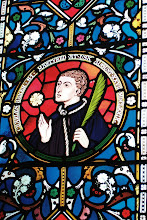
(The photo of St John Kemble is from a stained glass window at Harvington Hall and St David Lewis is from a stained glass window in the Catholic Church, Tenby.)

Monday, 28 December 2009

330TH ANNIVERSARY (PART 1)


2009 marks the 330th Anniversary of the martyrdom of four priests who were executed for “High Treason”. Philip Evans, John Lloyd, John Kemble and David Lewis were Catholic priests and to be a Catholic priest was considered treason. At the trial of Fr David Lewis, the judge, Sir Robert Atkins, made that abundantly clear when he said;

“It is enough that you have exercised the functions of a priest in copes and vestments used in your Church, and that you shall have read Mass
and taken Confessions.
He that uses to read Mass commits treason.”

Now, in the dying days of 2009, it is fitting to remember these four holy martyrs, two Jesuit priests and two secular priests.

FR PHILIP EVANS S J
Philip Evans, the son of William Evans and Winifred Morgan, was born at Monmouth in 1645. He was educated at St Omer and entered the Jesuit Novitiate at Watten on 7th
September 1665. Having completed his training, he was ordained at Liege in 1675 and sent upon the English Mission. Back in Wales, he worked diligently for four years, saying Mass, administering the Sacraments and preaching in Welsh and English. It is recorded that he ministered to large congregations at the home of Thomas Gunter in Abergavenny, at the home of Charles Prodger at Wernddu, and at Sker House, the home of Christopher Turberville.

During the wave of persecution generated by the Popish Plot, friends advised Fr Evans to go into hiding. However, he refused and bravely continued his work. On 4th December 1678, the priest was arrested at Sker House, betrayed by the owner’s younger brother, Edward Turberville, a lapsed Catholic. He was imprisoned in Cardiff Castle Gaol and kept in solitary confinement in the dungeon. After about three weeks, the governor was persuaded to allow Fr Evans and Fr John Lloyd, who had been arrested in late November, to share a cell.

The following May, Fr Evans was tried at Cardiff Assizes, found guilty of the treason of priesthood, and sentenced to death. The execution was delayed for some time and Fr Evans and Fr Lloyd were even allowed out of prison for recreation! Eventually, on 21st July, orders arrived that the execution was to take place the following day. At that time, the priest was playing tennis on the court near St John’s Church. (Lest we become self-righteous, this was near the spot where, a century earlier, Rawlins White, a Protestant, was burnt at the stake for his beliefs under Catholic Queen Mary.) When the gaoler went to the tennis court to tell the priest the news and to return him to prison, Fr Evans remarked,
“What haste is there? Let me first play out my game.”

Philip was a skilled harpist and when the officials came the next morning to lead him to his execution, they found him joyfully playing the harp. On 22nd July 1679, the Jesuit priest, Fr Philip Evans, was hanged, drawn and quartered at Gallows Field, Cardiff. He was 34 years old. His friend and cellmate, Fr John Lloyd, looked on, knowing he would be next.

FR JOHN LLOYD
John Lloyd, the son of Walter Lloyd, was born in Brecon around 1630. In 1649, John Lloyd entered the English College at Valladolid and was ordained there on 7th Jun
e 1653. In April 1654, he left for his homeland where he spent the next 24 years labouring among the Catholics of Glamorgan and Monmouthshire.

On 20th November 1678, Fr John Lloyd was arrested at the home of John Turberville at Penllyn. Fr Lloyd was taken to Cardiff castle Gaol where he was imprisoned, probably in the Black Tower. For a time, he was kept in solitary confinement until the Jesuit, Fr Philip Evans, who had been arrested in early December, joined him.

On 9th May 1679, the Assizes opened in the Shire Hall, within the grounds of the Castle. Fr Lloyd was indicted as a Catholic priest and therefore a traitor. He was found guilty and sentenced to be hanged, drawn and quartered. On 22nd July 1679, the gruesome sentence was carried out. Fr Lloyd had to watch as the younger priest, Fr Philip Evans was executed. Then he too was subjected to the same brutal martyrdom. Fr John Lloyd was 49 years old.

Fr John Lloyd was not the only member of his family to suffer because of the Popish Plot. His brother, Fr William Lloyd, who had been head of the secular clergy in South Wales, was arrested at the height of the Plot and imprisoned in Brecon Gaol. Sentenced to be hanged, drawn and quartered, he died in prison just days before his scheduled execution.
(TO BE CONTINUED)
(The pictures of St Philip Evans and St John Lloyd are taken from a stained glass window in the Catholic Church in Tenby, South Wales.)

Saturday, 19 December 2009

CHRISTMAS 1678


St David Lewis was a Welsh Jesuit priest who was born in Abergavenny in 1616 to a Catholic mother and a Protestant father. David, the youngest of nine children, was brought up as a Protestant although his eight siblings were brought up as Catholics. That could well have been for political and economic reasons. David’s father, Morgan Lewis, was headmaster of King Henry VIII Grammar School in Abergavenny and his Protestantism may have been genuine or it may have been for convenience. In his position, he would have been expected to conform to the new Religion. His son, David, attended the Grammar School and bringing him up as a Protestant would have added validity to Morgan’s claim to Protestantism. Whatever the reasoning behind it, David was indeed brought up as a Protestant. However, at about the age of nineteen, while on a visit to Paris, he converted to Catholicism. In 1638, David Lewis entered the English College in Rome and began studies for the Catholic priesthood. In July 1642, David was ordained and three years later he entered the Jesuit Novitiate at Sant’ Andrea, which had been founded by St Francis Borgia in 1565. Father David Lewis S J, was sent to Wales in 1647 but was soon recalled to Rome. In 1648, Fr Lewis returned to Wales and here he spent the remainder of his life working for the persecuted Catholics in Monmouthshire and the surrounding area.

Christmas of 1678 wasn’t exactly a joyful one for Fr David Lewis. Details of that Christmas are scant but we do know for certain that it was Fr Lewis’s last Christmas on earth. As he prepared to celebrate Mass on Sunday morning, 17th November, Fr Lewis was arrested at Llantarnam. He was incarcerated in Monmouth Gaol. The Justice of the Peace, John Arnold, who had feigned friendship with the priest, promised him that he would not allow him to be treated with “any incivility or severity”. The promise proved to be as false as the friendship! That very same day, the perfidious Arnold had ordered that a strict watch should be kept over the prisoner, who was guilty of “high treason”, i.e., he was a Catholic priest!

Christmas found Fr Lewis in Monmouth Gaol, where a friend of the Jesuit had paid 14/ a week to provide him with a good lower room, a bed, linen, fire and a candle. Officially, Fr Lewis was in Solitary Confinement but the Underkeeper of the Gaol allowed friends to visit him in his cell by day.

Early in December, the Lords ordered an investigation of the Jesuit College of St Francis Xavier at the Cwm, where Fr Lewis had been Superior. Just before Christmas, the Bishop of Hereford, Herbert Croft, led a raid on the Cwm. He had the enthusiastic help of John Arnold, John Scudamore and Charles Price. The buildings were ransacked and all books, papers and property confiscated. Some of the books stolen from the Cwm are today in the library of Hereford Cathedral. Croft reported that he had found
“two horse- loads of books in an adjoining Pig Cot covered with straw, also a great store of divinity books (but they are not yet brought to me, it being Christmas holy days, but they remain in a safe hand) many whereof are written by the principal learned Jesuits,”

In the first week of December, Fr Philip Evans, the youngest of the Jesuit missioners in South Wales, was arrested. He was imprisoned in Cardiff Castle where he was kept in Solitary Confinement for three weeks. After this time, the Governor was persuaded to allow Fr Evans and a secular priest, Fr John Lloyd, who had been arrested in November, to share a cell. Other priests had been arrested and some had died of hardship and exposure. All these things Fr David Lewis would have learned from the friends who visited him in Monmouth Gaol.

On the Sunday morning of Christmas week, Fr Lewis was visited in his cell by several magistrates who questioned him about William Bedloe’s allegation that he had supplied information about the Marquis of Worcester’s Agent’s complicity in the Popish Plot. Father Lewis deposed that he had neither spoken to nor corresponded with the informer. He further deposed that he had never even heard of the Plot until it became common knowledge throughout the land. His deposition was sent to London, but no more was heard of it.

So passed what was to be the last Christmas of Fr David Lewis. Early in 1679, the new High Sheriff, James Herbert, decided to move the County Gaol from Monmouth to Usk. On 13th January, a bitterly cold and miserable day, Fr Lewis was transferred to Usk Gaol to await his fate. Later that year, in the lovely month of August, Fr David Lewis was martyred at Usk. He was canonised in 1970 by Pope Paul VI.

Monday, 30 November 2009

IMPRISONED AT USK


On Monday, 18th November 1678, Fr David Lewis, a Jesuit priest, was incarcerated in Monmouth Gaol. His false friend, John Arnold, a Justice of the Peace, had promised that he would not allow him to be treated with “any incivility or severity”, but had secretly ordered that a strict watch be kept on the prisoner. Fr Lewis was kept a close prisoner and not allowed to leave his cell. However, the underkeeper allowed friends to visit the priest during the day. Through these visits, the prisoner learned of the fate of his friends and fellow priests and also, of events at the Jesuit College of St Francis Xavier, at a place called the Cwm. Fr Lewis had been Superior of the College and he must have been greatly distressed to hear of its devastation.

For Fr Lewis, Christmas 1678 would have been a bleak one indeed. Sunday morning in Christmas week, two magistrates visited him in his cell. They told him of Charles Price, a servant of the Marquis of Worcester of Raglan Castle. Price was accused by William Bedloe of conspiring to kill the King. The Magistrates questioned Fr Lewis as to what he knew about the affair. Under oath, Fr Lewis replied; “Upon oath, and under my hand I gave it, that to my knowledge I never saw Bedloe, I never spoke to him, I never had any correspondence with him directly or indirectly, I further deposed that I never heard, I know nothing of the Plot, till common fame had spread it over the country,” The deposition was sent to London but Fr Lewis heard no more about the matter.

In the New Year, the new High Sheriff, James Herbert, decided to move the County Gaol from Monmouth to Usk. So it was that, on 13th January 1679, the Deputy Sheriff and the Head Gaoler rode with Fr David Lewis to Usk. It was a bitterly cold day and snowing heavily. The group stopped at an inn in Raglan to warm themselves and, while there, a messenger arrived with sad news for Fr Lewis. A friend and colleague from the Cwm, Fr Ignatius Price, lay dying in a barn about half a mile away and wished to see Fr Lewis. Being in the custody of the Deputy Sheriff and the Head Gaoler, Fr Lewis was unable to comply with this poignant request. Three days later, Fr Lewis learned of the death of his friend.


Usk Gaol was situated on the north side of Bridge Street, where 28 Bridge Street is today. This Old Bridewell, or House of Correction, had originally been a Friary, a house of the Grey Friars. In January 1679, The Gaol was crowded with Catholics who had refused the Oaths of Allegiance and Supremacy. One was a widow, Jane Harris, who had given refuge to a priest but was betrayed by her butcher. Father Lewis would have known most, if not all, of these people. He had spent his priestly life toiling among the persecuted Catholics of the area, travelling on foot to bring them what help and comfort he could.

On 28th March 1679, Fr David Lewis was taken back to Monmouth to be tried at the Assizes. The charge against him was “David Lewis pro Sacred Roman” i.e. “David Lewis for being a Roman Priest”. He was indicted under Statute 27 Elizabeth which made it High Treason for a Catholic to be ordained abroad and return to England for more than forty days. The Clerk of Assizes read the charge against Fr Lewis. “Here thou standest indicted of High Treason by the name of David Lewis, for thou being a natural subject of the King of England, hast passed beyond the seas and taken Orders from the Church and See of Rome.” The jury, made up of Arnold’s toadies, returned the expected verdict, "Guilty", and Fr Lewis was sentenced to be hanged, drawn and quartered.


Father David Lewis S J, was returned to Usk Gaol. The sentence would not be carried out, just yet.


THE HISTORIC MONNOW BRIDGE AT MONMOUTH

Tuesday, 24 November 2009

SUNDAY, 17th NOVEMBER 1678


In November of 1678, Fr David Lewis S J was living in a cottage adjoining the Blacksmith’s at Llantarnam. He had been living at Llantarnam Abbey with his Aunt, Lady Frances Morgan, but, with the turmoil fomented by the Oates’ Plot, he had moved out in an attempt to protect his relatives.

Fr Lewis continued to minister to the Catholics of the area. On Sunday, 17th November, early in the morning, he was preparing to celebrate Holy Mass when a party of six armed dragoons arrested him. William James, a lapsed Catholic and former servant of Fr Lewis, joined Roger Seys and William Bedloe in leading the dragoons to apprehend the Jesuit. For this despicable act of betrayal, James was paid the sum of £220 – the Government reward of £20 for the apprehension of a priest and the additional £200 offered by the arch priest hunter, John Arnold. The priest was to be taken to Monmouth Gaol but first the group stopped at the house of Charles Price at Llanfoist. Here, three Justices of the Peace, Charles Price, John Arnold and Thomas Lewis, awaited them.

At about 2 o’clock that afternoon, Fr David Lewis, mounted on horseback, was led away from Llanfoist by Arnold and his henchmen. Guarded by twelve armed men, the priest was then taken to his hometown, Abergavenny. It being Sunday, the streets of Abergavenny were swarming with people. The contingent entered the Golden Lion on Frogmore Street where, in a guarded upper room, Fr Lewis was examined by the Recorder of Abergavenny, William Jones. The avaricious and vengeful William James swore that he had seen Fr Lewis say Mass at least twenty times. Fr Lewis was asked if he had played any part in the Titus Oates Plot and the priest swore on oath that he had no knowledge of or part in any plot. Arnold, showing his contempt for all things Catholic, sarcastically remarked that with Catholics, it was no oath to swear on the Bible. Arnold and Price had previously appeared to be friends of Fr Lewis and, curiously, now treated him with a certain degree of courtesy, although Arnold was not above making course remarks to the priest, at one point calling him the “pretended bishop of Llandaff”. The four now adjourned to the dining room, a large room where they had supper together. Fr Lewis, committed on a charge of Treason, was given the choice of spending the night at the Golden Lion, in a guarded room, or of being the guest of John Arnold at his home in Llanvihangel. Arnold assured the priest that he would be “most civilly entertained”. David Lewis left the decision to the others and it was decided that he should spend the night at Llanvihangel Court.

Fr David Lewis and his captors left the Golden Lion at about 10 o’clock that night. It was a moonlit night and a large crowd had gathered to catch a glimpse of the Jesuit prisoner as the party rode off into the night. Many in the crowd would have known Fr Lewis for he had grown up in the town and, as a priest, had ministered to the Catholics there. It would have been between 11 o’clock and midnight when the men reached Llanvihangel Court. Llanvihangel Court was a fine Elizabethan mansion that had been home to several generations of Arnolds. The defenceless priest spent the night here in a room guarded by two “strong men”.
(This recent photograph of Llanvihangel Court shows the main door of the house. This is not the original entrance. To the left of the window and at about the same height as the top of the window, one can clearly see in the brickwork where the original doorway was. On the night of his arrest, St David Lewis would have been brought in through this original doorway.)
Related Posts with Thumbnails