Showing posts with label King Henry VIII Grammar School. Show all posts

Tuesday, 12 November 2019

BLESSED PHILIP POWELL

Brecon has a proud history of loyalty to the 'Old Faith'.  Families such as  Powell and Lloyd have contributed much to the preservation of the Faith in that area and, as priests, shed their blood as Martyrs. One such priest was Philip Powell.
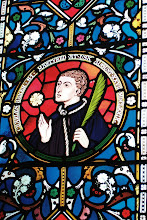
Blessed Philip Powell, O S B
Philip Powell was born at Trallong, Brecknockshire, to Roger ap Rosser Powell and Catherine Morgan on 2nd February 1594. Young Philip attended King Henry VIII Grammar School, Abergavenny.  The father of St David Lewis, Morgan Lewis, was headmaster and, being favourably impressed with Philip, recommended him to Dom Augustine Baker. Benedictine writer and mystic, Dom Augustine, was the uncle of Morgan's wife, Margaret, and therefore, a great uncle of St David Lewis.
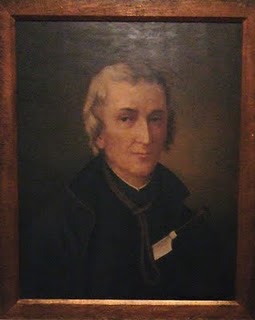
Dom Augustine Baker, O S B
(Photo by J D Smith)

Dom Augustine, who was already supporting a seminarian, his nephew  John Pritchard, took on responsibility for young Philip Powell.  He supervised his law studies at Gray's Inn from 1610-14. Then, from 1614-19, and at Dom Augustine's expense, Philip was sent to Flanders to the University of Louvain, studying under Leander Jones, O S B.  He was ordained priest in 1618 and professed a monk on 15th August 1619.

On 7th March 1622, Fr Powell was sent on the English Mission.  For sixteen months he lived with Dom Augustine in Gray's Inn Lane, London.  In an attempt to elude the priest hunters, it was customary for priests working covertly on the English Mission to assume an alias.  Thus, Fr Philip Powell was also known as Philip Morgan or Philip Prosser.  For about twenty years Fr Powell worked in the areas of Cornwall, Devon and Somerset.  When Civil War erupted, the priest went to Cornwall and served as Chaplain to the Catholic soldiers in General Goring's army.  

After Goring's force disbanded, Fr Powell took ship for South Wales in an attempt to reach Monmouthshire.  Unfortunately, the ship was captured off Mumbles and on 22nd February 1646 Philip Powell was arrested by Captain Crowther.  Crowther kept him confined in the ship until 11 may when he sent him to London to be imprisoned in St Catherine's Gaol, Southwark.

Due to the terrible conditions and harsh treatment, Fr Powell became severely ill with Pleurisy.  His trial had been fixed for 30th May but it did not take place until 9th June.  He was tried in Westminster Hall, where he brilliantly defended himself.  Predictably, he was found guilty of being a priest and condemned to death. When the sentence of death was pronounced, Fr Powell exclaimed, "Oh what am I that God thus honours me and will have me to die for his sake?"  

On 30th June 1646, the sentence was carried out and Fr Philip Powell was hanged, drawn and quartered at Tyburn. He was 52 years old. He met his death with unshaken faith in the God he had so long served and therefore, with joy.  He is recorded as saying, "This is the happiest day and the greatest joy that ever befell me, for I am brought hither for no other cause or reason than that I am a Roman Catholic priest and a monk of the Order of St Benedict."  His remains were buried in the old churchyard at Moorfields, London.  A crucifix of his and some other relics are in the possession of Downside Abbey, Bath.

On 8th December 1929, Fr Philip Powell was Venerated when Pope Pius XI issued a decree of Martyrdom.  A week later, 15th December 1929, another steadfast son of Wales, Fr Philip Powell, was Beatified by Pope Pius XI.  
Blessed Philip Powell, pray for us.

Sunday, 13 April 2014

A CATHOLIC CHURCH, A BOYS GRAMMAR SCHOOL AND A MASONIC LODGE


The Masonic Hall in St John’s Street, Abergavenny, occupies the site of an ancient Roman Catholic Church.  The Church, St John’s, began life as Abergavenny’s Parish Church.    A curfew bell in the tower was rung each evening to warn residents that the town gates were closing for the night.   Although the original building was taken down and rebuilt, the tower, which dates from the 14th century, still remains.   


The 14th century Tower

 
By the Dissolution of the Monasteries (1536-1541) more people were attending the Priory Church of St Mary so the Priory became the Parish Church.  At the request of the people King Henry VIII gave the tithes from the priory to establish the King Henry VIII Grammar School in the redundant St John’s Church.


King Henry VIII Grammar School opened in 1542. When the school opened it had 26 pupils, all boys, between the ages of 7 and 14.  The school’s first Headmaster, one Richard/Nicholas Oldsworthy, was appointed by the King himself.  Oldsworthy was said to be “learned and instructed” and had an M A degree.  A description of the necessary qualifications for a 16th century Headmaster might cause us to smile or perhaps even gasp!   It was pointless to apply unless you were “A graduate of one of the universities, not under seven and twenty years of age, skilful in the Greek and Latin tongues, a good poet, of a sound disposition, NEITHER A PAPIST NOR PURITAN, of good behaviour, of a sober and strict conversation, no tippler or haunter of alehouses, no puffer of tobacco and, above all, be apt to teach and severe in his government”.  Would any of you like to apply?
The main purpose of the school, as outlined in the Letters Patent, was the teaching of Latin Grammar.  The teaching was to be the responsibility of a master sufficiently versed in Latin.  He was to receive an annual salary of £13 6s 8d.  An usher or assistant master was also appointed and received an annual salary of £6 13s 4d. 
Grammar Schools in the 16th century accepted boys from the age of seven and they usually attended for six or seven years.  In summer the school day began at 6:00 am and continued until 11:00am.   The afternoon session was from 1:00pm, ending at 6:00pm.  Due to winter darkness, things were a little easier in winter.  Classes didn’t begin until 7:00am with the usual break at 11:00am.  Back again at 1:00pm, classes broke up early – at 5:00pm!    Just as today, the boys looked forward to their school holidays.  Twice a year they enjoyed a break of about fifteen days!
The boys had to supply their own candle and slate and they spent their days in the study of Latin grammar, logic, rhetoric, arithmetic, music, poetry and astronomy.  If a boy misbehaved, he was put into a basket and hoisted up to the rafters.  Here he remained for the rest of the day. 


A Naughty Boy in a Basket!

King Henry VIII Grammar School, Abergavenny, can claim many prominent Old Boys.  The school numbers among its former pupils Dr David Lewis, first Principal of Jesus College, Oxford, Dom Augustine Baker, Benedictine writer and mystic, and St David Lewis, the Jesuit Martyr. 


St David Lewis was born in Abergavenny in 1616 to Morgan Lewis and Margaret Pritchard.  Margaret Pritchard was a devout Catholic but her husband conformed to the new Established Religion.  Eight of their nine children were brought up as Catholics.  Morgan Lewis ensured that their youngest, David, was brought up in the Protestant Religion.
Morgan Lewis was Headmaster of King Henry VIII Grammar School and his youngest son attended his school.  Since Morgan’s wife was a Catholic and there were a number of recusant children attending the school, Morgan and the school came under suspicion of being a centre of recusancy in Monmouthshire.   William Herbert of Coldbrook was not a particularly influential member of Monmouthshire society so it is quite likely that his ties to William Herbert, 3rd Earl of Pembroke, account for his election for Monmouthshire in 1626.  Mr Herbert, known to be a ‘godly Protestant’, was nominated to committees for bills to direct the true conformity of popish recusants.  He was the Member of Parliament who alerted the Committee of Religion to the suspicions of popery surrounding Morgan Lewis.  Subsequently, questions arose in the Parliament of 1626.  However, Morgan was reported to be “very conformable” and he and his career were able to survive the questioning.
This building housed the King Henry VIII Grammar School until 1898 when a new school was built at Pen-y-Pound.   The former Catholic Church, turned Grammar School, became a Masonic Lodge.
Holy Trinity Church in Baker St, Abergavenny, is a pretty and welcoming church erected and endowed by Miss Rachael Herbert in 1840.   Miss Herbert was the daughter of Charles Herbert who made a fortune as a dealer in iron in Abergavenny and was a descendant of William Herbert.  Although a relatively ‘new’ church, Holy Trinity has some very interesting historic links.
 
The stone slab of Holy Trinity’s present altar was originally that of the ancient parish church of St John.  It was discovered by Iltyd Gardner and Fred Gardner walled up in a chimney breast of the old Cow Inn in Neville Street.  


The Former Cow Inn


The Plaque on the former Cow Inn, Neville Street

The Gardners presented this valuable piece of Abergavenny History to Holy Trinity Church.  The consecration marks, roughly cut, are still visible in the stone. 


The original Altar Stone from the ancient Church of St John,
in Holy Trinity Church, Abergavenny

In the sanctuary of Holy Trinity one can see an early English piscina. This piscina was found in the wall of the north transept of the old St John’s Church and presented to the church by the Worshipful Master and Brethren of the St John’s Lodge of Freemasons.
 
The Piscina from St John's Church, in Holy Trinity Church, Abergavenny
Catholic Church; Boys' Grammar School; Masonic Lodge.  If only this building could talk!

Friday, 25 February 2011

MORGAN LEWIS AND KING HENRY VIII GRAMMAR SCHOOL

Morgan Lewis was the father of St David Lewis. Although he was of an old Catholic family, Morgan was a Protestant. He was a kinsman of the Morgans of Skenfrith in Monmouthshire. St John Kemble’s mother, a Catholic, was one of the Skenfrith Morgans, as was her relative, Fr William Morgan S J. Fr Morgan, who died in 1667, succeeded Fr John Salisbury (John Parry) as Superior of the Jesuit Mission in Wales.

Morgan Lewis and his wife, Margaret Pritchard, had nine children. Margaret was a devout Catholic and she brought eight of their children up as Catholics. However, Morgan had his youngest son, David, brought up in the Protestant religion. Morgan’s adherence to the Established religion may have been quite genuine and it is not for us to judge a man’s conscience. On the other hand, it could have been for practical purposes.

Morgan was the headmaster of the Royal Grammar School (King Henry VIII School) in Abergavenny. During his father’s headship, David was educated there. It certainly would have been advantageous, if not downright necessary, for Morgan and young David to follow the Protestant religion.

King Henry VIII Grammar School was one of many founded from property seized from monasteries and religious houses during the Reformation. Before King Henry’s break with Rome, the Royal Grammar School had been the Parish Church, St John’s. With the King’s sweeping changes, the Priory Church became the Parish Church and in 1542 the old St John’s Catholic Church became the town’s Grammar School.

Dr David Lewis, whose tomb is in the Priory Church, was a great great uncle of St David Lewis. Dr David Lewis, a former pupil of King Henry VIII Grammar School, went on to become an advisor to Queen Elizabeth I, a Judge of the High Court of Admiralty, an M P, and the first Principal of Jesus College, Oxford.

The esteemed Benedictine writer, Dom Augustine Baker, was the nephew and Godson of Dr David Lewis and the great uncle of St David Lewis. Augustine (David) Baker recommended many Catholic children to King Henry VIII Grammar School under the headship of his niece’s husband, Morgan Lewis.

In 1898, a new school was built in Penypound. The Grammar School that had been a Catholic Church then became a Freemasons’ Lodge!

The altar stone of St John’s Church was discovered by Fred and Iltyd Gardner walled up in a chimney breast of the “Cow Inn” in Neville Street, Abergavenny. They presented it to Holy Trinity Church in Baker Street where it was incorporated into the altar. An ancient piscina was found in the wall of the north transept of the old St John’s Church. The piscina was presented to Holy Trinity Church by the Worshipful Master and Brethren of the St John’s Lodge of Freemasons.

Catholic Church, Royal Grammar School, Freemasons’ Lodge, this storied old building still stands. I can’t help but wonder what Morgan Lewis, who converted to Catholicism before his death in 1638, would make of it all?
Related Posts with Thumbnails