Showing posts with label Llantarnam Abbey. Show all posts

Friday, 29 March 2019

SR CELSUS, LOYAL FRIEND OF ST DAVID LEWIS

I wish to dedicate this post to a loyal and devoted friend of St David Lewis, Sr M Celsus Taylor who has been called home to God. The following announcement is taken from the South Wales Argus: 

"SISTER M CELSUS TAYLOR
Sisters of St Joseph Sister M. Celsus Taylor Peacefully on 23rd March 2019 at St Joseph's Convent, Llantarnam Abbey, aged 96 years. Funeral Mass on Thursday, 4th April in Llantarnam Abbey Chapel at 10am followed by interment at the Abbey Cemetery. Family flowers only. Online messages of condolence may be left at www.ptsfunerals.co.uk. Further enquiries to Phillip Tom and Sons, Pontymister. Tel: 615005"

Llantarnam Abbey
Mary Taylor was born in County Kerry, Ireland, on 13th August 1922.  As a young girl she travelled to Wales to join the Sisters of St Joseph at Llantarnam Abbey. She was given the name of Sister Mary Celsus.  Sr Celsus trained as a teacher and taught in various places throughout the UK, including Our Lady of the Angels School in Cwmbran.

After retirement, Sr Celsus again found herself back at Llantarnam Abbey.  During this time Sr Mary of Lourdes was Parish Sister at Our Lady of the Angels Parish in Old Cwmbran.  Sr Mary was an excellent and well respected Parish Sister but she was getting on in years and Sr Celsus became her assistant.  Eventually, Sr Celsus took over from Sr Mary and she was welcomed as the Parish Sister.  What a Parish Sister she was!

Sr Celsus immersed herself into Parish life and, working closely with then Parish Priest, Canon F O'Donnell, she worked tirelessly for the people.  Nothing was too much trouble for her and her kindness and compassion quickly endeared her to all at Our Lady's.

Sr Celsus had a strong devotion to local Martyr, St David Lewis.  Fr David Lewis had often stayed at Llantarnam Abbey with his relatives, the Morgans. He had been staying there when the poison of the fabricated Oates Plot swept the country.  In the hope of saving his relatives trouble, Fr Lewis moved into a rented cottage next to the Blacksmith's Shop on the other side of the Road to the Abbey (opposite the Church of St Michael and All Angels).  It was here that Fr Lewis was arrested on Sunday, 17th November 1678.  After almost a year of imprisonment, on 29th  August 1679, the good priest was executed at Usk for being a Catholic priest and saying Mass.
The Plaque which was placed through the initiative of Sr Celsus

Fr David Lewis was canonised in 1970 as one of the Forty Martyrs of England and Wales.  Sr Celsus  felt that he should have more recognition in the area and so she decided to do  something about it.

The group, 'Friends of Saint David Lewis', was begun by Sr Celsus.  The group held its first meeting on Wednesday, 13th February 2008.  Sr Celsus did much to spread devotion to St David Lewis and to make him better known and appreciated. Through her initiative,  the Cwmbran Historical Society placed a commemorative plaque at the site of the Saint's arrest.  Sr Celsus was also responsible for organising days dedicated to St David Lewis.  These events were held at  Llantarnam Abbey with Mass by a visiting priest and guest speakers with knowledge of the Saint's life and times.
Sr Celsus and Fr John Meredith at the Blessing of the Plaque
Sr Celsus Taylor was a beautiful and faithful lady who did so much good for others and she will be sorely missed.  I like to think that St David Lewis was one of those waiting to welcome her home on 23rd March.  May her generous soul rest in the peace of Christ. 


Tuesday, 18 December 2012

FR JOHN EDWARDS S J, REST IN PEACE


Many people are sad today at the news of the death of Fr John Edwards S J.   

Fr John, who had been ill for several months, passed away shortly after hearing Mass on 12th December, the Feast of Our Lady of Guadalupe. 

The privilege of knowing Fr John was ours through the many retreats he conducted at Llantarnam Abbey.  The Annual Day in memory of the Holy Souls on 2nd November was always a touching and moving experience. 

It was also our great good fortune to have Fr John with us at the Abbey on the days held in honour of St David Lewis, the Welsh Jesuit who was martyred in 1679.  Fr John’s saintly presence was an inspiration to all in attendance on those occasions.  Fr John Edwards, who counted his lung cancer a gift from God, will surely be remembered with affection and gratitude whenever we gather at Llantarnam Abbey.  

Fr John Edwards S J, conducting a service at
the site of the arrest of St David Lewis
at Llantarnam, Cwmbran
 

Fr John’s Requiem Mass will take place at Farm St Church, London, at 11 am on Thursday, 20th December.   Fr John, we were honoured to know you.  May your gentle soul rest in peace.

Wednesday, 17 November 2010

THE HORROR BEGINS!


In 1678, the Popish Plot, also known as the Oates Plot, was spawned in the perverted mind of Titus Oates, who was encouraged and spurred on by his friend, Israel Tonge. It wasn’t long before the country was engulfed in the tide of anti-Catholic passion which it engendered.

The Superior of the Jesuit College of St Francis Xavier at the Cwm, Fr David Lewis (alias Charles Baker), had been living with relatives, the Morgans, at what is now Llantarnam Abbey. From here Fr Lewis ministered to the needs of the people, celebrating Mass in the Morgan’s chapel and administering the sacraments. Realising the danger of the Plot and fearing to put the family in jeopardy, the priest moved out of their home and into a cottage nearby. The cottage was adjoining the blacksmith’s forge opposite the Parish Church of Llanfihangel Llantarnam.

The Government offered a reward of £50 for the apprehension of any priest and to this John Arnold of Llanvihangel Crucorney added his own reward of £200. Arnold, a Justice of the Peace and Member of Parliament, was a fanatical priest hunter but he had always feigned friendship for Fr Lewis. Three hundred and thirty-two years ago today, 17th November 1678, Arnold’s true nature was revealed and Fr David Lewis S J took his first steps on the road to martyrdom.

It was a Sunday morning, about daybreak, and the Jesuit was preparing to celebrate Holy Mass. Six armed dragoons, sent by John Arnold, burst into the little cottage and arrested Fr Lewis. They confiscated all the altar furnishings and anything which they considered ‘popish’. With the prisoner, they set out for Monmouth, stopping first at the house of Charles Price at Llanfoist, where Price, John Arnold and Thomas Lewis, another J P, awaited their arrival.

Of his arrest Fr Lewis wrote: “After my full thirty years poor missionary labours in South Wales, on Sunday morning, a little before day, being the 17th November 1678, I was taken by six armed men sent by Mr John Arnold and Mr Charles Price, until then my two very good friends and acquaintances. I was taken in a little house in the parish of St Michael-Llantarnam in the County of Monmouth. From thence by the soldiers, together with such church stuff of mine they there found, carried I was to the house of Mr Charles Price in Llanfoist”


At about two o’clock in the afternoon Arnold and his clique led the priest away. Guarded by twelve armed men, Fr David Lewis was taken to Abergavenny and then on to Arnold’s house, Llanvihangel Court. Here they spent the night. Early the next morning Fr Lewis was taken, again under armed guard, to Monmouth Gaol where he was incarcerated.

The horror was just beginning!

Monday, 25 October 2010

FORTIETH ANNIVERSARY OF CANONISATION


On 25th October 1970, 10,000 English and Welsh pilgrims converged on Rome. They had come for the canonisation of the Forty Martyrs of England and Wales. During the dark days of the 16th and 17th centuries, almost 400 Catholic men and women gave their lives for their faith. On that wonderful day forty years ago, Pope Paul VI canonised forty of those courageous and faithful Catholics. The Last Welsh Martyr, Fr David Lewis S J, was among the forty.

For that joyful occasion, Sister Canisius, a Sister of St Joseph of Annecy at Llantarnam Abbey, composed a hymn in honour of St David Lewis. St David Lewis had lived for awhile at Llantarnam Abbey and from this base he ministered to the persecuted Catholics in the area. Llantarnam Abbey is near the site of the arrest of St David Lewis.
Here are the words of the hymn, sung to the tune of Hyfrydol. (You can even sing along with the video!)


HYMN IN HONOUR OF SAINT DAVID LEWIS

Holy Martyr, David Lewis,
Monmouth County's glorious Saint.
Father of the Poor they named you,
When you lived and toiled in Gwent.
Priestly work was undertaken,
Danger-fraught from dawn till dusk.
Gladly still you served your people,
Till you died for them at Usk.

From your capture at Llantarnam,
Through your time in Monmouth Gaol,
Threats and tortures could not shake you,
For your faith would never fail.
Bravely then you faced the gallows,
Crudely fashioned for your death,
Further torment someone spared you,
Till you drew your latest breath.

Great and glorious David Lewis,
Staunch and steadfast in the strife,
Bless your people here in Monmouth,
Those for whom you gave your life.
Help us to be strong, courageous,
Loyal to our loving God,
To Him then will glory flourish,
In the places you have trod.


To mark the fortieth Anniversary of the canonisation of St David Lewis and the Forty Martyrs of England and Wales, a very special ceremony took place yesterday 24th October 2010, at Usk, near the spot where Fr Lewis was martyred in 1679. After 10:00 a m Mass at the Church of St Francis Xavier and St David Lewis, Sr Celsus SSJ of Llantarnam Abbey unveiled a plaque which was then blessed by Fr Richard Reardon, the Parish Priest. The plaque, which was erected by the group Friends of St David Lewis, is at the side of the church on Porth-y-Carne Street and it marks the original stone which lay on the grave of the martyr. After the canonisation of Fr David Lewis, this old and broken stone was removed and a new one placed on his grave in the churchyard of St Mary’s Priory Church. The old stone was reassembled by the side of the Catholic Church where it remains to this day.

Thursday, 21 October 2010

CELEBRATING THE BIRTH OF FR JEAN PIERRE MEDAILLE


This year, the month of October is special for Sisters of St Joseph around the world. They are celebrating the 400th anniversary of the birth of their founder, Jean Pierre Médaille. Jean Pierre Médaille was born in Carcassonne in the south-west of France. According to the parish registers, Jean Pierre was born on 6th October 1610, to Phelippe and Jean Médaille. Jean Pierre was the eldest of three brothers. Jean Pierre was not quite sixteen when, on 15th September 1626, he entered the Jesuit Novitiate at Toulouse. While studying humanities and philosophy here in 1629, Jean Pierre became acquainted with a fellow student, Fr Francis Regis, who had been sent to the College in 1628. Fr Regis is better known to us today as the great Jesuit saint, Saint John Francis Regis. In 1637, at the age of 27, Jean Pierre was ordained priest. He was assigned to the Jesuit College in Aurillac as assistant to the rector.

In 1642, Fr Médaille returned to Toulouse for his final formal period of formation. A colleague at that time was Fr Noël Chabanel. At the end of this year of formation, Fr Chabanel was sent on mission to Canada where he was martyred in 1649. The youngest of the Canadian Martyrs, Fr Noël Chabanel was canonised in 1930.

About 1646 Fr Médaille formed an association of six women which was called the ‘Little Design’. This group of women, filled with love of God and neighbour, was dedicated to working for the disadvantaged and neglected. The group officially became known as the Congregation of the Sisters of St Joseph in 1650. On 15th October of that year the Bishop of LePuy gave them canonical status.

The French Revolution dealt a blow to the rapidly growing congregation. The sisters were dispersed, some were imprisoned and some even executed. However, in 1808 Mother St John Fontbonne, who had narrowly escaped execution, began the re-formation of the Sisters of St Joseph. The sisters became know by the Diocese in which they reformed and in 1833 the groups in Annecy Diocese joined with the Sisters from Pignerol, Italy. They became known as the Sisters of St Joseph of Annecy. The Sisters of St Joseph of Annecy came to Wiltshire, England in 1864. From there they spread throughout the country.

In 1946 the Sisters of St Joseph of Annecy moved to Llantarnam Abbey, Cwmbran. Llantarnam Abbey was the site of a Cistercian Abbey which was suppressed during the dissolution of the monasteries by King Henry VIII and his lackey, Thomas Cromwell. It eventually came into the ownership of the wealthy Morgan Family. Generations of the Morgans were Catholic and, despite the severe Penal Laws against Catholics, they maintained a chapel in their home where Catholics of the area could attend Mass. The Morgans were instrumental in establishing the Jesuit College of St Francis Xavier at the Cwm, Hereford. One of the Superiors of the College was Fr David Lewis.

Fr Lewis was born in Abergavenny in 1616. A Protestant, he converted to Catholicism and, in 1642, he was ordained priest. Following his uncle, John Pritchard, he joined the Jesuits in Rome and was sent on the English Mission in 1647. Except for a brief period in Rome, Fr David Lewis spent the remainder of his life ministering to the persecuted Catholics of Monmouthshire and surrounding area.

Lady Frances Morgan was an aunt of Fr David Lewis. For a time Fr Lewis lived at Llantarnam with his relatives and regularly celebrated Mass in the chapel there. From this base he administered the Sacraments and tended to the needs of the Catholics. During the alarm caused by the false Oates Plot, Fr Lewis wished to protect his relatives from danger so he moved to a cottage opposite.

One Sunday morning, 17th November 1678, Fr Lewis was preparing to celebrate Holy Mass. A group of armed dragoons arrived and arrested the priest. After months in prison, the Jesuit was tried and convicted of being a Catholic priest and celebrating Mass. This was deemed High Treason so Fr Lewis was sentenced to be hanged, drawn and quartered, the usual sentence for High Treason. On 27th August 1679, Fr David Lewis S J was martyred at Usk. His remains were interred in the churchyard of the priory Church at Usk. On 25th October 1970, David Lewis was canonised as one of the Forty Martyrs of England and Wales.

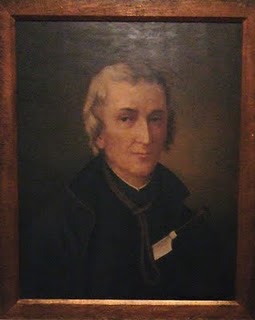
The Sisters at Llantarnam Abbey have continued to honour his memory and a portrait of the Saint who once lived there hangs in the hallway. Several years ago one of the Sisters from the Abbey founded a group, Friends of Saint David Lewis, which aims to spread devotion to St David Lewis. This Sister was also the driving force behind the installation of a plaque at the Old Post Office, Llantarnam, Cwmbran. The plaque marks the site of the arrest of St David Lewis.

Fr Jean Pierre Médaille died in the College of Billom on 30th December 1669. He was 59 years old. Fr Médaille could never have imagined the far reaching consequences of his work with that little band of women. The ripples have spread out to embrace the world and the good work started by Fr Medaille continues today through the dedicated and outstanding Sisters of St Joseph.

Friday, 19 March 2010

THE FEAST OF ST JOSEPH


On this, the Feast of St Joseph, we will explore briefly a link between St David Lewis and St Joseph.

The Sisters of St Joseph were founded at LePuy, France, in 1650 by Fr Jean-Pierre Medaille of the Society of Jesus. Fr Medaille was a noted teacher of philosophy who distinguished himself as a preacher and by his wonderful zeal for souls. The constitutions which Father Médaille wrote for the sisters are borrowed from the rules of St. Ignatius, the founder of the Jesuits to which Fr Medaille belonged.

This congregation had its martyrs! During the reign of terror, several Sisters of St. Joseph died for the Faith, and several others escaped the guillotine only by the fall of Robespierre. Among the latter was Mother St. John Fontbonne, who in her notebook records the names of four Sisters of St. Joseph imprisoned with her at St-Didier, five others in the dungeon of Feurs, and twenty in Clermont and other parts of France. The first use Mother St. John made of her liberty was to try to reassemble her dispersed community. The Sisters regrouped and reformed in various places and while all are Sisters of St Joseph as founded by Fr Medaille, they now carry the name of the place where they were reformed. Hence you will find The Sisters of St Joseph of Lyons, Sisters of St Joseph of Annecy, etc. Our link with St David Lewis is through the Sisters of St Joseph of Annecy.
In 1179, a Cistercian Abbey was founded at Llantarnam. It was a daughter house of Strata Florida. Owing to a 14th century fire and, two centuries later, the Reformation, little remains of the original Abbey. During the Reformation, the Abbey was dissolved. The property was acquired by William Morgan, a devout Catholic, who turned the Abbey into his family home. For generations, the Morgan Family held to their Catholic Faith and kept a chapel in their home where Catholics of the area could attend Mass. They were also instrumental in establishing the Jesuit College of St Francis Xavier at the Cwm, near Monmouth. St David Lewis a Welsh Jesuit, who was executed at Usk in 1679, lived for a time at Llantarnam with the Morgan Family. His Aunt was Lady Frances Morgan. Fr Lewis ministered to the Catholics of the area, saying Mass at the Morgan home, hearing Confessions, performing Baptisms, Weddings and generally tending to the needs of the persecuted Catholics. When the wave of persecution, generated by the Titus Oates Plot of 1678, broke over the country, Fr Lewis moved out of Llantarnam Abbey. He wished to prevent trouble being brought to the Morgans so, while continuing to serve the Catholics around Llantarnam, he moved into a cottage near the Abbey. It was here, on 17th November 1678, that the courageous Jesuit, Fr David Lewis, was arrested as he prepared to celebrate Holy Mass. He was tried and convicted of high Treason, that is, of being a Catholic priest and saying Mass. After a period of incarceration in various prisons, Fr Lewis was martyred at Usk on 27th August 1679.

In time, Llantarnam Abbey passed to various owners and in 1946, the “Residential & Agricultural Estate of Llantarnam Abbey” came on the market. The Sisters of St Joseph of Annecy, who were in need of larger premises, purchased the Abbey. That year, on 26th October, the Feast of Christ the King, Holy Mass was joyfully celebrated there for the first time in two hundred and sixty-eight years. The celebrant was Fr John Cahalane, Parish Priest of Our Lady of the Angels, Cwmbran.

St Joseph, the protector and foster father of the young Jesus, is the patron of the wonderful women who live at Llantarnam Abbey. Through their varied ministries, they spend their days living the word and the love of God. St Joseph is the quiet man of Scripture. Not one word of his is to be found in Scripture. We aren’t told much about him either, except that he was a just man and a righteous man. A man of great faith and trust in God, he did God’s will in all things. Today, St Joseph is the Patron of many countries and the Church rightly proclaims him Patron of the Universal Church. At Llantarnam Abbey, St Joseph is loved and revered by the Sisters of St Joseph of Annecy. They display many reminders and representations of their Patron Saint and there is a particularly beautiful statue of St Joseph in the well kept grounds of the Abbey. Nor is St David Lewis forgotten at the house in which he lived and celebrated Holy Mass. A portrait of the Martyr hangs in a place of honour at Llantarnam Abbey and the good Sisters treasure a relic of the Saint which they are proud to possess.

Today we honour St Joseph on this, his special day. Let us go to him in humble prayer and seek his aid in living faithful lives, open always to the will of God. Let us ask, too, the help of St David Lewis as we try to live our faith in a world where many have forgotten God.
LINKS TO THIS POST:

Wednesday, 3 February 2010

ST DAVID LEWIS AT LLANTARNAM


I think I might have jumped the gun a bit in my last post. I said now that the snow had gone we could get out and about again. When I got up the next morning, there was a light covering of snow on the ground! So, I am making no further comment on weather conditions! I will continue though with a blogging trip in the footsteps of our patron, St David Lewis.


In the time of St David Lewis (1616-1679) Penal Laws were in force and it was considered High Treason to be a Catholic priest and to say Mass. Priests risked being hanged, drawn and quartered, the usual punishment for treason, and Catholics who sheltered or helped them risked fines, imprisonment and, in some cases, even death. In Wales, the authorities, for the most part, were sympathetic to their Catholic neighbours, friends and families, and were somewhat lax in enforcing the laws. However, there were some, particularly John Arnold, an M P and Justice of the Peace, who were determined to stamp out Catholicism by making sure that the laws were rigidly enforced. The evil Titus Oates, with his fabricated Popish Plot, was a boon to men like Arnold, and the authorities, sympathetic or not, were forced to act.


Despite the dangers, there were many, up and down the country, who were willing to provide safe houses for priests and places where Catholics could gather for Mass and to receive the Sacraments. The Morgans of Llantarnam were one such family. They had a chapel in their home and Fr Lewis, who was a nephew of Lady Frances Morgan, lived there for a time, saying Mass and ministering to the Catholics of the area. In 1670 John Arnold and several others informed the House of Lords that "At Llantarnam, an eminent papist's house in Monmouthshire, there is a room fitted up chapelwise for saying of Mass where Fr David Lewis, a popish priest, hath said Mass for many years past". Today Llantarnam Abbey, pictured above, is a convent of the Sisters of St Joseph of Annecy.


With the increased persecution brought about by the Popish Plot, Fr Lewis, not wishing to put the Morgans in danger, moved out of Llantarnam Abbey and into a cottage opposite. This cottage was next to the Blacksmith's Shop and it was here, on 17th November 1678, that the priest was arrested. It was early on a Sunday morning and Fr Lewis was about to celebrate Holy Mass when the arresting party, including armed dragoons, arrived. On 17th November 2007, a plaque was unveiled at the site of the arrest, now a private home.


Opposite the Blacksmith's Shop, and running beside the Church of St Michael and All Angels, is an ancient public footpath which leads to Llantarnam Abbey. This footpath is still in use. One wonders if the holy Jesuit walked this path on his way to say Mass. It is certainly very likely.


In November 2008, to commemorate the 330th Anniversary of the arrest of St David Lewis, a tree was blessed and planted in the little Garden of Remembrance at the site of the Saint's arrest at Llantarnam. A large group, led by Fr John Edwards S J, gathered to pray and give thanks for the life and example of Fr David Lewis.


At Llantarnam Abbey, where he once lived and worked, the memory of St David Lewis burns bright. His portrait hangs in a place of honour and the Sisters treasure a relic of the Martyr. Every November, the Abbey hosts a special day of remembrance in honour of St David Lewis. Watch your local press for notification of this event. (I know, I'm a bit early with the plug! I will remind you again next November!)

ST DAVID LEWIS, PRAY FOR US.

Thursday, 31 December 2009

HONOURED AT LAST


Thanks to the devotion and perseverance of Sr Celsus, a Sister of St Joseph of Annecy, of Llantarnam Abbey, a public tribute was at last paid locally to Jesuit Martyr, St David Lewis. On Saturday, 17th November 2007, the Vicar General of Cardiff Archdiocese, Very Rev Canon Robert Reardon, himself a Cwmbran boy, unveiled a plaque at the Old Post Office, Llantarnam, the home of Mr and Mrs John O'Neill. Fr John Meredith, then Parish Priest of Cwmbran, blessed the plaque. Mr Stephen Brooks, K S S, was Master of Ceremonies. The plaque marks the site of the arrest of St David Lewis in 1678. In a corner of their front garden, John O'Neill and his wife, Wendy, have built a lovely Garden of Remembrance. Its focal point is the metal ring that once marked the site of the old smithy and the place of the martyr's arrest. The long overdue event was well attended by people from Cwmbran and surrounding area and Sister David Lewis S S J A, came from Devizes, Wiltshire, to be present at this service in honour of her Patron Saint.


THE METAL RING (A TYRING RING) WHICH ORIGINALLY MARKED THE SITE OF THE OLD SMITHY


Tuesday, 24 November 2009

SUNDAY, 17th NOVEMBER 1678


In November of 1678, Fr David Lewis S J was living in a cottage adjoining the Blacksmith’s at Llantarnam. He had been living at Llantarnam Abbey with his Aunt, Lady Frances Morgan, but, with the turmoil fomented by the Oates’ Plot, he had moved out in an attempt to protect his relatives.

Fr Lewis continued to minister to the Catholics of the area. On Sunday, 17th November, early in the morning, he was preparing to celebrate Holy Mass when a party of six armed dragoons arrested him. William James, a lapsed Catholic and former servant of Fr Lewis, joined Roger Seys and William Bedloe in leading the dragoons to apprehend the Jesuit. For this despicable act of betrayal, James was paid the sum of £220 – the Government reward of £20 for the apprehension of a priest and the additional £200 offered by the arch priest hunter, John Arnold. The priest was to be taken to Monmouth Gaol but first the group stopped at the house of Charles Price at Llanfoist. Here, three Justices of the Peace, Charles Price, John Arnold and Thomas Lewis, awaited them.

At about 2 o’clock that afternoon, Fr David Lewis, mounted on horseback, was led away from Llanfoist by Arnold and his henchmen. Guarded by twelve armed men, the priest was then taken to his hometown, Abergavenny. It being Sunday, the streets of Abergavenny were swarming with people. The contingent entered the Golden Lion on Frogmore Street where, in a guarded upper room, Fr Lewis was examined by the Recorder of Abergavenny, William Jones. The avaricious and vengeful William James swore that he had seen Fr Lewis say Mass at least twenty times. Fr Lewis was asked if he had played any part in the Titus Oates Plot and the priest swore on oath that he had no knowledge of or part in any plot. Arnold, showing his contempt for all things Catholic, sarcastically remarked that with Catholics, it was no oath to swear on the Bible. Arnold and Price had previously appeared to be friends of Fr Lewis and, curiously, now treated him with a certain degree of courtesy, although Arnold was not above making course remarks to the priest, at one point calling him the “pretended bishop of Llandaff”. The four now adjourned to the dining room, a large room where they had supper together. Fr Lewis, committed on a charge of Treason, was given the choice of spending the night at the Golden Lion, in a guarded room, or of being the guest of John Arnold at his home in Llanvihangel. Arnold assured the priest that he would be “most civilly entertained”. David Lewis left the decision to the others and it was decided that he should spend the night at Llanvihangel Court.

Fr David Lewis and his captors left the Golden Lion at about 10 o’clock that night. It was a moonlit night and a large crowd had gathered to catch a glimpse of the Jesuit prisoner as the party rode off into the night. Many in the crowd would have known Fr Lewis for he had grown up in the town and, as a priest, had ministered to the Catholics there. It would have been between 11 o’clock and midnight when the men reached Llanvihangel Court. Llanvihangel Court was a fine Elizabethan mansion that had been home to several generations of Arnolds. The defenceless priest spent the night here in a room guarded by two “strong men”.
(This recent photograph of Llanvihangel Court shows the main door of the house. This is not the original entrance. To the left of the window and at about the same height as the top of the window, one can clearly see in the brickwork where the original doorway was. On the night of his arrest, St David Lewis would have been brought in through this original doorway.)

Sunday, 8 November 2009

LLANTARNAM ABBEY AND ST DAVID LEWIS


Llantarnam Abbey, the Cistercian Abbey of the Blessed Virgin, was founded as a daughter house of Strata Florida Abbey about 1179. The Abbey was dissolved in 1536, after Henry VIII’s break with Rome. Llantarnam Abbey had four bells, weighing, in total, more than 38 cwt. The four bells were acquired by a William Jones of Caerleon, who paid the sum of £15 to have them taken down, the lead removed and melted down. It was reported that the lead weighed over 4 fothers. (1 fother = 2,000 lbs.)

In 1561, William Morgan acquired the dissolved Abbey from the Earl of Pembroke, to whom it had been granted by Queen Elizabeth in 1559. A new mansion was built from the stones of the Abbey and Morgan, a staunch Catholic, maintained in the house a Catholic Chapel. Lady Frances Morgan, an Aunt of The Jesuit Martyr, St David Lewis, married a descendent of William Morgan and lived at Llantarnam until her death in 1676. The property passed to her son, Sir Edward who, although a Deputy Lieutenant and a Justice of the Peace, held fast to the Old Faith. He also kept a Catholic Chapel which was frequently crowded with Catholics of the surrounding area. In 1670, the priest hunter, John Arnold, informed the House of Lords, that “At Llantarnam, an eminent papist’s house in Monmouthshire, there is a room fitted up chapel wise for saying of Mass where Fr David Lewis, a popish priest, hath said Mass for many years past”. Indeed, for several years Fr Lewis had lived at Llantarnam Abbey with his relatives and ministered to the Catholics in the area. Later, to avoid endangering his relatives, the priest moved to a nearby cottage adjoining the blacksmith's opposite the church of St Michael Llantarnam. However, Fr Lewis continued to say Mass in the Morgans’ Chapel. According to a helpful young lady at the Rights of Way Office, the present Public Footpath, which runs beside St Michael’s Church, has been legally registered since 1967 but has probably been there as long as the church itself . What route did the faithful priest take to the Abbey? Did he walk parts of this path across the fields on his way to celebrate Holy Mass?

In the 1830s, Reginald Blewitt, a relation of the Morgans, restored Llantarnam Abbey. Later, Sir Clifford Corey bought the Abbey and, later still, it became the property of the Government. During the Second World War, it was used as a storage depot by the R A F. In 1946 it was purchased by the Sisters of St Joseph of Annecy. That year, on 26th October, the Feast of Christ the King, Holy Mass was joyfully celebrated there for the first time in two hundred and sixty-eight years. The celebrant was Fr John Cahalane, Parish Priest of Our Lady of the Angels, Cwmbran.

A large metal ring in the pavement, originally a tyring platform used by the wheelwright, marked the site of the blacksmith’s in Llantarnam. That was providential because it also marked the site of Fr Lewis’s cottage and, later, the old Post Office. Today, the old Post Office is a private house. The owners have preserved the metal ring in a beautiful garden of remembrance, which they have lovingly created in honour of the last Welsh Martyr, St David Lewis.

Monday, 12 October 2009

HYMN IN HONOUR OF SAINT DAVID LEWIS


On 17th November 2007, a plaque was unveiled at the Old Post Office, Llantarnam, in memory of St David Lewis. The Post Office, now a private house, is the site of the old Blacksmith's shop and the spot where, on 17th November 1678, Fr David Lewis was arrested. The plaque was unveiled by the Vicar General of Cardiff Archdiocese, Canon Robert Reardon and blessed by Fr John Meredith, Parish Priest of Cwmbran. The hymn being sung is the Hymn in Honour of Saint David Lewis. The words were written by Sr Canisius S S J A, of Llantarnam Abbey.

This is a very nice video which I am pleased to share.   However, I should point out that there is a MISTAKE in it.  St David Lewis was the last WELSH martyr.  He was NOT the last Catholic martyr in "mainstream Britain" as stated in the video.  ST OLIVER PLUNKETT, Bishop of Armagh, was the last Catholic executed for his faith in Britain.  He was martyred at Tyburn, London, in 1681.


HYMN IN HONOUR OF SAINT DAVID LEWIS

Holy Martyr, David Lewis,
Monmouth County's glorious Saint.
Father of the Poor they named you,
When you lived and toiled in Gwent.
Priestly work was undertaken,
Danger-fraught from dawn till dusk.
Gladly still you served your people,
Till you died for them at Usk.

From your capture at Llantarnam,
Through your time in Monmouth Gaol,
Threats and tortures could not shake you,
For your faith would never fail.
Bravely then you faced the gallows,
Crudely fashioned for your death,
Further torment someone spared you,
Till you drew your latest breath.

Great and glorious David Lewis,
Staunch and steadfast in the strife,
Bless your people here in Monmouth,
Those for whom you gave your life.
Help us to be strong, courageous,
Loyal to our loving God,
To Him then will glory flourish,
In the places you have trod.

Wednesday, 7 October 2009

FRIENDS OF SAINT DAVID LEWIS


About two years ago, a group dedicated to Saint David Lewis was formed in Cwmbran. Under the guidance of Sr Celsus S S J A, of Llantarnam Abbey, this group is based at Our Lady of the Angels Church. The group, named "Friends of Saint David Lewis", meets regularly at the Church in Wesley Street. They have a very interesting and informative Website which is well worth browsing.

Related Posts with Thumbnails