Showing posts with label Pope John Paul II. Show all posts

Saturday, 28 September 2019

ABERGAVENNY AND ST MICHAEL

St Michael the Archangel, whose feast is celebrated on 29th September, (Michaelmas) is the Patron Saint of the dying and also of grocers, policemen, soldiers, bankers, and of artists.  Abergavenny, the birthplace of St David Lewis, has an ancient connection to St Michael.
ST MICHAEL THE ARCHANGEL (Photo by J D Smith)
An old Welsh legend tells the story of a prominent Abergavenny man who had committed three murders.  Racked with guilt, he undertook a penitential pilgrimage to Rome to seek forgiveness. Upon his return to Abergavenny, he climbed the rocky path to the top of Skirrid Fawr.  Here, while praying, the nobleman saw the Archangel Michael.  This experience moved him to erect on the site a chapel dedicated to St Michael.  Skirrid Fawr is also known as St Michael's Mount or the Holy Mountain.

Skirrid Fawr played an important part in the Catholic history of the Abergavenny area. For centuries, Catholics climbed the Holy Mountain on Good Friday and on St Michael's Feast to pray in the little chapel.  Even in the troubled times of the 16th and 17th centuries they defiantly carried on the practice of their faith.  John Arnold testified to Parliament that "hundreds of Papists meet on top of a high hill called St Michael's Mount where is frequent meetings eight or ten times in the year."  Arnold went on to say that Mass was said there and sometimes sermons were preached.
Skirrid Fawr or St Michael's Mount, Abergavenny
(Photo by J D Smith)
This was confirmed by another anti-Catholic witness who stated that he had seen "very great numbers of people at their devotions on the top of a high hill in Monmouthshire, called St Michael's Mount, where there is a ruinous chapel and a stone with crosses upon it, which he took to be an altar.  And he hath seen people with beads in their hands, kneeling toward the said stone, both within and without the said chapel.  Some Papists have affirmed in his presence that they have heard as good sermons preached there as ever thy heard in their lives."

Abergavenny born St David Lewis (1616-1679) laboured in the area for more than thirty years.  He served two terms as Rector of the Jesuit College at the Cwm and it is recorded that he said Mass at the house of Thomas Gunter in Cross Street, Abergavenny.  Thomas Gunter was the son of his sister, Mary Lewis and Thomas Gunter senior.  Fr Lewis also stayed at the home of his aunt, Lady Frances Morgan, at Llantarnam, and said Mass in the chapel there and conducted, weddings, christenings, and other  services for the local Catholics.  He is one of the priests thought to have led pilgrimages to St Michael's Mount and said Mass there in the, by this time, ruined chapel.  
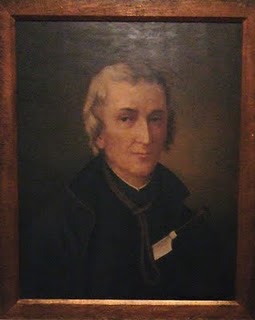
St David Lewis, alias Charles Baker
(Photo by J D Smith)
The Catholic Church in Abergavenny is in possession of a very interesting historical document.  This document, dated 1676, reads "Pope Clement X grants a Plenary Indulgence to those who devoutly visit the Chapel of St Michael on the Skirrid Fawr on 29th September - Michaelmas Day.  Anyone wishing to gain the Indulgence is required, first to go to confession and Holy Communion, then, on the Holy Mountain itself, to pray for peace among Christian Princes, for the rooting out of heresies, and for the exaltation of Holy Mother Church.  Given at St Mary Major's, Rome, under the Seal of the Fisherman, on 20th June 1676 and valid for seven years."

This rescript of Pope Clement clearly shows the importance of this awesome local landmark in the turbulent Penal times.  What of the Skirrid today?  Now in the hands of the National Trust, Skirrid Fawr is a popular site with tourists, hikers and others.  It is still a revered holy site and this is attested to by the devout pilgrims who still wend their way up the hillside at Michaelmas in honour of the archangel Michael.

In 1886 Pope Leo XIII instructed that this prayer to St Michael should be prayed after Low Mass: 
"St Michael, the Archangel, defend us in battle.  Be our safeguard against the wickedness and snares of the devil.  May God rebuke him, we humbly pray, and do thou, O  prince of the Heavenly Host, by the power of God, thrust down into hell Satan and all the wicked spirits who wander through the world seeking the ruin of souls.  Amen."

In 1964 it was decided to remove the obligation to recite this prayer after Mass and in 1965 it came into effect. However, it remained a popular prayer for private use and continued to be used on various other occasions.  In 1994 its use was encourage by Pope John Paul II.  In 'Regina Caeli', 24th April 1994, He wrote: "Although this prayer is no longer recited at the end of Mass, I ask everyone not to forget it and to recite it to obtain help in the battle against the forces of darkness and against the spirit of this world."  
Pope Saint John Paul II
That is excellent advice from a good and holy Pope who is now a Saint.  
St John Paul II, pray for us.
St David Lewis, pray for us.
St Michael the Archangel, pray for us.

LINK TO THIS POST:
ST MICHAEL'S MOUNT AND ST DAVID LEWIS (HERE)

Tuesday, 15 December 2009

NATIVITY SCENE IN ST PETER'S SQUARE


HAVE ANY OF YOU SEEN THE NATIVITY SCENE IN ST PETER'S SQUARE? IT MUST BE QUITE SOMETHING TO SEE.

Tuesday, 6 October 2009

THE VENERABLE ENGLISH COLLEGE

During the long reign of Queen Elizabeth I, it was the Government’s intention that the Catholic faith in the British Isles would die with the Marian priests. No priests, their reasoning ran, no Catholicism! However, many Catholics clung tenaciously to their faith but, as the priests ordained in Mary’s reign died, there were none to replace them. Cardinal William Allen conceived of a plan to remedy this dearth of priests.

Cardinal Allen founded overseas seminaries for the education and training of young men and boys from Britain. The first of these seminaries was founded in 1568 at Douai in Flanders. Then, in 1576, the Cardinal converted the English Hospice in Rome into a seminary and its first students arrived in 1577. Pope Gregory XIII issued the Bull of Foundation in 1579 and gave the new English College property and a yearly grant. David Lewis, alias Charles Baker, entered the English College in November 1638, aged 21, and was ordained there in July 1642. As this was a period of Catholic persecution in Britain and many of the students at the College, upon ordination, were destined for the “English Mission”, the College soon gained a reputation as a training ground for martyrs. Its first, or protomartyr, was St Ralph Sherwin. He was born in Derbyshire about 1550 and within four months of his return to England as a priest, he was captured, imprisoned and tortured. Finally, on 1st December 1581, he was hanged, drawn and quartered at Tyburn. The custom arose of a student preaching before the Pope every St Stephen’s Day on the theme of martyrdom. On Stephen’s Day 1642, Fr David Lewis preached before Pope Urban VIII in the Lateran Basilica. His Latin homily, entitled “Corona Christi pro spinis gemmea”, was on the martyrdom of St Stephen, the very first Christian Martyr.

In 1580, Durante Alberti painted “The Martyrs’ Picture” which hangs in the College Church. This impressive painting depicts the Holy Trinity with St Thomas Becket and St Edmond, two English martyrs, on either side. A map of the British Isles lies below the crucified Christ and blood from his wounds drops onto the map. Fire springs from the droplets of blood. A cherub holds a banner with the College mott
o, “Ignem veni mittere in terram”, I have come to bring fire to the earth”. So many of the College Alumni were martyred that students began the practice of gathering around the picture to sing a Te Deum upon receiving news of each martyrdom. This practice continues still as on “Martyrs’ Day”, 1st December, students gather to sing a Te Deum in front of the painting. The College produced a long line of priests who, for their faith, suffered imprisonment or exile. More than 40 former students were martyred. The last Alumnus to suffer martyrdom was St David Lewis who was executed at Usk on 27th August 1679. Because of its many martyrs, the College has been known as The Venerable English College since 1818.

On the occasion of the 400th Anniversary of the College in 1979, Pope John Paul II celebrated Holy Mass at the College. In his homily, the Pope said, “
A living faith in Jesus Christ has been the bedrock foundation of this College and of all its activities from the time of its establishment by my predecessor Gregory XIII in 1579. The men of faith who were your predecessors here continue to inspire you by the example of their lives. Yours is a great heritage; a whole martyrum candidatus exercitus honours the beginning of your College and spans an entire century from the time of St Ralph Sherwin in 1581 to Saint David Lewis in 1679. As supreme witnesses to the faith, these Martyrs speak to you today from this chapel and from every corner of this house. And the church herself corroborates their witness and exhorts you to “consider the outcome of their life, and imitate their faith”.
Related Posts with Thumbnails