
In this month of June Catholics traditionally honour the Sacred Heart of Jesus. I found this video on the Apostleship of Prayer site. Although today isn't the feast day of St Justin Martyr (1June is) I think it is appropriate to post this video here. I hope you find it interesting and uplifting.
Tuesday, 8 June 2010


Saturday, 29 May 2010
AN AWARD FOR LAST WELSH MARTYR!
 Sr Ann Marie, FRANCISCAN LIFE, has presented this Blog with a Sunshine Award. I am very pleased to receive an award - it's my first - and I thank Sr Ann Marie for her kindness. The reward comes with a few simple rules.
The rules are as follows:
1. Post the logo on your blog and/or within the post.
2. Pass it on to 12 other bloggers.
3. Add links to these 12 bloggers within your blog.
4. Let them know they are receiving the award.
5. Share the link of the person from whom you received the award.
I follow and enjoy many blogs and I have found it difficult to pick twelve but here are the ones I have chosen. Take a look at them and I think you will find them interesting and informative too.
Thank you, Sr Ann Marie. You have given me a great boost! God bless you.
Friday, 28 May 2010
A THANK YOU AND A TRIBUTE
This Blog is dedicated to the last Welsh martyr, St David Lewis, so I don't want it to stray far from our beloved Saint or to become personal. However, as you all know, I have been away for two months because several members of my close family were seriously ill. You have all been so kind and given me so much support that this post is to say "THANK YOU" to all of you and to pay tribute to my dear brothers and my wonderful family.
Even though I thought that the pride and love I felt for my large family could not be greater, I was wrong. It has increased with every day of the last two months as I watched them all, from the oldest to the youngest, support and help each other as two brothers were travelling their final journeys at the same time. At first, they were both in the same hospital and the family made its way between fourth and seventh floors to visit and comfort them. Later, as one brother was moved to Palliative care in another hospital, the love was carried back and forth between the two hospitals. Finally, on the morning of Friday, 14th May, my eldest brother, Bill, went to God with the prayers and blessings of the Church, and with his wife and children at his side. The next afternoon, Saturday, 15th May, my second eldest brother, John, also with the Church's prayers and blessings and his family at his side, went to meet his Lord. They had never moved far from the family home and for most of their married lives the two brothers lived next door to each other, one at number 19 and the other at number 21. Years ago, when any reluctance was shown at 'Family Rosary' time, my dear Dad was fond of quoting Fr Peyton, "The family that prays together stays together". I suppose that living so close together and then dying so close together proves my Dad right!
The neighbours made sure that everyone was well fed and sandwiches, cakes, cooked hams and turkeys were in abundance. The support of friends, neighbours and childhood friends, some of whom we hadn't seen since school days, was overwhelming. They turned out for the wakes and funerals in their hundreds!
And you, my loyal Blogging friends, you have been marvellous! Your supportive comments and your prayers have been a great blessing and I am grateful to all of you.
My eldest brother, Bill, made Rosary Beads and donated them all around the world. He sent them to Missions in Africa, India and South America, as well as to Primary Schools and Prisons in Wales. John also had a great devotion to the Rosary and his favourite hymn was "Hail Mary, Gentle Woman". As a small "THANK YOU" to everyone and as a tribute to my gorgeous big brothers, (who probably spoiled me rotten!) I am posting this lovely song. To all of you, family, friends, neighbours and blogging friends, I say a heartfelt thank you and wish you blessings galore. May your kindness be returned a hundred fold!
Wednesday, 5 May 2010
PENAL LAWS IN ENGLISH CANADA
 IT IS TIME I DID ANOTHER POST SO, SINCE I AM STILL IN NEWFOUNDLAND, I THOUGHT YOU MIGHT BE INTERESTED IN THE EARLY DAYS OF CATHOLICISM IN ENGLISH CANADA, PARTICULARLY IN NEWFOUNDLAND. THERE WERE NO MARTYRS BUT CERTAINLY PLENTY OF HARDSHIP!
Catholics who settled in Newfoundland suffered under the harsh Penal Laws, that body of discriminatory and oppressive legislation focused chiefly against Roman Catholics, but also against Protestant nonconformists.
Followers of Catholicism in English Canada faced great adversities in their efforts to establish their faith in the new country. This was partly due to the religious disdain of the English majority towards those who refused to conform to the tenets of the Protestant Reformation but also from animosity towards the ethnicity of those who professed Catholicism, particularly to the Irish. This antagonism was most intensely found in Newfoundland where, unlike in Canada, the Penal Laws were strictly applied. However, in spite of the influence the Irish had in English-speaking Canada, it is in Newfoundland that Irish Catholic mores run deepest.
Newfoundland’s rich resources of fish needed people to work in the expanding industry. In the seventeenth century, people from many parts of Ireland, especially Waterford, Wexford, Kilkenny and Tipperary, rose to the challenge and became seasonal visitors to the Island, working in the fisheries during the summer and returning home at the end of the fishing season in the Autumn. The English Merchants, who reaped the immense profits of the Newfoundland fishery, seldom paid these Irish workers so their financial lot was not improved. However, the fishery did provide them with cheap passage to America and the opportunity of eventually migrating to the American Colonies, where they hoped to find better conditions! Nonetheless, many Irish stayed and created a large and permanent Catholic presence in the Colony of Newfoundland. Under the Penal Laws, the Irish settlers stood little or no chance of either justice or mercy when accused of a crime. Irish Catholics were denied a defence counsel and had no way of knowing an indictment until it was read in court.
In Newfoundland at that time, the Catholic Church was an illegal institution and had great difficulty assisting the Irish in the Colony. Since it operated as an underground organization, its spiritual and religious role was restricted. Under the English Penal Laws, enacted from the reign of Queen Elizabeth I to that of King George III, when they were repealed in 1783, it was hoped to eliminate "Popery" by rendering it impossible for a Catholic to exist, except in the most degraded conditions imaginable. Catholics were barred from holding public office, from operating schools or sitting in parliament. Neither could they own property nor own a horse worth more than $5 and the practice of their religion was forbidden. As well as the Penal Laws, local orders were applied. Catholics could not bury their dead; only an Anglican minister was permitted to read the service of burial and collect a fee for doing so.
Rome was not unaware of its responsibility to the Catholic population and from 1535 to 1784, Newfoundland was under the administration of the Bishop of Rouen, then the Bishop of Quebec and then under the Vicariate of London. A number of itinerant priests were sent to Newfoundland and, at considerable risk, they traversed the rough terrain, covertly said Mass, and then moved on. Aware that Catholics were practising their religion by stealth, the local authorities hunted the itinerant priests who came to the Island disguised as fishermen. These priests hid, said Mass and fled. Punishment for participation in the Mass was severe. One account refers to a Michael Keating of Harbour Main who, in 1755, was fined $50 for allowing Mass to be celebrated in his fish store; his house was demolished, his goods were seized, and he was deported from the Colony. These men were under the constant threat of surveillance by Protestants who felt obliged to report their activities. One example, documented in 1755, stated: “ I am informed that a Roman Catholic priest is at this time at Harbour Grace, and that he publicly read mass which is contrary to the law and against the peace of our sovereign Lord, the King.”
Conditions for Newfoundland's Catholics, predominantly Irish, gradually improved as the laws changed. In 1784, "liberty of conscience" was proclaimed in Newfoundland, the first Catholic chapel was built, and an Irish Franciscan, James Louis O'Donel, was appointed the first Roman Catholic Bishop of St. John's, Newfoundland. More priests came from Ireland and, in 1833, the Presentation Sisters arrived from Galway. The Presentation Sisters were followed by The Sisters of Mercy in 1842 and the Irish Christian Brothers in 1857. Advantages were gained when Catholics received the vote and were able to sit in the assembly and on the Legislative Council. For these early Catholic settlers to the Colony of Newfoundland, the struggle to obtain their religious rights was long and difficult. Be that as it may, the Newfoundland Irish expressed a unique culture in various dialects, crafts, and traditions which are still identifiable. The Irish language was commonly spoken among the Newfoundland Irish until the beginning of the nineteenth century, creating an Irish pattern of speech and vocabulary that is evident even today in Newfoundland English. The Catholic Faith, which was sown in suffering, perseverance and faithfulness, flourishes today and the many churches built with the pennies and free labour of poor Irish fishermen are their memorials.
Tuesday, 20 April 2010
TODAY'S MARTYRS

HERE IS AN EXCELLENT SITE ON MARTYRS. STEPHEN OVER AT 'THE BLOOD OF THE MARTYRS' POSTS SOME EXCELLENT ARTICLES ON MARTYRS OF THE PAST BUT HE ALSO KEEPS US INFORMED OF THE MANY PLACES IN TODAY'S SO CALLED ENLIGHTENED WORLD WHERE CHRISTIANS ARE STILL SUFFERING DEATH FOR THEIR FAITH.
CHECK OUT THE LINK BELOW.
http://thebloodofthemartyrs.blogspot.com/2010/04/arshed-masih.html
CATHOLICISM, JESUITS, AND THE NEW WORLD
 The only connection between this post and St David Lewis is the Society of Jesus. However, here in Canada’s tenth Province, I have learned some fascinating facts about Catholicism in the early days of Newfoundland. I want to share this Catholic history in the hope that you too will find it interesting.
Newfoundland was the first part of North America explored by Europeans. There are those who believe that St Brendan, the ancient Irish navigator, sailed to Newfoundland in a leather Curach in the sixth century. Five hundred years before Columbus, Vikings established a settlement at what is now L’Anse aux Meadows, in northern Newfoundland. In May of 1497, John Cabot set sail from Bristol, England and on 24th June, the feast of St John the Baptist, landed at present day Bonavista, Newfoundland. It is not known for certain if Cabot was accompanied by a priest on his voyage but it is not improbable that he was. (Some historians believe that Cabot brought Augustinians with him.) Portuguese and French explorers visited the New-Found-Land and they brought their chaplains with them to say Mass. In 1583, Sir Humphrey Gilbert took possession of the Island, claiming it for his Queen, Elizabeth I of England. He decreed that all public worship must be according to the rites of the Church of England. It was more profitable for the English Merchants if Newfoundland remained just a fishing station and those who came out to fish were compelled to return home at the end of the fishing season. For this reason, permanent settlement was not considered and hence no clergyman, Church of England or otherwise, was installed on the Island. In 1610 John Guy established the first permanent settlement in Newfoundland. He brought with him the first Protestant Minister, the Reverend Erasmus Stourton.
The first confirmed settlement of Catholics on the Island was in the 1620s at Lord Baltimore’s colony at Ferryland. Sir George Calvert, Lord Baltimore, converted to Catholicism in 1625. On 7th April 1623 he had been granted the ‘Charter of Avalon’ by King James I. The charter, which created the Province of Avalon on the island of Newfoundland, gave Baltimore authority over the territory from Ferryland to Petty Harbour.
Lord Baltimore’s dream was not to create a Catholic colony but to establish in the New World a place of religious freedom and tolerance for Catholics and Protestants. On 23rd July 1627, Lord Baltimore arrived at Ferryland. He brought with him two Catholic priests, Fr Anthony Pole (alias Smith) and Fr Longville, two Jesuits. On that very day, in thanksgiving for a safe voyage, the two priests offered Mass. Thus, less than twenty years before St David Lewis entered the Jesuit Novitiate at Sant’ Andrea, the first Mass celebrated in British North America was celebrated by priests of the Society of Jesus. Also, it was the Jesuit, Fr Anthony Pole (Smith), who was the first Catholic priest to reside in British North America. The following year, Lord Baltimore brought out his wife, Lady Joan, and all his children except his eldest son Cecil who was to remain in England to take care of affairs there. He also brought another priest, Fr Hackett S J, with him. According to complaints made by Rev Stourton, Lord Baltimore was “encouraging Popery among English subjects at Ferryland” and that Mass was celebrated there regularly “and all other ceremonies of the Church of Rome were used in ample manner as tis used in Spain.”
Unfortunately, Lord Baltimore’s colony of Avalon was short-lived. There were frequent attacks from French Privateers and Pirates and despite the fact that he and his family lived in a comfortable stone mansion, food shortages and a severe winter caused Baltimore to lose heart. Also, Lady Joan’s health was not robust so Sir George Calvert applied for a grant of land in Maryland. In 1629, Calvert (Lord Baltimore) and his family left for a more gentle climate. Calvert died before achieving his goal but his son carried on with the enterprise and took possession of what is now the state of Maryland.
In the colony of Newfoundland, no one was put to death for their faith but the harsh Penal Laws were enforced and severe penalties were meted out to Catholics and any who sympathised with them. (The only known Mass Rock outside Ireland can be found at Renews on the southern shore of the Avalon Peninsula, not far from Baltimore’s colony of Ferryland.) In 1829 the King, George IV, reluctantly gave his ascent to the Catholic Relief Act. News of emancipation reached Newfoundland in May 1829 and there was much rejoicing and celebrating in the colony. However, this joy was of short duration as on 17th December 1829 the attorney general and supreme court justices decided that the Catholic Relief Act did not apply to Newfoundland. It was May 1832 before the British Parliament finally ordered that a new commission be issued to the Island’s Governor Cochrane to remove all restrictions against Catholics in Newfoundland. Although the Catholic faith had been proscribed in Newfoundland, Catholicism had flourished and Jesuits had played a prominent part in its establishment in British North America.
Thursday, 15 April 2010
ST JEAN DE BREBEUF
The first thing I would like to do is say a very big THANK YOU to all of you lovely people who have left messages of support and prayers since I have been away. I am still with my family and will be until about the middle of May. Today, I have a touch of the sniffles so I thought it unwise to visit the sick in case I add to their problems. That brought me to my brother’s computer and the thought of (since I am in Canada) posting on Canadian Martyrs. As it turns out, the Canadian Martyrs, Jean de Brebeuf, Antoine Daniel, Gabriel Lalemant, Charles Garnier, and Noel Chabanel, like St David Lewis, were Jesuits and very brave and faithful men. Like all our Holy Martyrs, their stories are worth the telling. Here, briefly, is the story of one of those martyrs.

Saint Jean de Brébeuf (March 25, 1593 – March 16, 1649) was a Jesuit missionary, martyred in Canada on March 16, 1649. He was born in Normandy, France, studied at Caen and became a Jesuit in 1617. In 1623 he was ordained and in 1625 he sailed to Canada as a missionary, arriving on June 19, and lived with the Huron natives near Lake Huron, learning their customs and language, of which he became an expert (it is said that he wrote the first dictionary of the Huron language). Because of war between France and England, Fr Brébeuf returned to France but when the peace was signed, he returned to the Hurons in 1634, travelling 800 miles from Quebec via the Ottawa River. Fr Brébeuf told many of his experiences in Canada in the "Jesuit Relations", which are an invaluable source of early Canadian history. He was head of the Huron mission until 1638 when he relinquished the position to Fr Jérôme Lalemant. The Jesuits were frequently blamed for disasters like epidemics, battle defeats, and crop failures so his success as a missionary was very slow and it was only in 1637 that he made his first converts. However, by 1647 there were thousands of converted Huron.
The Iroquois , at war with the Huron, destroyed a large Huron village in 1648 and on March 16, 1649, 1,200 Iroquois captured the mission of St. Ignace and then a few hours later captured another Huron village where they seized Fr Brébeuf and his fellow Jesuit, Gabriel Lallemant, and brought them back to St. Ignace. There they were fastened to stakes and tortured to death by scalping, mock baptism with boiling water, fire, necklaces of red hot hatchets and mutilation. Fr Brébeuf made no outcry while being tortured and he astounded the Iroquois, who later cut out his heart and ate it in hopes of gaining his courage. The remains of fifty-five year old Fr Jean de Brébeuf were buried with Fr Lalemant's in one coffin, and today rest in the Church of St. Joseph at the reconstructed Jesuit mission of Sainte-Marie among the Hurons, near Midland, Ontario.
Jean de Brébeuf was said to have been massive in body, hugely strong, yet gentle in character. He was known as "The Apostle of the Hurons". The Natives called him "Echon", pronounced like "Ekon" – meaning "Healing Tree", because of how much he had helped the Hurons and of the medicines he brought them from Europe. Fr Jean de Brébeuf was canonized in 1930 with seven other missionaries, known as the Canadian Martyrs. His feast day in Canada is celebrated on September 26, while in the United States it is celebrated on October 19.

Saint Jean de Brébeuf (March 25, 1593 – March 16, 1649) was a Jesuit missionary, martyred in Canada on March 16, 1649. He was born in Normandy, France, studied at Caen and became a Jesuit in 1617. In 1623 he was ordained and in 1625 he sailed to Canada as a missionary, arriving on June 19, and lived with the Huron natives near Lake Huron, learning their customs and language, of which he became an expert (it is said that he wrote the first dictionary of the Huron language). Because of war between France and England, Fr Brébeuf returned to France but when the peace was signed, he returned to the Hurons in 1634, travelling 800 miles from Quebec via the Ottawa River. Fr Brébeuf told many of his experiences in Canada in the "Jesuit Relations", which are an invaluable source of early Canadian history. He was head of the Huron mission until 1638 when he relinquished the position to Fr Jérôme Lalemant. The Jesuits were frequently blamed for disasters like epidemics, battle defeats, and crop failures so his success as a missionary was very slow and it was only in 1637 that he made his first converts. However, by 1647 there were thousands of converted Huron.
The Iroquois , at war with the Huron, destroyed a large Huron village in 1648 and on March 16, 1649, 1,200 Iroquois captured the mission of St. Ignace and then a few hours later captured another Huron village where they seized Fr Brébeuf and his fellow Jesuit, Gabriel Lallemant, and brought them back to St. Ignace. There they were fastened to stakes and tortured to death by scalping, mock baptism with boiling water, fire, necklaces of red hot hatchets and mutilation. Fr Brébeuf made no outcry while being tortured and he astounded the Iroquois, who later cut out his heart and ate it in hopes of gaining his courage. The remains of fifty-five year old Fr Jean de Brébeuf were buried with Fr Lalemant's in one coffin, and today rest in the Church of St. Joseph at the reconstructed Jesuit mission of Sainte-Marie among the Hurons, near Midland, Ontario.
Jean de Brébeuf was said to have been massive in body, hugely strong, yet gentle in character. He was known as "The Apostle of the Hurons". The Natives called him "Echon", pronounced like "Ekon" – meaning "Healing Tree", because of how much he had helped the Hurons and of the medicines he brought them from Europe. Fr Jean de Brébeuf was canonized in 1930 with seven other missionaries, known as the Canadian Martyrs. His feast day in Canada is celebrated on September 26, while in the United States it is celebrated on October 19.
Saturday, 20 March 2010
DON'T FORGET ST DAVID LEWIS

I just want to let the friends of this blog know that I won't be posting for several weeks. I am taking two, possibly three, weeks off to spend some time with some very ill members of my family. An occasional prayer for my family would be very much appreciated if you would be so kind.
Please don't forget ST DAVID LEWIS, the LAST WELSH MARTYR. I will be back soon, please God. Thanks for all your interest, comments, and support. Take care and God bless you.
Friday, 19 March 2010
THE FEAST OF ST JOSEPH

On this, the Feast of St Joseph, we will explore briefly a link between St David Lewis and St Joseph.
The Sisters of St Joseph were founded at LePuy, France, in 1650 by Fr Jean-Pierre Medaille of the Society of Jesus. Fr Medaille was a noted teacher of philosophy who distinguished himself as a preacher and by his wonderful zeal for souls. The constitutions which Father Médaille wrote for the sisters are borrowed from the rules of St. Ignatius, the founder of the Jesuits to which Fr Medaille belonged.
This congregation had its martyrs! During the reign of terror, several Sisters of St. Joseph died for the Faith, and several others escaped the guillotine only by the fall of Robespierre. Among the latter was Mother St. John Fontbonne, who in her notebook records the names of four Sisters of St. Joseph imprisoned with her at St-Didier, five others in the dungeon of Feurs, and twenty in Clermont and other parts of France. The first use Mother St. John made of her liberty was to try to reassemble her dispersed community. The Sisters regrouped and reformed in various places and while all are Sisters of St Joseph as founded by Fr Medaille, they now carry the name of the place where they were reformed. Hence you will find The Sisters of St Joseph of Lyons, Sisters of St Joseph of Annecy, etc. Our link with St David Lewis is through the Sisters of St Joseph of Annecy.

In 1179, a Cistercian Abbey was founded at Llantarnam. It was a daughter house of Strata Florida. Owing to a 14th century fire and, two centuries later, the Reformation, little remains of the original Abbey. During the Reformation, the Abbey was dissolved. The property was acquired by William Morgan, a devout Catholic, who turned the Abbey into his family home. For generations, the Morgan Family held to their Catholic Faith and kept a chapel in their home where Catholics of the area could attend Mass. They were also instrumental in establishing the Jesuit College of St Francis Xavier at the Cwm, near Monmouth. St David Lewis a Welsh Jesuit, who was executed at Usk in 1679, lived for a time at Llantarnam with the Morgan Family. His Aunt was Lady Frances Morgan. Fr Lewis ministered to the Catholics of the area, saying Mass at the Morgan home, hearing Confessions, performing Baptisms, Weddings and generally tending to the needs of the persecuted Catholics. When the wave of persecution, generated by the Titus Oates Plot of 1678, broke over the country, Fr Lewis moved out of Llantarnam Abbey. He wished to prevent trouble being brought to the Morgans so, while continuing to serve the Catholics around Llantarnam, he moved into a cottage near the Abbey. It was here, on 17th November 1678, that the courageous Jesuit, Fr David Lewis, was arrested as he prepared to celebrate Holy Mass. He was tried and convicted of high Treason, that is, of being a Catholic priest and saying Mass. After a period of incarceration in various prisons, Fr Lewis was martyred at Usk on 27th August 1679.
In time, Llantarnam Abbey passed to various owners and in 1946, the “Residential & Agricultural Estate of Llantarnam Abbey” came on the market. The Sisters of St Joseph of Annecy, who were in need of larger premises, purchased the Abbey. That year, on 26th October, the Feast of Christ the King, Holy Mass was joyfully celebrated there for the first time in two hundred and sixty-eight years. The celebrant was Fr John Cahalane, Parish Priest of Our Lady of the Angels, Cwmbran.
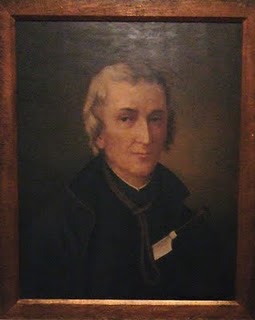
St Joseph, the protector and foster father of the young Jesus, is the patron of the wonderful women who live at Llantarnam Abbey. Through their varied ministries, they spend their days living the word and the love of God. St Joseph is the quiet man of Scripture. Not one word of his is to be found in Scripture. We aren’t told much about him either, except that he was a just man and a righteous man. A man of great faith and trust in God, he did God’s will in all things. Today, St Joseph is the Patron of many countries and the Church rightly proclaims him Patron of the Universal Church. At Llantarnam Abbey, St Joseph is loved and revered by the Sisters of St Joseph of Annecy. They display many reminders and representations of their Patron Saint and there is a particularly beautiful statue of St Joseph in the well kept grounds of the Abbey. Nor is St David Lewis forgotten at the house in which he lived and celebrated Holy Mass. A portrait of the Martyr hangs in a place of honour at Llantarnam Abbey and the good Sisters treasure a relic of the Saint which they are proud to possess.
Today we honour St Joseph on this, his special day. Let us go to him in humble prayer and seek his aid in living faithful lives, open always to the will of God. Let us ask, too, the help of St David Lewis as we try to live our faith in a world where many have forgotten God.
In time, Llantarnam Abbey passed to various owners and in 1946, the “Residential & Agricultural Estate of Llantarnam Abbey” came on the market. The Sisters of St Joseph of Annecy, who were in need of larger premises, purchased the Abbey. That year, on 26th October, the Feast of Christ the King, Holy Mass was joyfully celebrated there for the first time in two hundred and sixty-eight years. The celebrant was Fr John Cahalane, Parish Priest of Our Lady of the Angels, Cwmbran.
St Joseph, the protector and foster father of the young Jesus, is the patron of the wonderful women who live at Llantarnam Abbey. Through their varied ministries, they spend their days living the word and the love of God. St Joseph is the quiet man of Scripture. Not one word of his is to be found in Scripture. We aren’t told much about him either, except that he was a just man and a righteous man. A man of great faith and trust in God, he did God’s will in all things. Today, St Joseph is the Patron of many countries and the Church rightly proclaims him Patron of the Universal Church. At Llantarnam Abbey, St Joseph is loved and revered by the Sisters of St Joseph of Annecy. They display many reminders and representations of their Patron Saint and there is a particularly beautiful statue of St Joseph in the well kept grounds of the Abbey. Nor is St David Lewis forgotten at the house in which he lived and celebrated Holy Mass. A portrait of the Martyr hangs in a place of honour at Llantarnam Abbey and the good Sisters treasure a relic of the Saint which they are proud to possess.
Today we honour St Joseph on this, his special day. Let us go to him in humble prayer and seek his aid in living faithful lives, open always to the will of God. Let us ask, too, the help of St David Lewis as we try to live our faith in a world where many have forgotten God.
LINKS TO THIS POST:
Wednesday, 17 March 2010
AN IRISH MARTYR, ST OLIVER PLUNKETT

Oliver Plunkett was born in Loughcrew, County Meath, Ireland in 1629 to well-to-do parents. Desiring to become a priest, he set out for Rome in 1645. In 1646, he was admitted to the Irish College in Rome.
In 1654 Oliver Plunkett was ordained a priest and delegated by the Irish Bishops to act as their representative in Rome. Because of the extremely strict Penal Laws in force in Ireland at that time, it was many years before Fr Plunkett could return to his homeland. He served as theological professor at the College of Propaganda Fide and there, on 9th July 1669, he was appointed Archbishop of Armagh and was consecrated on 30th November at Ghent by the Bishop of Ghent, assisted by two Bishops, including the Bishop of Ferns.
The Restoration of the Monarchy in 1660 brought King Charles II to the throne and the new King wished to rule with tolerance for all his subjects. So, in March 1670, the Archbishop finally returned to Ireland. He received the pallium on 28th July 1670. Now that he was home, Archbishop Plunkett began the reorganising of the ravaged Catholic Church. He built schools both for the young and for the clergy and, in 1670, he established a Jesuit College in Drogheda. The Archbishop refused to sign the Test Act of 1673 and the college was razed to the ground and Plunkett went into hiding, travelling about in disguise.
In 1678, things became even worse for Catholics, particularly for Catholic priests! In England, the foul Titus Oates had concocted the fictitious Popish Plot and anti-Catholic hysteria was sweeping the country. Despite having a price on his head, Archbishop Plunkett refused to abandon his flock. He was arrested in Dublin in December 1679 and imprisoned in Dublin Castle. He was tried at Dundalk for conspiring against the state but this was unproven. The powerful and extremely anti-Catholic Lord Shaftsbury feared that Oliver Plunkett would never be convicted in Ireland so he had him moved to Newgate Prison in London. Even though the first grand jury found no true bill, the Archbishop was not released. At the second trial, which was claimed to be a kangaroo court, he was, as expected, found guilty of High Treason “for promoting the Roman faith” and he was condemned to be hanged, drawn and quartered.
On 1st July 1681, Oliver Plunkett, Archbishop of Armagh and Primate of all Ireland, was hanged, drawn and quartered at Tyburn. Originally, his body was buried in two tin boxes. Exhumed in 1683, his remains were moved to various places before finally coming to rest at Drogheda, Ireland (his head), Downside Abbey, England, and Lamspringe, Germany.
Archbishop Oliver Plunkett was beatified in 1920 and canonised in 1975. St Oliver Plunkett was the last Catholic Martyr to be executed in England.
In 1654 Oliver Plunkett was ordained a priest and delegated by the Irish Bishops to act as their representative in Rome. Because of the extremely strict Penal Laws in force in Ireland at that time, it was many years before Fr Plunkett could return to his homeland. He served as theological professor at the College of Propaganda Fide and there, on 9th July 1669, he was appointed Archbishop of Armagh and was consecrated on 30th November at Ghent by the Bishop of Ghent, assisted by two Bishops, including the Bishop of Ferns.
The Restoration of the Monarchy in 1660 brought King Charles II to the throne and the new King wished to rule with tolerance for all his subjects. So, in March 1670, the Archbishop finally returned to Ireland. He received the pallium on 28th July 1670. Now that he was home, Archbishop Plunkett began the reorganising of the ravaged Catholic Church. He built schools both for the young and for the clergy and, in 1670, he established a Jesuit College in Drogheda. The Archbishop refused to sign the Test Act of 1673 and the college was razed to the ground and Plunkett went into hiding, travelling about in disguise.
In 1678, things became even worse for Catholics, particularly for Catholic priests! In England, the foul Titus Oates had concocted the fictitious Popish Plot and anti-Catholic hysteria was sweeping the country. Despite having a price on his head, Archbishop Plunkett refused to abandon his flock. He was arrested in Dublin in December 1679 and imprisoned in Dublin Castle. He was tried at Dundalk for conspiring against the state but this was unproven. The powerful and extremely anti-Catholic Lord Shaftsbury feared that Oliver Plunkett would never be convicted in Ireland so he had him moved to Newgate Prison in London. Even though the first grand jury found no true bill, the Archbishop was not released. At the second trial, which was claimed to be a kangaroo court, he was, as expected, found guilty of High Treason “for promoting the Roman faith” and he was condemned to be hanged, drawn and quartered.
On 1st July 1681, Oliver Plunkett, Archbishop of Armagh and Primate of all Ireland, was hanged, drawn and quartered at Tyburn. Originally, his body was buried in two tin boxes. Exhumed in 1683, his remains were moved to various places before finally coming to rest at Drogheda, Ireland (his head), Downside Abbey, England, and Lamspringe, Germany.
Archbishop Oliver Plunkett was beatified in 1920 and canonised in 1975. St Oliver Plunkett was the last Catholic Martyr to be executed in England.
LINKS TO THIS POST:
Sunday, 14 March 2010
"A MOTHER'S LOVE IS A BLESSING"
This post is a little out of the ordinary for this blog but , on this Mothering Sunday, I wanted to post something especially for mothers. This lovely Irish song, sung by the equally lovely Bridie Gallagher, really says it all - "A MOTHER'S LOVE IS A BLESSING". To all mothers, thank you and a very Happy Mothering Sunday.
Thursday, 11 March 2010
CONFISCATED PLATE

This post was prompted by a comment from Pedro at Pedro The Fisherman Blog. The Catholic Church in Abergavenny is in possession of some plate, including a chalice, which was used by St David Lewis. Other than that, the following is all that I can discover about the whereabouts of the confiscated plate of Fr David Lewis.
On Sunday morning, 17th November 1678, Fr David Lewis S J, was preparing to celebrate Holy Mass. Just before daybreak, six of John Arnold’s dragoons arrived at his cottage in Llantarnam. The dragoons were led by Roger Seys, William Bedloe and William James, and they had been sent by the arch priest hunter, Arnold, to arrest the priest. The ultimate destination was Monmouth Gaol but first the party was to stop at the house of Charles Price of Llanfoist. Price was another Justice of the Peace and one of Arnold’s henchmen.
When Fr Lewis was taken from his cottage, those who had arrested him also took away all the altar furnishings, vestments, and anything considered “popish”! A report sent to the Privy Council asked for instructions as to what should be done with “all his robes, crucifixes, wafers, books and several other things”. The reply was that they should proceed according to the law, and all objects were to be burnt, “if they shall find the same to be popish or superstitious.”
The following is a list of items confiscated and kept by Charles Price of Llanfoist;
One large silver and gilt chalice and paten,
One pair of small silver flower pots,
One small thurible and cover,
One small silver plate for cruets,
One silver cruet,
One silver bell for the altar,
One small pair of silver candlesticks,
Several small pieces of silver belonging to a crucifix,
One picture of the Virgin Mary, with a silver and gilt inner frame
Charles Price was a rapacious man, hungry for power and wealth. Despite orders from the Privy Council, he was very loath to part with the plate taken from the home of Fr Lewis. In April 1860, the Treasury ordered Thomas Morgan, the Sheriff of Monmouth, to take delivery of this collection of plate from Price and give it to the constables as a reward for their diligence in priest hunting! However, Price still clung to his booty and, when an enquiry into the matter was conducted after the accession of King James II in 1685, the stolen articles were still in the possession of Charles Price.
The following is a list of items confiscated and kept by Charles Price of Llanfoist;
One large silver and gilt chalice and paten,
One pair of small silver flower pots,
One small thurible and cover,
One small silver plate for cruets,
One silver cruet,
One silver bell for the altar,
One small pair of silver candlesticks,
Several small pieces of silver belonging to a crucifix,
One picture of the Virgin Mary, with a silver and gilt inner frame
Charles Price was a rapacious man, hungry for power and wealth. Despite orders from the Privy Council, he was very loath to part with the plate taken from the home of Fr Lewis. In April 1860, the Treasury ordered Thomas Morgan, the Sheriff of Monmouth, to take delivery of this collection of plate from Price and give it to the constables as a reward for their diligence in priest hunting! However, Price still clung to his booty and, when an enquiry into the matter was conducted after the accession of King James II in 1685, the stolen articles were still in the possession of Charles Price.
Sunday, 7 March 2010
THY WILL BE DONE
This is a lovely song from Sister Miriam Therese Winter and The Medical Mission Sisters. They were in the forefront of the new style of music that became popular in the Catholic Church in the 1960s. This is a very lovely song and appropriate for this Lenten season.
Chorus:
Is there a song to ease our sorrow
to lead us along into tomorrow
to show us how, to live in our now
Father Thy Will be done
Father Thy Will be done
What have you done for my friends
how have you called, how have you lived
how have you died, how did you give
how have you tried
Chorus
What have you done for my Son
have you been called, have you received
have you been right, have you believed
have you been tried
Thursday, 4 March 2010
MAYNE TROTT
One of the principal witnesses at the trials of both Fr Philip Evans and Fr David Lewis was a disreputable character named Mayne Trott, of Llanvihangel Crucorny.
Born around 1629, Mayne Trott had been successively Court Dwarf to the Kings of Spain and of England. After the Restoration of the Monarchy, Trott was in the service of King Charles II of England but, because of his unsavoury conduct, he was banished from Court. Trott himself denied this and maintained that he had left Court of his own free will and was still welcome to go there whenever he pleased.
Mayne Trott had converted to Catholicism upon his marriage to a wealthy relative of Fr David Lewis. He soon went through her fortune and after her death he reverted to Protestantism. Having been banished from Court, he had to depend on the charity of others and thus he became a useful tool of the zealous anti-Catholic and priest hunter, John Arnold, and was now a tenant and servant of Arnold’s. Of course, because of his married life as a Catholic, Mayne Trott was able to supply his master with information as to the affairs of the Catholics in South East Wales.
At the trial of St David Lewis, Judge Atkins asked; “Mr Trott, what have you to say of the prisoner? Did you ever hear him read Mass? Was he reputed commonly a Jesuit, or Popish priest?” Trott replied; “Yes, my lord, he was commonly reputed so, and I have heard him often read Mass and I saw him marry Mr Gunter’s daughter to Mr Body.” Fr Lewis, who had trained as a Lawyer, was conducting his own defence and he pointed out to Judge Atkins and the court that, because of Trott’s straitened circumstances, “it is rather poverty and hope of gain, than anything else, that brings him here to accuse me.” To this Judge Atkins replied “Paupertas ad turpia rogat” (poverty leads to dishonesty).
In November 1679, three months after the execution of St David Lewis, there was a Pope-burning in Abergavenny. Instigated by John Arnold and his minions, the spectacle was led by Mayne Trott, armed with a blunderbuss. Shortly after this, 50 year old Mayne Trott dropped dead in a London street.

Monday, 1 March 2010
HAPPY ST DAVID’S DAY

1st March is a very special day. It is the day on which all red blooded Welshmen (wherever they are) celebrate the feast of their Patron Saint, St David. At the special St David’s Day Mass today, the schoolchildren will be decked out in something typically Welsh. There will be a sea of red Welsh Rugby Shirts, yellow daffodils, tall black Welsh Hats, Leeks and Red Dragons! The children always make their own special contribution to the Mass with their singing and readings. All in all, the St David’s Day Mass is lovely and the presence of the children makes it even lovelier!
Legend has it that St David of Wales was born around 462. He was the son of a chieftain in Cardigan and St Non. He was baptised by St Ailbe, Bishop of Munster.
Sometime after David was ordained a priest, together with three disciples, he went to a place called Hodnant in Welsh. In Irish it was known as Mynyw. It is now called St David’s and there they founded their monastery. The Rule David drew up for himself and his monks was exceedingly strict. David acquired the nickname ‘Dewi Ddyfrwr’ or ‘David the Waterman’, because of his daily practice of immersing himself in cold water for long periods of prayer!
The fame of David’s sanctity soon attracted many followers. He died on 1st March, but the year is not certain. As he lay dying, David admonished his monks, “Brothers, be joyful and keep the faith. Do those little things you have seen and heard from me.” He was buried in his own church and his shrine became a popular pilgrimage site. In mediaeval Britain, for penitential purposes, two pilgrimages to St David’s were equal to one pilgrimage to Rome. In the year 1140, William of Malmesbury stated that Pope Callixtus granted the same indulgence to those who went twice to St David’s as to those who went once to Rome.
Today, St David’s Shrine may be found in the beautiful St David’s Cathedral, built on the site of his former monastery. Over the centuries, the original shrine was desecrated several times and, during the Reformation, destroyed. In the 1800s some bones, thought to be the saint’s, were discovered under the floor of Holy Trinity Chapel. They are now in a splendid oak casket and pilgrims still come to honour the Patron Saint of Wales.
Subscribe to:
Posts (Atom)




.JPG)

.JPG)


