Sunday, 28 February 2010
AND THE WINNERS ARE

Tuesday, 23 February 2010
Sunday, 21 February 2010
TWO BOOKS TO GIVE AWAY
Over the years several books have been written about St David Lewis. However, they are now out of print and material on the saint is difficult to come by. In November of 2009, a booklet “ALL FOR THE GLORY OF GOD”, about the arrest, trial and martyrdom of St David Lewis, was launched at Llantarnam Abbey where the martyr frequently celebrated Holy Mass. This booklet was written by John M A Gray, a member of Friends of Saint David Lewis. I have two of John’s books to give away to the first two bloggers who trust me enough to leave their mailing address in the comments section of this post.
WHEN I HAVE MAILED THE BOOKS TO THE WINNERS, I WILL IMMEDIATELY DELETE THE ADDRESSES I HAVE RECEIVED! NONE WILL BE KEPT AND EVERYTHING WILL BE STRICTLY PRIVATE.
THE RULES ARE SIMPLE:
1) LEAVE YOUR MAILING ADDRESS IN THE COMMENTS BELOW.
2) THE FIRST TWO BLOGGERS TO LEAVE THEIR MAILING ADDRESS (IN STRICTEST CONFIDENCE) WILL BE THE WINNERS OF THE BOOKS.
3) COMMENTS CAN BE LEFT FROM NOW, SUNDAY 21st FEBRUARY UNTIL SATURDAY 27th FEBRUARY.
4) AFTER 27th FEBRUARY, I WILL POST THE BLOGGER NAMES OF THE TWO WINNERS.
Wednesday, 17 February 2010
ST DAVID LEWIS AT ABERGAVENNY
As we continue our blogging trip in the footsteps of St David Lewis we come to Abergavenny. A pretty little market town, Abergavenny is the birthplace of St David Lewis and it has many associations with him. Today we will visit just a few of them and leave the rest until we can make a return blogging visit.

, and a Protestant father, Morgan Lewis. Whether through expediency or religious conviction, Morgan made certain that his son, David, was brought up as a Protestant. Strangely, Margaret and Morgan’s other eight children were brought up as Catholics! David, as a Protestant, would have been baptised in St Mary’s Priory Church and attended services there. The beautiful font in the Priory Church is thought to be the one in which David would have been baptised. While the base is more recent, the bowl, with its rope design decoration, dates from the 12th century. During restoration of the church in the late 1800s, this bowl was found buried in the churchyard. It is believed that it was buried there between 1649 and 1660. During those years, the Commonwealth period, neither the adherents of the Old Faith nor those who followed the new Established religion were having an easy time, nor was infant baptism permitted. As a young man, David spent some time in Paris. While there he converted to Catholicism. Around 1636, Morgan Lewis also converted to Catholicism.
During the anti-Catholic frenzy generated by the Popish Plot, fabricated by the lying Titus Oates, Catholics in general and Catholic priests in particular, were in even greater danger than usual. On 17th November 1678, armed dragoons arrived to arrest Fr David Lewis at Llantarnam. It was early on Sunday morning and the priest was preparing to celebrate Mass. He had been pursued by a false friend, John Arnold, and betrayed by a lapsed Catholic and former servant, William James. Fr Lewis was imprisoned in Monmouth Gaol until January 1679. He was then transferred to the new county Gaol at Usk. On 27th August 1679, Fr David Lewis was taken from Usk Gaol and executed for the crime of being a Catholic priest and saying Mass! He was canonised in October 1970 by Pope Paul VI.
Monday, 15 February 2010
IRENA SENDLER, A TRUE HERO
One hundred years ago today Irena Sendler was born in Warsaw. Her work in the Warsaw Ghetto during World War II saved the lives of thousands of innocent children. If you have never heard of this courageous lady, please watch this video and see true love in action amid the horrors brought about by bigotry.
Sunday, 14 February 2010
"REDEMPTORIST ROSARY"
This is a bit of self-indulgence (before Lent comes). This is a favourite hymn from my school days and I have not heard it for years and years. I am grateful to Smiley and his blog, 'Dies Irae'. I found this video because Smiley was kind enough to look for another hymn, 'O Queen of the Holy Rosary', for me. Thanks Smiley. I hope everyone enjoys this lovely hymn in honour of Our Lady.
Thursday, 11 February 2010
THE VENERABLE ENGLISH COLLEGE (VIDEO)
I am very grateful to Stephen (THE BLOOD OF THE MARTYRS) for posting this very informative video. I am posting it too because St David Lewis was a student of The English College in Rome and one of its many martyrs. Thank you Stephen for bringing this to my attention. For information on martyrs, many of them modern ones, check out THE BLOOD OF THE MARTYRS, an excellent Blog.
Wednesday, 10 February 2010
ST DAVID LEWIS AT USK
The Martyred Fr David Lewis was permitted a decent burial. He was reverently carried in procession to the Priory Church of St Mary (photo below) and interred in the Churchyard. His grave is the nearest one to the main entrance of the church.
In Penal Days, priests celebrated Holy Mass wherever they could - houses, barns or woods. After the execution of St David Lewis, a house in Usk where he used to say Mass was confiscated. The house today is a popular pub, known as The Cross Keys.
Friday, 5 February 2010
FIRE AT THE GUNTER MANSION
This strange looking photograph was taken from the back of the Gunter Mansion and clearly shows the remains of the lintel of the doorway. This doorway was the entrance to the secret chapel, which was entered via an outside staircase. It is exciting to be able to see, even just partly, this centuries old entrance and to picture in the mind's eye, those faithful Catholics who risked so much by adhering to their faith.
Wednesday, 3 February 2010
ST DAVID LEWIS AT LLANTARNAM


In November 2008, to commemorate the 330th Anniversary of the arrest of St David Lewis, a tree was blessed and planted in the little Garden of Remembrance at the site of the Saint's arrest at Llantarnam. A large group, led by Fr John Edwards S J, gathered to pray and give thanks for the life and example of Fr David Lewis.
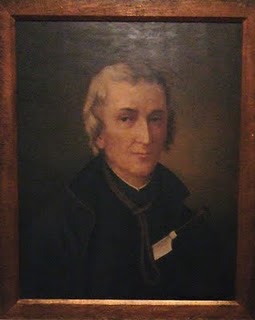
At Llantarnam Abbey, where he once lived and worked, the memory of St David Lewis burns bright. His portrait hangs in a place of honour and the Sisters treasure a relic of the Martyr. Every November, the Abbey hosts a special day of remembrance in honour of St David Lewis. Watch your local press for notification of this event. (I know, I'm a bit early with the plug! I will remind you again next November!)
ST DAVID LEWIS, PRAY FOR US.
Saturday, 30 January 2010
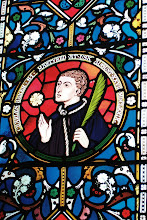
STAINED GLASS WINDOWS
(TO BETTER APPRECIATE THE THREE PHOTOS, ENLARGE THEM BY CLICKING ON EACH ONE.)
Wednesday, 27 January 2010
“TAD Y TLODION”
| St David Lewis (Photo J D Smith) |
David Lewis, (alias Charles Baker) was born in Abergavenny in 1616, the son of Margaret Pritchard and Morgan Lewis. His father, who was headmaster of Abergavenny Grammar School, raised him as a Protestant. As a young man he spent some time in Paris and while there he converted to Catholicism. Subsequently, he went to study at the English College in Rome where, in 1642, he was ordained as a Catholic priest. Three years later he became a Jesuit.
Father David Lewis returned to his native Wales and with the exception of a brief period in Rome, he spent his priestly life labouring for the people of Monmouthshire and area. He was greatly loved and, for his kindness to all, he was known as ‘Tad y Tlodion’, ‘Father of the Poor’. Father Lewis became a victim of the evil Titus Oates. He was arrested at Llantarnam on 17th November 1678 and was brought for trial at the Lenten Assizes in Monmouth on 16th March 1679. He was brought to the bar on a charge of High Treason, that is, for having become a Catholic priest and remaining in the country. He pleaded not guilty to the charge of being an accessory to the Popish Plot but several witnesses claimed they had seen him say Mass and perform other priestly duties. For this he was found guilty and the judge, Sir Robert Atkins, sentenced him to death. The condemned priest was brought to Newgate Prison in London with Fr John Kemble and questioned about the “plot” but Oates and his henchmen were unable to prove anything against him. Lord Shaftsbury advised him that if he gave evidence about the “plot” or renounced his Catholic faith his life would be spared and he would be well rewarded. The heroic priest said in his dying discourse, “discover the plot I could not, as I knew of none; and conform I would not, for it was against my conscience”. He was brought back to Usk Gaol to await his execution.
Fr David Lewis was martyred on 27th August 1679. He was taken from his cell in Usk Gaol and carried on a hurdle to a place known as the Coniger and the dreadful sentence was carried out. His body was taken in procession to the churchyard of St Mary's Priory Church, Usk, and there it was buried. His is the grave closest to the main door of the church. Every year on the Sunday nearest to 27th August there is a pilgrimage to this holy site.
| Grave of St David Lewis (Photo J D Smith) |
In October 1970, Pope Paul VI canonised the Forty Martyrs of England and Wales. Fr David Lewis, the last Welsh Martyr, was one of the Forty.
Friday, 22 January 2010
"BE THOU MY VISION" ALWAYS!
Sunday, 17 January 2010
Stories of Hope and Sadness amid earthquake ruins
RELICS OF ST DAVID LEWIS
The word “relic” comes from the Latin “reliquiae” and it means “remains”.
Saint Jerome said, “We do not worship, we do not adore, for fear that we should bow down to the creature rather than to the creator, but we venerate the relics of the martyrs in order the better to adore Him whose martyrs they are.”
In August 1679, at the
There are many known relics of St David Lewis still in existence. At Stonyhurst, there are several small unidentified relics of David Lewis. A small travelling chalice owned by St David Lewis is kept at the Catholic Church in Abergavenny, the saint’s birthplace.
Pieces of the rope with which Fr David Lewis was hanged are in the possession of several churches in this country. The Jesuit house in Farm Street, London, is said to have two pieces, a church at Roehampton has a piece and the Church of St David Lewis and St Francis Xavier, Usk, also has a piece.
The most numerous relics of St David Lewis seem to be cloths stained with his blood. Erdington Abbey has large pieces of linen soaked in his blood. The Church at Usk, as well as its fragment of rope, has a piece of linen stained with his blood. The Carmelite Convent at Lanherne, Cornwall, has a piece of blood stained linen. The Sisters of St Joseph of Annecy at Llantarnam Abbey also treasure a piece of linen stained with the blood of the martyr.
At one time, when Llantarnam Abbey was a private house, it was owned by Lady Frances Morgan, an aunt of Fr David Lewis. For a time, the priest lived with his relatives and regularly said Mass in the chapel there. The spot where he was arrested is opposite the Abbey. The Catholic Church of St David Lewis and St Francis Xavier, Usk, is either on or directly opposite the site of the martyrdom of St David Lewis. It seems appropriate then that relics of St David Lewis are in the safe keeping of the Catholic Church in Usk and Llantarnam Abbey in Cwmbran.