Tuesday, 28 August 2012

PILGRIMAGE IN HONOUR OF ST DAVID LEWIS, 2012

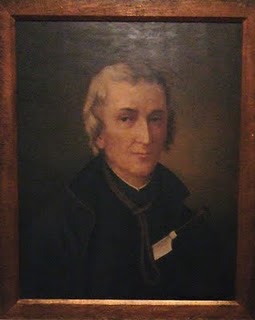
Portrait of St David Lewis in the Church of St Francis Xavier and St David Lewis, Usk

Two days ago, Sunday 26th August, the Annual Pilgrimage in honour of St David Lewis took place at Usk.  Despite the very wet summer we have experienced, the sun came out in all its splendour for the procession from Usk's Catholic Church to St Mary's Priory Church where the Martyr's remains are interred.  Below is a short video of the procession.


Mary in Monmouth has a good post about  Sunday's pilgrimage.  Click here to see it.

Monday, 27 August 2012

ST DAVID LEWIS, SUPERIOR OF THE CWM


Three hundred and thirty-three years ago today a Welsh Jesuit priest, Fr David Lewis, was executed at Usk.  His crime was to be a Catholic priest in a time when it was deemed High Treason to be a Catholic priest and to celebrate Mass in England. 
 
Plaque marking site of execution of St David Lewis
David Henry Lewis was a Monmouthshire man, born in Abergavenny in 1616.  He was the youngest of the nine children of Morgan Lewis and Margaret Pritchard.  Although David's Catholic mother brought up eight of the children in the Catholic Faith, David's Protestant father had David brought up in the Established Religion.
 
David attended the local grammar school of which his father was headmaster.   Later he went to London to study law.  He travelled to Paris as tutor to a young nobleman and while in Paris David converted to Catholicism.
 
After the deaths of his parents in 1638 David entered the English College in Rome to study for the priesthood.  He was ordained there in 1642.  Later, following in the footsteps of his Jesuit uncle, David entered the Jesuit Novitiate of Sant Andrea in Rome.  
 
After profession as a Jesuit, Fr Lewis was sent on the English Mission.  After only a year he was recalled to Rome to take up a position in his old college.  However, he soon returned to Wales and here he laboured among his own people for the remainder of his life.
 
He was twice Superior of the Jesuit College of St Francis Xavier at the Cwm, on the Monmouthshire-Herefordshire border.  According to a pamphlet published in London in 1679, the Cwm consisted of spacious houses with several entrances and secret passages between some of the rooms.  Underneath the buildings there were extensive cellars, accessible both from inside and outside the houses - useful strongrooms where valuables could be hidden.  From one room a tunnel ran out into the neighbouring woods, in which there were many caves.  Remote and secluded, the Cwm was an ideal meeting place for Catholics on both sides of the Anglo-Welsh border.


The site of the Jesuit College, The Cwm
The Cwm had been known to the government authorities since as early as 1660 and possibly earlier.  However it was not until December 1678 that the Lords ordered an investigation by the Bishop of Hereford, Herbert Croft.  Croft had the enthusiastic support and assistance of John Arnold, John Scudamore and Charles Price. 
 
By this time, all the priests had been evacuated from the Cwm.  In fact, the Superior, Fr David Lewis, was a prisoner in Monmouth Gaol and had been since his arrest at Llantarnam on 17th November 1678.  Some priests found shelter with recusant families, others, including Fr Philip Evans were imprisoned, and others, hunted like wild beasts, sheltered in caves or woods.
 
While the raid did not turn up any hidden priests, it did yield a store of church plate, vestments and books.  Bishop Croft added many of the stolen books to his Cathedral Library. 
 
 
Viewing some of the Cwm books in Hereford Cathedral Library
Recently we had the very great privilege of being permitted to view some of the confiscated books from the Cwm Library.   Dr Rosemary Firman, librarian of Hereford Cathedral, showed us several books which are known to have come from the Jesuit Library at the Cwm.  One of the books was inscribed with the name of Thomas Gunter.  Thomas Gunter had a secret chapel in his mansion on Cross St in Abergavenny where Frs David Lewis and Philip Evans said Mass and administered the Sacraments to the Catholics who crowded into the attic chapel.  Dr Firman imparted many interesting facts about the books and, quite honestly, we were more than a little awed to be looking at books which had very likely been held, consulted or  read by St David Lewis over three hundred years ago.
 
For some very interesting information about the Jesuit Library at the Cwm visit Hannah's excellent blog here
 
Fr David Lewis was executed at Usk on 27 August 1679.  He was beatified in 1929 and Canonised as one of the Forty Martyrs of England and Wales in 1970.

Wednesday, 22 August 2012

ST JOHN KEMBLE


THE EXECUTION OF ST JOHN KEMBLE

John Kemble, alias Holland, was born at Rhydicar Farm, St Weonard’s, Herefordshire in 1599. He was the son of John Kemble and Anne Morgan. He and St David Lewis were cousins. John Kemble’s mother, Anne Morgan, was a relative of David Lewis’s father, Morgan Lewis. John was ordained a priest at Douai on 23rd February 1625 and, on 4th June, was sent upon the English Mission. He spent the next 54 years labouring for the people of Herefordshire and Monmouthshire. He was greatly loved by his own people and respected throughout the area because, it was said, “he gave offence to none”.


In 1678, Fr John Kemble became another innocent victim of the non-existent Popish Plot. A lapsed Catholic, Captain John Scudamore of Kentchurch, was sent to arrest Fr Kemble at Pembridge Castle, where the aged priest was staying with his relatives. When urged to flee, the 80-year-old priest said, “According to the course of nature I have but a few years to live. It will be an advantage to suffer for my religion and therefore I will not abscond.” After three months in Hereford Gaol, he endured an agonizing journey to London where he and Fr David Lewis were lodged in Newgate Prison. They were interrogated by Oates and his fellow plotters but, since no evidence of involvement in any plot could be found, he was sent back to Hereford. In accordance with Statute 27 of Elizabeth I, he was tried for treason, i.e., for being a Catholic priest and saying Mass. He was found guilty and condemned to be hanged, drawn and quartered.


On the morning of his execution, Fr Kemble made his devotions as usual. He then drank a cup of sack and smoked a pipe of tobacco with the undersheriff, Mr Digges, and the prison governor. (This is the origin of the Herefordshire custom of calling a parting drink or smoke a “Kemble Cup” or a “Kemble Pipe”.) Before his execution on Widemarsh Common, the good priest forgave those who had conspired against him and asked forgiveness of any whom he may have offended. He consoled the distraught hangman thus, “Honest Anthony, my friend Anthony, be not afraid; do thy office. I forgive thee with all my heart. Thou wilt do me a greater kindness than discourtesy.” He prayed silently for a few minutes then commended himself to God. The cart was drawn away and he was hanged. Such was the affection for Fr Kemble that he was allowed to die upon the gallows before being beheaded. He was also spared the grisly ritual of drawing and quartering. It was said, even by his persecutors, that they never saw one die so like a gentleman and so like a Christian. 


When the Martyr’s body was cut down from the scaffold, he fell with his hand beneath his head.  When he was beheaded, the hand was also cut off.  A devout woman in the crowd picked up the hand and carried it home in her apron.  For many years the hand was preserved in a small red wood box.  Eventually, it was given to the Catholic Church of St Francis Xavier, Hereford.    Near the end of the nineteenth century, a Mr Monteith of Carstairs presented the parish with a magnificent jewel- studded silver reliquary in which the hand now lies.  It can be seen today to the right of the High Altar.     
The Martyr's severed hand

 The martyr’s nephew, Captain Richard Kemble, who had saved the life of King Charles II at the Battle of Worcester, took the mutilated body to the church at Welsh Newton and buried it beside the churchyard cross. The gravestone is inscribed “J K Dyed the 22 of August Anno Do 1679”. There is a pilgrimage to the Saint’s grave every year on the Sunday nearest to 22nd August.


On 25th October 1970, St John Kemble and thirty-nine others were canonised by Pope Paul VI as the Forty Martyrs of England and Wales.

Sunday, 12 August 2012

ANNUAL PILGRIMAGE IN HONOUR OF ST DAVID LEWIS


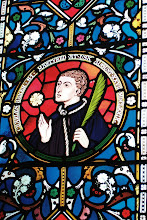
St David Lewis depicted in a stained glass window in the Catholic Church, Porth-y-Carne St, Usk

The Annual Pilgrimage in honour of St David Lewis will take place on Sunday 26th August 2012.  The programme is as follows:


3:00 p m:  Benediction of the Blessed Sacrament at the Catholic Church of SS Francis Xavier and St David Lewis, Porth-y-Carne St, Usk.
Ss Francis Xavier  & David Lewis Church, Porth-y-Carne St, Usk


Immediately Following Benediction, there will be a procession to the Martyr's grave at the Priory Church of St Mary, Usk.
The grave of St David Lewis, Priory Church, Usk

After a short service at the graveside, refreshments will be served in the Parish Hall, Porth-y-Carne St.

Tuesday, 7 August 2012

PILGRIMAGE TO THE GRAVE OF ST JOHN KEMBLE


THE GRAVE OF ST JOHN KEMBLE AT WELSH NEWTON
The Annual Pilgrimage to the grave of St John Kemble at Welsh Newton will take place on Sunday 19th August 2012. His Grace Archbishop George Stack will be in attendance. The programme is as follows:

10 a m: MONMOUTH
The walk begins from St Mary’s Church, Monmouth. Pilgrims are advised to bring a packed lunch.

3 p m: WELSH NEWTON
Rosary, Readings and prayers at the grave of St John Kemble in the churchyard of St Mary the Virgin, Welsh Newton, Herefordshire.

4:15 p m: MONMOUTH
Benediction at St Mary's Church, Monmouth. Following Benediction, tea will be served in the garden. 

Tuesday, 24 July 2012

OUR LADY OF BRITANNIA

I found this beautiful poem on Richard's blog, "STABAT MATER".  The poem was written by Pearl of Tyburn and Richard found it on her blog, "LONGBOWS AND ROSARY BEADS".   I was just bowled over by the beauty of this poem and I want to give you the opportunity of enjoying it too.  Thank you Pearl and thank you Richard.
OUR LADY OF THE TAPER/OUR LADY OF CARDIGAN
 
 "OUR LADY OF BRITANNIA

Thou stood on Newgate Arch and graced Pendragon’s shield,
Cardigan bore thy taper, and Walsingham thy seal,
Humbly we now beseech thee as that thy feet we kneel,
Our Lady of Britannia, Ora pro nobis!

Thy beads hung from the sword-belts of Locksley’s Merry Men,
Thy hymns were sung by choirs, O Mother Free from Sin,
This land was once thy Dowry; pray make it so again,
Our Lady of Britannia, Ora pro nobis!

When Alfred lead his warriors in battle for the land,
Thou were his source of courage, the strength that made him stand,
Seven Swords were pierced through thy heart, and one
was in thy hand,
Our Lady of Britannia, Ora pro nobis!

Thy hands are in the Highlands to show us how to pray,
Thy footprints are in Cornwall to guide us in Christ’s ways,
Direct us, Holy Virgin, if God forbid we stray,
Our Lady of Britannia, Ora pro nobis!

Thou art the Dove of Peace for Ulster’s troubled sons,
The Queen of Thorns and Blossoms, whose seat was Avalon,
Look down on us from Heaven, Most Highly Favored One,
Our Lady of Britannia, Ora pro nobis!

From Scotia’s misty moors, to Albion’s fertile plains,
From Cambria’s mountain climes, to Northern Erin’s glens,
We offer thee this land to be thy own again,
Our Lady of Britannia, Ora pro nobis!

Thy name was oft times chanted by peasants and bold knights,
Preparing for the harvest, or arming for the fight,
Though centuries have elapsed, thou’st kept us in thy sight,
Our Lady of Britannia, Ora pro nobis!

Though stormy skies did threaten, thou still remained the same,
A constant source of succor to those who called thy name,
Thou art the Gilded Lamp that held the Burning Flame,
Our Lady of Britannia, Ora pro nobis!
 
Recall the martyrs’ deaths in Christ’s own imitation,
Come rack and then come rope, they braved the tribulation,
The ruby blood they shed cries out in supplication,
Our Lady of Britannia, Ora pro nobis!

Remember this, our country, amidst the stormy sea,
O may she stand united, a stronghold for the free
But foremost make her faithful to Jesus Christ and thee,
Our Lady of Britannia, Ora pro nobis!

Sunday, 22 July 2012

ST JOHN LLOYD

St Philip Evans and St John Lloyd were two Welsh priests who shared a cell in Cardiff Castle in 1678/79.  They were executed on the same day, 22nd July 1679, at Gallows Field, Cardiff.  Most accounts of St Philip Evans and St John Lloyd are joint accounts but, although they shared so much, I think that each man’s story deserves a separate telling.  On this 333rd anniversary of their martyrdom I will endeavour to do just that.  Of course there will be similarities and crossovers but I will do my best to give a brief account of their individual stories.  (LINK HERE)
St John Lloyd


ST JOHN LLOYD, a secular priest, was one of the many itinerant priests of South Wales who was caught up in the horror of the fabricated Popish Plot.  I say “fabricated” because today historians agree that the plot existed only in the warped psyche of Titus Oates and his perverted fellows. 

John Lloyd was the son of Walter Lloyd.  He was born into a devout Catholic family in Brecon around 1630.  John entered the Royal College of St Alban at Valladolid in 1649 and took the customary oath to return to the English Mission.  He was ordained on 7th June 1653.  The following April he left for his homeland.  Fr Lloyd spent the next twenty-four years labouring among the Catholics of Glamorgan and Monmouthshire. 

He was known to frequent the home of John Turberville at Penllyn.  He also stayed at the home of Walter James at Trivor near St Maughans.  At Trivor one can still see the room once used as a chapel.  There is a niche in the wall where a statue or crucifix would have been placed, probably above the altar.  Finding shelter at these and other Catholic recusant homes, the intrepid priest did not spare himself in celebrating Mass, administering the sacraments and caring for the needs of his oppressed flock.  At this very dangerous time, John Lloyd’s brother, Fr William Lloyd, was also working among the Catholics of South Wales.  Fr William Lloyd was head of the secular clergy in South Wales.

The niche in the wall of the secret chapel at Trivor

In 1678 the first rumblings of the Oates Plot/Popish Plot crept across the country.  It was a time when fear and suspicion lurked in the hearts of ordinary decent people for the safety of every man depended on who was in power at any given time.  Protestants had suffered much under Catholic Queen Mary.  There had been Catholic plots and rumours of Catholic plots so it was easy for Titus Oates and his iniquitous ilk to foment the horror that was unleashed by the Oates Plot.

On 20th November 1678 Fr John Lloyd was arrested at the home of John Turberville at Penllyn.  He was taken to Cardiff Castle Gaol where he was imprisoned, possibly in the Black Tower.  For a time he was kept in solitary confinement. Eventually he and Fr Philip Evans S J, who was arrested on 4th December, were permitted to share a cell.  Coincidentally, both Fr Lloyd and Fr Evans had sisters who were Blue Nuns in Paris.  Fr Lloyd’s sister, Mother Margaret Bruno, had died four years earlier, in 1674.

On 9th May 1679 the Assizes opened in the Shire Hall within the Castle grounds.  Fr Lloyd was indicted as a Catholic priest and therefore a traitor.  He was found guilty and sentenced to be hanged, drawn and quartered. 

At the height of the Plot, Fr William Lloyd was arrested and imprisoned in Brecon Gaol.  He too was found guilty of being a Catholic priest and performing the functions of a priest.  Like his brother, he was sentenced to be hanged, drawn and quartered.  However, Fr William Lloyd was treated so harshly in prison that he died in Brecon Gaol just days before his scheduled execution.

The day of Martyrdom arrived for Fr John Lloyd on 22nd July 1679.  He and Fr Philip Evans were dragged on a hurdle to Gallows Field (often referred to today as ‘Death Junction’).  Fr Lloyd had to stand and watch as the young Jesuit who had been his cellmate and friend was butchered before his eyes.  Then he was subjected to the same barbaric death.  Fr John Lloyd was forty-nine years old.

Plaque in St David's Cathedral, Cardiff

There was great rejoicing in Rome and in Britain on Sunday 25th October 1970.  On that day, Pope Paul VI canonised forty Catholics who had died for their faith during the sad years of religious persecution in England.  After years of investigation and scrutiny, the forty had been chosen from the hundreds who had given their lives for the Old Faith.  On that happy day Fr John Lloyd became known as St John Lloyd, one of the Forty Martyrs of England and Wales.      

Saturday, 21 July 2012

ST PHILIP EVANS S J

St Philip Evans and St John Lloyd were two Welsh priests who shared a cell in Cardiff Castle in 1678/79.  They were executed on the same day, 22nd July 1679, at Gallows Field, Cardiff.  Most accounts of St Philip Evans and St John Lloyd are joint accounts but, although they shared so much, I think that each man’s story deserves a separate telling.  As the 333rd anniversary of their martyrdom approaches I will endeavour to do just that.  Of course there will be similarities and cross overs but I will do my best to give a brief account of their individual stories.  (LINK HERE)
The Parish Church at Llangattock Vibon Avel which contains monuments
to members of the Evans family
PHILIP EVANS was born at Monmouthshire in 1645.  He was the son of Winifred Morgan of Llanvihangel Crucorney and William Evans of Llangattock Vibon Avel, near Monmouth.  Philip was educated at St Omer and he entered the Jesuit Novitiate at Watten on 7th September 1665.  When he completed his training he was ordained at Liege in 1675 and sent upon the English Mission.

17th century chalice believed to have 
belonged to St Philip Evans
Back in Wales, Fr Philip Evans S J worked diligently for four years, saying Mass, administering the Sacraments and preaching in Welsh and English.  It is known that the young Jesuit, along with Fr David Lewis, regularly stayed at the home of Thomas Gunter of Cross Street in Abergavenny.  Here he celebrated Mass and tended to the needs of the Catholics of the area.  The Catholic Church at Abergavenny has in its possession a small travelling chalice which is thought to have been owned by Fr Evans.  He also stayed at the homes of Charles Prodger of Wernddu and of Christopher Turberville of Sker House and cared for the Catholics in these locations.

During the wave of persecution generated by the Popish Plot, friends advised Fr Evans to go into hiding.  However, he refused and bravely continued his work.  On 4th December 1678, the priest was arrested at Sker House, betrayed by the owner’s younger brother, Edward Turberville, a lapsed Catholic.  Philip Evans was imprisoned in Cardiff Castle Gaol and kept in solitary confinement in the dungeon.  After several weeks he and another Welsh priest, Fr John Lloyd, were permitted to share a cell. Fr Lloyd, a secular priest, had been arrested in November.

The following May, Fr Philip Evans was tried at Cardiff Assizes, found guilty of the treasonable offence of being a Catholic priest, and sentenced to death.  The execution was delayed for some time and Fr Evans was even allowed out of prison for recreation!  Eventually, on 21st July 1679, orders arrived that his execution was to take place the following day.  At that time he was playing tennis on the court near St John’s Church.  When the gaoler went to the tennis court to tell the priest the news and to return him to prison, Fr Evans remarked, “What haste is there?  Let me first play out my game.”   This he did!

St Philip Evans S J,
with his harp
Fr Evans had a sister, Sister Barbara Catherine, who was a Blue Nun in Paris.  When he returned to his cell after his game of tennis, he wrote to her. He told her of his approaching death and insisted that she should not mourn for him but be joyful.  He asked her to pray for him and promised that he would pray for her. 

Philip was a skilled harpist and when the officials came the next morning to lead him to his execution they found the priest joyfully playing the harp.  His legs had been bound with heavy chains.  They were so tight that the struggle to remove them lasted more than an hour and caused the poor priest indescribable agony.

Fr Philip Evans was then taken to the place of martyrdom.   When he mounted the scaffold Fr Evans said; “This is the best pulpit a man can have to preach in, therefore, I cannot forbear to tell you again that I die for God and for Religion’s sake.”  He addressed the crowd in English and in Welsh, then turning to Fr Lloyd, who stood waiting his own turn, he said, “Adieu, Mr Lloyd!  Though only for a little time, for we shall soon meet again.”

On 22nd July 1679, thirty-four year old Fr Philip Evans S J was hanged, drawn and quartered at Gallows Field (the northern end of Richmond Road) Cardiff.   He was beatified in 1929 and canonised in 1970.  St Philip Evans is one of the Forty Martyrs of England and Wales.

Thursday, 12 July 2012

"A TRUE RELIGIOUS OF ST FRANCIS"

Today, 12th July, we celebrate the Memorial of a Welsh Franciscan, St John Jones.

ST JOHN JONES O F M
John Jones was born to recusant Catholic parents at Clynnog Fawr near Caernarvon, Wales. The date of his birth is uncertain but it was possibly around 1530. He entered the Observant Franciscan Convent at Greenwich, taking the name of Godfrey Maurice. At its dissolution in 1559 he and his fellow friars fled to the Continent and John was professed at Pontoise, France.

After many years John travelled to Rome where he stayed at the Ara Coeli Franciscan Observant House. Then, in 1591, he joined the Roman Province of the reformed Franciscan Order of Strict Observance. (This was one of the strictest orders and the first to be suppressed by King Henry VIII.)

Despite being aware that a priest going on the English Mission often ended his days being hanged, drawn and quartered, John Jones begged his superiors to send him. They acquiesced and he was granted an audience with Pope Clement VII from whom he received a special blessing. Pope Clement told him “Go, for I believe that you are a true religious of St Francis. Pray to God for me and for His Holy Church.”

The Franciscan Friar arrived in London in late 1592. At first he worked in the London area, finding shelter in the London house of St Anne Line. Eventually he extended his work to different parts of the country. At that time it was necessary for Catholic priests working clandestinely in the country to use one or more aliases. John Jones had several. He was also known as John Buckley, John Griffith and Godfrey Maurice. He was held in high esteem by his fellow Franciscans and they elected him as their Provincial.

SITE OF INFAMOUS CLINK PRISON
In 1596 Fr Jones was captured by the ruthless Richard Topcliffe and sent to the infamous Clink prison. Topcliffe held a deep hatred of Catholics and would stop at nothing to eradicate the Faith in England. John was mercilessly tortured and even scourged. The priest was then taken to Topcliffe’s house where the torture continued. Astonishingly, the Queen allowed Topcliffe to maintain a private torture chamber in his house for the interrogation of the Catholic priests he apprehended.

On 3rd July 1598 Fr John Jones was brought to trial for having exercised his ministry as a Catholic priest in England. He was tried alongside Jane Wiseman and Robert Barnes. The charges against Wiseman and Barnes were that they had feloniously received and comforted a priest. Fr Jones said he had never been guilty of any treason against his Queen or country and that he wished his case to be referred to the conscience of the judge rather than to an ignorant jury. Judge Clinch informed him that they were aware he was no plotter but he was a Romish priest who had returned to this country contrary to the statute of 1585 and this was deemed to be High Treason. (Statute 27 Elizabeth)

At the trial, Robert Barnes was permitted to make a long defence by which he disproved the evidence against them and exposed the underhand and brutal methods used by Topcliffe to obtain evidence against Catholics. As a result of this trial, Topcliffe was discredited and shortly after he retired to the country. Nevertheless, Barnes and Wiseman were condemned to death but they were later reprieved.

Fr Jones was found guilty of High Treason and sentenced to be hanged, drawn and quartered. Early on the morning of 12th July 1598, he was taken to St Thomas Waterings, Southwark, where Albany Road meets the Old Kent Road. Here he had to stand and wait for an hour because, amazingly, the hangman had forgotten to bring the rope! John used the hour well, saying his prayers and preaching to the crowd who had come to witness the martyrdom of this well loved priest. When the rope was finally brought, John Jones was hanged until dead. His body was then cut down, disembowelled and quartered. His quarters were fixed atop poles on roads to Newington and Lambeth and his head displayed in Southwark. Some brave Catholics later recovered his body parts. This was a dangerous thing to do and at least one of the Catholics was caught and imprisoned for this act.

In 1929 John Jones O F M was beatified by Pope Pius XI. On 25th October 1970, Pope Paul VI canonised two Franciscans, Fr John Jones and Fr John Wall, and thirty-eight others as the Forty Martyrs of England and Wales.

Sunday, 24 June 2012

THE FEAST OF ST JOHN THE BAPTIST

In writing about St John the Baptist, E LeJoly said:

“John the Baptist points to God, a signpost on the way of life, for men to see and obey.  John the Baptist comes as a witness.  Filled with love for God, he has one thought, one concern, one purpose: to direct men’s minds and hearts to the Saviour who comes, to the Light of men, that they may turn to Him and believe in Him.”

In St John’s Gospel we read that John the Baptist “Came to bear witness to the Light.”  LeJoly tells us that John bears witness through his mode of life and through his preaching.  “There is no greater calling than to witness to the Light, that men may believe in Jesus.  The Father sent John to be the herald announcing His Son.  The Holy Spirit inspired him as he inspired the older prophets and the apostles and saints of the New Testament.  They witnessed by their personality, their speech, their life, even unto the shedding of their blood.  They witnessed to Christ under the lash, on the gridiron, chained in prison.  They proclaimed Him the Lord when stoned, bound to crosses, thrown to wild beasts.”

St David Lewis bore witness to Christ by his personality and his mode of life.   He studied at the English College in Rome and an entry in the College Diary describes him as “Vir prudens et pius”, that is “a wise and holy man”.  Later, in his ministry in Wales, he travelled the countryside, usually at night, on foot or on horseback to care for the persecuted Catholics.  But no person, Catholic or otherwise, was outside his love and concern and his kindness to all earned for him the affectionate appellation of “Tad y Tlodion” or “Father of the Poor”.

Like St John the Baptist and the saints and martyrs of the New Testament, St David Lewis bore witness to the Light by the shedding of his blood.  As he prepared to celebrate Mass on Sunday, 17th November 1678, Fr David Lewis was arrested at Llantarnam.  Betrayed by his so called friend, John Arnold, he was conveyed to Monmouth Gaol where he was incarcerated for several months.  Then, on a bitterly cold day in the dead of winter, 13th January 1679, he was moved to Usk Gaol.  At the March Assizes in Monmouth, David Lewis was condemned as a Catholic priest who said Mass.  In passing sentence, Judge Atkins said, “He that uses to read Mass commits treason”.  Convicted of High Treason, Fr Lewis was sentenced to be hanged, drawn and quartered, the usual punishment for High Treason.  He was returned to Usk Gaol.

In April of 1679, Fr David Lewis, Fr John Kemble, Fr Roger Hanslip and Fr John Wall were ordered to London to be questioned by the odious Titus Oates and his fellow perjurers, William Bedloe and Stephen Dugdale.  The four priests were lodged in vile conditions in Newgate Prison.  Although they were rigorously interrogated by the trio, no evidence of involvement in any plot could be found against them.  Indeed, there was no evidence of a plot at all!  The priests were offered freedom and wealth if they would perjure themselves with details of a nonexistent plot or renounce their faith.  All four priests unequivocally refused.  They were sent back to their respective prisons to await their fate.

For Fr David Lewis S J this came on 27th August 1679.  On that summer day David Lewis gave witness by his holy manner and the courageous way in which he willingly shed his blood for Christ.  The name of St David Lewis was added to the Church’s list of Martyred Saints on 25th October 1970 when he and 39 others were canonised by Pope Paul VI in Rome.  Collectively they are known as the Forty Martyrs of England and Wales.

From the beginnings of Christianity the followers of Jesus have been persecuted.  Right down to the present day, Christians are bearing witness to Christ through persecution and death.  On this feast of St John the Baptist, let us be mindful of the sufferings of our fellow Christians around the world and keep them in our prayers.

Let us also be mindful of our great blessing of freedom of worship.  Never take it for granted! 

Friday, 15 June 2012

FEAST OF THE SACRED HEART

SACRED HEART OF JESUS, I PLACE MY TRUST IN THEE.
Once again I am posting a link to Catholic Culture.  Their page for today deals with the Sacred Heart and they do it far better than I can.  So just click here for the link or you can use the widget on my sidebar.  

Sunday, 10 June 2012

CORPUS CHRISTI

 This took place last year in Preston.  It has generated a bit of controversy but I still think it worth posting today on this feast of Corpus Christi.  What do you think?

Thursday, 7 June 2012

SUMMONED TO LONDON

St David Lewis
In March 1679, having been caught up in the fabricated Popish Plot spawned by the evil Titus Oates, Fr David Lewis S J was convicted of being a Catholic priest and saying Mass.  At that time this was considered High Treason.  The punishment for High Treason was to be hanged, drawn and quartered.  Fr Lewis was returned to his cell in Usk Gaol to await his fate. 

In late April 1679 there was a great hullabaloo in Parliament.  Word had been received that there was a plot afoot to poison Oates and his fellow lowlife, Bedloe.  Once again, there was no plot but, as Canon J Barrett Davies tells us, “The Government had not been able to produce any evidence to lend substance to the inventions of Titus Oates, and no doubt they felt it was high time a real Catholic priest was implicated or the commonalty might become as sceptical about the Plot as His Majesty was already known to be”. 

The House of Lords Journal for 28th March 1704 records;

“23 rd April 1679, Upon report from the Lords Committees for Examinations, that their Lordships find it requisite that David Lewis, who hath been tried and condemned as a Popish Priest at the Assizes held for the County of Monmouth, and is now in Gaol there, may be brought to Town.  It is ordered that the Sheriff for the said County of Monmouth be, and is hereby required, to take care and give order for the speedy conveying of the said David Lewis in safety from the said Gaol, to be delivered into the Prison of Newgate; the charges of which service shall be allowed to the said Sheriff upon his Account in the Exchequer.
The like Order for Roger Hanslip, in the Gaol at Gloucester.
The like Order for John Kemble, in the Gaol at Hereford.
The like Order for Francis Johnson, alias Webb, in the Gaol at Worcester.”
<>

Newgate Prison


So it came to pass that on 23rd April Fr David Lewis was ordered to be brought to London for questioning.   He was lodged in the disgusting hellhole that was Newgate Prison.  He was joined there by the three other priests, Fr John Kemble, Fr John Wall O F M (alias Francis Johnson) and Fr Roger Hanslip.   Fr Kemble, an eighty year old secular priest, and Fr Lewis were cousins.  John Wall* and David Lewis had been students together and were old friends. 
<>

St John Kemble

The journey to London was a torturous one for the aged Fr Kemble who suffered from a complaint, possibly arthritis, which made riding practically impossible for him.  Dom Bede Camm says that he made the journey strapped like a pack on the horse.  The four priests were to be examined by Titus Oates and two other miscreants involved in the Plot.  In the House of Lords Journal for 23rd May 1679 we read:
“Oates, Bedloe and Dugdale to visit condemned priests to see if they are any of those whom they knew to be concerned in the (Popish) Plot.”  It continues; 

“ORDERED, by the Lords Spiritual and Temporal in Parliament assembled, that Mr Titus Oates, Mr William Bedloe and Mr Stephen Dugdale be and are hereby appointed to repair to the Prison of Newgate this afternoon, there to see and speak with David Lewis, Roger Hanslip, John Kemble and Francis Johnson, alias Webb, condemned Popish Priests, now prisoners there; and that the said Titus Oates, William Bedloe and Stephen Dugdale do attend the Lords Committees for examining matters relating to the discovery of the late horrid conspiracy tomorrow at nine of the clock in the forenoon to give the said Lords Committees an account whether they know that any of the said Popish Priests have been engaged in the said horrid conspiracy.”


The unholy trio of examiners could find nothing to implicate the priests in any plot and, although the three were ordered to report to the Lords Committees the next day, it appears that only Oates did so.  The priests were then questioned by Lord Shaftsbury who offered each of them life as well as rich rewards if they would reveal something of the Plot or renounce their Catholic faith. 
St John Wall
Shaftsbury had wasted his breath for the priests would neither lie nor apostatize!  On 18th July, John Wall stated in a letter, “I told them I would not buy my life at so dear a rate as to wrong my conscience”.  Fr Lewis, in his last speech on 27th August, said “Discover a plot I could not, for I knew of none, and conform I would not, for it was against my conscience”.

Despite the rigorous interrogation of the four priests, nothing was found to incriminate them.  Therefore, on 28th May, an order was issued to return them to their respective gaols.  Fr Kemble was permitted to walk for most of the journey back to Hereford – no mean feat for a man of eighty!  Not surprisingly, he was in very poor health after this ordeal.   By 9th June Fr Kemble and Fr Lewis were back in their respective gaols, Hereford and Usk.

John Wall was hanged, drawn and quartered at Red Hill near Worcester on 22nd August 1679.  On the same day, at Widemarsh Common, Hereford, Fr John Kemble was executed.  Less than a week later, on 27th August, Fr David Lewis was martyred at Usk, in Monmouthshire. 

As far as I can ascertain, Fr Roger Hanslip was reprieved.  If anyone knows differently, I would be very pleased to hear from you.

*While working on the English Mission, John Wall used several aliases, including Francis Johnson, Francis Webb and Francis Dromore.

Saturday, 12 May 2012

BUT JUST WHO WERE THEY?

Of course we have all heard of the Forty Martyrs of England and Wales but just who were they?

The Forty Martyrs of England and Wales were some of the hundreds of brave, faithful Catholics who, during the dark days of persecution in this country, laid down their lives rather than apostatize.  Among them were priests, teachers, fathers and mothers.  The following is a brief breakdown of the Forty Martyrs of England and Wales.


THIRTEEN WERE SECULAR PRIESTS

           1.      Cuthbert Mayne                Launceston                  29th November 1577

2.      Ralph Sherwin                  Tyburn                        1st December 1581
St John Lloyd

3.      John Payne                        Chelmsford                 2nd April 1582

4.      Luke Kirby                        Tyburn                         30th May 1582

5.      Edmund Gennings             London                  10th December 1591

6.      Polydore Plasden              Tyburn                  10th December 1591

7.      Eustace White                   Tyburn                   10th December 1591

8.      John Boste                         Durham                   24th July 1594

9.      John Almond                    Tyburn                     5th December 1612

10.  John Southworth               Tyburn                        28th June 1654

11.  John Plessington               Chester                        19th July 1679

12.  John Lloyd                        Cardiff                          22nd July 1679

13.  John Kemble                     Hereford                       22nd August 1679

TEN WERE JESUITS

         14      Edmund Campion               Tyburn                         1st December 1581
St David Lewis S J
         15.      Alexander Briant                 Tyburn                         1st December 1581

        16.      Robert Southwell                Tyburn                         21st February 1595
         17.      Henry Walpole                    York                            7th April 1595

          18.     Nicholas Owen                    London                       2nd March 1606

19.    Thomas Garnet                    Tyburn                         23rd June 1608

20.      Edmund Arrowsmith          Lancaster                     28th August 1628

21.       Henry Morse                        Tyburn                         1st February 1645
22.      Philip Evans                         Cardiff                          22nd July 1679

23.       David Lewis                        Usk                              27th August 1679

THREE WERE BENEDICTINES

24.     John Roberts                     Tyburn                         10th December 1610

25.     Ambrose Barlow               Lancaster                     10th September 1641

26.    Alban Roe                         Tyburn                         21st January 1642
THREE WERE CARTHUSIANS

             27.     John Houghton                       Tyburn                         4th May 1535
             28.     Augustine Webster                 Tyburn                         4th May 1535
             29.     Robert Lawrence                    Tyburn                         4th May 1535

TWO WERE FRANCISCANS

              30.     John Jones                               Southwark                   12th July 1598
              31.    John Wall                                Worcester                    22nd August 1679

ONE WAS A BRIGITTINE
         32.      Richard Reynolds                   Tyburn                         4th May 1535

ONE WAS AN AUGUSTINIAN
              33.      John Stone                              Canterbury                  27th December 1539

St John Rigby
FOUR WERE LAYMEN


              34.      Richard Gwyn                         Wrexham              15th October 1584
              35.      Swithun Wells                         London                 10th December 1591
              36.      Philip Howard                         London                  19th October 1595
              37.   John Rigby                                  London                 21st June 1600


St Margaret Clitherow


THREE WERE LAYWOMEN

              38.     Margaret Clitherow    York     25th March 1586
              39.     Margaret Ward       Tyburn     30th August 1588
              40.     Anne Line        Tyburn         27th February 1601


All Forty were canonised on 25th October 1970 by Pope Paul VI.
Related Posts with Thumbnails