
Sunday, 22 March 2020


Tuesday, 12 November 2019
BLESSED PHILIP POWELL
Brecon has a proud history of loyalty to the 'Old Faith'. Families such as Powell and Lloyd have contributed much to the preservation of the Faith in that area and, as priests, shed their blood as Martyrs. One such priest was Philip Powell.
 |
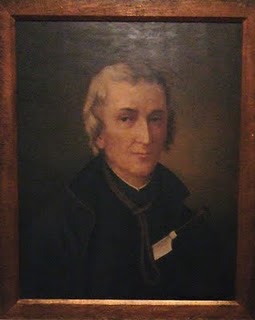
| Blessed Philip Powell, O S B |
 | |
| Dom Augustine Baker, O S B (Photo by J D Smith) |
On 7th March 1622, Fr Powell was sent on the English Mission. For sixteen months he lived with Dom Augustine in Gray's Inn Lane, London. In an attempt to elude the priest hunters, it was customary for priests working covertly on the English Mission to assume an alias. Thus, Fr Philip Powell was also known as Philip Morgan or Philip Prosser. For about twenty years Fr Powell worked in the areas of Cornwall, Devon and Somerset. When Civil War erupted, the priest went to Cornwall and served as Chaplain to the Catholic soldiers in General Goring's army.
After Goring's force disbanded, Fr Powell took ship for South Wales in an attempt to reach Monmouthshire. Unfortunately, the ship was captured off Mumbles and on 22nd February 1646 Philip Powell was arrested by Captain Crowther. Crowther kept him confined in the ship until 11 may when he sent him to London to be imprisoned in St Catherine's Gaol, Southwark.
Due to the terrible conditions and harsh treatment, Fr Powell became severely ill with Pleurisy. His trial had been fixed for 30th May but it did not take place until 9th June. He was tried in Westminster Hall, where he brilliantly defended himself. Predictably, he was found guilty of being a priest and condemned to death. When the sentence of death was pronounced, Fr Powell exclaimed, "Oh what am I that God thus honours me and will have me to die for his sake?"
On 30th June 1646, the sentence was carried out and Fr Philip Powell was hanged, drawn and quartered at Tyburn. He was 52 years old. He met his death with unshaken faith in the God he had so long served and therefore, with joy. He is recorded as saying, "This is the happiest day and the greatest joy that ever befell me, for I am brought hither for no other cause or reason than that I am a Roman Catholic priest and a monk of the Order of St Benedict." His remains were buried in the old churchyard at Moorfields, London. A crucifix of his and some other relics are in the possession of Downside Abbey, Bath.
On 8th December 1929, Fr Philip Powell was Venerated when Pope Pius XI issued a decree of Martyrdom. A week later, 15th December 1929, another steadfast son of Wales, Fr Philip Powell, was Beatified by Pope Pius XI.
On 8th December 1929, Fr Philip Powell was Venerated when Pope Pius XI issued a decree of Martyrdom. A week later, 15th December 1929, another steadfast son of Wales, Fr Philip Powell, was Beatified by Pope Pius XI.
Blessed Philip Powell, pray for us.
Tuesday, 5 November 2019

Monday, 4 November 2019
GREAT UNCLE, RICHARD BAKER
St David Lewis was a member of a large and prominent Abergavenny family. Many traces and echos of his family can be found in and around the area. The magnificent Priory Church of St Mary the Virgin has several memorials to his close family members. One memorial is dedicated to his Great Uncle, Richard Baker.
Richard Baker was the eldest son of William Baker, Steward to Lord Abergavenny. Richard was born in 1497. He became an attorney at Law and practised in Abergavenny, working alongside his father. He was made Recorder of Abergavenny.
Unfortunately, Richard died suddenly in 1551, aged just 54 years. His brother, David, was summoned home from London by their father, William. David took on the work of his brother Richard and he too became Recorder of Abergavenny. David's story is a fascinating one and he eventually became a Benedictine, known as Dom Augustine Baker. He was instrumental in reviving the Benedictine Order in this country and his writings are still read and celebrated today.
Richard Baker is less celebrated and definitely not as well remembered. However, in the Herbert Chapel of St Mary's Priory Church, there is a most unusual, and slightly confusing, memorial plaque. It was placed there by his son, William Baker, sometime after 1598. You will have to crane your neck a little and look up to see this memorial on the wall but, if you want to keep up with the relatives of our local Martyr, St David Lewis, it is worth the search (and the stiff neck).
It seems that William's son, also named Richard, died in October 1598. William then had erected a brass plaque commemorating both his father, Richard, and his son, the other Richard. Are you still with me? Well, hang in there because it just might get a little cloudier!
 |
| Richard Baker's Memorial in St Mary's Priory Church (Photo J D Smith) |
"To Richard Baker, his father, and a son of the same name. To the father, once a Burgess of this Town. To a son, in later times his likeness, having departed this life in peace: the former aged 54, on 7th January 1551; the latter, 7th October, aged 41, and in the year of our salvation, 1598. To both. To the father of a numerous family who deserved well of his country, William Baker, with the respect due from a son to his father and with the greatest affection for his son, hoping to be partaker of the same happiness in the Resurrection of the Just, among the eternal spirits of the Kingdom of Heaven; intending for himself a tomb between them, being full of years, and wearied of anxiety. Because of his grief for a renowned father and his son, he has placed and dedicate this, such as it is, Sacred to their Memory."
Believe it or not, the inscription goes on a little more, still in Latin, but I don't have the translation.
So, now we have found another connection to St David Lewis. I hope that finding relationships to the Martyr helps bring home to us that St David Lewis was a real, flesh and blood man, with family and friends. They all have left echos and shadows of themselves.
Would that the faith and courage of St David Lewis reverberate in our lives.
Links to more family
First Principal of Jesus College
An Unexpected Discovery
Believe it or not, the inscription goes on a little more, still in Latin, but I don't have the translation.
So, now we have found another connection to St David Lewis. I hope that finding relationships to the Martyr helps bring home to us that St David Lewis was a real, flesh and blood man, with family and friends. They all have left echos and shadows of themselves.
Would that the faith and courage of St David Lewis reverberate in our lives.
St David Lewis, pray for us.
Links to more family
First Principal of Jesus College
An Unexpected Discovery
Saturday, 28 September 2019
ABERGAVENNY AND ST MICHAEL
 |
| ST MICHAEL THE ARCHANGEL (Photo by J D Smith) |
Skirrid Fawr played an important part in the Catholic history of the Abergavenny area. For centuries, Catholics climbed the Holy Mountain on Good Friday and on St Michael's Feast to pray in the little chapel. Even in the troubled times of the 16th and 17th centuries they defiantly carried on the practice of their faith. John Arnold testified to Parliament that "hundreds of Papists meet on top of a high hill called St Michael's Mount where is frequent meetings eight or ten times in the year." Arnold went on to say that Mass was said there and sometimes sermons were preached.
 |
| Skirrid Fawr or St Michael's Mount, Abergavenny (Photo by J D Smith) |
Abergavenny born St David Lewis (1616-1679) laboured in the area for more than thirty years. He served two terms as Rector of the Jesuit College at the Cwm and it is recorded that he said Mass at the house of Thomas Gunter in Cross Street, Abergavenny. Thomas Gunter was the son of his sister, Mary Lewis and Thomas Gunter senior. Fr Lewis also stayed at the home of his aunt, Lady Frances Morgan, at Llantarnam, and said Mass in the chapel there and conducted, weddings, christenings, and other services for the local Catholics. He is one of the priests thought to have led pilgrimages to St Michael's Mount and said Mass there in the, by this time, ruined chapel.
 |
| St David Lewis, alias Charles Baker (Photo by J D Smith) |
This rescript of Pope Clement clearly shows the importance of this awesome local landmark in the turbulent Penal times. What of the Skirrid today? Now in the hands of the National Trust, Skirrid Fawr is a popular site with tourists, hikers and others. It is still a revered holy site and this is attested to by the devout pilgrims who still wend their way up the hillside at Michaelmas in honour of the archangel Michael.
In 1886 Pope Leo XIII instructed that this prayer to St Michael should be prayed after Low Mass:
"St Michael, the Archangel, defend us in battle. Be our safeguard against the wickedness and snares of the devil. May God rebuke him, we humbly pray, and do thou, O prince of the Heavenly Host, by the power of God, thrust down into hell Satan and all the wicked spirits who wander through the world seeking the ruin of souls. Amen."
In 1964 it was decided to remove the obligation to recite this prayer after Mass and in 1965 it came into effect. However, it remained a popular prayer for private use and continued to be used on various other occasions. In 1994 its use was encourage by Pope John Paul II. In 'Regina Caeli', 24th April 1994, He wrote: "Although this prayer is no longer recited at the end of Mass, I ask everyone not to forget it and to recite it to obtain help in the battle against the forces of darkness and against the spirit of this world."
That is excellent advice from a good and holy Pope who is now a Saint.
In 1964 it was decided to remove the obligation to recite this prayer after Mass and in 1965 it came into effect. However, it remained a popular prayer for private use and continued to be used on various other occasions. In 1994 its use was encourage by Pope John Paul II. In 'Regina Caeli', 24th April 1994, He wrote: "Although this prayer is no longer recited at the end of Mass, I ask everyone not to forget it and to recite it to obtain help in the battle against the forces of darkness and against the spirit of this world."
 |
| Pope Saint John Paul II |
St John Paul II, pray for us.
St David Lewis, pray for us.
St Michael the Archangel, pray for us.
LINK TO THIS POST:
ST MICHAEL'S MOUNT AND ST DAVID LEWIS (HERE)
Saturday, 24 August 2019
TOMORROW IS THE DAY!
Don't forget, tomorrow is the day! The pilgrimage in honour of our patron, St David Lewis, will take place tomorrow, 25th August.

To learn more about St David Lewis, have a look at the official website of Friends of Saint David Lewis (link here).
Monday, 29 July 2019
ANOTHER DATE FOR YOUR DIARY!
John Kemble (link here) son of John Kemble and Anne Morgan, was born at Rhydicar Farm, St Weonards, Herefordshire in 1599. He was ordained priest in 1625 and for 54 years he laboured for the persecuted Catholics of Monmouthshire and Herefordshire. In 1678 Fr Kemble became another innocent victim of the sordid and fabricated Popish Plot (link here) The 80 year old priest was arrested at Pembridge Castle and confined to Hereford Gaol. He was tried for the treason of being a Catholic priest, found guilty and sentenced to be hung, drawn and quartered.
 |
| The execution of Fr John Kemble (Photo J D Smith) |
 |
| The grave of St John Kemble, Welsh Newton (Photo J D Smith) |
Fr John Kemble is one of the Forty Martyrs of England and Wales (link here) canonised by Pope Paul VI in 1970. There is an annual pilgrimage to the Saint's grave and this year's pilgrimage will take place on Sunday, 18th August 2019 at 3 pm at Welsh Newton.
Saturday, 27 July 2019
FOR YOUR DIARY!
 |
| St David Lewis, portrait in Llantarnam Abbey (Photo J D Smith) |
Saint David Lewis, the last Welsh Martyr, was executed on 27th August 1679. The site of his martyrdom is in the grounds of Porth Y Carne House, opposite the Catholic Church in Usk.
Every year, on the last Sunday of August, a pilgrimage in the Saint's honour (click here) takes place from the Catholic Church to his grave in the churchyard of St Mary's Priory Church.
 |
| St David Lewis was martyred on or near this spot in 1679 (Photo J D Smith) |
 |
| St Mary's Priory Church, Usk (Photo J D Smith) |
Wednesday, 24 July 2019
ANOTHER FAITHFUL WELSH CATHOLIC
On 5th July 1589, four Catholic men were executed at Oxford. They were Fr George Nichols, Fr Richard Yaxley, and laymen Thomas Belson and Humphrey Pritchard.
 |
| Bridge of Sighs, Oxford (J D Smith) |
 |
| Plaque marking site of Martyrdom (J D Smith) |
Humphrey Pritchard was arrested at The Catherine Wheel and, accused of being a traitor because of his Catholic Faith, he was sent to Bridewell Prison, London. After being examined and tortured in London, Humphrey and his three companions were returned to Oxford where they were tried and sentenced to be hung, drawn and quartered. On 5th July 1589 the barbaric sentence was carried out at what is now the junction of Holywell Street and Longwall Street. Humphrey Pritchard was the last of the four to be executed and as he mounted the scaffold he called out: “I call you all to witness, in the presence of God and His holy angels, that I am a Catholic and that I am condemned to die for the confession of the Catholic Faith. I die willingly.”
 |
| Plaque in University Church of St Mary the Virgin, Oxford. Humphrey Pritchard's is the third name from the top of column three. (J D Smith) |
What became of the widow who owned The Catherine Wheel? She, poor lady, was condemned to Perpetual Imprisonment!
THIS STEADFAST AND FAITHFUL WELSHMAN, HUMPHREY PRITCHARD, WAS BEATIFIED ON 22nd NOVEMBER 1987 BY POPE JOHN PAUL II.
Monday, 22 July 2019
ON THIS DAY IN 1679
On this day, 22 July, in the year 1679, two Welsh Catholic Priests were hung, drawn and quartered at Gallows Field, Cardiff. Brecon born secular priest, Fr John Lloyd and Jesuit Philip Evans were caught up in the evil plot spawned in the fetid mind of Titus Oates and executed for being Catholic priests and exercising their ministry in the country. Both priests were canonised in 1970 by Pope Paul VI.
To learn more about St John Lloyd click here

To learn more about St Philip Evans click here

Tuesday, 23 April 2019
VENERABLE EDWARD MORGAN
Today, 23rd April, our thoughts turn to some famous people who are embedded in our culture. Today is the Feast of St George, Patron Saint of England. It is also the birth date of William Shakespeare.
However, there is another I wish to remember on this Blog today. A fellow countryman of our beloved St David Lewis, Edward Morgan was born in Flintshire, North Wales. He studied at the English Colleges of Rome, Madrid and Valladolid. In 1621 Edward Morgan was ordained priest at Salamanca.
 |
| St George, Patron Saint of England |
 |
| Photo J D Smith |
 |
| Photo J D Smith |
 |
| Pope Leo XIII (1878-1903) |
Friday, 29 March 2019
SR CELSUS, LOYAL FRIEND OF ST DAVID LEWIS
I wish to dedicate this post to a loyal and devoted friend of St David Lewis, Sr M Celsus Taylor who has been called home to God. The following announcement is taken from the South Wales Argus:
"SISTER M CELSUS TAYLOR
Sisters of St Joseph Sister M. Celsus Taylor Peacefully on 23rd March 2019 at St Joseph's Convent, Llantarnam Abbey, aged 96 years. Funeral Mass on Thursday, 4th April in Llantarnam Abbey Chapel at 10am followed by interment at the Abbey Cemetery. Family flowers only. Online messages of condolence may be left at www.ptsfunerals.co.uk. Further enquiries to Phillip Tom and Sons, Pontymister. Tel: 615005"
 |
| Llantarnam Abbey |
After retirement, Sr Celsus again found herself back at Llantarnam Abbey. During this time Sr Mary of Lourdes was Parish Sister at Our Lady of the Angels Parish in Old Cwmbran. Sr Mary was an excellent and well respected Parish Sister but she was getting on in years and Sr Celsus became her assistant. Eventually, Sr Celsus took over from Sr Mary and she was welcomed as the Parish Sister. What a Parish Sister she was!
Sr Celsus immersed herself into Parish life and, working closely with then Parish Priest, Canon F O'Donnell, she worked tirelessly for the people. Nothing was too much trouble for her and her kindness and compassion quickly endeared her to all at Our Lady's.
Sr Celsus had a strong devotion to local Martyr, St David Lewis. Fr David Lewis had often stayed at Llantarnam Abbey with his relatives, the Morgans. He had been staying there when the poison of the fabricated Oates Plot swept the country. In the hope of saving his relatives trouble, Fr Lewis moved into a rented cottage next to the Blacksmith's Shop on the other side of the Road to the Abbey (opposite the Church of St Michael and All Angels). It was here that Fr Lewis was arrested on Sunday, 17th November 1678. After almost a year of imprisonment, on 29th August 1679, the good priest was executed at Usk for being a Catholic priest and saying Mass.
Fr David Lewis was canonised in 1970 as one of the Forty Martyrs of England and Wales. Sr Celsus felt that he should have more recognition in the area and so she decided to do something about it.
The group, 'Friends of Saint David Lewis', was begun by Sr Celsus. The group held its first meeting on Wednesday, 13th February 2008. Sr Celsus did much to spread devotion to St David Lewis and to make him better known and appreciated. Through her initiative, the Cwmbran Historical Society placed a commemorative plaque at the site of the Saint's arrest. Sr Celsus was also responsible for organising days dedicated to St David Lewis. These events were held at Llantarnam Abbey with Mass by a visiting priest and guest speakers with knowledge of the Saint's life and times.
Sr Celsus Taylor was a beautiful and faithful lady who did so much good for others and she will be sorely missed. I like to think that St David Lewis was one of those waiting to welcome her home on 23rd March. May her generous soul rest in the peace of Christ.
 |
| The Plaque which was placed through the initiative of Sr Celsus |
Fr David Lewis was canonised in 1970 as one of the Forty Martyrs of England and Wales. Sr Celsus felt that he should have more recognition in the area and so she decided to do something about it.
 |
| Sr Celsus and Fr John Meredith at the Blessing of the Plaque |
Wednesday, 6 March 2019
HOGAN'S "THE REDEEMER IN DEATH"
Just to help us get into Lenten mode, I am posting this photo which my husband took several years ago. I think many of you will know that it is John Hogan's masterpiece, "The Redeemer in Death" or "The Dead Christ".
 |
JOHN HOGAN'S "REDEEMER IN DEATH"
(Photo J D Smith)
|
Renowned Irish sculptor, John Hogan, executed three versions of this beautiful work in pure Carrara Marble. The first, in 1829, is now located in St Therese's Church, Dublin. The second was completed in 1833 and can be seen in St Finbarr's (South) Church, Cork. The third version, and the one pictured here, was completed 1854. It was purchased by Bishop M A Fleming and shipped across the Atlantic to St John's Newfoundland. Today, it is one of the many artistic treasures to be seen and appreciated in the Basilica of St John the Baptist, St John's.
Thursday, 28 February 2019
ST DAVID'S DAY GREETINGS
 |
Patron Saint of Wales
(PHOTO J D SMITH)
|
St David, the Patron Saint of Wales, was born about 470. His life was one of prayer and penance. St David died on 1st March but the year of his death is uncertain. He was buried in his own church and his shrine soon became one of the chief centres of pilgrimage in Britain.
On this St David's Day 2019, let us indeed be joyful and keep the faith.
A VERY HAPPY ST DAVID'S DAY TO ONE AND ALL.
Monday, 25 February 2019
ANOTHER GUNTER
Because of their relationship to and support of St David Lewis, the Gunters of Abergavenny feature prominently on this Blog Site. William Gunter was born in Raglan and I cannot say for certain if he was an ancestor of our Abergavenny Gunters. However, William Gunter is another Gunter who, like Thomas Gunter and his family, was willing to face hardship and even death for his Catholic Faith.
 |
| The home of Thomas Gunter, Abergavenny |
 |
| Cardinal William Allen |
Life for Catholics in Elizabethan England was difficult, to say the least, but the failed invasion of the Spanish Armada in 1588 made the situation far worse. The authorities were determined to show any foolhardy Catholic the awful fate that would befall them should they attempt a plot or uprising. To this end, new gallows were hastily erected in different locations around London. Many Catholics were arrested and imprisoned by the authorities. Fr Gunter was among them. The priest admitted that he had reconciled others to the Catholic Faith and declared that he would continue to do so if he could. Thus Fr Gunter sealed his own fate and he was condemned to death without a trial by jury.
On 28th August 1588, 21 priests were martyred. Queen Elizabeth I had shown a modicum of mercy. Fr Gunter would not suffer the sentence of being hanged, drawn and quartered. He would just be hanged! It is said that on hearing this, the priest replied that it was fitting because he was not worthy to suffer as much as his brethren. He was taken to Shoreditch where the sentence was carried out.
The sacrifice of William Gunter was recognised in 1986 when, on 10th November, Pope John Paul II issued a decree of martyrdom declaring Fr Gunter Venerable. The next step to canonisation came on 22nd November 1987 when Pope John Paul II declared Fr William Gunter Blessed.
There you have it. Another brave and faithful Gunter and another Welsh Martyr. Blessed William Gunter, ora pro nobis.
 |
| The Tyburn Tree |
The sacrifice of William Gunter was recognised in 1986 when, on 10th November, Pope John Paul II issued a decree of martyrdom declaring Fr Gunter Venerable. The next step to canonisation came on 22nd November 1987 when Pope John Paul II declared Fr William Gunter Blessed.
There you have it. Another brave and faithful Gunter and another Welsh Martyr. Blessed William Gunter, ora pro nobis.
Subscribe to:
Posts (Atom)




.JPG)

.JPG)


