Saturday, 29 August 2020

341 YEARS AGO TODAY

ABERGAVENNY, BIRTHPLACE OF ST DAVID LEWIS
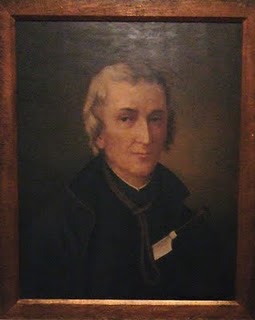
David Henry Lewis was born in Abergavenny in 1616. He attended King Henry VIII Grammar School in the town. At that time his father, Morgan Lewis, was Headmaster.  David then went to London to study law.  During a stay in Paris, David converted to Catholicism.  Returning to Abergavenny, David lived with his parents until their deaths.  After their deaths, he set out for Rome to study for the priesthood. Shortly after ordination, Fr Lewis joined the Jesuits.

KING HENRY VIII GRAMMAR SCHOOL
Sent on the "English Mission",   Fr David Lewis S J returned to his homeland. During that time of persecution it was usual for priests to work under an assumed name so David Lewis adopted the alias of Charles Baker.  For more than 30 years Fr Lewis laboured tirelessly for his flock. 

THE SITE OF THE CWM

Based at the Jesuit College of St Francis Xavier at The Cwm, David Lewis traversed the area, usually at night and on foot, ministering to the needs of the people.  His kindness and compassion knew no bounds and extended to all in need.  He was well loved and because of his care to all, he became known as "Tad y Tlodion", "Father of the Poor".

THE GUNTER MANSION, CROSS ST, ABERGAVENNY
It is recorded that Fr Lewis, as well as his fellow Jesuit, Fr Philip Evans, stayed with the Gunters of Cross Street, Abergavenny.  Relatives of David Lewis, the Gunters were staunch Catholics who had a secret chapel in their home.  The priests regularly said Mass there and conducted Catholic services.  David Lewis also stayed at the home of his aunt, Lady Frances Morgan, at Llantarnam.  The Morgans also had a chapel in their home where the priest celebrated Mass and ministered to the people of that area.

LLANTARNAM ABBEY, HOME OF THE MORGANS
The Popish Plot was a fabricated plot spread by the vile Titus Oates and his sordid ilk. When its poison  spread to Wales, Fr Lewis moved from the Morgan's home in an attempt to spare them any trouble that might befall him.  He rented a little cottage at Llantarnam, roughly opposite where the lovely old Church of St Michael and All Angels is situated.  

PLAQUE MARKING SITE OF ARREST OF ST DAVID LEWIS
Early on Sunday morning, 17 November 1678, Fr Lewis was preparing to celebrate Holy Mass. Suddenly, a group of armed dragoons burst into the cottage and arrested him.  Several days later he was incarcerated in Monmouth Gaol.  On a freezing cold day in January 1679, the Jesuit was moved to the prison at Usk. He had been found guilty of high treason for the 'crime' of being a Catholic priest and saying Mass!  Here he remained to await his execution.

THE FORMER USK GAOL 
On 29 August 1679, 341 years ago today, Fr David Lewis was taken from the Gaol on Bridge St and dragged on a hurdle along the river path to the place of his execution.  It was on a makeshift gallows at the hands of a makeshift hangman that Fr David Lewis  met his martyrdom.

THE RIVER PATH TODAY
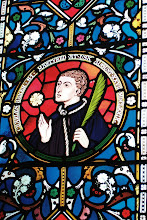
On 25 October 1970, Pope Paul VI canonised Fr David Lewis S J and 39 other Reformation Martyrs.  They are known collectively as the "Forty Martyrs of England and Wales".  Today, the Catholic Church of Ss David Lewis and Francis Xavier stands opposite the site of his martyrdom and St David Lewis is remembered with a lovely shrine in his honour.  

ST DAVID LEWIS

"Blessed be God in His Angels and in His Saints".

Saturday, 20 June 2020

BLESSED JOHN ROCHE

John Roche was born in Ireland and, as a young man, he went to London where he found work as a servant and a waterman.  As was common at that time, Catholics often worked under an alias and Roche sometimes used the name of John Neale.  A devout Catholic, he became involved with Margaret Ward and others who were aiding persecuted priests.  One such priest was Fr William/Richard Watson.  
Blessed John Roche
Fr Watson had been arrested and tortured and, upon learning of this, Margaret Ward began visiting the priest in Bridewell Prison.  Eventually she devised a plan to help the priest escape.  She smuggled a length of rope into the priest and , at a prearranged time, he was to let himself down from his cell at the top of the prison.  She found two Catholic watermen who would be waiting nearby with a boat to spirit the priest away.  However, the two watermen lost their nerve and backed out.  Margaret did not give up!  John Roche readily agreed to assist the priest.  Disastrously, the rope was too short and the priest had to jump the remaining distance.  He crashed down onto a shed below, breaking his right arm and leg.  Immediately, John Roche ran to his assistance and carried him to the boat. 

Of course, the clatter had alerted the jailor and others and the rope, still dangling from the cornice, was discovered.  Margaret Ward, being Fr Watson's only visitor, was swiftly arrested.  

John had managed to get the priest to safety and he was recuperating in John's house.  When he had recovered, John swapped clothes with him and the priest got safely away.  Sadly, John, in the priest's clothes, was spotted by the jailor who arrested him. He was vigorously interrogated and  eventually admitted his role in the escape of Fr Watson.  He was charged with treason and condemned to death.  Offered a full pardon if he would seek the Queen's forgiveness and attend a Protestant service, John Roche refused both!

On 30th August 1588, John Roche and Margaret Ward were hanged, drawn and quartered at Tyburn. Four other Catholics, including Welshman Richard Flowers, were executed with them that day.  

On 15th December 1929, Pope Pius XI beatified John Roche. He is counted among the English Martyrs and is also venerated in Ireland where his feast is celebrated on 20th June. 

Monday, 15 June 2020

OUR AMAZING PRIESTS

Throughout this awful Covid 19 pandemic, our amazing priests have been there for us.  Here in Wales, as well as in the rest of the U K, our priests have used YouTube, Facebook and all the modern technology to bring us the comforts of our Catholic Faith.  Such devoted pastoral care is not confined to this country either as priests all over the world are doing their very best for their parishioners.  Just as our priests are doing, priests everywhere are live streaming Holy Mass, Adoration and Benediction of the Blessed Sacrament,  the Rosary and Stations of the Cross.  
Holy Mass, live streamed
God has blessed us with wonderful priests and we owe them so very much. So, we say a heartfelt "Thank You" to priests everywhere.  May God shower blessings galore upon you all and keep you safe.

Wednesday, 10 June 2020

SAINTS JULIUS AND AARON

We are on home ground with these two pre-reformation martyrs.  Ss Julius and Aaron were martyred at Caerleon, which is just 7 miles from Usk, where our own St David Lewis died for the faith in 1679.

Most of what is known about Ss Julius and Aaron we glean from the writings of Bede.  In his 'History of the English Church and Peoples', Bede writes "In the same persecution (as Alban) suffered Aaron and Julius, citizens of the City of Legions."  Not too much else is known about the two martyrs.  Some legends maintain that that were Roman soldiers who were converted by the priest, Amphibalus, after his escape from Verulamium.  Some hold the belief that Aaron was a native Briton, and Julius a Roman.  It is thought that, dying soon after Alban, they were probably victims of the Diocletian persecution.  
Catholic Church of Saints Julius, Aaron
and David, Caerleon
The Catholic Church in Caerleon is dedicated to Ss Julius and Aaron.  In Wales, their feast day is celebrated with St Alban on 20th June. 

Saturday, 6 June 2020

THE PROTOMARTYR

In the month of June several martyrs are commemorated.  Over the next few weeks it might be good to take a look at some of them. So far, this blog has dealt only with Reformation Martyrs, mainly St David Lewis, but the beginning is usually the best place to start! So we will start with St Alban, thought to be the first Briton to shed his blood for the faith, and as such, the Protomartyr.  
The martyrdom of St Alban
Alban was a pagan who lived in Verulamium circa third/fourth century.  A Christian priest, possibly named Amphibalus, was fleeing persecution and Alban gave him shelter. Alban was impressed by the priest's holiness and experienced a conversion. Consequently he sought instruction in the faith from the priest.

Discovering where the priest was hiding, the authorities sent soldiers to apprehend him. They found Alban, dressed in the priest's cloak, and thinking him to be Amphibalus, they arrested him.  Alban was brought before a judge who became furious when he realised that this man was not the priest.  He ordered that Alban should receive the punishment that the priest would have been given unless he worshipped pagan gods.  Alban replied that he would never again worship such false gods and said, "If you want to know the truth about my religion, know that I am a Christian, and carry out Christian rites". The judge demanded to know to what family Alban belonged but Alban bravely replied "My parents named me Alban, and I worship and adore the living and true God, who crated all things".  The judge had Alban flogged, tortured, and  beheaded.  On the way to the place of execution, Alban converted the soldier who was to be his executioner and another had to be found to carry out the beheading.  

According to St Bede, the martyrdom took place on 22nd June but the year is uncertain.  St Alban's feast is celebrated on 20th June. 

Monday, 1 June 2020

JUNE, MONTH OF THE SACRED HEART

The month of June is dedicated to the Sacred Heart.  The Catholic Church celebrates the Solemnity of the Sacred Heart of Jesus on the Friday following the second Sunday after Pentecost.  This year, 2020, the Feast occurs on Friday, 19th June.
"Sacred Heart of Jesus, we place our trust in Thee"
St Margaret Mary Alacoque, a Religious of the Visitation Order,  was born at Lhautecour, France, on 22 July 1647.  In the 1670s she experienced visions of Our Lord in which He made know to her His desire to be loved by men and to manifest His Heart with all its treasures of love, mercy and salvation.  In one of the many private revelations that Jesus gave to her, Our Lord made twelve promises to those who honour His Sacred Heart.

1.  I will give to them all the graces necessary for their state in life.
2.  I will establish peace in their families.
3.  I will comfort them in their trials.
4. I will be their secure refuge during life, and, above all, in death.
5. I will shed abundant blessings on all their undertakings.
6.  Sinners will find in my Heart an infinite ocean of mercy.
7. Lukewarm souls will become fervent.
8. Fervent souls will rapidly grow in holiness and perfection.
9. I will bless every place where an image of my Heart shall be exposed and honoured.
10. I will give to priests the gift of touching the most hardened hearts.
11. The names of those who promote this devotion will be written in my heart, never to be blotted out.
12. I promise them in the excessive mercy of My Heart, that my all-powerful love will grant to all those who receive Holy Communion on the First Friday of nine consecutive months, the grace of final penitence.  They shall not die in My disgrace nor without receiving their Sacraments.  My Divine Heart shall be their safe refuge in this last moment.

Love of the Sacred Heart was the fire which consumed St Margaret Mary Alacoque.  She died at Paray-le-Monial on 17 October 1690.  She was canonised by Pope Benedict XV in 1920 and her feast is kept on 16 October.

This June, as the world is still struggling in the grip of the deadly Covid 19 pandemic,  let's turn once more to the Sacred Heart of Jesus, remembering especially the third promise; "I WILL COMFORT THEM IN THEIR TRIALS".

"Most Sacred Heart of Jesus, have mercy on us". 

Sunday, 31 May 2020

AN OLD IRISH PRAYER

We are nearing the end of another May. As May is Mary's month, it is appropriate that our last post for May 2020 should be in Our Lady's honour.  Therefore, we end with an old Irish prayer to Our Lady of the Wayside.
"Our lady of the Wayside,
for the sake of the Child
you hold in your arms,
take hold of my hand
for the rest of the road." 
"For the sake of the Child you hold in your arms"
(Photo J D Smith)
The spread of the dreadful Covid 19 virus seems to be lessening somewhat but it is still bringing suffering and death to people everywhere.  Please be sensible, follow the rules, keep safe and well.  Let's also ask Our Lady  to take hold of our hands for the rest of the road.

Wednesday, 20 May 2020

ANOTHER BAKER RELATIVE

As most of you will know, St David Lewis was born into a prominent  Abergavenny family in 1616.  His father, Morgan Lewis, was head master of King Henry VIII Grammar School in the town.  Morgan saw to it that David, the youngest of his nine children, was brought up in the new state religion.  David's mother, Margaret, was a devout Catholic who openly practiced her faith and brought her other children up as Catholics.  When David was a young man he spent some time in Paris. It was in this city that David converted to Catholicism.  Some years later he became a priest and, under the strict penal laws of the time, he was eventually arrested and executed for the crime of being a Catholic Priest and for saying Mass.  His remains were laid to rest in the churchyard of the Priory Church in Usk.

Some of David's maternal relatives are buried or commemorated in the very beautiful Priory Church of St Mary, Abergavenny. They were important men of their time and their memorials are easily found in that church.  Several of them have already been posted about on this blog,  (HERE) and (HERE).  Now we will post about another of the martyr's close family who is commemorated in this venerable old church.

William Baker was the son of Richard Baker. Richard, until his early death, had been Recorder of Abergavenny. Richard's brother, David, was summoned home from London and he then became Recorder.  Shaken by a profound religious experience, David Baker converted to Catholicism and  went on to became a Benedictine Monk.  He  is well know as the writer and mystic, Dom Augustine Baker  (HERE).  William was also the first cousin of Margaret Pritchard. Margaret was the wife of Morgan Lewis and the mother of St David Lewis. Below is a simple chart showing the relationship.  
William Baker and Margaret Pritchard were first cousins
As we said, William, born around 1584, was the son of Richard Baker.  It was William who had erected the Brass plaque in the Herbert Chapel in memory of his father.  William's son, also named Richard, is remembered on the memorial too. 

William Baker was a Royalist and a staunch supporter of the Stuarts.  During the Civil War he raised an army for the king's service and maintained them for three months.

William, later Sir William, was Recorder of Abergavenny and Sheriff of the county.  In 1640, he presented a bell to the town of Abergavenny.  The bell was inscribed "Bayliff Baker, 1640" This bell was taken down, recast, and re-presented to the town in 1868.  

William Baker married, in 1606, Joan, daughter of Henry Vaughan of Bredwardine Castle, Herefordshire.  Theirs seems to have been a happy marriage for at his death in 1648, Joan erected an elaborate monument to him on the north side of the Herbert Chapel.  A brass plaque informs us, in Latin,  "Here, resting in Christ, William Baker, armiger, magistrate, maintainer of justice, of unspotted integrity, of renowned judgement and eloquence, asserter of the orthodox faith, waits for the resurrection of the just.  He changed life for immortality, 30th October, in the year of our salvation1648, of his age 64, and of a happy marriage 42.  His wife, Joan, the daughter of Henry Vaughan of Bredwardine Castle, and an old family, and lord of the territory of Hereford and Brecon, of illustrious memory.  Therefore she, sorrowful and grieving, caused this monument to be erected."
William Baker's Memorial in the Herbert Chapel, Abergavenny Priory Church
(Photo J D Smith)
So, we have located another relative of St David Lewis.  Llantarnam, Usk, and various places around Monmouthshire and area speak to us of the Last Welsh Martyr. None speak louder than Abergavenny, his birthplace, and the birthplace and last resting place of so many of his family members.

Saturday, 9 May 2020

A MESSAGE OF HOPE

The world is still suffering the ravages of Covid 19.  A group of Catholic Artists have come together in song to bring us their lovely rendition of this well known song. Please take a few minutes to listen to it.  It will uplift you and renew your hope.


Friday, 1 May 2020

MARY'S MONTH

It is a centuries old custom to dedicate the month of May to the Blessed Virgin Mary.  Special ceremonies and traditions are all a part of our Catholic memories. May Crownings take place the world over and they are probably the most loved of all the traditions associated with Mary's Month.  May Altars in classrooms and homes were also very popular at one time.  Of course the Rosary has always held a special place in the hearts of Catholics everywhere.  Therefore, in the beautiful month of May, many Catholics make a sincere effort to pray the Rosary daily.
May is Mary's month
Rosary Beads have been around for a long time. Henry VIII's flagship, Mary Rose, went down off the Isle of Wight in 1545.  Early in the 1980s, the Mary Rose was raised and many well preserved items were recovered.  Among the items was a wooden Rosary. There is even a  poem which describes Robin Hood at his devotions!
"Robin Hood, Robin Hood,
Telling his beads,
All in the greenwood
Among the green weeds."
Robin Hood, "telling his beads"
Those who made prayer beads were known as "Pater Nosterers" and they commonly worked in the area surrounding St Paul's Cathedral.  Here they would display and sell an array of Rosary Beads.

The Reformation Martyrs were known to be devoted to the Rosary.  It is said that as John Boste mounted the gallows he was praying the rosary.  In a letter from prison, Alexander Bryant said that he was saying the Rosary.  It is well documented that Scottish Martyr, John Ogilvie, carried his Rosary Beads to the gallows with him.  Just before he was pushed off the gallows, he threw his beads into the crowd.  They hit a Protestant man in the chest.  That man said he would have held on to the beads except the Catholics who were there made such  a dash for them that he was afraid to keep them.
St John Ogilvie throwing his Rosary Beads into the crowd
Even as we pray the Rosary, we are reminded of Our Mother Mary's compassion and willingness to help.  In the Second Joyful Mystery, "The Visitation", the young Mary hastens to the aid of her elderly cousin, Elizabeth, who is six months pregnant with her first child.  Then in the second Luminous Mystery, "The Wedding at Cana", Jesus performs His first miracle.  At Mary's intervention He turns water into wine, thereby saving the host and the young married couple from a sad and embarrassing situation.

The word "bead" is from the Old English "bede", meaning to "request in prayer".  In this May of 2020, so blighted by Covid 19, we would do well to turn to Mary and to "request in prayer" her aid in this horrendous pandemic.  At Fatima, Mary herself said "I am the lady of the Rosary; pray the Rosary daily".  Can we answer Mary's plea?  As we struggle with the terrible illness ravaging the world, let's all ask the help of Our Lady with a Rosary a day for the month of May.  Are you up to the challenge?  
"I am the lady of the Rosary"

Wednesday, 15 April 2020

THANK YOU!

To all Healthcare workers, here and around the world, a sincere and heartfelt "THANK YOU"
May God bless and protect you all as you so bravely and selflessly care for the sick.  
"If I but touch the hem of his garment" (Matt 9:21)

Monday, 13 April 2020

THEN AND NOW!

What a difference a year makes!  The first photo was taken by my husband last April at  beautiful Tintern Abbey. 
Tintern Abbey, April 2019
The second?  I have no idea who took it but it perfectly suits April 2020!  We need to heed its message and, perhaps, to increase our prayers.
April 2020
May God in His mercy soon cleanse the world of the scourge of Covid 19. May He bless and protect us all.
Sacred Heart of Jesus, we place our trust in Thee.

Monday, 6 April 2020

"YOU HAVE REDEEMED THE WORLD"

"We adore You, O Christ, and we bless You.  Because by Your Holy Cross You have redeemed the world."
"Apart from the Cross, there is no other ladder by which we may get to heaven." (St Rose of Lima)
Related Posts with Thumbnails