Showing posts with label ABERGAVENNY. Show all posts

Tuesday, 17 November 2020

ARRESTED AT LLANTARNAM

Abergavenny born Jesuit, Fr David Lewis, had been staying with his relatives, the Morgans of Llantarnam, but was concerned that they would suffer because of him should he become  implicated in the anti Catholic hysteria that was then sweeping the country. The warped minds of the despicable Titus Oates and Israel Tonge had concocted a vile story of a Catholic plot to kill the King, Charles II, and place his Catholic brother, James, on the throne.  Of course, the leaders of this fabricated plot were supposed to be the Jesuits.  Therefore, the priest moved into a rented cottage opposite the Morgan estate.

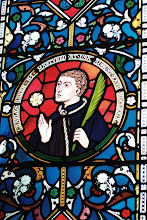
St David Lewis, window in Catholic Church, Usk
The Oates/Popish Plot was an opportunity for some politicians to further their own interests.  Although the King did not believe the snivelling little miscreant, Oates, he nevertheless had to bow to pressure from his ministers. Hence, harsh laws and punishments were enacted against all Catholics, particularly priests!

King Charles II
Early on the Sunday morning of  17 November, 1678, the good priest was preparing to celebrate Holy Mass.  Suddenly a troop of armed dragoons burst into the little house, arrested Fr Lewis, and dragged him away.  We have, in his own words, a description of that terrifying event.  Fr Lewis described his arrest: “After my full thirty years poor missionary labours in South Wales, on Sunday morning, a little before day, being the 17th November 1678, I was taken by six armed men sent by Mr John Arnold and Mr Charles Price, until then my two very good friends and acquaintances.  I was taken in a little house in the parish of St Michael-Llantarnam in the County of Monmouth.  From thence by the soldiers, together with such church stuff of mine they there found, carried I was to the house of Mr Charles Price in Llanfoist”.

Though innocent of any wrong doing (for there was no plot!) the Jesuit was found guilty of High Treason and sentenced to be hung, drawn and quartered.  After nearly a year of incarceration, first at Monmouth Gaol then at Usk Gaol, the barbaric sentence was carried out.  Fr David Lewis S J was martyred at Usk on 29 August 1679.  His crime?  He was a Catholic priest and he celebrated Holy Mass! 

Site of the arrest of St David Lewis, 
Fr David Lewis was canonised on 25 October 1970 by Pope Paul VI. Today, 17 November, is the anniversary of his arrest so we remember and give thanks for the life and legacy of one of our brave and faithful priests.

For more on the arrest of St David Lewis, just click HERE, and HERE.

St David Lewis, pray for us.

 Mary, Queen of Martyrs, pray for us.

Tuesday, 29 September 2020

ST MICHAEL AND THE ROMAN PLAGUE OF 590

Who is St Michael?  Revelation 12:7-9 shows us Michael as the champion and leader of the faithful angels in their struggle against the rebel angels who were led by Lucifer.  St Michael, whose name translates as "Who is like God", is the Guardian Angel of the Church.  He has long figured prominently in Christian tradition and is patron of policemen, sailors, soldiers, radiologists and the sick. 

St Michael, Belmont Abbey (Photo J D Smith)
Abergavenny, birthplace of our own St David Lewis, has an ancient connection to St Michael.  Legend has it that a nobleman, praying atop Skirrid Fawr, had a vision of St Michael.  The nobleman erected a chapel there and dedicated it to Michael. (Skirrid Fawr is also known as St Michael's Mount or the Holy Mountain.)  For centuries this Chapel was a centre of pilgrimage and generations of Catholics wended their way to the top of the mountain.  On Good Friday and on 29th September, Michael's feast, priests celebrated Holy Mass and led the faithful in prayer.  Even during the persecutions of the 16th and 17th centuries the pilgrimages continued and St David Lewis was among the priests who conducted services atop the Holy Mountain.

Early in the year 590, a severe plague broke out in Rome.  (According to Wikipedia, it was probably Bubonic Plague.)  As we can well imagine, it was a difficult time for the people!  This plague ravaged the city and many died, including the Pope, Pelagius II.  His successor was Pope Gregory I (St Gregory the Great).  

Pope St Gregory the Great (Photo J D Smith)
Gregory organised a massive procession around the city, asking the people to pray to God for an end to the plague.  The procession took place on 25th April 590.  The people carried an ancient image of the Virgin Mary as they chanted litanies and prayers.  When the procession reached the Mausoleum of Emperor Hadrian, the Pope saw an Angel of the Lord standing at the top of the Castle of Crescentius, wiping a bloody sword then sheathing it.  Gregory took this as a sign that the plague was ended, as indeed it was.  Thereafter, the castle was called the Castle of the Holy Angel.  

In 1753 a bronze statue of St Michael the Archangel, in Roman armor, and sheathing his sword, was placed on the top of Castel Sant' Angelo.  It was executed by Peter Anton von Verschaffelt, a Flemish sculptor and architect.

Now, in our own Covid 19 ravaged world, I definitely would NOT advocate any processions!  Even during Pope Gregory's procession, eighty people collapsed as a result of being infected by the Rome Plague!  However, I would heartily recommend putting in some extra prayers.  Today, his special feast day, might be a very good time to turn to St Michael the Archangel and ask his help in cleansing the world of our present pandemic.        

Saturday, 29 August 2020

341 YEARS AGO TODAY

ABERGAVENNY, BIRTHPLACE OF ST DAVID LEWIS
David Henry Lewis was born in Abergavenny in 1616. He attended King Henry VIII Grammar School in the town. At that time his father, Morgan Lewis, was Headmaster.  David then went to London to study law.  During a stay in Paris, David converted to Catholicism.  Returning to Abergavenny, David lived with his parents until their deaths.  After their deaths, he set out for Rome to study for the priesthood. Shortly after ordination, Fr Lewis joined the Jesuits.

KING HENRY VIII GRAMMAR SCHOOL
Sent on the "English Mission",   Fr David Lewis S J returned to his homeland. During that time of persecution it was usual for priests to work under an assumed name so David Lewis adopted the alias of Charles Baker.  For more than 30 years Fr Lewis laboured tirelessly for his flock. 

THE SITE OF THE CWM

Based at the Jesuit College of St Francis Xavier at The Cwm, David Lewis traversed the area, usually at night and on foot, ministering to the needs of the people.  His kindness and compassion knew no bounds and extended to all in need.  He was well loved and because of his care to all, he became known as "Tad y Tlodion", "Father of the Poor".

THE GUNTER MANSION, CROSS ST, ABERGAVENNY
It is recorded that Fr Lewis, as well as his fellow Jesuit, Fr Philip Evans, stayed with the Gunters of Cross Street, Abergavenny.  Relatives of David Lewis, the Gunters were staunch Catholics who had a secret chapel in their home.  The priests regularly said Mass there and conducted Catholic services.  David Lewis also stayed at the home of his aunt, Lady Frances Morgan, at Llantarnam.  The Morgans also had a chapel in their home where the priest celebrated Mass and ministered to the people of that area.

LLANTARNAM ABBEY, HOME OF THE MORGANS
The Popish Plot was a fabricated plot spread by the vile Titus Oates and his sordid ilk. When its poison  spread to Wales, Fr Lewis moved from the Morgan's home in an attempt to spare them any trouble that might befall him.  He rented a little cottage at Llantarnam, roughly opposite where the lovely old Church of St Michael and All Angels is situated.  

PLAQUE MARKING SITE OF ARREST OF ST DAVID LEWIS
Early on Sunday morning, 17 November 1678, Fr Lewis was preparing to celebrate Holy Mass. Suddenly, a group of armed dragoons burst into the cottage and arrested him.  Several days later he was incarcerated in Monmouth Gaol.  On a freezing cold day in January 1679, the Jesuit was moved to the prison at Usk. He had been found guilty of high treason for the 'crime' of being a Catholic priest and saying Mass!  Here he remained to await his execution.

THE FORMER USK GAOL 
On 29 August 1679, 341 years ago today, Fr David Lewis was taken from the Gaol on Bridge St and dragged on a hurdle along the river path to the place of his execution.  It was on a makeshift gallows at the hands of a makeshift hangman that Fr David Lewis  met his martyrdom.

THE RIVER PATH TODAY
On 25 October 1970, Pope Paul VI canonised Fr David Lewis S J and 39 other Reformation Martyrs.  They are known collectively as the "Forty Martyrs of England and Wales".  Today, the Catholic Church of Ss David Lewis and Francis Xavier stands opposite the site of his martyrdom and St David Lewis is remembered with a lovely shrine in his honour.  

ST DAVID LEWIS

"Blessed be God in His Angels and in His Saints".

Wednesday, 20 May 2020

ANOTHER BAKER RELATIVE

As most of you will know, St David Lewis was born into a prominent  Abergavenny family in 1616.  His father, Morgan Lewis, was head master of King Henry VIII Grammar School in the town.  Morgan saw to it that David, the youngest of his nine children, was brought up in the new state religion.  David's mother, Margaret, was a devout Catholic who openly practiced her faith and brought her other children up as Catholics.  When David was a young man he spent some time in Paris. It was in this city that David converted to Catholicism.  Some years later he became a priest and, under the strict penal laws of the time, he was eventually arrested and executed for the crime of being a Catholic Priest and for saying Mass.  His remains were laid to rest in the churchyard of the Priory Church in Usk.

Some of David's maternal relatives are buried or commemorated in the very beautiful Priory Church of St Mary, Abergavenny. They were important men of their time and their memorials are easily found in that church.  Several of them have already been posted about on this blog,  (HERE) and (HERE).  Now we will post about another of the martyr's close family who is commemorated in this venerable old church.

William Baker was the son of Richard Baker. Richard, until his early death, had been Recorder of Abergavenny. Richard's brother, David, was summoned home from London and he then became Recorder.  Shaken by a profound religious experience, David Baker converted to Catholicism and  went on to became a Benedictine Monk.  He  is well know as the writer and mystic, Dom Augustine Baker  (HERE).  William was also the first cousin of Margaret Pritchard. Margaret was the wife of Morgan Lewis and the mother of St David Lewis. Below is a simple chart showing the relationship.  
William Baker and Margaret Pritchard were first cousins
As we said, William, born around 1584, was the son of Richard Baker.  It was William who had erected the Brass plaque in the Herbert Chapel in memory of his father.  William's son, also named Richard, is remembered on the memorial too. 

William Baker was a Royalist and a staunch supporter of the Stuarts.  During the Civil War he raised an army for the king's service and maintained them for three months.

William, later Sir William, was Recorder of Abergavenny and Sheriff of the county.  In 1640, he presented a bell to the town of Abergavenny.  The bell was inscribed "Bayliff Baker, 1640" .  This bell was taken down, recast, and re-presented to the town in 1868.  

William Baker married, in 1606, Joan, daughter of Henry Vaughan of Bredwardine Castle, Herefordshire.  Theirs seems to have been a happy marriage for at his death in 1648, Joan erected an elaborate monument to him on the north side of the Herbert Chapel.  A brass plaque informs us, in Latin,  "Here, resting in Christ, William Baker, armiger, magistrate, maintainer of justice, of unspotted integrity, of renowned judgement and eloquence, asserter of the orthodox faith, waits for the resurrection of the just.  He changed life for immortality, 30th October, in the year of our salvation1648, of his age 64, and of a happy marriage 42.  His wife, Joan, the daughter of Henry Vaughan of Bredwardine Castle, and an old family, and lord of the territory of Hereford and Brecon, of illustrious memory.  Therefore she, sorrowful and grieving, caused this monument to be erected."
William Baker's Memorial in the Herbert Chapel, Abergavenny Priory Church
(Photo J D Smith)
So, we have located another relative of St David Lewis.  Llantarnam, Usk, and various places around Monmouthshire and area speak to us of the Last Welsh Martyr. None speak louder than Abergavenny, his birthplace, and the birthplace and last resting place of so many of his family members.

Tuesday, 12 November 2019

BLESSED PHILIP POWELL

Brecon has a proud history of loyalty to the 'Old Faith'.  Families such as  Powell and Lloyd have contributed much to the preservation of the Faith in that area and, as priests, shed their blood as Martyrs. One such priest was Philip Powell.
Blessed Philip Powell, O S B
Philip Powell was born at Trallong, Brecknockshire, to Roger ap Rosser Powell and Catherine Morgan on 2nd February 1594. Young Philip attended King Henry VIII Grammar School, Abergavenny.  The father of St David Lewis, Morgan Lewis, was headmaster and, being favourably impressed with Philip, recommended him to Dom Augustine Baker. Benedictine writer and mystic, Dom Augustine, was the uncle of Morgan's wife, Margaret, and therefore, a great uncle of St David Lewis.
Dom Augustine Baker, O S B
(Photo by J D Smith)

Dom Augustine, who was already supporting a seminarian, his nephew  John Pritchard, took on responsibility for young Philip Powell.  He supervised his law studies at Gray's Inn from 1610-14. Then, from 1614-19, and at Dom Augustine's expense, Philip was sent to Flanders to the University of Louvain, studying under Leander Jones, O S B.  He was ordained priest in 1618 and professed a monk on 15th August 1619.

On 7th March 1622, Fr Powell was sent on the English Mission.  For sixteen months he lived with Dom Augustine in Gray's Inn Lane, London.  In an attempt to elude the priest hunters, it was customary for priests working covertly on the English Mission to assume an alias.  Thus, Fr Philip Powell was also known as Philip Morgan or Philip Prosser.  For about twenty years Fr Powell worked in the areas of Cornwall, Devon and Somerset.  When Civil War erupted, the priest went to Cornwall and served as Chaplain to the Catholic soldiers in General Goring's army.  

After Goring's force disbanded, Fr Powell took ship for South Wales in an attempt to reach Monmouthshire.  Unfortunately, the ship was captured off Mumbles and on 22nd February 1646 Philip Powell was arrested by Captain Crowther.  Crowther kept him confined in the ship until 11 may when he sent him to London to be imprisoned in St Catherine's Gaol, Southwark.

Due to the terrible conditions and harsh treatment, Fr Powell became severely ill with Pleurisy.  His trial had been fixed for 30th May but it did not take place until 9th June.  He was tried in Westminster Hall, where he brilliantly defended himself.  Predictably, he was found guilty of being a priest and condemned to death. When the sentence of death was pronounced, Fr Powell exclaimed, "Oh what am I that God thus honours me and will have me to die for his sake?"  

On 30th June 1646, the sentence was carried out and Fr Philip Powell was hanged, drawn and quartered at Tyburn. He was 52 years old. He met his death with unshaken faith in the God he had so long served and therefore, with joy.  He is recorded as saying, "This is the happiest day and the greatest joy that ever befell me, for I am brought hither for no other cause or reason than that I am a Roman Catholic priest and a monk of the Order of St Benedict."  His remains were buried in the old churchyard at Moorfields, London.  A crucifix of his and some other relics are in the possession of Downside Abbey, Bath.

On 8th December 1929, Fr Philip Powell was Venerated when Pope Pius XI issued a decree of Martyrdom.  A week later, 15th December 1929, another steadfast son of Wales, Fr Philip Powell, was Beatified by Pope Pius XI.  
Blessed Philip Powell, pray for us.

Monday, 25 February 2019

ANOTHER GUNTER

Because of their relationship to and support of St David Lewis, the Gunters of Abergavenny feature prominently on this Blog Site. William Gunter was born in Raglan and I cannot say for certain if he was an ancestor of our Abergavenny Gunters. However, William Gunter is another Gunter who, like Thomas Gunter and his family, was willing to face hardship and even death for his Catholic Faith.
The home of Thomas Gunter, Abergavenny
On 29th September 1568 Cardinal William Allen set up the English Collage at Douai, France.  The college would eventually number 158 martyrs among its students.  The first was Cuthbert Mayne in 1577 and the last was Thomas Thwing in 1680.
Cardinal William Allen
William Gunter chose to travel to the English College to study for the priesthood. He was ordained in March 1587.  Within months of his ordination William was back in England working among the beleaguered Catholics.  

Life for Catholics in Elizabethan England was difficult, to say the least, but the failed invasion of the Spanish Armada in 1588 made the situation far worse.  The authorities were determined to show any foolhardy Catholic the awful fate that would befall them should they attempt a plot or uprising.  To this end, new gallows were hastily erected in different locations around London. Many Catholics were arrested and imprisoned by the authorities.  Fr Gunter was among them.  The priest admitted that he had reconciled others to the Catholic Faith and declared that he would continue to do so if he could.  Thus Fr Gunter sealed his own fate and he was condemned to death without a trial by jury. 
The Tyburn Tree
On 28th August 1588, 21 priests were martyred.  Queen Elizabeth I had shown a modicum of mercy. Fr Gunter would not suffer the sentence of being hanged, drawn and quartered.  He would just be hanged!  It is said that on hearing this, the priest replied that it was fitting because he was not worthy to suffer as much as his brethren.  He was taken to Shoreditch where the sentence was carried out.

The sacrifice of William Gunter was recognised in 1986 when, on 10th November, Pope John Paul II issued a decree of martyrdom declaring Fr Gunter Venerable.  The next step to canonisation came on 22nd November 1987 when Pope John Paul II declared Fr William Gunter Blessed.

There you have it.  Another brave and faithful Gunter and another Welsh Martyr.  Blessed William Gunter, ora pro nobis. 

Tuesday, 7 August 2018

ST DAVID LEWIS AND LLANVIHANGEL COURT

This year marks the 339th anniversary of  the martyrdom of St David Lewis. Abergavenny born David Lewis was a Jesuit priest who risked life and limb ministering to the embattled Catholics of Monmouthshire and surrounding areas during the dreadful days of Penal Laws against Catholics.  It was against the law to be a Catholic and those who chose to stubbornly stay loyal to the "Old Faith" did so at great financial as well as  personal risk.  To be a Catholic Priest was considered High Treason and, if found guilty, the punishment was to be hanged, drawn and quartered.
 St David Lewis, Llantarnam Abbey (Photo J D Smith)
To be fair, in most places, the local authorities were usually hesitant in applying the laws and many turned a blind eye to the religious practises of their neighbours, friends, and even family members who still clung to their Catholic faith. In Wales Catholics were know by that beautiful name of "Plant Mair"  which means "Children of Mary".  How lovely is that? 

Monmouthshire Member of Parliament, John Arnold, was certainly not one of those tolerant men.  Indeed, he was a fanatical anti-Catholic and rabid priest hunter.  He was determined to root out Catholicism from every corner of the country.  

Although Arnold feigned friendship with Fr David Lewis, he played the main part in the downfall of the priest.  Unlike Arnold, Fr Lewis was a kind and gentle man who was greatly loved.  For his kindness to all, he was  know as "Tad y Tlodion", "Father of the poor".

On Sunday morning, 29th  November 1678, as Fr Lewis prepared to celebrate Mass, Arnold's lackeys arrested him. (For more on his arrest, click here) He was first taken to Abergavenny and then to Arnold's home, Llanvihangel Court, Llanvihangel Crucorney,  about 5 miles from Abergavenny.  Here David Lewis spent his first night in captivity before being taken to Monmouth Gaol where he was incarcerated.  
Llanvihangel Court (Photo J D Smith)
In 1679, on a cold and utterly miserable January day, The good priest was moved to Usk Gaol. Eventually, on 27th August 1679, Father David Lewis S J, was executed at Usk. It is a testimony to the high esteem in which he was held that he was given a respectful burial in the churchyard of the Anglican Priory of St Mary, Usk. David Lewis was canonised in October 1970 by Pope Paul VI. It is true that we give glory to God by honouring His saints and, even today, many people visit this saint's grave to pay homage to his courage and steadfast faith and to ask his prayers for their own needs.
The Saint's grave (Photo J D Smith)
If you are in the Abergavenny area, you might like to avail of the opportunity of visiting what was once John Arnold's home.  It is a private home but Llanvihangel Court is open to the public at certain times of the year.  This year, you can visit this historic Tudor house between the hours of 2:30 and 5:30 from 10th to 15th August.  Entrance fee includes a guided tour of the house and access to the beautiful gardens. 

When we visited several years ago there wasn't much said of John Arnold's nefarious deeds.  St David Lewis wasn't spoken of at all. As I said, it is a few years since we visited and it might be different now. We did ask questions about St David Lewis and the night he spent there so perhaps he now gets a mention.  You never know!

I am not touting for business for Llanvihangel Court but it is an awesome feeling, as well as a great privilege, to find yourself in a house where once a holy man, who gave his life for the Catholic faith and the Mass, was briefly lodged.  
The Becket Window, Christ Church, Oxford (Photo J D Smith)
"For wherever a saint has dwelt, wherever a martyr has given his blood for the blood of Christ, there is holy ground, and the sanctity shall not depart from it though armies trample over it, though sightseers come with guidebooks looking over it."  (T S Eliot, "Murder in the Cathedral")

Saturday, 18 November 2017

"WHEREVER A SAINT HAS DWELT"

“For wherever a saint has dwelt, wherever a martyr has given his blood for the blood of Christ, there is holy ground, and the sanctity shall not depart from it though armies trample over it, though sightseers come with guide-books looking over it.”

So wrote T S Eliot in "Murder in the Cathedral", his play about the murder of St Thomas Becket in Canterbury Cathedral in 1170.
The Gunter Mansion, Cross St, Abergavenny
St Philip Evans
St David Lewis
If Eliot is right, then the Gunter Mansion on Cross St, Abergavenny, is indeed "holy ground" for here, not one but two, martyrs dwelt! Thomas Gunter, who had built a secret chapel in the attic of his Cross St mansion, kept two Jesuits at his home at a time when being a Catholic could mean death. His uncle, Fr David Lewis, and Fr Philip Evans, both stayed at Gunter's where they said Mass and tended to the spiritual needs of the Catholics of Abergavenny and surrounding area. Falsely accused in the fictitious Popish Plot, the two priests were martyred in 1679.  In 1970, Fr David Lewis and Fr Philip Evans were canonised by Pope Paul VI.

The Friends of Gunter Mansion are attempting to restore this important historic property.  To this end, they have opened a Pop-Up Exhibition in part of the old mansion.  It is open from 10:30 - 4:00, every Tuesday, Friday and Saturday.  Entry is free (although donations wouldn't be refused).  Come in and meet the volunteers and, keeping Eliot's words in mind, learn about the courageous Gunters and the Saints who have dwelt in this venerable old building.
The Pop-Up Exhibition in part of the historic Gunter Mansion

Thursday, 26 October 2017

SAVING THE GUNTER MANSION


The Gunter Premises on Cross Street, Abergavenny have for too long been neglected but at last something positive is happening. The Welsh Georgian Trust has purchased the building and a group of interested people, the Friends of Gunter Mansion, is dedicated to restoring the property and saving it for posterity.

The Gunter Mansion, Cross St, Abergavenny (Photo J D Smith)
To learn more about this very worthwhile project, just follow these links:
https://www.facebook.com/pg/GunterMansionAbergavenny/about/?ref=page_internal

The A Board outside the Pop-Up Space (Photo J D Smith)

The Gunter Project Pop-Up Space (Photo J D Smith)
Just who were the Gunters and why is their former home so important?

James Gunter, born circa 1519, was the son of Watkin Gunter and Gwenllian Llwyd. James was descended from the Gunters of Tregunter, Breconshire, and it was his grandfather who had first settled at Abergavenny.  In 1536 he was admitted to Gray’s Inn where he trained as a lawyer.  About 1544, James married Ann Westcott.  In 1554 he was elected to Parliament as the Member for Monmouthshire. 

In partnership with his cousin, Richard Gunter of Oxford, James Gunter speculated in monastic lands, both as an agent for others and also on his own behalf. At the dissolution of the monasteries under Henry VIII, Abergavenny’s Benedictine Priory Church became the Parish Church and Gunter purchased the Priory and its demesne. 

King Charles I
James Gunter died in London in 1558. The Gunter family continued to live at the Priory for five generations and, in July 1645, his descendant, also named James Gunter, entertained no less a personage than King Charles I after the King’s escape from the Battle of Naseby.

Sometime around 1600, James Gunter’s grandson, Thomas Gunter, purchased part of the Priory lands and constructed a house (the Gunter Mansion on Cross Street). Little did Thomas know the vital part his mansion would play in the history of Abergavenny and of Catholicism!

Plaque on Gunter House
(Photo J D Smith)
Thomas Gunter’s son, Thomas, was a prominent Abergavenny lawyer and justice of the peace.  He was also a staunch Catholic.  This Thomas Gunter furnished a secret chapel in the attic of their home on Cross Street.  Here the Catholics of the area came to hear Mass and to receive the comforts of their forbidden religion. 

Thomas kept two Jesuits, his uncle, Fr
Fr David Lewis
(Photo J D Smith)
David Lewis, and Fr Philip Evans.  Fr Lewis was Abergavenny born and had links with many of Abergavenny’s leading citizens. The secret chapel was obviously not so secret because rabid priest hunter, John Arnold, reported its existence to Parliament. Mr Greenhaugh, the Vicar of Abergavenny did likewise. They described the
“mark of the Jesuits” on the outside of the house and reported the comings and goings of the Catholics who attended services in the Gunter chapel

Fr Philip Evans
(Photo J D Smith)
At the height of the Titus Oates Plot in 1678, both priests were arrested.  David Lewis was captured at Llantarnam and Philip Evans at Sker House.  In the summer of 1679 they were martyred for the treasonable offence of being Catholic priests and saying Mass. 

In October 1970, Frs David Lewis and Philip Evans, along with 38 others, were canonised by Pope Paul VI.  The group is known collectively as the Forty Martyrs of England and Wales.

So, why save this wonderful old building? Certainly its association with the prominent Gunter family and with two saints of the Catholic Church affords it great significance.  It is a little known but very significant part of not only Abergavenny’s history but also of the nation’s history.  As well, its attic chapel, where two brave and holy priests provided for the religious needs of their fellow Catholics, should surely be of major import to Catholics everywhere.
Inside the Pop-Up Space (Photo J D Smith)
To keep up to date with this exciting project, remember to visit the links below.

Friday, 7 August 2015

ST DAVID LEWIS: PILGRIMAGE 2015

THE ANNUAL PILGRIMAGE IN HONOUR OF ST DAVID LEWIS WILL TAKE PLACE ON SUNDAY, 30th AUGUST 2015.  THE CEREMONY WILL COMMENCE AT 3:00 pm WITH BENEDICTION AT THE CHURCH OF SS FRANCIS XAVIER AND DAVID LEWIS, PORTH-Y-CARNE ST, USK.  PILGRIMS WILL THEN PROCESS TO THE MARTYR’S GRAVE AT ST MARY’S PRIORY CHURCH, USK, FOR A SHORT SERVICE. FOLLOWING THIS SERVICE, ALL ARE INVITED TO RETURN TO THE PARISH HALL FOR LIGHT REFRESHMENTS.


The Church of SS Francis Xavier and David Lewis,
Porth-Y-Carne St, Usk

St David Lewis was a Jesuit priest who was falsely accused of taking part in the Popish Plot.  The Popish Plot was spawned in the disordered brain of one Titus Oates.  Although the so called plot was a figment of the imagination of the despicable Oates, terror and suspicion swept the country and many innocent people suffered and died.  Among those executed for their faith was Abergavenny born Fr David Lewis S J, (alias Charles Baker).

St David Lewis depicted in a stained glass window in the
Catholic Church at Abergavenny
Fr David Lewis laboured on the Hereford-Monmouth border for more than 30 years.  His kindness to all merited him the designation “Father of the Poor”.  Amidst the mayhem of the Oates Plot, he was arrested as he prepared to offer Holy Mass at Llantarnam, Cwmbran on 17th November 1678.  At that time, the law of the land deemed it High Treason to be a Catholic Priest and to say Mass in the country.   Having been found guilty of High Treason, Fr Lewis was condemned to be hanged, drawn and quartered, the usual punishment meted out to those convicted of the crime of High Treason.  On 27th August 1679 he was taken from his cell in Usk Gaol and dragged on a hurdle to a place knows as the Coniger and there executed for his faith, his priesthood, and for the Mass.  The site of the Saint’s execution is near the Catholic Church in Porth-Y-Carne St.
 
The plaque marking the site of the execution of St David Lewis
The martyred Jesuit was given a decent burial, an indication of the esteem in which the priest was held by all classes.  His butchered remains were reverently carried in procession to the Priory Church of St Mary, Usk, where the incumbent was Phineas Rogers, and interred in the Churchyard, just outside the west porch.  Fr David Lewis S J was the Last Welsh Martyr.
 
The grave of St David Lewis, just outside the west
porch of the Priory Church of St Mary, Usk
In October 1970, Fr David Lewis, along with his kinsman, Fr John Kemble, and thirty-eight others, was canonised by Pope Paul VI.  Collectively, this group of men and women, who gave their all for their faith, is known as THE FORTY MARTYRS OF ENGLAND AND WALES.   

The Forty Martyrs of England and Wales

Sunday, 13 April 2014

A CATHOLIC CHURCH, A BOYS GRAMMAR SCHOOL AND A MASONIC LODGE


The Masonic Hall in St John’s Street, Abergavenny, occupies the site of an ancient Roman Catholic Church.  The Church, St John’s, began life as Abergavenny’s Parish Church.    A curfew bell in the tower was rung each evening to warn residents that the town gates were closing for the night.   Although the original building was taken down and rebuilt, the tower, which dates from the 14th century, still remains.   


The 14th century Tower

 
By the Dissolution of the Monasteries (1536-1541) more people were attending the Priory Church of St Mary so the Priory became the Parish Church.  At the request of the people King Henry VIII gave the tithes from the priory to establish the King Henry VIII Grammar School in the redundant St John’s Church.


King Henry VIII Grammar School opened in 1542. When the school opened it had 26 pupils, all boys, between the ages of 7 and 14.  The school’s first Headmaster, one Richard/Nicholas Oldsworthy, was appointed by the King himself.  Oldsworthy was said to be “learned and instructed” and had an M A degree.  A description of the necessary qualifications for a 16th century Headmaster might cause us to smile or perhaps even gasp!   It was pointless to apply unless you were “A graduate of one of the universities, not under seven and twenty years of age, skilful in the Greek and Latin tongues, a good poet, of a sound disposition, NEITHER A PAPIST NOR PURITAN, of good behaviour, of a sober and strict conversation, no tippler or haunter of alehouses, no puffer of tobacco and, above all, be apt to teach and severe in his government”.  Would any of you like to apply?
The main purpose of the school, as outlined in the Letters Patent, was the teaching of Latin Grammar.  The teaching was to be the responsibility of a master sufficiently versed in Latin.  He was to receive an annual salary of £13 6s 8d.  An usher or assistant master was also appointed and received an annual salary of £6 13s 4d. 
Grammar Schools in the 16th century accepted boys from the age of seven and they usually attended for six or seven years.  In summer the school day began at 6:00 am and continued until 11:00am.   The afternoon session was from 1:00pm, ending at 6:00pm.  Due to winter darkness, things were a little easier in winter.  Classes didn’t begin until 7:00am with the usual break at 11:00am.  Back again at 1:00pm, classes broke up early – at 5:00pm!    Just as today, the boys looked forward to their school holidays.  Twice a year they enjoyed a break of about fifteen days!
The boys had to supply their own candle and slate and they spent their days in the study of Latin grammar, logic, rhetoric, arithmetic, music, poetry and astronomy.  If a boy misbehaved, he was put into a basket and hoisted up to the rafters.  Here he remained for the rest of the day. 


A Naughty Boy in a Basket!

King Henry VIII Grammar School, Abergavenny, can claim many prominent Old Boys.  The school numbers among its former pupils Dr David Lewis, first Principal of Jesus College, Oxford, Dom Augustine Baker, Benedictine writer and mystic, and St David Lewis, the Jesuit Martyr. 


St David Lewis was born in Abergavenny in 1616 to Morgan Lewis and Margaret Pritchard.  Margaret Pritchard was a devout Catholic but her husband conformed to the new Established Religion.  Eight of their nine children were brought up as Catholics.  Morgan Lewis ensured that their youngest, David, was brought up in the Protestant Religion.
Morgan Lewis was Headmaster of King Henry VIII Grammar School and his youngest son attended his school.  Since Morgan’s wife was a Catholic and there were a number of recusant children attending the school, Morgan and the school came under suspicion of being a centre of recusancy in Monmouthshire.   William Herbert of Coldbrook was not a particularly influential member of Monmouthshire society so it is quite likely that his ties to William Herbert, 3rd Earl of Pembroke, account for his election for Monmouthshire in 1626.  Mr Herbert, known to be a ‘godly Protestant’, was nominated to committees for bills to direct the true conformity of popish recusants.  He was the Member of Parliament who alerted the Committee of Religion to the suspicions of popery surrounding Morgan Lewis.  Subsequently, questions arose in the Parliament of 1626.  However, Morgan was reported to be “very conformable” and he and his career were able to survive the questioning.
This building housed the King Henry VIII Grammar School until 1898 when a new school was built at Pen-y-Pound.   The former Catholic Church, turned Grammar School, became a Masonic Lodge.
Holy Trinity Church in Baker St, Abergavenny, is a pretty and welcoming church erected and endowed by Miss Rachael Herbert in 1840.   Miss Herbert was the daughter of Charles Herbert who made a fortune as a dealer in iron in Abergavenny and was a descendant of William Herbert.  Although a relatively ‘new’ church, Holy Trinity has some very interesting historic links.
 
The stone slab of Holy Trinity’s present altar was originally that of the ancient parish church of St John.  It was discovered by Iltyd Gardner and Fred Gardner walled up in a chimney breast of the old Cow Inn in Neville Street.  


The Former Cow Inn


The Plaque on the former Cow Inn, Neville Street

The Gardners presented this valuable piece of Abergavenny History to Holy Trinity Church.  The consecration marks, roughly cut, are still visible in the stone. 


The original Altar Stone from the ancient Church of St John,
in Holy Trinity Church, Abergavenny

In the sanctuary of Holy Trinity one can see an early English piscina. This piscina was found in the wall of the north transept of the old St John’s Church and presented to the church by the Worshipful Master and Brethren of the St John’s Lodge of Freemasons.
 
The Piscina from St John's Church, in Holy Trinity Church, Abergavenny
Catholic Church; Boys' Grammar School; Masonic Lodge.  If only this building could talk!

Related Posts with Thumbnails