Showing posts with label Penal Laws. Show all posts

Saturday, 6 July 2013

AN UNEXPECTED DISCOVERY

A recent visit to pretty little Grosmont provided us with an unexpected discovery.  
 
Gravestone of Charles William/s and Joan Baker
 
 
Details of the Gravestone, displayed to the left of the stone. 
 Is this where the Gabb branch of the family originated?
 

Grosmont is a village located near the Welsh/English border.  Not far from Abergavenny, Grosmont is a small village but, as well as pretty, it is full of history.   As we explored the ancient parish church we came upon a memorial of particular interest to  this blog.  The Church of St Nicholas was built around the 13th century but it was restored in the mid 19th century.  We spent a good hour or more exploring its many interesting features.  We were saddened to learn that part of a medieval crucifix which had been displayed in the church was stolen recently. 
 
St David Lewis, to whom this blog is dedicated, was born in Abergavenny into a large and prominent family.  Like families today, his family was a mixture of Catholic and Protestant members.    Descended from Lewys Wallis, a Protestant Vicar of St Mary's Priory Church, Abergavenny, David was brought up in the Established Church by his Anglican father, Morgan Lewis.  However, David's mother, Margaret Pritchard, was a Catholic and she brought his eight siblings up in the Catholic faith.
 
When he was about sixteen years of age, David spent some time in Paris and, while there, he converted to Catholicism.  After the death of his parents in 1638 David entered the English College in Rome where he commenced studies for the priesthood.  Several years after his ordination, Fr Lewis joined the Jesuits.  He was eventually assigned to the English Mission.   Because of the Penal Laws against Catholics, which were in force at that time, he worked under the alias of Charles Baker.  After more than thirty years of serving the Catholics of South Wales, Fr David Lewis was arrested at Llantarnam on 17th  November 1678.  He was imprisoned first in Monmouth Gaol then later transferred to Usk Gaol.  Found guilty of being a Catholic Priest and saying Mass, which was considered High Treason, he was sentenced to be hanged, drawn and quartered.  On 27th August 1679, Fr David Lewis S J was taken from his cell in Usk Gaol, tied head down to a hurdle and dragged along the River Path to his execution.  He was buried in the churchyard of St Mary's Priory Church, Usk.  In October 1970, he was canonised as one of the Forty Martyrs of England and Wales.  
 
We are always interested in any connection to St David Lewis and it was in the Church of St Nicholas at Grosmont that we found a lovely connection, a monument to a cousin of St David Lewis!  The old gravestone of Charles William/s and his wife Joan Baker is mounted on the wall at the rear of the church and details are given on a display to the left of the stone.  I was surprised and delighted to find that Joan Baker was a cousin of St David Lewis.  I have done a rough chart to show the relationship of the two.
 
This chart shows the relationship between
Joan Baker and St David Lewis
 
If you are interested in St David Lewis, you would find a trip to Grosmont rewarding.  If you aren't interested in St David Lewis, you would still find a trip to Grosmont rewarding!  As well as the ancient church you can explore the equally ancient castle and  the pretty, well kept village. You can then relax in the friendly atmosphere of  Gentle Jane's with a delicious cake and a steaming drink.  All in all, a visit to Grosmont is a pleasure not to be missed.

Friday, 10 September 2010

THE PERJURER TITUS OATES AND EIGHT JESUITS (PART 5)

BLESSED JOHN GAVAN S J

A plot, known as the ‘Oates Plot’ or the ‘Popish Plot’ was conceived in the fertile but warped mind of the malevolent Titus Oates. In August 1678, Oates claimed that a plot to murder the King, bring down the Protestant Establishment and re-establish Catholicism in England was being hatched by Catholics. The Jesuits, according to Oates, were the leaders of this imagined plot. In reality, there was no plot against the Crown or Protestantism. The real plot was the one which Oates was building up against the Jesuits. Before Oates and the bunch of criminals who were his co-conspirators were finally exposed many innocent Catholics had suffered and died. Among those who were put to death for their faith were eight Jesuit priests. The horror began for the Jesuits in January 1679 when Fr William Ireland was executed at Tyburn in London. Another victim was 39 year old Fr John Gavan or Green.

John Gavan was born in London in 1640. The young Gavan went to St Omer and, in 1660, he entered the Jesuits. He was ordained in Rome in 1670. Like all priests who returned to minister in England, Fr Gavan was fully cognisant of the dangers under the severe Penal Laws which existed at that time. Nonetheless, Fr Gavan returned to his homeland in 1671 and commenced his work, chiefly in the Staffordshire area, where he laboured untiringly.

At the height of the Oates Plot, the Government offered a £50 reward for the apprehension of any priest. This lead to a vigorous search for and betrayal of priests, Jesuit and otherwise, up and down the country. In the hope of escaping to the Continent, Fr Gavan made his way to London. Unfortunately, that was not to be and he was apprehended on 23rd January 1679. Along with four other Jesuits, Fr John Gavan was brought to trial at the Old Bailey on 13th June 1679.

Fr Gavan was an erudite and articulate priest and he skilfully defended the group. In this instance, the skill and honesty of the Jesuit were no match for the false witnesses, prejudiced Judge and rigged jury. As was expected, the jury returned a verdict of guilty. Fr John Gavan was martyred at Tyburn on 20th June 1679. His mutilated and quartered remains were claimed by friends and buried in St Giles in the Fields.

LINKS TO THIS POST:

The Perjurer Titus Oates and Eight Jesuits (Part 1)

(Part 2) (Part 3) (Part 4)

Tuesday, 29 June 2010

VIRTUAL PILGRIMAGE

Usk, in South East Wales, is a pretty and historic little market town of about 2,500 people. As the sunshine encourages us to head off on holidays or day trips, a visit to Usk would definitely prove to be enjoyable. For the pilgrim, in this 40th Anniversary year of the canonisation of St David Lewis, a visit to the places associated with the martyred Welsh Jesuit should be seriously considered. But for you bloggers who are unable to do this in person, come with me on a virtual pilgrimage in the final footsteps of the Last Welsh Martyr, St David Lewis. (MOST OF THE PHOTOS WILL ENLARGE IF YOU CLICK ON THEM.)


On 13th January 1679, Jesuit priest, Fr David Lewis (alias Charles Baker) was transferred from Monmouth Gaol to the Gaol at Usk, ‘The Old Bridewell’ or ‘House of Correction’. This was on the north side of Bridge Street and, at that time, many of the Catholics to whom Fr Lewis ministered were also incarcerated at Usk for refusing the Oaths of Allegiance and Supremacy. Ironically, this Old Bridewell had originally been a Friary, a house of the Grey Friars. The first two photos show the site of the old Gaol.


On 27th August 1679, Fr David Lewis was taken from Usk Gaol and bound to a hurdle, feet uppermost and his head to the ground. He was carried along the path by the river to the place of execution, the Island or the Coniger. The photos are of the river path today and of a sign along the path which directs one to the plaque marking the place of execution.


Fr David Lewis had the love and respect of many and it was a Protestant man who prevented the priest from being mutilated while still alive. On or near this spot, the priest was hanged but this unnamed Protestant held his hand until he was dead, thus ensuring that Fr Lewis was not cut down while still alive to suffer the agony of disembowelling. The body was decapitated and mutilated but not quartered. The plaque in this photo is in the grounds of Porth-Y-Carne House. Porth-Y-Carne House is a private residence but the plaque is visible from the roadway beside it.


This group of photographs shows:
1) The Catholic Church of St David Lewis and St Francis Xavier which is opposite Porth-Y-Carne House. The church was originally dedicated to St Francis Xavier but in 1974 it was rededicated and now honours the Jesuit who was martyred near the spot in 1679.
2 & 3) The broken and cracked gravestone, believed to be the original, which was removed from the Saint’s grave at Usk Priory Church. This old stone is outside and to the right of the Catholic Church.
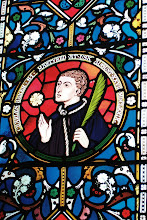
4, 5 & 6) Inside the Catholic Church, an explanatory notice, the Martyr’s Shrine and the colourful, modern stained glass window depicting the church’s two Jesuit patrons, St Francis Xavier and St David Lewis.


The Jesuit’s body was taken in procession to Usk’s Priory Church of St Mary and respectfully buried in the churchyard. His grave is the one nearest the door of the west porch and just to the left of the path as you approach the church. The stone marking the grave is relatively new, having been placed there after the canonisation of St David Lewis. It replaces an old and broken stone generally believed to be the original gravestone. The Priory Church West porch and the Martyr’s gravestone are in the next photographs.


In Penal Times, Mass was celebrated whenever and wherever possible. This could mean in a private house, an inn, a barn, in a field, or in the woods. After the execution of Fr David Lewis in 1679, a house in Usk where he used to say Mass was confiscated. The popular Pub, Cross Keys, is thought to be that house. It is located on Bridge Street, not far from the site of the former Usk Gaol.

Fr David Lewis was beatified in 1929 and on 25th October 1970, he was canonised by Pope Paul VI as one of the Forty Martyrs of England and Wales. His feast day is kept on 27th August. Every year on the Sunday nearest to the 27th August, there is a pilgrimage to the grave of St David Lewis.

ST DAVID LEWIS, PRAY FOR US

Wednesday, 5 May 2010

PENAL LAWS IN ENGLISH CANADA

IT IS TIME I DID ANOTHER POST SO, SINCE I AM STILL IN NEWFOUNDLAND, I THOUGHT YOU MIGHT BE INTERESTED IN THE EARLY DAYS OF CATHOLICISM IN ENGLISH CANADA, PARTICULARLY IN NEWFOUNDLAND. THERE WERE NO MARTYRS BUT CERTAINLY PLENTY OF HARDSHIP!

Catholics who settled in Newfoundland suffered under the harsh Penal Laws, that body of discriminatory and oppressive legislation focused chiefly against Roman Catholics, but also against Protestant nonconformists.

Followers of Catholicism in English Canada faced great adversities in their efforts to establish their faith in the new country. This was partly due to the religious disdain of the English majority towards those who refused to conform to the tenets of the Protestant Reformation but also from animosity towards the ethnicity of those who professed Catholicism, particularly to the Irish. This antagonism was most intensely found in Newfoundland where, unlike in Canada, the Penal Laws were strictly applied. However, in spite of the influence the Irish had in English-speaking Canada, it is in Newfoundland that Irish Catholic mores run deepest.

Newfoundland’s rich resources of fish needed people to work in the expanding industry. In the seventeenth century, people from many parts of Ireland, especially Waterford, Wexford, Kilkenny and Tipperary, rose to the challenge and became seasonal visitors to the Island, working in the fisheries during the summer and returning home at the end of the fishing season in the Autumn. The English Merchants, who reaped the immense profits of the Newfoundland fishery, seldom paid these Irish workers so their financial lot was not improved. However, the fishery did provide them with cheap passage to America and the opportunity of eventually migrating to the American Colonies, where they hoped to find better conditions! Nonetheless, many Irish stayed and created a large and permanent Catholic presence in the Colony of Newfoundland. Under the Penal Laws, the Irish settlers stood little or no chance of either justice or mercy when accused of a crime. Irish Catholics were denied a defence counsel and had no way of knowing an indictment until it was read in court.

In Newfoundland at that time, the Catholic Church was an illegal institution and had great difficulty assisting the Irish in the Colony. Since it operated as an underground organization, its spiritual and religious role was restricted. Under the English Penal Laws, enacted from the reign of Queen Elizabeth I to that of King George III, when they were repealed in 1783, it was hoped to eliminate "Popery" by rendering it impossible for a Catholic to exist, except in the most degraded conditions imaginable. Catholics were barred from holding public office, from operating schools or sitting in parliament. Neither could they own property nor own a horse worth more than $5 and the practice of their religion was forbidden. As well as the Penal Laws, local orders were applied. Catholics could not bury their dead; only an Anglican minister was permitted to read the service of burial and collect a fee for doing so.

Rome was not unaware of its responsibility to the Catholic population and from 1535 to 1784, Newfoundland was under the administration of the Bishop of Rouen, then the Bishop of Quebec and then under the Vicariate of London. A number of itinerant priests were sent to Newfoundland and, at considerable risk, they traversed the rough terrain, covertly said Mass, and then moved on. Aware that Catholics were practising their religion by stealth, the local authorities hunted the itinerant priests who came to the Island disguised as fishermen. These priests hid, said Mass and fled. Punishment for participation in the Mass was severe. One account refers to a Michael Keating of Harbour Main who, in 1755, was fined $50 for allowing Mass to be celebrated in his fish store; his house was demolished, his goods were seized, and he was deported from the Colony. These men were under the constant threat of surveillance by Protestants who felt obliged to report their activities. One example, documented in 1755, stated: “ I am informed that a Roman Catholic priest is at this time at Harbour Grace, and that he publicly read mass which is contrary to the law and against the peace of our sovereign Lord, the King.”

Conditions for Newfoundland's Catholics, predominantly Irish, gradually improved as the laws changed. In 1784, "liberty of conscience" was proclaimed in Newfoundland, the first Catholic chapel was built, and an Irish Franciscan, James Louis O'Donel, was appointed the first Roman Catholic Bishop of St. John's, Newfoundland. More priests came from Ireland and, in 1833, the Presentation Sisters arrived from Galway. The Presentation Sisters were followed by The Sisters of Mercy in 1842 and the Irish Christian Brothers in 1857. Advantages were gained when Catholics received the vote and were able to sit in the assembly and on the Legislative Council. For these early Catholic settlers to the Colony of Newfoundland, the struggle to obtain their religious rights was long and difficult. Be that as it may, the Newfoundland Irish expressed a unique culture in various dialects, crafts, and traditions which are still identifiable. The Irish language was commonly spoken among the Newfoundland Irish until the beginning of the nineteenth century, creating an Irish pattern of speech and vocabulary that is evident even today in Newfoundland English. The Catholic Faith, which was sown in suffering, perseverance and faithfulness, flourishes today and the many churches built with the pennies and free labour of poor Irish fishermen are their memorials.
Related Posts with Thumbnails