
Recently Belmont Abbey held several open
days, one of which we attended. It was
on a lovely autumn day that we wended our way to Hereford and the welcoming
Benedictine Abbey.
It was our good fortune to be guided
around the Abbey by the inimitable Brother Bernard. Brother Bernard’s grasp of the Benedictine
history and of the history of Belmont is second to none and he imparted much of
interest to his attentive hearers.
The Monastery of St Michael and All
Angels at Belmont was begun in 1854 as a common novitiate to train young monks
for the Abbeys of Downside, Douai and Ampleforth. Until the foundation of the Cardiff
Archdiocese Belmont Abbey served as the Cathedral for the Diocese of Newport
and Menevia. The professed monks were
the Canons of the Chapter, making Belmont the only monastic Cathedral in
post-Reformation England. In
pre-Reformation times, monastic cathedrals were a special feature of
ecclesiastical life in the country. Many
of the great cathedrals, including Canterbury itself, were Benedictine
Cathedrals.
 |
| BELMONT ABBEY, HEREFORD |
Although St David Lewis, the Last Welsh
Martyr, was a Jesuit, he has a strong connection to the Benedictines. The famous Benedictine writer and mystic,
Dom Augustine Baker, was a great uncle of his.
David Baker was born in Abergavenny on 9th
December 1575. He was the nephew and
godson of Dr David Lewis, the first principal of Jesus College, Oxford. In 1596 David went to London’s Inner Temple
to study law where he excelled in his studies.
Upon the death of his elder brother, Richard, David was called home to
assist his father and David became the Recorder of Abergavenny. David’s parents may have been Church papists
but, by his mid-twenties, David had completely abandoned religion and was an
atheist. After his return to
Abergavenny, David had a near death experience which profoundly changed his
life and, in 1603, he was received into the Catholic Church.
At the age of thirty David Baker was clothed
with the Benedictine Habit at the Abbey of St Justina in Padua. He was given the name of Augustine. In 1613 he was ordained priest by Dr Gifford,
the Archbishop of Rheims. Dom Augustine
Baker returned to London and took up residence in the lawyers’ district, Grays
Inn Lane, where he assisted Catholics in matters of law. He also undertook research into the English Benedictines. It had been claimed by some that an English
Benedictine Congregation did not exist before the Reformation. David’s research cost him two years and £200
of his own funds, but it proved the critics wrong. About 1625 the results of his research were
published in the book, “Apostolatus Benedictinorum in Anglia”. Augustine Baker is probably best remembered
for his treatise on the prayer of contemplation, “Sancta Sophia” or “Holy
Wisdom”.
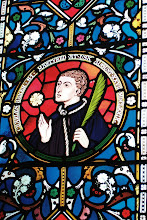
 |
| DOM AUGUSTINE BAKER, FROM A WINDOW IN ABERGAVENNY CATHOLIC CHURCH |
Due to the anti-Catholic feelings in
England at that time, many priests left for the continent. Fr Baker went to Douai, in Flanders. He was appointed Spiritual Director of the
English Benedictine Nuns at the Abbey of Our Ladye of Consolation in Douai,
(the Nuns of Stanbrook Abbey). He remained
in that post for nine years then returned to London.
Fr Baker maintained at Douai two young men. One was Philip Morgan, alias Powell, who was
martyred in 1646. The other was his
nephew, John Pritchard, who later became a Jesuit. John Pritchard’s sister, Margaret, married
Morgan Lewis, headmaster of Abergavenny Grammar School. They were the parents of David Lewis, who
also became a Jesuit. During the furore
stirred up by the fabricated Oates’ Plot, David Lewis was martyred at Usk in
1679. In 1620, on his last visit to
Abergavenny, Dom Augustine Baker stayed with his sister who was the grandmother
of David Lewis. It was inevitable that
he would have met his four year old great nephew. We can only wonder at such a
momentous meeting as the great Benedictine, whose motto was “I am
nothing. I have nothing. I crave nothing, save Jesus” met the
future martyr, Saint David Lewis!
David Augustine Baker O S B, whose
health was never good, was stricken with the plague and died in London on 9th
August 1641. He was 65 years old.




.JPG)

.JPG)


