Showing posts with label Tyburn. Show all posts

Thursday, 10 December 2020

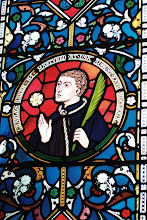
Welsh Benedictine Martyr, St John Roberts, whose feast we celebrate today, was born at Trawsfynydd, Merionethshire, in 1577.  He was the first prior of Douai.   He was sent on the English Mission in December 1602 and arrived in England in April 1603, the first monastic to enter England since the Reformation.  

ST JOHN ROBERTS, OSB
Dom John Roberts was executed at Tyburn on 10 December  1610.  On Sunday, 25 October 1970, Pope Paul VI canonised forty men and women who had surrendered their lives for their Catholic faith.  They are known collectively as The Forty Martyrs of England and Wales. St John Roberts is numbered among the Forty.

SITE OF TYBURN TREE, LONDON

ST JOHN ROBERTS, PRAY FOR US

QUEEN OF MARTYRS, PRAY FOR US

Saturday, 20 June 2020

BLESSED JOHN ROCHE

John Roche was born in Ireland and, as a young man, he went to London where he found work as a servant and a waterman.  As was common at that time, Catholics often worked under an alias and Roche sometimes used the name of John Neale.  A devout Catholic, he became involved with Margaret Ward and others who were aiding persecuted priests.  One such priest was Fr William/Richard Watson.  
Blessed John Roche
Fr Watson had been arrested and tortured and, upon learning of this, Margaret Ward began visiting the priest in Bridewell Prison.  Eventually she devised a plan to help the priest escape.  She smuggled a length of rope into the priest and , at a prearranged time, he was to let himself down from his cell at the top of the prison.  She found two Catholic watermen who would be waiting nearby with a boat to spirit the priest away.  However, the two watermen lost their nerve and backed out.  Margaret did not give up!  John Roche readily agreed to assist the priest.  Disastrously, the rope was too short and the priest had to jump the remaining distance.  He crashed down onto a shed below, breaking his right arm and leg.  Immediately, John Roche ran to his assistance and carried him to the boat. 

Of course, the clatter had alerted the jailor and others and the rope, still dangling from the cornice, was discovered.  Margaret Ward, being Fr Watson's only visitor, was swiftly arrested.  

John had managed to get the priest to safety and he was recuperating in John's house.  When he had recovered, John swapped clothes with him and the priest got safely away.  Sadly, John, in the priest's clothes, was spotted by the jailor who arrested him. He was vigorously interrogated and  eventually admitted his role in the escape of Fr Watson.  He was charged with treason and condemned to death.  Offered a full pardon if he would seek the Queen's forgiveness and attend a Protestant service, John Roche refused both!

On 30th August 1588, John Roche and Margaret Ward were hanged, drawn and quartered at Tyburn. Four other Catholics, including Welshman Richard Flowers, were executed with them that day.  

On 15th December 1929, Pope Pius XI beatified John Roche. He is counted among the English Martyrs and is also venerated in Ireland where his feast is celebrated on 20th June. 

Tuesday, 23 April 2019

VENERABLE EDWARD MORGAN

Today, 23rd April, our thoughts turn to some famous people who are embedded in our culture. Today is the Feast of St George, Patron Saint of England.  It is also the birth date of William Shakespeare.  
St George, Patron Saint of England
However, there is another I wish to remember on this Blog today. A fellow countryman of our beloved St David Lewis, Edward Morgan was born in Flintshire, North Wales.   He studied at the English Colleges of Rome, Madrid and Valladolid.  In 1621 Edward Morgan was ordained priest at Salamanca.
Photo J D Smith
Using the alias of John Singleton, Fr Morgan returned to his homeland to work among his struggling Catholic brethren. In April 1629 he was imprisoned in Flintshire for refusing to take the Oath of Allegiance.  Three years later, 1632, the priest was condemned in the Star Chamber to have his ears nailed to the pillory for accusing certain judges of treason.
Photo J D Smith
Immediately after, Fr Morgan was committed to the Fleet Prison in London.  He languished there for almost ten years.  On St George's Day, 23rd April 1642, at the Old Bailey, Fr Morgan was condemned to death for being a priest.  Soon after, on 26th April 1642, Welsh priest, Fr Edward Morgan,  was executed at Tyburn.  In 1886, he was declared Venerable by Pope Leo XIII. So, on this St George's Day, 23rd April 2019, let us remember another stalwart Welsh priest and martyr, Venerable Edward Morgan.
Pope Leo XIII (1878-1903)

Friday, 25 January 2013

NOT THE LAST!

I have read several books, written by local authors, stating that St David Lewis was the last Catholic martyr in Britain.  This has also been said in an otherwise excellent video available on youtube.  I don't wish to engender any controversy but I feel I should point out that this is incorrect. 
 
Fr David Lewis S J (alias Charles Baker) was executed at Usk on 27th August 1679.  He, along with 39 others, was canonised in 1970 by Pope Paul VI as one of the Forty Martyrs of England and Wales.  ST DAVID LEWIS was the LAST WELSH MARTYR.  
 
 
St David Lewis, the Last Welsh Martyr
 
On 1st July 1681 Oliver Plunkett, the Archbishop of Armagh, was hanged, drawn and quartered at Tyburn, London.  He was beatified in 1920 and canonised in 1975 by Pope  Paul VI.  ST OLIVER PLUNKETT was the LAST CATHOLIC MARTYR in this country.
 
 
St Oliver Plunkett, the last Catholic martyr
in Britain


Follow this link for more information on St Oliver Plunket.
 

Sunday, 11 September 2011

A VISIT TO TYBURN

The first recorded execution took place at Tyburn field, near the present day Marble Arch, in 1196. In 1571 the Tyburn Tree replaced the original gallows. The Tree was a horizontal wooden triangle supported on three legs. It was designed thus to accommodate multiple hangings at the same time. Although it was done only once, 24 prisoners could be executed simultaneously. The first victim of the Tyburn Tree was Dr John Story, a Catholic who refused to recognise Queen Elizabeth I as head of the church. Thousands had been executed at Tyburn before John Austin, a highwayman, was hanged there in November 1783. That was the last time the Tyburn Tree was used.

Between 1535 and 1681, almost 400 Catholics were executed at Tyburn. The last Catholic Tyburn Martyr was St Oliver Plunkett, executed in July 1681. The Vatican has officially recognised 105 of these as Martyrs and many of them have been canonised.

At the beginning of the last century the Benedictine Adorers of the Sacred Heart of Jesus set up home at Tyburn Convent, just yards from the site of the old gallows. The Sisters pray night and day before the exposed Blessed Sacrament. In recognition of the men and women who gave their lives for the faith, the Sisters maintain the Martyrs’ Shrine. Here are preserved relics of some of the martyrs, and a replica of the three cornered gallows, the Tyburn Tree, forms part of the altar.

Last month Cwmbran based Friends of Saint David Lewis visited Tyburn Convent. At 8 o’clock in the morning our group of 42 pilgrims left Cwmbran and headed up the motorway for London. Several hours later our genial coach driver, Terry from Tryline Travel, deposited us near Tyburn Convent. By now it was almost lunch time so, of course, we set off in search of food! There are restaurants aplenty in that area, Marble Arch, so pretty soon we were all happily catering to the inner man. That taken care of, we made our way down the road to Tyburn Convent.

Our tour was scheduled for 2 o’clock so we had some time to spare. This gave us the welcome opportunity to spend time in the chapel where the Blessed Sacrament is exposed night and day. What a great privilege!

Just before 2 o’clock, a smiling Mother Lioba arrived to escort us to the Martyrs’ Shrine in the crypt. Our parish priest had accompanied us on our pilgrimage and, as he vested for Holy Mass, Mother welcomed the group and briefly outlined the history of the Convent. Then, wearing red vestments, Father celebrated the Mass of the Martyrs. We were privileged to attend Holy Mass where, in days gone by, priests had died for celebrating Mass and for being Catholic priests. Father brought this home to us in his very apt homily.

When Mass was concluded, Mother Lioba recounted the story of the many Catholic martyrs who had been executed at Tyburn for their faith. Although our patron, St David Lewis, did not suffer at Tyburn – he was martyred at Usk – Welshmen, including St John Roberts and Blessed Philip Powell, were among the victims of Tyburn. Mother Lioba held us spellbound with her animated accounts of the lives and deaths of the martyrs. Mother’s knowledge of the martyrs was extensive, her enthusiasm palpable, and her devotion clear to all.

After Mother Lioba’s talk, there was time to wander around the crypt at leisure and to view the many treasured relics housed there. Mother was on hand to answer any questions or just to chat.

Our visit to Tyburn Convent was not over yet. We were directed to an adjoining room where pretty young Novices served refreshments to the pilgrims. Alas, it was time to leave. Mother Lioba, still smiling, saw us off with a handshake and a “God bless you”. Then it was back down the M4 to Wales.

It had been a memorable day and a happy yet humbled and thoughtful group arrived back in Cwmbran. All marvelled at the courage and faith of those holy men and women who had died for their faith. The experience certainly gave us food for thought and, hopefully, a greater appreciation of our Catholic faith and of the freedom we have to practise it. Remember, there are still countries in which Christians are dying for their faith.

PRAYER FOR PERSECUTED CHRISTIANS
Father, in your mysterious providence, your Church is called to share in the sufferings of Christ, your Son. Give the spirit of endurance and love to those who are persecuted for their faith in You. May they always be true and faithful witnesses to your promise of eternal life. This we ask in Jesus’ name. Amen.

Friday, 15 October 2010

THE PERJURER TITUS OATES AND EIGHT JESUITS (PART 7)

To continue our posts on the eight Jesuits who fell victim to the false Oates/Popish Plot, we come to Blessed William Harcourt S J.


William Barrow was born in Lancashire in 1609. He studied at St Omer and entered the Society of Jesus (Jesuits) in 1632 at Watten. In 1644 Fr William Barrow S J returned to England to work in the London district. Using the aliases of Waring and Harcourt, he spent thirty-five years labouring in dangerous conditions.

In the late summer of 1678 Titus Oates set off a frenzy of fear, suspicion and hatred that resulted in the deaths of many innocent Catholics. Oates fabricated a story, remembered in history as the Oates Plot or the Popish Plot, in which Catholics, led by the Jesuits, were planning to restore the country to Catholicism by murdering the King and bringing down the Protestant Establishment. As the fury grew, Oates found others willing to join him in his heinous deception, notably William Bedloe and Stephen Dugdale. Of course, money was also a great incentive as the Government offered a reward for the capture of any priest. As expected, this brought in many a rogue who was willing to perjure himself.

Through all this, Fr Harcourt urged his fellow Jesuits to flee abroad. However, he remained in London and did his utmost to care for his imprisoned brethren. The priest changed his residence daily but he was betrayed by a servant at one of the houses and, on 7th May 1679, he was arrested. He was thrown into Newgate Prison, joining fellow Jesuits Thomas Whitbread, John Fenwick, John Gavan and Anthony Turner. With the others, Fr Harcourt came to trial on 13th June.

Chief Justice Scroggs presided at the trial and the abhorrent trio of Oates, Bedloe and Dugdale were the chief witnesses against the priest. It was a surprise to no one that the Jesuit was found guilty and condemned to be hanged, drawn and quartered, the usual sentence for High Treason. The gruesome execution was carried out at Tyburn on 20th June 1679. His martyred remains were claimed by friends who interred them in the Churchyard of St Giles in the Fields.

Although his real name was William Barrow a Papal Decree of 4th December 1886 introduced his cause for canonisation under the name of William Harcourt. It was under the name of William Harcourt that he was beatified in 1929.

LINKS TO THIS POST:
THE PERJURER TITUS OATES AND EIGHT JESUITS (PART1)
(PART 2) (PART 3) (PART 4) (PART 5) (PART 6)

Friday, 10 September 2010

THE PERJURER TITUS OATES AND EIGHT JESUITS (PART 5)

BLESSED JOHN GAVAN S J

A plot, known as the ‘Oates Plot’ or the ‘Popish Plot’ was conceived in the fertile but warped mind of the malevolent Titus Oates. In August 1678, Oates claimed that a plot to murder the King, bring down the Protestant Establishment and re-establish Catholicism in England was being hatched by Catholics. The Jesuits, according to Oates, were the leaders of this imagined plot. In reality, there was no plot against the Crown or Protestantism. The real plot was the one which Oates was building up against the Jesuits. Before Oates and the bunch of criminals who were his co-conspirators were finally exposed many innocent Catholics had suffered and died. Among those who were put to death for their faith were eight Jesuit priests. The horror began for the Jesuits in January 1679 when Fr William Ireland was executed at Tyburn in London. Another victim was 39 year old Fr John Gavan or Green.

John Gavan was born in London in 1640. The young Gavan went to St Omer and, in 1660, he entered the Jesuits. He was ordained in Rome in 1670. Like all priests who returned to minister in England, Fr Gavan was fully cognisant of the dangers under the severe Penal Laws which existed at that time. Nonetheless, Fr Gavan returned to his homeland in 1671 and commenced his work, chiefly in the Staffordshire area, where he laboured untiringly.

At the height of the Oates Plot, the Government offered a £50 reward for the apprehension of any priest. This lead to a vigorous search for and betrayal of priests, Jesuit and otherwise, up and down the country. In the hope of escaping to the Continent, Fr Gavan made his way to London. Unfortunately, that was not to be and he was apprehended on 23rd January 1679. Along with four other Jesuits, Fr John Gavan was brought to trial at the Old Bailey on 13th June 1679.

Fr Gavan was an erudite and articulate priest and he skilfully defended the group. In this instance, the skill and honesty of the Jesuit were no match for the false witnesses, prejudiced Judge and rigged jury. As was expected, the jury returned a verdict of guilty. Fr John Gavan was martyred at Tyburn on 20th June 1679. His mutilated and quartered remains were claimed by friends and buried in St Giles in the Fields.

LINKS TO THIS POST:

The Perjurer Titus Oates and Eight Jesuits (Part 1)

(Part 2) (Part 3) (Part 4)

Tuesday, 24 August 2010

THE PERJURER TITUS OATES AND EIGHT JESUITS (PART 3)

BLESSED JOHN FENWICK John Fenwick was born in Durham, England, in 1628. Fenwick, whose real surname was Caldwell, was disowned by his Protestant parents when he converted to Catholicism. In 1654 he went to St Omer and, on 28th September 1656, he entered the Jesuit novitiate at Watten. He was ordained priest in 1664 and, returning to St Omer, he was made procurator of the College. In 1674, Fr Fenwick was sent upon the English Mission to work in the London area.

On the night of 28th September 1678, armed soldiers, led by that convicted perjurer, Titus Oates, entered his lodgings and arrested Fr Fenwick. Another Jesuit, Fr William Ireland, and an assistant, John Grove, were also taken prisoner. The three were incarcerated at Newgate Prison where they received harsh treatment. John Fenwick suffered so much from his chains and bolts that amputation of one of his legs was considered. This was decided against because the authorities were certain he would soon be convicted and executed anyway!

On 17th December 1678, Fr John Fenwick appeared at the Old Bailey and was tried for High Treason. Being a Catholic priest and saying Mass constituted High Treason! Because there was insufficient evidence to find the Jesuit guilty, he was sent back to prison. Witnesses had already testified but justice was not meant for Catholics, especially Catholic priests. Under the Penal Laws the only objective was to find priests guilty and execute them so the trial was postponed to a later date!

On 13th June 1679, Fr Fenwick again appeared at the Old Bailey for trial. Titus Oates and the equally corrupt Stephen Dugdale were witnesses against him. Lord Chief Justice William Scroggs instructed the jury to find the priest guilty. As expected, the jury complied and John Fenwick was found guilty of high Treason and sentenced to be hanged, drawn and quartered.

One week later, on Friday, 20th June 1679, Fr John Fenwick was taken to Tyburn in London. As he stood awaiting his fate, a messenger arrived shouting “A pardon, a pardon.” He delivered to the sheriff a document stating that the condemned man would be pardoned if he admitted his guilt and told all about the plot. The steadfast Fr Fenwick replied that he could acknowledge no guilt for a non-existent plot and would not lie to gain a pardon. The barbaric execution was carried out and the martyred priest’s remains were claimed by friends who buried them in the churchyard of St Giles in the Fields.

Jesuit martyr, Fr John Fenwick, was beatified by Pope Pius XI on 15th December 1929.
LINKS TO THIS POST:
THE ANNUAL PILGRIMAGE IN HONOUR OF ST DAVID LEWIS WILL TAKE PLACE ON SUNDAY 29TH AUGUST 2010. HOLY MASS WILL BE CELEBRATED AT THE CATHOLIC CHURCH, PORTH-Y-CARNE STREET, USK, AT 3 P M. MASS WILL BE FOLLOWED BY A PROCESSION TO THE MARTYR'S GRAVE WHERE A SHORT SERVICE WILL BE HELD. REFRESHMENTS WILL THEN BE SERVED IN THE PARISH HALL. ALL ARE WELCOME!

Tuesday, 17 August 2010

THE PERJURER TITUS OATES AND EIGHT JESUITS (PART 2)

THE FIRST JESUIT VICTIM, BLESSED WILLIAM IRELAND

William Ireland (alias Ironmonger) was born in Lincolnshire in 1636. In 1655, at the age of 19, he entered the Jesuit Novitiate and was ordained in 1667. In June 1677, Fr William Ireland was sent upon the English Mission, taking up work in London. Little more than a year later, 28th September 1678, he, Fr John Fenwick, and their assistant, John Grove, were arrested by a group led by the evil Titus Oates. The perjurer Oates was the instigator of the fabricated but deadly, Popish Plot. The two Jesuits and the layman, John Grove, were imprisoned in Newgate Prison where they were bound in heavy chains.

The three came to trial on 17th December 1678. At the trial, Titus Oates testified that in April the Jesuits had held a meeting to make plans to assassinate King Charles and place his Catholic brother, James, Duke of York, on the throne. Oates claimed to have been present at this meeting and that Frs Ireland and Fenwick and Mr Grove were also present. Fr Ireland, stated Oates, had been seen loitering about the royal residence during August. Fr Ireland had witnesses to prove that, at the time he was supposed to have been around the royal residence, he was actually in North Wales and the Midlands. Absurdly, the word of a convicted perjurer was taken over the word of reliable witnesses. Fr Ireland, John Grove and a Benedictine brother, Thomas Pickering, were found guilty of high treason and sentenced to be hanged, drawn and quartered.

The King, Charles II, never believed in the claims of Titus Oates and he postponed the execution. However, popular opinion, whipped up by certain politicians, was in agreement with Oates. Perhaps remembering his own father’s fate, the King allowed the executions to take place. On 24th January 1679, amid the taunts and insults of the people of London, Fr William Ireland was dragged to Tyburn. There he was hanged then cut down to be drawn and quartered.

The diabolical fabrication of the vile Titus Oates had claimed its first Jesuit martyr. Fr William Ireland was the first Jesuit to die during the frenzy generated by the Oates Plot but before it ended, seven more Jesuits, including St David Lewis, would be executed.

Fr William Ireland S J was beatified by Pope Pius XI in 1929.
LINKS TO THIS POST:

Wednesday, 17 March 2010

AN IRISH MARTYR, ST OLIVER PLUNKETT


Oliver Plunkett was born in Loughcrew, County Meath, Ireland in 1629 to well-to-do parents. Desiring to become a priest, he set out for Rome in 1645. In 1646, he was admitted to the Irish College in Rome.

In 1654 Oliver Plunkett was ordained a priest and delegated by the Irish Bishops to act as their representative in Rome. Because of the extremely strict Penal Laws in force in Ireland at that time, it was many years before Fr Plunkett could return to his homeland. He served as theological professor at the College of Propaganda Fide and there, on 9th July 1669, he was appointed Archbishop of Armagh and was consecrated on 30th November at Ghent by the Bishop of Ghent, assisted by two Bishops, including the Bishop of Ferns.

The Restoration of the Monarchy in 1660 brought King Charles II to the throne and the new King wished to rule with tolerance for all his subjects. So, in March 1670, the Archbishop finally returned to Ireland. He received the pallium on 28th July 1670. Now that he was home, Archbishop Plunkett began the reorganising of the ravaged Catholic Church. He built schools both for the young and for the clergy and, in 1670, he established a Jesuit College in Drogheda. The Archbishop refused to sign the Test Act of 1673 and the college was razed to the ground and Plunkett went into hiding, travelling about in disguise.

In 1678, things became even worse for Catholics, particularly for Catholic priests! In England, the foul Titus Oates had concocted the fictitious Popish Plot and anti-Catholic hysteria was sweeping the country. Despite having a price on his head, Archbishop Plunkett refused to abandon his flock. He was arrested in Dublin in December 1679 and imprisoned in Dublin Castle. He was tried at Dundalk for conspiring against the state but this was unproven. The powerful and extremely anti-Catholic Lord Shaftsbury feared that Oliver Plunkett would never be convicted in Ireland so he had him moved to Newgate Prison in London. Even though the first grand jury found no true bill, the Archbishop was not released. At the second trial, which was claimed to be a kangaroo court, he was, as expected, found guilty of High Treason “for promoting the Roman faith” and he was condemned to be hanged, drawn and quartered.

On 1st July 1681, Oliver Plunkett, Archbishop of Armagh and Primate of all Ireland, was hanged, drawn and quartered at Tyburn. Originally, his body was buried in two tin boxes. Exhumed in 1683, his remains were moved to various places before finally coming to rest at Drogheda, Ireland (his head), Downside Abbey, England, and Lamspringe, Germany.

Archbishop Oliver Plunkett was beatified in 1920 and canonised in 1975. St Oliver Plunkett was the last Catholic Martyr to be executed in England.
LINKS TO THIS POST:


Saturday, 31 October 2009

TEN WERE JESUITS (PART 2)


On 25th October 1970, Pope Paul VI canonised 40 men and women from England and Wales who had given their lives for their faith. St David Lewis was the last of the forty to be martyred. Ten of the Forty Martyrs of England and Wales, including St David Lewis, were Jesuits. In this and the next couple of posts, we intend to tell, briefly, their stories. (FOR PART 1, SEE PREVIOUS POST)

3) St Robert Southwell was born in 1561 and sent to Douai while still a child. He remained there for some time and eventually made his way to Rome where he entered the Jesuit Novitiate of Sant’ Andrea. He was ordained in 1584 and, in 1586, he was sent upon the English Mission with Fr Henry Garnet. Robert was a tireless worker in Christ’s vineyard. He was instrumental in setting up a chain of Mass centres, he protected hunted priests, smuggled students for the priesthood abroad, sheltered priests arriving from the continent, and maintained a printing press on which he produced Catholic literature, including his own works. To his enemies he was known as “the chief dealer for the papists in England”. On 20th June 1592, Fr Southwell was apprehended at Uxendon Hall in Harrow, Middlesex. He had been betrayed by the owner’s daughter, Anne Bellamy, after she had been interrogated and raped by Topcliffe, the Queen’s chief priest-hunter and torturer. Fr Southwell was imprisoned in the Tower for three years and questioned under horrendous torture. Finally, shortly before his trial, he was moved to Newgate Prison and thrown into a dungeon called “Limbo”. At his trial in February 1595, he was, predictably, found guilty and sentenced to be hanged, drawn and quartered. The next day, 21st February, the condemned priest was taken to Tyburn for execution. Standing on the cart under the noose, Robert made the Sign of the Cross, though his hands were bound, and began to speak to the assembled crowd. “Whether we live, we live to the Lord: or whether we die, we die to the Lord. Therefore, whether we live or die, we belong to the Lord.” The Sheriff tried to stop him speaking but he was permitted to carry on. When he finished speaking, he again blessed himself and, as the cart was drawn away he prayed in Latin, “Into thy hands, O Lord, I commend my spirit”. The crowd, including many Protestants, would not allow the priest to be cut down until he was dead and for this reason, some of them tugged at his legs to hasten the end of his suffering. When he was dead, the martyr’s body was cut down, disembowelled and quartered and his head displayed to the crowd. Unusually, the traditional cry of “Traitor” was not uttered. St Robert Southwell, S J, was 33 years old.

4) St Henry Walpole, the eldest of a large family, was born at Docking, Norfolk in 1558. He studied at Peterhouse, Cambridge, and, in 1578, went to study law at Gray’s Inn, London. Upon witnessing the martyrdom of St Edmund Campion in 1581, he converted to Catholicism. He went to Douai in 1582 and the entry in the Douai Diary states “On 7th July Mr Henry Walpole came to us out of England, a discreet, grave and pious man”. He remained here until April 1583 when he was sent to Rome to enter the Society of Jesus. On 15th December 1588 Henry Walpole was ordained in Paris. He was not sent on the English Mission until 1593, arriving in Yorkshire on the night of 6th December. Twenty-four hours later he was captured by the authorities. Three days later he was taken to York where, upon admitting that he was a priest, he was committed to York Gaol. On 25th February 1594, he was ordered to be sent to London and he was imprisoned in the Tower for a year. Carvings that he made on the wall of his cell can still be seen in the Salt Tower. While a prisoner in the Tower, Fr Walpole was tortured at least fourteen times. In 1595, the prisoner was sent back to York to be tried. At his trial he refuted the charges against him, replying at one point, “You, my Lords, sit here at present in judgement as men, and judge as such, being subject to error and passion, but know for certain that there is a Sovereign Judge who will judge righteously, whom in all things we must obey in the first place, and then our lawful princes in such things as are lawful, and no further.” As directed, the jury returned a guilty verdict and Henry was sentenced to death for being a priest, at that time considered high treason. On 7th April 1595, Fr Henry Walpole, along with Fr Alexander Rawlins, was taken to the place of execution at Knavesmire, just outside York. Fr Walpole was forced to watch as his companion was butchered and the authorities offered him his life if he would conform. The priest rejected their bribes and climbed the ladder. He asked the prayers of all Catholics present and lifted his eyes to heaven and began to pray. Before he had finished the Hail Mary, he was shoved off the ladder. He was fully conscious when he was dismembered, disembowelled and quartered. Many witnesses were so moved by the saint’s martyrdom that they converted to Catholicism. The Jesuit Martyr, Saint Henry Walpole, was 37 years old when he gave up his life for his faith.

Related Posts with Thumbnails