
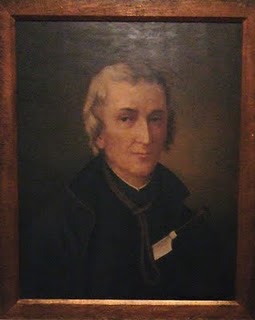
This being St Patrick's Day, I will post on another Irish Martyr, Blessed William Tirry. I am indebted to kee at LITTLE HARE for introducing me to this faithful and brave Irish Augustinian. Thanks, kee, and a Happy St Patrick's Day to you & yours. (I am also indebted to the site, Augustinians of the Midwest. I hope they will forgive me for borrowing from them. I think it is important to spread the word about this great Irish Augustinian Martyr, Blessed William Tirry.)
William Tirry (1608-1654) was martyred because he chose loya lty to God and Church over obedience to civil authority.
William Tirry (1608-1654) was martyred because he chose loya
 lty to God and Church over obedience to civil authority.
William Tirry was born in Cork, Ireland in 1608. His uncle was Bishop of Cork-Cloyne.
William entered the Augustinian Order in Cork. He must have been a promising student, as he was sent for studies in Valladolid, Spain and Paris, France. Following completion of his courses in Paris, he spend five years (1636-1641) in Brussels, Belgium.
He returned to Ireland in 1641. A few years later, when hostilities broke out in Ireland, Augustinian community life became impossible. William went to serve for a time on the staff of his uncle, the Bishop. He was later named Secretary of his Augustinian province.
He was chosen in 1649 as Prior (local superior) of the Augustinian house in Skreen. However, Oliver Cromwell's troops would not permit him to live there.
A law enacted January 6, 1653 declared that any Roman Catholic priest in Ireland was guilty of treason. William and other priests were forced into hiding. Three men betrayed William in return for money. He was arrested March 25, 1654, Holy Thursday, as he was preparing to celebrate Holy Mass.
While awaiting trial, William was imprisoned at Clonmel. Here, his spirit of prayer and penance helped to inspire the other priests who were also incarcerated there.
At his trial, William readily proclaimed his loyalty to the government in civil matters. But, in matters of religion, he declared that he was bound to obey only his conscience, his Augustinian superiors and the Pope. He was found guilty of treason and sentenced to death by hanging.
William was executed May 12, 1654. He was 45. An account told by another friar who had been tried with William gives some details of that day: William, wearing his Augustinian habit, was led to the gallows praying the rosary. He blessed the crowd which had gathered, pardoned his betrayers and affirmed his faith. It was a moving moment for Catholics and Protestants alike.
The body of William was buried on the grounds of the destroyed Augustinian friary at Fethard. His grave was not marked, however, and its exact location is unknown. He, along with 16 other Irish martyrs, was declared Blessed in 1992 by Pope John Paul II.
LINKS TO THIS POST
IRISH MARTYR, ST OLIVER PLUNKETT
AN IRISH FRANCISCAN MARTYR
William entered the Augustinian Order in Cork. He must have been a promising student, as he was sent for studies in Valladolid, Spain and Paris, France. Following completion of his courses in Paris, he spend five years (1636-1641) in Brussels, Belgium.
He returned to Ireland in 1641. A few years later, when hostilities broke out in Ireland, Augustinian community life became impossible. William went to serve for a time on the staff of his uncle, the Bishop. He was later named Secretary of his Augustinian province.
He was chosen in 1649 as Prior (local superior) of the Augustinian house in Skreen. However, Oliver Cromwell's troops would not permit him to live there.
A law enacted January 6, 1653 declared that any Roman Catholic priest in Ireland was guilty of treason. William and other priests were forced into hiding. Three men betrayed William in return for money. He was arrested March 25, 1654, Holy Thursday, as he was preparing to celebrate Holy Mass.
While awaiting trial, William was imprisoned at Clonmel. Here, his spirit of prayer and penance helped to inspire the other priests who were also incarcerated there.
At his trial, William readily proclaimed his loyalty to the government in civil matters. But, in matters of religion, he declared that he was bound to obey only his conscience, his Augustinian superiors and the Pope. He was found guilty of treason and sentenced to death by hanging.
William was executed May 12, 1654. He was 45. An account told by another friar who had been tried with William gives some details of that day: William, wearing his Augustinian habit, was led to the gallows praying the rosary. He blessed the crowd which had gathered, pardoned his betrayers and affirmed his faith. It was a moving moment for Catholics and Protestants alike.
The body of William was buried on the grounds of the destroyed Augustinian friary at Fethard. His grave was not marked, however, and its exact location is unknown. He, along with 16 other Irish martyrs, was declared Blessed in 1992 by Pope John Paul II.
LINKS TO THIS POST
IRISH MARTYR, ST OLIVER PLUNKETT
AN IRISH FRANCISCAN MARTYR


.jpg)




.JPG)

.JPG)


