Showing posts with label Douai. Show all posts

Monday, 25 February 2019

ANOTHER GUNTER

Because of their relationship to and support of St David Lewis, the Gunters of Abergavenny feature prominently on this Blog Site. William Gunter was born in Raglan and I cannot say for certain if he was an ancestor of our Abergavenny Gunters. However, William Gunter is another Gunter who, like Thomas Gunter and his family, was willing to face hardship and even death for his Catholic Faith.
The home of Thomas Gunter, Abergavenny
On 29th September 1568 Cardinal William Allen set up the English Collage at Douai, France.  The college would eventually number 158 martyrs among its students.  The first was Cuthbert Mayne in 1577 and the last was Thomas Thwing in 1680.
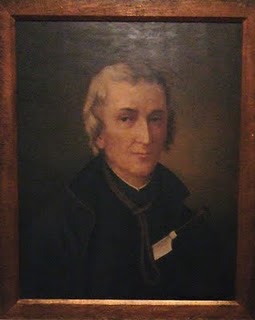
Cardinal William Allen
William Gunter chose to travel to the English College to study for the priesthood. He was ordained in March 1587.  Within months of his ordination William was back in England working among the beleaguered Catholics.  

Life for Catholics in Elizabethan England was difficult, to say the least, but the failed invasion of the Spanish Armada in 1588 made the situation far worse.  The authorities were determined to show any foolhardy Catholic the awful fate that would befall them should they attempt a plot or uprising.  To this end, new gallows were hastily erected in different locations around London. Many Catholics were arrested and imprisoned by the authorities.  Fr Gunter was among them.  The priest admitted that he had reconciled others to the Catholic Faith and declared that he would continue to do so if he could.  Thus Fr Gunter sealed his own fate and he was condemned to death without a trial by jury. 
The Tyburn Tree
On 28th August 1588, 21 priests were martyred.  Queen Elizabeth I had shown a modicum of mercy. Fr Gunter would not suffer the sentence of being hanged, drawn and quartered.  He would just be hanged!  It is said that on hearing this, the priest replied that it was fitting because he was not worthy to suffer as much as his brethren.  He was taken to Shoreditch where the sentence was carried out.

The sacrifice of William Gunter was recognised in 1986 when, on 10th November, Pope John Paul II issued a decree of martyrdom declaring Fr Gunter Venerable.  The next step to canonisation came on 22nd November 1987 when Pope John Paul II declared Fr William Gunter Blessed.

There you have it.  Another brave and faithful Gunter and another Welsh Martyr.  Blessed William Gunter, ora pro nobis. 

Monday, 16 November 2009

ST JOHN WALL O F M

THE AIM
The aim of this blog is to spread knowledge of and devotion to the Last Welsh Martyr, St David Lewis. However, St David Lewis did not live in a vacuum or in a bubble! He had family, friends and colleagues. He went places and did things. Events took place and life went on. To convey a sense of his life and times, we have included in previous posts people and places that have touched the life of the martyr. In this post and in future posts, we will continue to do the same.

ST JOHN WALL O F M
St John Wall was born into a wealthy Catholic family in Lancashire in
1620 and, at a young age, was sent to the English College at Douai. Interestingly, he was baptised by the future Jesuit Martyr, Edmund Arrowsmith. He enrolled at the English College in Rome on 5th November 1641 under the alias John Marsh. Later, on the English Mission, he used the names of Francis Johnson, Francis Webb and Francis Dromore. Already studying at the English College was a young Welshman, David Lewis, alias Charles Baker. The two became friends and it is thought that John Wall was present in the Lateran Basilica when, on St Stephen’s Day 1642, the recently ordained Fr Lewis preached a short Latin discourse in the presence of Pope Urban VIII.

On 3rd December 1645 John Wall was ordained to the sacred priesthood. On 1st January 1651, he received the Franciscan habit at St Bonaventure's Friary, Douai. A year later he was professed and took the name Fr Joachim of St Anne. He soon became vicar of the monastery and then novice master before being sent upon the English Mission in 1656. For twenty-two years he laboured zealously, chiefly in Worcestershire, and won many converts through his preaching and example. For twelve of the twenty-two years, he used Harvington Hall as his base and went under the alias of Webb. It was during the Titus Oates Plot that Fr John Wall was apprehended quite by accident. In December 1678, the Sheriff’s Deputy was searching for a debtor at Rushock Court when he came upon the unfortunate priest, who was immediately taken before the Justice of the Peace. Refusing to take the Oath of Supremacy, the priest was committed to Worcester Gaol. On 25th April 1679, The Franciscan was finally brought to trial before Judge Atkins at Worcester. He was indicted for high treason for being a priest and remaining in the country. He was found guilty and sentenced to death. John bowed low and said “Thanks be to God; God save the King; and I beseech God to bless your lordship, and all this honourable bench.” The prisoner was returned to his cell.

Later that month, Fr Wall was summoned to London for questioning about the alleged Popish Plot. He was lodged in the notorious Newgate Prison where his friend, Fr David Lewis S J, the aged Fr John Kemble, and Fr Roger Handslip, were also incarcerated. In an attempt to implicate them in the fabricated Plot, the four priests had been brought from their respective prisons to be questioned by Titus Oates, William Bedloe, Stephen Dugdale and Myles Prance. Fr Wall spent a month in London and was strictly examined several times by all four. No evidence could be found against him and he was declared innocent of involvement in any plot. Bedloe was the last to examine Fr Wall and he offered the priest his life if he would embrace the Protestant religion. The saintly priest wrote, “But I told them I would not buy my life at so dear a rate as to wrong my conscience”.

In June, Fr Wall was returned to prison in Worcester and there he remained until his execution in August. Two days before his execution, Fr William Levison visited Fr Wall and found him “a cheerful sufferer of his present imprisonment, and ravished, as it were, with joy, with the future hopes of dying for so good a cause”. Fr Levison heard the condemned man’s confession and gave him communion. On the day of execution, 22nd August 1679, Fr Levison stood near the gallows and, as the priest was turned off the ladder, gave him the last absolution. The Sheriff had offered John Wall the opportunity of dying the following day so as to spare him the further humiliation of dying with two common criminals. John thanked the Sheriff for his consideration but told him that if it was good enough for Jesus, then it was good enough for him. Although, as the sentence demanded, Fr John Wall was quartered and his head cut off, his body was permitted to be buried. The Catholics of the town accompanied his body to St Oswald’s Churchyard where it was buried. Less than a week later, on 27th August 1679, Fr Wall’s friend, Fr David Lewis S J, was martyred at Usk.

Fr Levison had taken possession of the Franciscan martyr’s head and, at the first opportunity, conveyed it to Douai. It was kept in the cloisters of the English Franciscans of Douai until the dissolution of that house during the French Revolution. The Fanciscan Nuns at Taunton possess a tooth and a bone of the martyr.

Fr John Wall was beatified in 1929 by Pope Pius XI. On 25th October 1970, Pope Paul VI canonised the Forty Martyrs of England and Wales. Among the forty were the two fellow students and friends, St John Wall and St David Lewis.

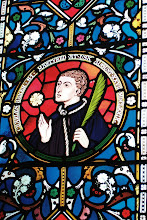
*(The photographs, which were taken at Harvington Hall, show a stained glass window depicting St John Wall and the secret chapel that would have been used by St John Wall and other priests in the times of persecution.)

Wednesday, 4 November 2009

TEN WERE JESUITS (PART4)

On 25th October 1970, Pope Paul VI canonised forty martyrs from England and Wales. The Forty Martyrs of England and Wales were a diverse group - men and women, priests and lay people – but, between the years of 1535 and 1679, they all shed their blood for their Catholic faith. Saint David Lewis was the last of the forty to die. Ten of the Forty Martyrs of England and Wales, including Saint David Lewis, were Jesuits. Our intention is to tell, briefly, the story of each of the Jesuits. (SEE PREVIOUS POSTS FOR PARTS 1, 2 & 3)

7) ST EDMUND ARROWSMITH was born in Lancashire in 1585. His parents were devout Catholics who had been fined and even imprisoned for recusancy. In December 1605, Edmund travelled to Flanders and entered the English College at Douai. Having survived several bouts of ill health, Edmund was finally ordained in Arras on 9th December 1612 and sent upon the English Mission on 17th June 1613. In 1622, he was arrested and imprisoned but he was pardoned and released. In 1624, Fr Arrowsmith joined the Society of Jesus. In August 1628, a Justice of the Peace, Captain Rawsthorn, issued a warrant for Edmund’s arrest and he was captured on Brindle Moor and taken to the Boar’s Head Inn and thence to Lancaster Castle and thrown into prison for refusing to take the oath and on suspicion of being a Jesuit priest. On 26th August, Edmund was brought before Judge Yelverton, who asked him if he was a priest. Making the sign of the Cross, Edmund replied, “I would to God I were worthy". The priest then spent some time in isolation in a dungeon while Yelverton drew up an indictment against him. He was charged with being a priest and a Jesuit and with seducing the people to Popery. Fr Arrowsmith was duly found guilty of high treason and sentenced to die in the usual way of hanging, drawing and quartering. The condemned priest was bound in heavy irons and placed in a dark hole so small that he could not even lie down. From Tuesday to Thursday, without a change of clothes, he endured the misery of having to sit in the ghastly hole. Just before noon on 28th August, Edmund Arrowsmith was taken to the place of execution. Near the gallows, a Mr Lee, pointing to a huge fire and a cauldron of boiling water, taunted Edmund: “Look what is provided for your death; will you conform yourself yet and enjoy the mercy of the king?” Edmund replied, “Good sir, tempt me no more. The mercy which I look for is in heaven, through the death and Passion of my Saviour Jesus and I most humbly beseech Him to make me worthy of this death.” Edmund climbed the ladder and, stopping several times to pray, finally reached the top where he pulled his hat over his eyes and prayed loudly. He was pushed off the ladder and the last words uttered by Fr Arrowsmith were “Bone Jesu” (O good Jesus). He was left to hang until he was dead then his body was cut down, disembowelled and quartered. His head was placed atop Lancaster castle and his four quarters were prominently displayed in various places around the castle. St Edmund Arrowsmith S J, was 43 years old when he was martyred on 28th August 1628. His hand is preserved in St Oswald’s Church in Ashton-in-Makerfield.

8) ST HENRY MORSE (alias Cuthbert Claxton) was born in Suffolk in 1595. He was the sixth of nine sons of a Protestant family. Henry went to London to study law but began to question his religion. He finally went to Douai in Flanders and, on 5th June 1614, he was received into the Catholic Church. He began preparations to train for the priesthood. On a short trip to England, he landed at Dover and was immediately ordered to take the Oath of Supremacy. He refused and was therefore imprisoned in New Prison, Southwark, for four years. Henry was released in an amnesty by King James and he went straight back to Douai and trained there until September 1620. On 15th September of that year, he entered the English College in Rome and completed his priestly studies, being ordained in 1623. Fr Morse joined the Jesuits in 1626. (His older brother, William, also became a Jesuit.) He was sent upon the English Mission in June 1624 and was immediately taken before a magistrate on suspicion of being a priest. He was incarcerated in York Prison for three years, after which time he was released and banished from England. Fr Morse returned to England in 1633 and worked among the poor of London. In 1636 he tended the victims of the plague, giving comfort and assistance to Catholic and Protestant alike. Many referred to him with admiration as the “Priest of the Plague”. Three times the priest himself fell victim to the plague but somehow managed to survive. On 27th February 1638, Fr Henry Morse was arrested by special warrant and committed to Newgate. At the next assizes he was brought to trial and accused of being a priest and of attempting to seduce His Majesty’s subjects to Catholicism. He was found guilty of being a priest but, on the personal intervention of the King’s Catholic wife, Fr Morse was bailed. Again, he was banished. In 1643, Fr Henry Morse was back in England and after about 18 months, he was apprehended by a band of Roundhead soldiers. With the help of a constable’s wife, the priest managed to escape. Six weeks later, the tenacious priest was again apprehended. This time he was thrown into Durham Gaol where he was held for several weeks before being sent to London’s Newgate Prison. He arrived in London on 24th January and on 30th January 1645 the prisoner was found guilty of being the same priest who had already been banished. At 9 o’clock on the morning of 1st February 1645, Henry was taken to Tyburn, the place of execution. After addressing the crowd and praying, he forgave his enemies and persecutors and hoped that God would so the same. He prayed for all Christian Kingdoms, especially England, and finished with the words of Jesus, “Into Thy hands, O Lord, I commend my spirit”. The cart was drawn away and he hanged until dead. The martyr’s head was placed on London Bridge and his quarters on the four city gates for all to see and be warned. St Henry Morse S J, was 50 years old when he died for the faith at Tyburn.

Saturday, 31 October 2009

TEN WERE JESUITS (PART 2)


On 25th October 1970, Pope Paul VI canonised 40 men and women from England and Wales who had given their lives for their faith. St David Lewis was the last of the forty to be martyred. Ten of the Forty Martyrs of England and Wales, including St David Lewis, were Jesuits. In this and the next couple of posts, we intend to tell, briefly, their stories. (FOR PART 1, SEE PREVIOUS POST)

3) St Robert Southwell was born in 1561 and sent to Douai while still a child. He remained there for some time and eventually made his way to Rome where he entered the Jesuit Novitiate of Sant’ Andrea. He was ordained in 1584 and, in 1586, he was sent upon the English Mission with Fr Henry Garnet. Robert was a tireless worker in Christ’s vineyard. He was instrumental in setting up a chain of Mass centres, he protected hunted priests, smuggled students for the priesthood abroad, sheltered priests arriving from the continent, and maintained a printing press on which he produced Catholic literature, including his own works. To his enemies he was known as “the chief dealer for the papists in England”. On 20th June 1592, Fr Southwell was apprehended at Uxendon Hall in Harrow, Middlesex. He had been betrayed by the owner’s daughter, Anne Bellamy, after she had been interrogated and raped by Topcliffe, the Queen’s chief priest-hunter and torturer. Fr Southwell was imprisoned in the Tower for three years and questioned under horrendous torture. Finally, shortly before his trial, he was moved to Newgate Prison and thrown into a dungeon called “Limbo”. At his trial in February 1595, he was, predictably, found guilty and sentenced to be hanged, drawn and quartered. The next day, 21st February, the condemned priest was taken to Tyburn for execution. Standing on the cart under the noose, Robert made the Sign of the Cross, though his hands were bound, and began to speak to the assembled crowd. “Whether we live, we live to the Lord: or whether we die, we die to the Lord. Therefore, whether we live or die, we belong to the Lord.” The Sheriff tried to stop him speaking but he was permitted to carry on. When he finished speaking, he again blessed himself and, as the cart was drawn away he prayed in Latin, “Into thy hands, O Lord, I commend my spirit”. The crowd, including many Protestants, would not allow the priest to be cut down until he was dead and for this reason, some of them tugged at his legs to hasten the end of his suffering. When he was dead, the martyr’s body was cut down, disembowelled and quartered and his head displayed to the crowd. Unusually, the traditional cry of “Traitor” was not uttered. St Robert Southwell, S J, was 33 years old.

4) St Henry Walpole, the eldest of a large family, was born at Docking, Norfolk in 1558. He studied at Peterhouse, Cambridge, and, in 1578, went to study law at Gray’s Inn, London. Upon witnessing the martyrdom of St Edmund Campion in 1581, he converted to Catholicism. He went to Douai in 1582 and the entry in the Douai Diary states “On 7th July Mr Henry Walpole came to us out of England, a discreet, grave and pious man”. He remained here until April 1583 when he was sent to Rome to enter the Society of Jesus. On 15th December 1588 Henry Walpole was ordained in Paris. He was not sent on the English Mission until 1593, arriving in Yorkshire on the night of 6th December. Twenty-four hours later he was captured by the authorities. Three days later he was taken to York where, upon admitting that he was a priest, he was committed to York Gaol. On 25th February 1594, he was ordered to be sent to London and he was imprisoned in the Tower for a year. Carvings that he made on the wall of his cell can still be seen in the Salt Tower. While a prisoner in the Tower, Fr Walpole was tortured at least fourteen times. In 1595, the prisoner was sent back to York to be tried. At his trial he refuted the charges against him, replying at one point, “You, my Lords, sit here at present in judgement as men, and judge as such, being subject to error and passion, but know for certain that there is a Sovereign Judge who will judge righteously, whom in all things we must obey in the first place, and then our lawful princes in such things as are lawful, and no further.” As directed, the jury returned a guilty verdict and Henry was sentenced to death for being a priest, at that time considered high treason. On 7th April 1595, Fr Henry Walpole, along with Fr Alexander Rawlins, was taken to the place of execution at Knavesmire, just outside York. Fr Walpole was forced to watch as his companion was butchered and the authorities offered him his life if he would conform. The priest rejected their bribes and climbed the ladder. He asked the prayers of all Catholics present and lifted his eyes to heaven and began to pray. Before he had finished the Hail Mary, he was shoved off the ladder. He was fully conscious when he was dismembered, disembowelled and quartered. Many witnesses were so moved by the saint’s martyrdom that they converted to Catholicism. The Jesuit Martyr, Saint Henry Walpole, was 37 years old when he gave up his life for his faith.

Related Posts with Thumbnails