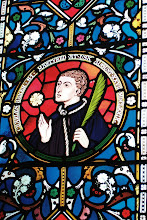
The generally accepted site of the grave of the last Welsh Catholic Martyr, St David Lewis, is just outside the door of the west porch of the Priory Church of St Mary, Usk. John Hobson Matthews arrived at a different conclusion. This presents another mystery – where is St David Lewis buried?

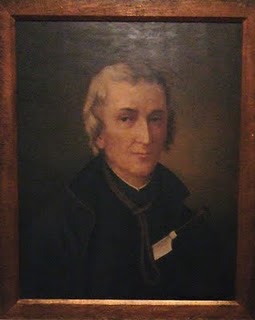
John Hobson Matthews, solicitor, archivist and historian, was born in 1858. In 1877, aged nineteen, he converted to Catholicism. He became a solicitor in 1889 and practised for many years in Cardiff. He was an accomplished linguist and, although he was born in Croydon, he was fluent in Welsh.
Matthews was archivist for the Cardiff Corporation and one of the original members of the Catholic Records Society. The Catholic Records Society holds valuable information relating to Catholics in south east Wales and much of this was gathered by Matthews. He died at Ealing on 30th January 1914. I have had a rummage through the Catholic Records available on the internet and was intrigued with what I found.
Matthews wrote: “Close to the north-west angle of the west porch is a plain and massive slab of grey stone. No inscription is now visible, and the stone is fractured across the middle. It bears faint traces of ornamental carving, and of the shaft of a long cross. This is traditionally regarded by the local Catholics as the grave of the Ven. David Lewis, S.J., alias Charles Baker, who was executed at Usk in 1679 for alleged complicity in the bogus Popish Plot.
In 1889 I was told that this grave was still cleaned and decorated every year, by an aged Catholic Irishwoman of Usk, on the 27th of August, the anniversary of the martyrdom.
In the year 1904 the tradition had grown faint, and I took steps to renew it before it should expire. The following are portions of letters written by the Rev. Isidore Heneka, priest in charge of the mission of Usk, and the late Rev. Thomas Burgess Abbot, for over 50 years rector of the Monmouth mission.”
The following letter, dated 24th August 1901, supports the accepted position of the martyr’s grave.
On 24 Aug. 1901, the Rev. Mr. Abbot wrote:
“Father Baker (or Lewis), S.J., martyred at Usk in August 1679 and buried in the church yard, where the present gravel walk passes from the street to the church door, and about 10 paces from the door of the church as old Mr. McDonnell of Usk pointed out to me where, as a boy, he had seen the " square stone " marking the grave of the Popish Recusant. He told us also that he was pointed out the part of the “island" on the other side of the Usk, as the place of his martyrdom.”
The following letter from Rev Heneka also supports this.
“USK, 18 Feb. 1904.
Dear Mr. Matthews,
I am afraid that we shall never be at a certainty as to Ven. Father Lewis grave. I have searched the whole churchyard to find a stone with an inscription, without result. We can only go by tradition. The old people of Usk, Catholic and Protestant alike, point out the grave at the left corner next the porch. The stone is broken, but without any sign of inscription, right or left.
I. HENEKA.”
However, in April of the following year, 1905, Rev Heneka wrote a somewhat startling letter which could cause us to reconsider. It convinced Mr Matthews!
“USK, 13 April 1905.
Dear Mr. Matthews,
Today I had removed the broken gravestone of the supposed grave of the Ven. David Lewis, S.J., near the west porch of Usk parish church. I found under it some broken pieces of a gravestone with the inscription "April 18 aged 62"; and a full-sized stone halfway under the priest’s, with the words "Mary Low of this town 1721. IHS." I also found in the same spot a small bone which evidently got there when they made some alterations in the church and reburied remains taken from there. Strange that local tradition has not kept up the grave!
I. HENEKA.”
Mr Matthews said: “It would appear from the evidence of Father Heneka’s letter of 1905, that the stone traditionally regarded as that of the Ven. David Lewis was removed to its present site some years later than 1721.”
Matthews also quotes Brother Foley who stated that the holy priest’s body was “interred in the porch of the church”. This, claims Mr Matthews, is the statement made by most writers as to Father David Lewis resting-place.
John Hobson Matthews concluded: “After studying the question carefully for years, my own belief is that the martyr lies buried in the west porch, and that his gravestone was ousted from its original site sometime early in the 19th century when the pavement of the porch was repaired.”
The original gravestone, the “plain and massive slab of grey stone”, of which Mr Matthews speaks was replaced after the canonisation of Saint David Lewis. This old stone now lies at the side of the Catholic Church of Ss Francis Xavier and David Lewis, in Usk. On 24th October 2010, in commemoration of the fortieth anniversary of the canonisation of St David Lewis and the Forty Martyrs of England and Wales, a new plaque beside the old stone was unveiled and blessed.
 Despite the very interesting findings and conclusion of the respected Mr John Hobson Matthews, it is generally accepted that our Saint is buried just outside the west porch. The grave is fittingly marked by a well appointed stone, placed there about 1979. I too accept this commonly held opinion.

Inside or just outside the west porch, does it matter so very much? It is only a matter of a step or two across the path and it is therefore certainly in the right location. As T S Eliot wrote, “Wherever a saint has dwelt, wherever a martyr has given his blood for the blood of Christ, there is holy ground, and the sanctity shall not depart from it though armies trample over it, though sightseers come with guide-books looking over it.........From such ground springs that which forever renews the earth though it is forever denied.”




.JPG)

.JPG)


