Showing posts with label St Philip Evans. Show all posts

Monday, 22 July 2019

ON THIS DAY IN 1679

On this day, 22 July, in the year 1679, two Welsh Catholic Priests were hung, drawn and quartered at Gallows Field, Cardiff.  Brecon born secular priest, Fr John Lloyd and Jesuit Philip Evans were caught up in the evil plot spawned in the fetid mind of Titus Oates and executed for being Catholic priests and exercising their ministry in the country.  Both priests were canonised in 1970 by Pope Paul VI.

To learn more about St John Lloyd click here


To learn more about St Philip Evans click here

Saturday, 18 November 2017

"WHEREVER A SAINT HAS DWELT"

“For wherever a saint has dwelt, wherever a martyr has given his blood for the blood of Christ, there is holy ground, and the sanctity shall not depart from it though armies trample over it, though sightseers come with guide-books looking over it.”

So wrote T S Eliot in "Murder in the Cathedral", his play about the murder of St Thomas Becket in Canterbury Cathedral in 1170.
The Gunter Mansion, Cross St, Abergavenny
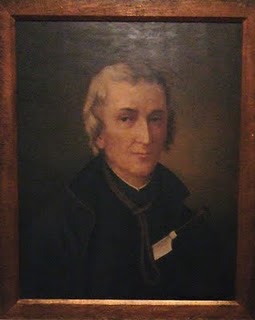
St Philip Evans
St David Lewis
If Eliot is right, then the Gunter Mansion on Cross St, Abergavenny, is indeed "holy ground" for here, not one but two, martyrs dwelt! Thomas Gunter, who had built a secret chapel in the attic of his Cross St mansion, kept two Jesuits at his home at a time when being a Catholic could mean death. His uncle, Fr David Lewis, and Fr Philip Evans, both stayed at Gunter's where they said Mass and tended to the spiritual needs of the Catholics of Abergavenny and surrounding area. Falsely accused in the fictitious Popish Plot, the two priests were martyred in 1679.  In 1970, Fr David Lewis and Fr Philip Evans were canonised by Pope Paul VI.

The Friends of Gunter Mansion are attempting to restore this important historic property.  To this end, they have opened a Pop-Up Exhibition in part of the old mansion.  It is open from 10:30 - 4:00, every Tuesday, Friday and Saturday.  Entry is free (although donations wouldn't be refused).  Come in and meet the volunteers and, keeping Eliot's words in mind, learn about the courageous Gunters and the Saints who have dwelt in this venerable old building.
The Pop-Up Exhibition in part of the historic Gunter Mansion

Thursday, 25 October 2012

HYMN IN HONOUR OF THE SIX WELSH MARTYRS

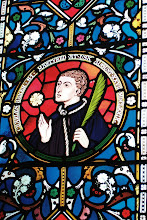
ST STEPHEN & THREE WELSH MARTYRS DEPICTED IN A STAINED
GLASS WINDOW IN THE CATHOLIC  CHURCH, TENBY


Today we celebrate the Feast of The Six Welsh Martyrs of the Reformation.  The Six Welsh Martyrs, who were canonised by Pope Paul VI on 25th October 1970, are:
 
St Richard Gwyn was born about 1537 in Llanidloes, Montgomeryshire. He was a teacher and a married man. He and his wife, Catherine, had six children. He was executed at Wrexham on 15th October 1584. St Richard Gwyn is the protomartyr of Wales.
 
St John Jones O F M was born at Clynog Fawr, Caernarvonshire around the year 1530. He entered the Franciscan Convent at Greenwich and, at its dissolution in 1559, he went to the Continent and was professed at Pontoise, France. He died for the Faith at Southwark on 12th July 1598. At his execution, he had to wait an hour because the hangman had forgotten to bring the rope!

 
St John Roberts O S B born at Trawsfynydd, Merionethshire, was the first prior of St Gregory’s, Douai. He was sent upon the English Mission in December 1602, arriving in England in April 1603. He was probably the first monastic to enter England since the Reformation. He was executed at Tyburn on 10th December 1610.
 

St Philip Evans S J was born in Monmouth in 1645. He entered the Society of Jesus on 7th September 1665. He was ordained at Liege and sent upon the English Mission in 1675. He diligently and joyfully served the area of South Wales for four years before his arrest at the house of Christopher Turberville at Sker, Glamorganshire on 4th December 1678. He was martyred at Cardiff on 22nd July 1679. He was thirty-four years old.
 
St John Lloyd was Brecon born and studied at Ghent and Valladolid. He was ordained a priest at Valladolid in 1653. He returned to Wales and laboured in Brecon and Monmouthshire for 24 years. In November of 1678, he was captured at a house at Penllyn, Glamorganshire. He and St Philip Evans shared a cell at Cardiff Castle until their martyrdom at Cardiff on 22nd July 1679.

St David Lewis S J was born in 1616 at Abergavenny, Monmouthshire. He attended the local Grammar school where his father, Morgan Lewis, was headmaster. Ordained in 1642, David entered the Jesuit novitiate in 1645. He returned to Wales and, based at the Cwm, he served the Catholics of the area for 34 years. He was arrested at Llantarnam on 17th November 1678 and martyred at Usk on 27th August 1679. St David Lewis was the last Welsh martyr.

HYMN OF THE WELSH REFORMATION MARTYRS

(Tune Hyfrydol or Blaenwern)
Came a time upon our nation
when the faith of Rome was banned.
Christians found their hearts were broken,
torn apart throughout our land.
Thus a traitor to the nation
anyone who loved the Pope.
Christians stood in condemnation.
Who could bring them any hope?
 
Men who trained  as priests for Cymru
came from Europe’s shores ere long.
Traversed far and wide our nation,
come to keep the Old Faith strong.
Saying Mass and heard confession,
priests of God , their only crime
was that laws of England’s kingdom
made such treason, at that time.
 
David Lewis, priest of Monmouth
gladly in Usk met his end.
As at Cardiff, Philip Evans
with John Lloyd, his holy friend.
From the north did Saint John Roberts
die for Christ, a Martyr true,
and Franciscan, Saint John Jones,
from the noose to heaven flew.
 
With these priests, to Rome so loyal,
one more Saint of Wales did die.
Richard Gwyn, the edict Royal
did at first its ways comply.
But this man, of Wales a teacher,
taught us now the better way.
He renounced the Royal churches,
chose with Rome alone to pray.
 
Time hath passed upon our nation,
the Old Faith no longer banned.
Other Christians, once oppressive,
now as friends beside us stand.
*This is not a day for gloating,
Or for raising ancient wrong,
but a day for celebrating
loyal Saints whose faith proved strong.*


Monday, 27 August 2012

ST DAVID LEWIS, SUPERIOR OF THE CWM


Three hundred and thirty-three years ago today a Welsh Jesuit priest, Fr David Lewis, was executed at Usk.  His crime was to be a Catholic priest in a time when it was deemed High Treason to be a Catholic priest and to celebrate Mass in England. 
 
Plaque marking site of execution of St David Lewis
David Henry Lewis was a Monmouthshire man, born in Abergavenny in 1616.  He was the youngest of the nine children of Morgan Lewis and Margaret Pritchard.  Although David's Catholic mother brought up eight of the children in the Catholic Faith, David's Protestant father had David brought up in the Established Religion.
 
David attended the local grammar school of which his father was headmaster.   Later he went to London to study law.  He travelled to Paris as tutor to a young nobleman and while in Paris David converted to Catholicism.
 
After the deaths of his parents in 1638 David entered the English College in Rome to study for the priesthood.  He was ordained there in 1642.  Later, following in the footsteps of his Jesuit uncle, David entered the Jesuit Novitiate of Sant Andrea in Rome.  
 
After profession as a Jesuit, Fr Lewis was sent on the English Mission.  After only a year he was recalled to Rome to take up a position in his old college.  However, he soon returned to Wales and here he laboured among his own people for the remainder of his life.
 
He was twice Superior of the Jesuit College of St Francis Xavier at the Cwm, on the Monmouthshire-Herefordshire border.  According to a pamphlet published in London in 1679, the Cwm consisted of spacious houses with several entrances and secret passages between some of the rooms.  Underneath the buildings there were extensive cellars, accessible both from inside and outside the houses - useful strongrooms where valuables could be hidden.  From one room a tunnel ran out into the neighbouring woods, in which there were many caves.  Remote and secluded, the Cwm was an ideal meeting place for Catholics on both sides of the Anglo-Welsh border.


The site of the Jesuit College, The Cwm
The Cwm had been known to the government authorities since as early as 1660 and possibly earlier.  However it was not until December 1678 that the Lords ordered an investigation by the Bishop of Hereford, Herbert Croft.  Croft had the enthusiastic support and assistance of John Arnold, John Scudamore and Charles Price. 
 
By this time, all the priests had been evacuated from the Cwm.  In fact, the Superior, Fr David Lewis, was a prisoner in Monmouth Gaol and had been since his arrest at Llantarnam on 17th November 1678.  Some priests found shelter with recusant families, others, including Fr Philip Evans were imprisoned, and others, hunted like wild beasts, sheltered in caves or woods.
 
While the raid did not turn up any hidden priests, it did yield a store of church plate, vestments and books.  Bishop Croft added many of the stolen books to his Cathedral Library. 
 
 
Viewing some of the Cwm books in Hereford Cathedral Library
Recently we had the very great privilege of being permitted to view some of the confiscated books from the Cwm Library.   Dr Rosemary Firman, librarian of Hereford Cathedral, showed us several books which are known to have come from the Jesuit Library at the Cwm.  One of the books was inscribed with the name of Thomas Gunter.  Thomas Gunter had a secret chapel in his mansion on Cross St in Abergavenny where Frs David Lewis and Philip Evans said Mass and administered the Sacraments to the Catholics who crowded into the attic chapel.  Dr Firman imparted many interesting facts about the books and, quite honestly, we were more than a little awed to be looking at books which had very likely been held, consulted or  read by St David Lewis over three hundred years ago.
 
For some very interesting information about the Jesuit Library at the Cwm visit Hannah's excellent blog here
 
Fr David Lewis was executed at Usk on 27 August 1679.  He was beatified in 1929 and Canonised as one of the Forty Martyrs of England and Wales in 1970.

Sunday, 22 July 2012

ST JOHN LLOYD

St Philip Evans and St John Lloyd were two Welsh priests who shared a cell in Cardiff Castle in 1678/79.  They were executed on the same day, 22nd July 1679, at Gallows Field, Cardiff.  Most accounts of St Philip Evans and St John Lloyd are joint accounts but, although they shared so much, I think that each man’s story deserves a separate telling.  On this 333rd anniversary of their martyrdom I will endeavour to do just that.  Of course there will be similarities and crossovers but I will do my best to give a brief account of their individual stories.  (LINK HERE)
St John Lloyd


ST JOHN LLOYD, a secular priest, was one of the many itinerant priests of South Wales who was caught up in the horror of the fabricated Popish Plot.  I say “fabricated” because today historians agree that the plot existed only in the warped psyche of Titus Oates and his perverted fellows. 

John Lloyd was the son of Walter Lloyd.  He was born into a devout Catholic family in Brecon around 1630.  John entered the Royal College of St Alban at Valladolid in 1649 and took the customary oath to return to the English Mission.  He was ordained on 7th June 1653.  The following April he left for his homeland.  Fr Lloyd spent the next twenty-four years labouring among the Catholics of Glamorgan and Monmouthshire. 

He was known to frequent the home of John Turberville at Penllyn.  He also stayed at the home of Walter James at Trivor near St Maughans.  At Trivor one can still see the room once used as a chapel.  There is a niche in the wall where a statue or crucifix would have been placed, probably above the altar.  Finding shelter at these and other Catholic recusant homes, the intrepid priest did not spare himself in celebrating Mass, administering the sacraments and caring for the needs of his oppressed flock.  At this very dangerous time, John Lloyd’s brother, Fr William Lloyd, was also working among the Catholics of South Wales.  Fr William Lloyd was head of the secular clergy in South Wales.

The niche in the wall of the secret chapel at Trivor

In 1678 the first rumblings of the Oates Plot/Popish Plot crept across the country.  It was a time when fear and suspicion lurked in the hearts of ordinary decent people for the safety of every man depended on who was in power at any given time.  Protestants had suffered much under Catholic Queen Mary.  There had been Catholic plots and rumours of Catholic plots so it was easy for Titus Oates and his iniquitous ilk to foment the horror that was unleashed by the Oates Plot.

On 20th November 1678 Fr John Lloyd was arrested at the home of John Turberville at Penllyn.  He was taken to Cardiff Castle Gaol where he was imprisoned, possibly in the Black Tower.  For a time he was kept in solitary confinement. Eventually he and Fr Philip Evans S J, who was arrested on 4th December, were permitted to share a cell.  Coincidentally, both Fr Lloyd and Fr Evans had sisters who were Blue Nuns in Paris.  Fr Lloyd’s sister, Mother Margaret Bruno, had died four years earlier, in 1674.

On 9th May 1679 the Assizes opened in the Shire Hall within the Castle grounds.  Fr Lloyd was indicted as a Catholic priest and therefore a traitor.  He was found guilty and sentenced to be hanged, drawn and quartered. 

At the height of the Plot, Fr William Lloyd was arrested and imprisoned in Brecon Gaol.  He too was found guilty of being a Catholic priest and performing the functions of a priest.  Like his brother, he was sentenced to be hanged, drawn and quartered.  However, Fr William Lloyd was treated so harshly in prison that he died in Brecon Gaol just days before his scheduled execution.

The day of Martyrdom arrived for Fr John Lloyd on 22nd July 1679.  He and Fr Philip Evans were dragged on a hurdle to Gallows Field (often referred to today as ‘Death Junction’).  Fr Lloyd had to stand and watch as the young Jesuit who had been his cellmate and friend was butchered before his eyes.  Then he was subjected to the same barbaric death.  Fr John Lloyd was forty-nine years old.

Plaque in St David's Cathedral, Cardiff

There was great rejoicing in Rome and in Britain on Sunday 25th October 1970.  On that day, Pope Paul VI canonised forty Catholics who had died for their faith during the sad years of religious persecution in England.  After years of investigation and scrutiny, the forty had been chosen from the hundreds who had given their lives for the Old Faith.  On that happy day Fr John Lloyd became known as St John Lloyd, one of the Forty Martyrs of England and Wales.      

Saturday, 21 July 2012

ST PHILIP EVANS S J

St Philip Evans and St John Lloyd were two Welsh priests who shared a cell in Cardiff Castle in 1678/79.  They were executed on the same day, 22nd July 1679, at Gallows Field, Cardiff.  Most accounts of St Philip Evans and St John Lloyd are joint accounts but, although they shared so much, I think that each man’s story deserves a separate telling.  As the 333rd anniversary of their martyrdom approaches I will endeavour to do just that.  Of course there will be similarities and cross overs but I will do my best to give a brief account of their individual stories.  (LINK HERE)
The Parish Church at Llangattock Vibon Avel which contains monuments
to members of the Evans family
PHILIP EVANS was born at Monmouthshire in 1645.  He was the son of Winifred Morgan of Llanvihangel Crucorney and William Evans of Llangattock Vibon Avel, near Monmouth.  Philip was educated at St Omer and he entered the Jesuit Novitiate at Watten on 7th September 1665.  When he completed his training he was ordained at Liege in 1675 and sent upon the English Mission.

17th century chalice believed to have 
belonged to St Philip Evans
Back in Wales, Fr Philip Evans S J worked diligently for four years, saying Mass, administering the Sacraments and preaching in Welsh and English.  It is known that the young Jesuit, along with Fr David Lewis, regularly stayed at the home of Thomas Gunter of Cross Street in Abergavenny.  Here he celebrated Mass and tended to the needs of the Catholics of the area.  The Catholic Church at Abergavenny has in its possession a small travelling chalice which is thought to have been owned by Fr Evans.  He also stayed at the homes of Charles Prodger of Wernddu and of Christopher Turberville of Sker House and cared for the Catholics in these locations.

During the wave of persecution generated by the Popish Plot, friends advised Fr Evans to go into hiding.  However, he refused and bravely continued his work.  On 4th December 1678, the priest was arrested at Sker House, betrayed by the owner’s younger brother, Edward Turberville, a lapsed Catholic.  Philip Evans was imprisoned in Cardiff Castle Gaol and kept in solitary confinement in the dungeon.  After several weeks he and another Welsh priest, Fr John Lloyd, were permitted to share a cell. Fr Lloyd, a secular priest, had been arrested in November.

The following May, Fr Philip Evans was tried at Cardiff Assizes, found guilty of the treasonable offence of being a Catholic priest, and sentenced to death.  The execution was delayed for some time and Fr Evans was even allowed out of prison for recreation!  Eventually, on 21st July 1679, orders arrived that his execution was to take place the following day.  At that time he was playing tennis on the court near St John’s Church.  When the gaoler went to the tennis court to tell the priest the news and to return him to prison, Fr Evans remarked, “What haste is there?  Let me first play out my game.”   This he did!

St Philip Evans S J,
with his harp
Fr Evans had a sister, Sister Barbara Catherine, who was a Blue Nun in Paris.  When he returned to his cell after his game of tennis, he wrote to her. He told her of his approaching death and insisted that she should not mourn for him but be joyful.  He asked her to pray for him and promised that he would pray for her. 

Philip was a skilled harpist and when the officials came the next morning to lead him to his execution they found the priest joyfully playing the harp.  His legs had been bound with heavy chains.  They were so tight that the struggle to remove them lasted more than an hour and caused the poor priest indescribable agony.

Fr Philip Evans was then taken to the place of martyrdom.   When he mounted the scaffold Fr Evans said; “This is the best pulpit a man can have to preach in, therefore, I cannot forbear to tell you again that I die for God and for Religion’s sake.”  He addressed the crowd in English and in Welsh, then turning to Fr Lloyd, who stood waiting his own turn, he said, “Adieu, Mr Lloyd!  Though only for a little time, for we shall soon meet again.”

On 22nd July 1679, thirty-four year old Fr Philip Evans S J was hanged, drawn and quartered at Gallows Field (the northern end of Richmond Road) Cardiff.   He was beatified in 1929 and canonised in 1970.  St Philip Evans is one of the Forty Martyrs of England and Wales.

Tuesday, 1 May 2012

TWO SEVENTEENTH CENTURY CHALICES


During the years of persecution in England, Catholics could not hold public office, attend university, inherit or own a horse nor practise their religion.  To be a Catholic priest was deemed high treason and many were hanged, drawn and quartered for saying Mass and carrying out their priestly functions.  Central to the Mass are the sacred vessels used.  The Catholic Encyclopedia tells us “The chalice occupies the first place among sacred vessels”.


Many examples of ancient chalices have been discovered.  Some are simple & some are elaborate.  The two I will deal with today are quite simple chalices.  Though they are simple in appearance they are both valuable in that they were owned and used by priests during the penal days of the 1600s.  Both chalices are in the safekeeping of the Catholic Church at Abergavenny and I am grateful to the Parish Priest, Dom Thomas Regan O S B, for allowing us to see and photograph these precious relics.

Two 17th century silver chalices used during Penal Times when to be a Catholic priest was considered High Treason
Thomas Gunter was a prominent and wealthy citizen of Abergavenny.  He was also a fearless and staunch Catholic.  At his mansion in Cross Street, Gunter kept two Jesuit priests, Frs Philip Evans and David Lewis.  Thomas Gunter also had a secret chapel in his house where Catholics of the area would gather for Mass celebrated by the intrepid Jesuits.  A report referring to this “secret” chapel said there was at Abergavenny “a public chapel for Papists adorned with the marks of the Jesuits on the outside, and such numbers flocked there that a hundred were seen to come out of it when not above forty attended the parish (Established) church.”

 During the bloodbath engendered by the Popish Plot invented by the evil Titus Oates, both priests were arrested and imprisoned.  Fr Evans was imprisoned in Cardiff Castle and Fr Lewis in Monmouth Gaol.  Fr Lewis was later moved to Usk Gaol.  Tried and convicted of the High Treason of being Catholic priests who “read Mass” Fr Evans and Fr Lewis were condemned to be hanged drawn and quartered.

Monmouth born Fr Philip Evans was martyred at Cardiff on 22nd July 1679.  He was thirty-four years old.  This 17th century chalice is thought to have belonged to Fr Philip Evans.

This 17th century silver chalice is thought to have
 belonged to St Philip Evans
His friend, colleague and superior, Fr David Lewis, who was Abergavenny born and bred, was martyred at Usk on 27th August 1679.   This silver chalice was designed to be dismantled and hidden away at the first sign of priest hunters. It was owned and used by Fr David Lewis.  As such it is a sacred relic of the martyred priest and a very important part of our Catholic heritage in this country.     

This 17th century silver chalice belonged to St David Lewis
On 25th October 1970, the two heroic Welsh priests, Fr Philip Evans and Fr David Lewis, were canonised by Pope Paul VI as two of the Forty Martyrs of England and Wales. 

Sunday, 15 April 2012

SIX OF THE FORTY

The Forty Martyrs of England and Wales were selected from among the hundreds of Catholics who gave their lives for the faith during the dark days of persecution in England. The Forty were canonised by Pope Paul VI on 25th October 1970. Six of the Forty were Welsh. They were a married man, a Franciscan, a Benedictine, two Jesuits and a secular priest.

St Richard
Gwyn was born about 1537 in Llanidloes, Montgomeryshire. He was a teacher and a married man. He and his wife, Catherine, had six children. He was executed at Wrexham on 15th October 1584. St Richard Gwyn is the Protomartyr of Wales.

St John Jones O F M was born at Clynog Fawr, Caernarvonshire around the year 1530. He entered the Franciscan Convent at Greenwich and, at its dissolution in 1559, he went to the Continent and was professed at Pontoise, France. He died for the Faith at Southwark on 12th July 1598. At his execution, he had to wait an hour because the hangman had forgotten to bring the rope!

St John Roberts O S B, born at Trawsfynydd, Merionethshire, was the first prior of St Gregory’s, Douai. He was sent upon the English Mission in December 1602, arriving in England in April 1603. He was probably the first monastic to enter England since the Reformation. He was executed at Tyburn on 10th December 1610.

St Philip Evans S J was born in Monmouth in 1645. He ent
ered the Society of Jesus on 7th September 1665. He was ordained at Liege and sent upon the English Mission in 1675. He diligently and joyfully served the area of South Wales for four years before his arrest at the house of Christopher Turberville at Sker, Glamorganshire on 4th December 1678. He was martyred at Cardiff on 22nd July 1679. He was thirty-four years old.

St John Lloyd was Brecon born and studied at Ghent and Valladolid. He was ordained a priest at Valladolid in 1653. He returned to Wales and laboured in Brecon and Monmouthshire for 24 years. In November of 1678, he was captured at a house at Penllyn, Glamorganshire. He and St Philip Evans shared a cell at Cardiff Castle until their martyrdom at Cardiff on 22nd July 1679.

St David Lewis was born in 1616 at Abergavenny, Monmouthshire. He attended the local Grammar school where his father, Morgan Lewis, was headmaster. Ordained in 1642, David entered the Jesuit novitiate in 1645. He returned to Wales and, based at the Cwm, he served the Catholics of the area for 34 years. He was arrested at Llantarnam on 17th November 1678 and martyred at Usk on 27th August 1679. St David Lewis was the last Welsh martyr.

Monday, 1 November 2010

THE PERJURER TITUS OATES AND EIGHT JESUITS (PART 8)

ST PHILIP EVANS S J
Philip Evans was born at Monmouthshire in 1645. He was the son of Winifred Morgan of Llanvihangel Crucorney and William Morgan of Llangattock Vibon Avel. Philip was educated at St Omer in Flanders and, on the 7th September 1665, he entered the Jesuit Novitiate at Watten. Ordained at Liege in 1675, Fr Philip Evans S J was sent on the English Mission to work among the Catholics of his native Wales. He was a diligent and tireless worker, preaching in both Welsh and English, administering the Sacraments and celebrating Mass.

It is known that the young Jesuit, along with Fr David Lewis, regularly stayed at the home of Thomas Gunter of Cross Street in Abergavenny. Here he celebrated Mass and tended to the needs of Catholics of the area. He also stayed at the homes of Charles Prodger of Wernddu and Christopher Turberville of Sker House and cared for Catholics in these locations.

As the sinister tendrils of the Oates Plot snaked across the country in the autumn and winter of 1678, friends advised Fr Evans to flee and to go into hiding. This he refused to do, preferring to continue with his work among the oppressed and abused Catholics. The Government offered a £50 reward for the apprehension of any priest or Jesuit. To this £50 reward a local magistrate and bitter anti-Catholic, John Arnold of Llanvihangel Court, added an extra incentive of £200. To be sure, there was no shortage of willing informers so time was running out for the courageous priest.

The arrest of Fr Philip Evans at Sker House of 4th December 1678 was brought about by the quisling, Edward Turberville. Edward Turberville was a lapsed Catholic and the younger brother of Christopher Turberville. Philip Evans was imprisoned in Cardiff Castle and spent several weeks in solitary confinement. Eventually he and Fr John Lloyd, a secular priest who had been arrested in November, shared a cell. In May 1679, Fr Evans was brought to trial at Cardiff Assizes. He was found guilty of being a Catholic priest and of saying Mass. This was, under the Penal Laws of the time, considered High Treason so Philip Evans was sentenced to be hanged, drawn and quartered, the usual sentence for treason.

The sentence was not immediately carried out and, strangely, Fr Evans was even allowed out of prison for recreation! On 21st July, the gaoler received orders that the priest was to be executed the next day. Fr Evans was playing tennis so the Gaoler went to return him to his cell and to tell him the sad news. Fr Evans was unperturbed and asked, “What haste is there? Let me first play out my game.”

When Philip was returned to prison, his legs were bound in chains. His spirit was unquenchable and, a skilled harpist, he took up his harp and played. The next morning when the authorities came to take him to the place of execution, they were astounded to find Fr Evans joyfully playing the harp. The chains on the priest’s legs were so tight that it took over an hour to remove them. Their removal caused a great deal of pain to the prisoner. Finally he and Fr Lloyd, who was to die that day too, were taken to the place of execution, Gallows Field, outside Cardiff. When he mounted the gallows Fr Evans said, “This is the best pulpit a man can have to preach in, therefore, I cannot forbear to tell you again that I die for God and religion’s sake.” He addressed the crowd in English and Welsh, then turning to Fr Lloyd he said, “Adieu, Mr Lloyd! Though only for a little time, for we shall soon meet again”.

Thirty-four year old Fr Philip Evans, joyful to the last, was martyred at Gallows Field, Cardiff (the northern end of Richmond Road) on 22nd July 1679. He was the seventh Jesuit to be executed due to the evil scheming of Titus Oates and his lying henchmen. On 15th December 1929 Pope Pius XI beatified Philip Evans. On 25th October 1970 this Welsh martyr was canonised by Pope Paul VI as one of the Forty Martyrs of England and Wales.

Saturday, 31 July 2010

HAPPY FEAST DAY TO JESUITS EVERYWHERE

The Last Welsh Martyr, St David Lewis, was a Jesuit priest who was martyred for the Faith during the Popish Plot. The Popish Plot, the invention of the base Titus Oates, began in the summer of 1678 and before its horrific executions ended in 1681, eight Jesuit priests were among the innocent Catholics who gave their lives. Two of the Jesuits, Fr David Lewis and Fr Philip Evans, were canonised by Pope Paul VI in 1970.

St Ignatius Loyola was the founder of the Society of Jesus (Jesuits). Today, 31st July, is the Feast Day of this illustrious saint.

The first video tells a little of the story of St Ignatius of Loyola. The second video is the well known prayer attributed to St Ignatius. The prayer has been put to music and it will be familiar to many of us.


HAPPY FEAST DAY TO JESUITS EVERYWHERE!

Thursday, 4 March 2010

MAYNE TROTT

One of the principal witnesses at the trials of both Fr Philip Evans and Fr David Lewis was a disreputable character named Mayne Trott, of Llanvihangel Crucorny.

Born around 1629, Mayne Trott had been successively Court Dwarf to the Kings of Spain and of England. After the Restoration of the Monarchy, Trott was in the service of King Charles II of England but, because of his unsavoury conduct, he was banished from Court. Trott himself denied this and maintained that he had left Court of his own free will and was still welcome to go there whenever he pleased.

Mayne Trott had converted to Catholicism upon his marriage to a wealthy relative of Fr David Lewis. He soon went through her fortune and after her death he reverted to Protestantism. Having been banished from Court, he had to depend on the charity of others and thus he became a useful tool of the zealous anti-Catholic and priest hunter, John Arnold, and was now a tenant and servant of Arnold’s. Of course, because of his married life as a Catholic, Mayne Trott was able to supply his master with information as to the affairs of the Catholics in South East Wales.

At the trial of St David Lewis, Judge Atkins asked; “Mr Trott, what have you to say of the prisoner? Did you ever hear him read Mass? Was he reputed commonly a Jesuit, or Popish priest?” Trott replied; “Yes, my lord, he was commonly reputed so, and I have heard him often read Mass and I saw him marry Mr Gunter’s daughter to Mr Body.” Fr Lewis, who had trained as a Lawyer, was conducting his own defence and he pointed out to Judge Atkins and the court that, because of Trott’s straitened circumstances, “it is rather poverty and hope of gain, than anything else, that brings him here to accuse me.” To this Judge Atkins replied “Paupertas ad turpia rogat” (poverty leads to dishonesty).

In November 1679, three months after the execution of St David Lewis, there was a Pope-burning in Abergavenny. Instigated by John Arnold and his minions, the spectacle was led by Mayne Trott, armed with a blunderbuss. Shortly after this, 50 year old Mayne Trott dropped dead in a London street.


Friday, 5 February 2010

FIRE AT THE GUNTER MANSION


Yesterday's local newspapers carried the news of a fire in Abergavenny. The fire, which is believed to have started in an empty flat above an Indian Takeaway, sent flames shooting 12ft or more into the night sky. Fortunately, no one was seriously injured in the blaze. However, there is cause for concern as the fire has left the building, part of the 16th century Gunter Mansion, structurally unsound. It was in the Gunter home that Fr David Lewis and Fr Philip Evans regularly said Mass and ministered to the Catholics of Abergavenny and surrounding area. (Both priests were martyred in 1679.) It was common knowledge that Thomas Gunter had a secret Catholic Chapel in his home but its exact location had been lost to memory. In 1908, during renovations to the property, Gunter's secret chapel was discovered by surprised workmen. The above photo shows the Gunter Mansion, now divided into shops. The small, attic window in the gable in the foreground looks out onto Cross Street from the former chapel.


This strange looking photograph was taken from the back of the Gunter Mansion and clearly shows the remains of the lintel of the doorway. This doorway was the entrance to the secret chapel, which was entered via an outside staircase. It is exciting to be able to see, even just partly, this centuries old entrance and to picture in the mind's eye, those faithful Catholics who risked so much by adhering to their faith.

Saturday, 30 January 2010

STAINED GLASS WINDOWS

Now that the snow has gone (we hope) and everyone is able to get out and about again, I thought I would do some posts on places associated with St David Lewis. If you are in the area, you might like to visit the sites and see them for yourself. If that isn't possible, then I hope you will enjoy seeing them in photographs. I will start with some lovely stained glass windows which commemorate St David Lewis.
This beautiful window is in the Catholic Church of Our Ladye and St Michael, Abergavenny. In the window, St David Lewis is referred to as 'Charles Baker S J'. In those extremely dangerous times, it was the prudent custom of Catholic priests to work under an alias. 'Charles Baker' was the alias used by Fr David Lewis. St David Lewis was born in Abergavenny in 1616. He was the son of Morgan Lewis and Margaret (Pritchard) Lewis.
This colourful window is in the Baptistry of the Catholic Church in Usk. In 1679, St David Lewis was executed on or near the site of this church. He was canonised by Pope Paul VI in 1970. The church was originally dedicated to St Francis Xavier but in 1974 it was rededicated and it now bears the name of 'St David Lewis and St Francis Xavier'. This beautiful window honours these two Jesuit Saints.
This window is in the Catholic Church in Tenby. As well as honouring St David Lewis, it also commemorates two other Welsh priests, Fr John Lloyd and Fr Philip Evans, who were martyred as a consequence of the fabricated Popish Plot. The fourth person depicted is St Stephen, the very first Christian Martyr.

(TO BETTER APPRECIATE THE THREE PHOTOS, ENLARGE THEM BY CLICKING ON EACH ONE.)


Related Posts with Thumbnails