
THE MARTYRS’ PAINTING
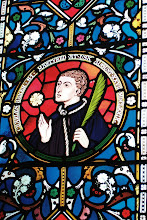
 The second of the two English Martyrs depicted in Durante Alberti’s painting is St Thomas Becket whose feast is kept today, 29th December.
Becket, portrayed in the left side of the painting, was the son of a wealthy Norman merchant. Thomas was born in London in 1118. He became acquainted with the young King, Henry II, and the two became close friends.
The King appointed his friend as Chancellor and, upon the death of Theobald, Archbishop of Canterbury in 1161, Henry pressed him to accept the bishopric. Thomas was not in favour and strongly argued against it but, nevertheless, the King appointed him Archbishop of Canterbury. It has been suggested that the King’s reason for appointing his friend was to have a ‘yes-man’ at Canterbury. If this was the case, Henry had sadly misjudged his friend for Becket was nobody’s flunky! Thomas was genuinely devout and, knowing the King’s mind, warned him; “I know your plans for the Church and that you will put forth claims which I, as Archbishop of Canterbury, must necessarily oppose”.
To be free of all civil ties, Thomas displeased the King further by insisting on resigning his chancellorship. This led to open hostility between the former friends. Because of the Archbishop’s resistance to the “Constitutions of Clarendon”, the King implemented a policy of financial persecution, imposing upon the See of Canterbury huge monetary fines. Realizing the danger he was in, Becket fled to France. All of the Archbishop’s property was confiscated and his family and friends persecuted or exiled.
In 1170, King and Archbishop seemed to have been reconciled and Thomas Becket returned to England. It wasn’t very long before Becket realized that he was in mortal danger. We don’t know the exact words of the infuriated King but Shakespeare’s are the ones most often quoted; “Who will rid me of this turbulent priest?” Whatever the rash words uttered by Henry, four of his knights, perhaps hoping to curry favour with their King, hastened to England to kill Becket. They found him in the cathedral and murdered him at the foot of the altar steps. As the Archbishop lay on the floor and the assassins carried out their foul deed, Becket was heard to say “For the name of Jesus and the defence of the Church, I am ready to embrace death.” The four, Reginald FitzUrs, William de Tracy, Richard le Breton and Hugh de Moreville, fled north to Knaresborough Castle, which was held by de Moreville, where they remained for about a year.
The despicable act was met with shock and outrage. The martyr’s shrine became a place of popular pilgrimage. On 21st February 1173, Thomas Becket was canonised by Pope Alexander III. In 1538, on the orders of King Henry VIII, the shrine was destroyed and the Saint’s relics scattered. A simple candle marks the place where it once stood and a modern memorial marks the place where he was martyred. St Thomas Becket is venerated in both the Catholic and Anglican Churches and - the pilgrims still come!
LINKS TO THIS POST:




.JPG)

.JPG)


