Showing posts with label Dom Augustine Baker O S B. Show all posts

Wednesday, 26 September 2012

A BENEDICTINE CONNECTION


Recently Belmont Abbey held several open days, one of which we attended.  It was on a lovely autumn day that we wended our way to Hereford and the welcoming Benedictine Abbey. 

It was our good fortune to be guided around the Abbey by the inimitable Brother Bernard.  Brother Bernard’s grasp of the Benedictine history and of the history of Belmont is second to none and he imparted much of interest to his attentive hearers.

The Monastery of St Michael and All Angels at Belmont was begun in 1854 as a common novitiate to train young monks for the Abbeys of Downside, Douai and Ampleforth.  Until the foundation of the Cardiff Archdiocese Belmont Abbey served as the Cathedral for the Diocese of Newport and Menevia.  The professed monks were the Canons of the Chapter, making Belmont the only monastic Cathedral in post-Reformation England.  In pre-Reformation times, monastic cathedrals were a special feature of ecclesiastical life in the country.  Many of the great cathedrals, including Canterbury itself, were Benedictine Cathedrals.

BELMONT ABBEY, HEREFORD
 Although St David Lewis, the Last Welsh Martyr, was a Jesuit, he has a strong connection to the Benedictines.   The famous Benedictine writer and mystic, Dom Augustine Baker, was a great uncle of his.

David Baker was born in Abergavenny on 9th December 1575.  He was the nephew and godson of Dr David Lewis, the first principal of Jesus College, Oxford.  In 1596 David went to London’s Inner Temple to study law where he excelled in his studies.  Upon the death of his elder brother, Richard, David was called home to assist his father and David became the Recorder of Abergavenny.  David’s parents may have been Church papists but, by his mid-twenties, David had completely abandoned religion and was an atheist.  After his return to Abergavenny, David had a near death experience which profoundly changed his life and, in 1603, he was received into the Catholic Church.
 
At the age of thirty David Baker was clothed with the Benedictine Habit at the Abbey of St Justina in Padua.  He was given the name of Augustine.  In 1613 he was ordained priest by Dr Gifford, the Archbishop of Rheims.  Dom Augustine Baker returned to London and took up residence in the lawyers’ district, Grays Inn Lane, where he assisted Catholics in matters of law.  He also undertook research into the English Benedictines.  It had been claimed by some that an English Benedictine Congregation did not exist before the Reformation.  David’s research cost him two years and £200 of his own funds, but it proved the critics wrong.  About 1625 the results of his research were published in the book, “Apostolatus Benedictinorum in Anglia”.   Augustine Baker is probably best remembered for his treatise on the prayer of contemplation, “Sancta Sophia” or “Holy Wisdom”.


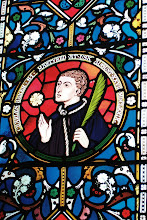
DOM AUGUSTINE BAKER, FROM A WINDOW
IN ABERGAVENNY CATHOLIC CHURCH
 
Due to the anti-Catholic feelings in England at that time, many priests left for the continent.  Fr Baker went to Douai, in Flanders.  He was appointed Spiritual Director of the English Benedictine Nuns at the Abbey of Our Ladye of Consolation in Douai, (the Nuns of Stanbrook Abbey).  He remained in that post for nine years then returned to London.

Fr Baker maintained at Douai two young men.  One was Philip Morgan, alias Powell, who was martyred in 1646.  The other was his nephew, John Pritchard, who later became a Jesuit.  John Pritchard’s sister, Margaret, married Morgan Lewis, headmaster of Abergavenny Grammar School.  They were the parents of David Lewis, who also became a Jesuit.  During the furore stirred up by the fabricated Oates’ Plot, David Lewis was martyred at Usk in 1679.  In 1620, on his last visit to Abergavenny, Dom Augustine Baker stayed with his sister who was the grandmother of David Lewis.  It was inevitable that he would have met his four year old great nephew. We can only wonder at such a momentous meeting as the great Benedictine, whose motto was “I am nothing.  I have nothing.  I crave nothing, save Jesus” met the future martyr, Saint David Lewis!

David Augustine Baker O S B, whose health was never good, was stricken with the plague and died in London on 9th August 1641.  He was 65 years old.    

Sunday, 3 April 2011

NOT LACKING IN MEN OF THE CLOTH

Morgan Lewis and his wife, Margaret Pritchard, were the parents of nine children, four girls and five boys. Margaret was a Catholic and she reared eight of the children as Catholics. Morgan, a Protestant, saw to it that their youngest child, David, was brought up in the Protestant religion.


David Henry Lewis was born in late 1616, at Abergavenny, Monmouthshire. He attended King Henry VIII Grammar School where his father was headmaster. When he was sixteen, David went to London to study law. It would appear that the boy’s heart was not in it for he soon availed of an opportunity to visit Paris. It was while he was in Paris that David was received into the Catholic Church. In 1636 David returned to Abergavenny and lived with his parents until their deaths in 1638. Deciding to become a priest, David then entered the English College in Rome. This was made possible by the financial assistance of Fr Charles Gwynne (alias Brown), the Superior of the Jesuit College of St Francis Xavier at the Cwm. After ordination, David Lewis joined the Jesuits. He was sent to work among the beleaguered Catholics of his homeland. With the exception of one year in Rome, Fr Lewis spent the rest of his life labouring among his countrymen in Wales. During the mad frenzy fomented by the Titus Oates Plot, Fr David Lewis was arrested at Llantarnam in 1678. In March 1679 he was tried and convicted of the crime of being a Catholic priest and of saying Mass. High Treason! Although the Titus Oates Plot was the impetus for his arrest, David was never implicated in the Plot and he was executed solely for his religion. This was made abundantly clear when, at the trial the Presiding Judge, Robert Atkins, stated, “He that uses to read Mass commits treason”. On 27th August 1679, Fr David Lewis S J was executed at Usk. Beatified in 1929, he was canonised in 1970.

From just a cursory look at the family of St David Lewis one can see that his was a family not lacking in men of the cloth.


David’s Great-great-grandfather was Lewis ap John (Wallis) who was Vicar of Abergavenny and Llandeilo Bertholau. Lewis ap John was Vicar of St Mary’s Priory Church where the tomb of his son, Dr David Lewis, can be seen today. Since Morgan Lewis had his son David brought up in the Established Church, David would have been baptised in the Priory Church where once his great-great-grandfather had been the vicar.


Lewis ap John’s grandson, David Baker, became a Benedictine. As Dom Augustine Baker, David Baker is famous as a mystic and writer. He was also instrumental in re-establishing the Benedictines in England. Dom Augustine Baker O S B was the great uncle of St David Lewis and the Benedictine and the future Jesuit Martyr would have met on the Benedictine’s last visit to Abergavenny in 1620. On his last visit to his hometown, Augustine Baker stayed with his sister, Margaret (Baker) Pritchard. Margaret Pritchard was the grandmother of St David Lewis.


As well as being the sister of a priest, Dom Augustine Baker, Margaret Pritchard was also the mother of a priest. Her son John became a Jesuit and, being just six year older than his sister’s son David, may have been the stimulus for his nephew’s decision to join the Jesuits. David Lewis himself states that he numbered among his closest friends his uncle, Fr John Pritchard who was a Jesuit. Dom Augustine Baker maintained at Douai a nephew who later became a Jesuit. It is widely held that this nephew was indeed Fr John Pritchard S J (alias Lewis).

A nephew of St David Lewis became a priest. His nephew, also named David Lewis, was the son of the Saint’s brother, Richard. Born in Monmouth, Richard’s son was educated at St Omer and entered the English College in Rome in 1690. The young man followed in the footsteps of his uncle, St David Lewis, and his great uncle, Fr John Pritchard and, in 1707, he was professed as a member of the Society of Jesus. This Fr David Lewis S J lived and worked in Rome where he died in 1741.


Although Morgan Lewis was a Protestant, he was from an old Catholic family and a relative of the Morgans of Skenfrith. St John Kemble’s mother, Anne, was one of the Skenfrith Morgans, thus through Morgan Lewis and Anne Kemble, the two Saints were cousins. Anne Morgan and her husband, John Kemble, were the parents of at least two priests.

Not a lot is known about their elder son, William Walter Kemble. We do know that he was born in Herefordshire and studied at Douai. He entered the Benedictine Order in 1619 and was professed on 1st October 1620. After ordination he was sent to the south of England to work. On 23rd October 1633 he died at Fownhope, Herefordshire.


More is known about Anne and John’s other priest son, St John Kemble. John was born at Rhydicar Farm, St Weonard’s, Herefordshire in 1599. Following his brother, William Walter, he began training for the priesthood. He went to Douai, adopted the alias of “Holland”, and was ordained on 23rd February 1625. Later that year, on 4th June, he was sent on the English Mission. For 54 years this humble and good man laboured for the people of Herefordshire and Monmouthshire. He was loved and respected by all. It was said of him that “He gave offence to none”. However, in 1678 the poisonous tentacles of the Oates Plot wrapped themselves around Fr John Kemble. He was arrested at Pembridge Castle, the home of his relatives, and on 22nd August 1679, the eighty year old secular priest was martyred at Widemarsh Common, Hereford.

As well as the same bloodline, Fr David Lewis and Fr John Kemble shared the same fate. They were executed within days of each other and both were beatified in 1929. In 1970, Pope Paul VI canonised the Forty Martyrs of England and Wales. Among the Forty were the cousins, St David Lewis and St John Kemble.
Related Posts with Thumbnails