Showing posts with label Holy Mountain. Show all posts

Saturday, 28 September 2019

ABERGAVENNY AND ST MICHAEL

St Michael the Archangel, whose feast is celebrated on 29th September, (Michaelmas) is the Patron Saint of the dying and also of grocers, policemen, soldiers, bankers, and of artists.  Abergavenny, the birthplace of St David Lewis, has an ancient connection to St Michael.
ST MICHAEL THE ARCHANGEL (Photo by J D Smith)
An old Welsh legend tells the story of a prominent Abergavenny man who had committed three murders.  Racked with guilt, he undertook a penitential pilgrimage to Rome to seek forgiveness. Upon his return to Abergavenny, he climbed the rocky path to the top of Skirrid Fawr.  Here, while praying, the nobleman saw the Archangel Michael.  This experience moved him to erect on the site a chapel dedicated to St Michael.  Skirrid Fawr is also known as St Michael's Mount or the Holy Mountain.

Skirrid Fawr played an important part in the Catholic history of the Abergavenny area. For centuries, Catholics climbed the Holy Mountain on Good Friday and on St Michael's Feast to pray in the little chapel.  Even in the troubled times of the 16th and 17th centuries they defiantly carried on the practice of their faith.  John Arnold testified to Parliament that "hundreds of Papists meet on top of a high hill called St Michael's Mount where is frequent meetings eight or ten times in the year."  Arnold went on to say that Mass was said there and sometimes sermons were preached.
Skirrid Fawr or St Michael's Mount, Abergavenny
(Photo by J D Smith)
This was confirmed by another anti-Catholic witness who stated that he had seen "very great numbers of people at their devotions on the top of a high hill in Monmouthshire, called St Michael's Mount, where there is a ruinous chapel and a stone with crosses upon it, which he took to be an altar.  And he hath seen people with beads in their hands, kneeling toward the said stone, both within and without the said chapel.  Some Papists have affirmed in his presence that they have heard as good sermons preached there as ever thy heard in their lives."

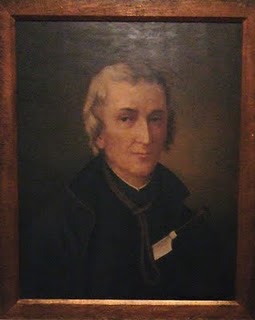
Abergavenny born St David Lewis (1616-1679) laboured in the area for more than thirty years.  He served two terms as Rector of the Jesuit College at the Cwm and it is recorded that he said Mass at the house of Thomas Gunter in Cross Street, Abergavenny.  Thomas Gunter was the son of his sister, Mary Lewis and Thomas Gunter senior.  Fr Lewis also stayed at the home of his aunt, Lady Frances Morgan, at Llantarnam, and said Mass in the chapel there and conducted, weddings, christenings, and other  services for the local Catholics.  He is one of the priests thought to have led pilgrimages to St Michael's Mount and said Mass there in the, by this time, ruined chapel.  
St David Lewis, alias Charles Baker
(Photo by J D Smith)
The Catholic Church in Abergavenny is in possession of a very interesting historical document.  This document, dated 1676, reads "Pope Clement X grants a Plenary Indulgence to those who devoutly visit the Chapel of St Michael on the Skirrid Fawr on 29th September - Michaelmas Day.  Anyone wishing to gain the Indulgence is required, first to go to confession and Holy Communion, then, on the Holy Mountain itself, to pray for peace among Christian Princes, for the rooting out of heresies, and for the exaltation of Holy Mother Church.  Given at St Mary Major's, Rome, under the Seal of the Fisherman, on 20th June 1676 and valid for seven years."

This rescript of Pope Clement clearly shows the importance of this awesome local landmark in the turbulent Penal times.  What of the Skirrid today?  Now in the hands of the National Trust, Skirrid Fawr is a popular site with tourists, hikers and others.  It is still a revered holy site and this is attested to by the devout pilgrims who still wend their way up the hillside at Michaelmas in honour of the archangel Michael.

In 1886 Pope Leo XIII instructed that this prayer to St Michael should be prayed after Low Mass: 
"St Michael, the Archangel, defend us in battle.  Be our safeguard against the wickedness and snares of the devil.  May God rebuke him, we humbly pray, and do thou, O  prince of the Heavenly Host, by the power of God, thrust down into hell Satan and all the wicked spirits who wander through the world seeking the ruin of souls.  Amen."

In 1964 it was decided to remove the obligation to recite this prayer after Mass and in 1965 it came into effect. However, it remained a popular prayer for private use and continued to be used on various other occasions.  In 1994 its use was encourage by Pope John Paul II.  In 'Regina Caeli', 24th April 1994, He wrote: "Although this prayer is no longer recited at the end of Mass, I ask everyone not to forget it and to recite it to obtain help in the battle against the forces of darkness and against the spirit of this world."  
Pope Saint John Paul II
That is excellent advice from a good and holy Pope who is now a Saint.  
St John Paul II, pray for us.
St David Lewis, pray for us.
St Michael the Archangel, pray for us.

LINK TO THIS POST:
ST MICHAEL'S MOUNT AND ST DAVID LEWIS (HERE)

Wednesday, 29 September 2010

ST MICHAEL’S MOUNT AND ST DAVID LEWIS


Devotion to St Michael the Archangel spread from Brittany to Wales in the 8th century. Churches dedicated to St Michael abound. Interestingly, many of these churches are associated with hills or mountains. One such place is Ysgyrid Fawr (Great Skirrid) in the Black Mountains of Wales. Ysgyrid Fawr lies on the outskirts of Abergavenny, the birthplace of St David Lewis. Ysgyrid Fawr is also known as ‘The Skirrid’, ‘The Holy Mountain’ or ‘St Michael’s Mount’.

At its highest point, St Michael’s Mount rises to 1,595 feet. It is here that one finds vestiges of a mediaeval Catholic Chapel dedicated to St Michael. Centuries ago, Catholics of the area struggled up the rough path on Good Friday and on 29th September, the feast of St Michael. There is not much left of the ancient chapel now but the sharp eyed will discern hints of its presence.

Even during Penal Times, Catholics were known to attend Mass and other services amid the ruins of St Michael’s Chapel. St David Lewis led Catholics there for the annual Michaelmas Pilgrimage. At that time, the altar was still intact. All of this must have been a very bitter pill for John Arnold to swallow. From his home, Llanvihangel Court, this rabid anti-Catholic and priest hunter could see the Catholics at their devotions atop the Holy Mountain. In 1680, in his Examinations as to Popery in Monmouthshire, Arnold stated that: “He hath seen a hundred papists meet on the top of an high Hill, called St Michael’s Mount, here is frequent meetings eight or ten times in the year, as he is informed. Mass is said, and sometimes Sermons are preached there. Mr John Scudamore of Kentchurch also deposed that:- He saw very great numbers of people at their Devotion on top of a high hill in Monmouthshire called St Michael’s Mount, where there is a ruinous Chappel and a stone with crosses on it, which he took to be an Altar and that he hath seen people with Beads in their hands kneeling towards the said stone, both within and without the Chappel and he has been informed that Mass is often said there.”

The Catholic Church of Our Ladye and St Michael, Abergavenny, possesses a *rescript of Pope Clement X. This rescript, dated three years before the martyrdom of St David Lewis, reads: “Pope Clement X grants a Plenary Indulgence to those who devoutly visit the Chapel of St Michael on the Skirrid Fawr on 29th September-Michaelmas Day. Anyone making this Pilgrimage and wishing to gain the Indulgence is required, first, to go to Confession and Holy Communion, then, on the Holy Mountain itself, to pray for peace among Christian Princes, for the rooting out of heresies, and for the exaltation of Holy Mother Church. Given at St Mary Major’s, Rome, under the Seal of the Fisherman, on 20th June 1676 and valid for seven years.”

St Michael’s Mount has belonged to the National Trust since 1939 and, with its magnificent views and ancient history, it is much favoured by hikers. It is said that Rudolph Hess, Hitler’s deputy, used to walk there when he was held at nearby Maindiff Court during WWII.

What of the pilgrims? Do they still come? Indeed they do! Every September, St Michael is honoured on his Feast Day as pilgrims wend their way to the summit, to the site of the ancient chapel where their ancestors risked danger and even death to remember Michael the Archangel and to practise their cherished Catholic faith.

*an ecclesiastical ruling - a formal reply by the pope or some other high dignitary of the Roman Catholic Church on a matter of doctrine or discipline
(CLICK ON THE PHOTOS TO ENLARGE THEM)
Related Posts with Thumbnails