Monday, 2 November 2009

TEN WERE JESUITS (PART 3)


On 25th October 1970, Pope Paul VI canonised forty martyrs from England and Wales. The Forty Martyrs of England and Wales were a diverse group - men and women, priests and lay people – but, between the years of 1535 and 1679, they all shed their blood for their Catholic faith. Saint David Lewis was the last of the forty to die. Ten of the Forty Martyrs of England and Wales, including Saint David Lewis, were Jesuits. Our intention is to tell, briefly, the story of each of the Jesuits. (SEE PREVIOUS POSTS FOR PARTS 1 & 2)

5) ST NICHOLAS OWEN was born into a staunchly Catholic family around 1550. Two of his brothers, John and Walter, became Jesuit priests. Nicholas, a carpenter by trade, was consecrated by Fr Henry Garnet, Superior of the English Jesuits, as one of the first Jesuit laybrothers. Because of his size, about 5ft tall, he was nicknamed “Little John” but he was, it has been said, very strong. He put his skills and strength to invaluable use in the times of persecution in which he lived, becoming the consummate builder of priest hiding holes. (Nicholas Owen appears as a minor character in Robert Hugh Benson's 1912 novel “Come Rack! Come Rope!”, where he is erroneously named Hugh Owen.) Trusting no one, Nicholas worked alone and at night, miraculously, without ever disturbing the sleeping household. So as not to arouse suspicion, Nicholas did ordinary carpentry work by day. Of necessity, all of the priest holes had to be different. Some priest holes were merely holes under a floor, but those built by Nicholas were very sophisticated and very difficult to uncover. Pursuivants were persistent and thorough in their searches of houses for priests and they would sometimes spend weeks dismantling a property. One such search resulted in the capture of Nicholas Owen himself. After the, fortunately, unsuccessful Gunpowder Plot, oppression of Catholics increased. Nicholas and another Jesuit laybrother, Ralph Ashley, hid in one of the 11 holes at the home of Thomas Abingdon, Hindlip Hall in Worcestershire, for a week as 100 pursuivants ransacked the building in their search for Catholic priests. Eventually the two men, who had only one apple between them, staggered weak and hungry from their concealment. Nicholas was captured and incarcerated at Marshelsea. When his real identity became known, the officials were overjoyed. Cecil, the Secretary of State, wrote “It is incredible how great was the joy caused by his arrest...... knowing the great skill of Owen in constructing hiding places, and the innumerable qualities of dark holes which he had schemed for hiding priests all through England.” Nicholas was moved to the Tower where he was ruthlessly tortured. Despite his extreme pain and suffering, he disclosed nothing of his work or the whereabouts of any priests. He eventually died of the torture and the authorities, realizing that they had gone too far, tried to say that he had committed suicide on 2nd March 1606. This calumny, however, was disproved by several sources but the exact date of his death remains clouded. Some historians hold that he died on 2nd March 1606 while others claim that he lived until 12th November 1606. Whether it was March or November, Nicholas Owen died heroically for his faith. Fr John Gerard wrote of Nicholas Owen, "I verily think no man can be said to have done more good of all those who laboured in the English vineyard. He was the immediate occasion of saving the lives of many hundreds of persons, both ecclesiastical and secular”.

6) ST THOMAS GARNET, the son of recusant Richard Garnet, was born in 1575. He was still a school boy when, with the rest of his family, he spent a period in prison for recusancy. Thomas was educated at home but when the college opened at St Omer, the young man was sent there, going on, in 1595, to the English College at Valladolid. There, in 1599, Thomas was ordained. He was sent on the English Mission that same year. For six years he toiled, mainly in Warwickshire, and won many converts. He was admitted into the Society of Jesus by his uncle, Fr Henry Garnet, who was at that time, Superior of the English Jesuits. In 1605, Thomas was arrested on suspicion of being involved in the Gunpowder Plot. Cleared of any involvement in the Plot, Fr Garnet was nonetheless imprisoned for nine months before, in 1606, being banished with 46 other priests. He went to the recently established Jesuit novitiate at Louvain but returned to England in September 1607. Just six weeks later, Thomas Garnet was captured. He refused to take the new Oath of Allegiance, stating that if Catholics did take it, it was out of fear, to which he hoped he would never succumb. He was sent to Newgate Prison. He was tried at the Old Bailey, indicted on a charge of high treason, i.e., of having been ordained a priest by the authority of Rome and remaining in England. Unsurprisingly, he was found guilty and sentenced to death. On 23rd June 1608, Fr Thomas Garnet was taken to Tyburn where a great crowd, including the Earl of Exeter, had gathered to witness his execution. The Earl, a member of the Privy Council, urged the condemned priest to save his life by taking the Oath. Thomas steadfastly refused saying, “No, I will not take the Oath, though I might have a thousand lives.” He was then ordered into the cart. Thomas recited the Lord’s Prayer, the Hail Mary and the Creed before the cart was pulled away. At the insistence of the crowd, particularly of the Earl of Exeter, he was left hanging until he was dead. They would not allow his body to be mutilated while he was still alive. St Thomas Garnet’s relics, which had been kept at St Omer, were lost during the French Revolution.

Saturday, 31 October 2009

TEN WERE JESUITS (PART 2)


On 25th October 1970, Pope Paul VI canonised 40 men and women from England and Wales who had given their lives for their faith. St David Lewis was the last of the forty to be martyred. Ten of the Forty Martyrs of England and Wales, including St David Lewis, were Jesuits. In this and the next couple of posts, we intend to tell, briefly, their stories. (FOR PART 1, SEE PREVIOUS POST)

3) St Robert Southwell was born in 1561 and sent to Douai while still a child. He remained there for some time and eventually made his way to Rome where he entered the Jesuit Novitiate of Sant’ Andrea. He was ordained in 1584 and, in 1586, he was sent upon the English Mission with Fr Henry Garnet. Robert was a tireless worker in Christ’s vineyard. He was instrumental in setting up a chain of Mass centres, he protected hunted priests, smuggled students for the priesthood abroad, sheltered priests arriving from the continent, and maintained a printing press on which he produced Catholic literature, including his own works. To his enemies he was known as “the chief dealer for the papists in England”. On 20th June 1592, Fr Southwell was apprehended at Uxendon Hall in Harrow, Middlesex. He had been betrayed by the owner’s daughter, Anne Bellamy, after she had been interrogated and raped by Topcliffe, the Queen’s chief priest-hunter and torturer. Fr Southwell was imprisoned in the Tower for three years and questioned under horrendous torture. Finally, shortly before his trial, he was moved to Newgate Prison and thrown into a dungeon called “Limbo”. At his trial in February 1595, he was, predictably, found guilty and sentenced to be hanged, drawn and quartered. The next day, 21st February, the condemned priest was taken to Tyburn for execution. Standing on the cart under the noose, Robert made the Sign of the Cross, though his hands were bound, and began to speak to the assembled crowd. “Whether we live, we live to the Lord: or whether we die, we die to the Lord. Therefore, whether we live or die, we belong to the Lord.” The Sheriff tried to stop him speaking but he was permitted to carry on. When he finished speaking, he again blessed himself and, as the cart was drawn away he prayed in Latin, “Into thy hands, O Lord, I commend my spirit”. The crowd, including many Protestants, would not allow the priest to be cut down until he was dead and for this reason, some of them tugged at his legs to hasten the end of his suffering. When he was dead, the martyr’s body was cut down, disembowelled and quartered and his head displayed to the crowd. Unusually, the traditional cry of “Traitor” was not uttered. St Robert Southwell, S J, was 33 years old.

4) St Henry Walpole, the eldest of a large family, was born at Docking, Norfolk in 1558. He studied at Peterhouse, Cambridge, and, in 1578, went to study law at Gray’s Inn, London. Upon witnessing the martyrdom of St Edmund Campion in 1581, he converted to Catholicism. He went to Douai in 1582 and the entry in the Douai Diary states “On 7th July Mr Henry Walpole came to us out of England, a discreet, grave and pious man”. He remained here until April 1583 when he was sent to Rome to enter the Society of Jesus. On 15th December 1588 Henry Walpole was ordained in Paris. He was not sent on the English Mission until 1593, arriving in Yorkshire on the night of 6th December. Twenty-four hours later he was captured by the authorities. Three days later he was taken to York where, upon admitting that he was a priest, he was committed to York Gaol. On 25th February 1594, he was ordered to be sent to London and he was imprisoned in the Tower for a year. Carvings that he made on the wall of his cell can still be seen in the Salt Tower. While a prisoner in the Tower, Fr Walpole was tortured at least fourteen times. In 1595, the prisoner was sent back to York to be tried. At his trial he refuted the charges against him, replying at one point, “You, my Lords, sit here at present in judgement as men, and judge as such, being subject to error and passion, but know for certain that there is a Sovereign Judge who will judge righteously, whom in all things we must obey in the first place, and then our lawful princes in such things as are lawful, and no further.” As directed, the jury returned a guilty verdict and Henry was sentenced to death for being a priest, at that time considered high treason. On 7th April 1595, Fr Henry Walpole, along with Fr Alexander Rawlins, was taken to the place of execution at Knavesmire, just outside York. Fr Walpole was forced to watch as his companion was butchered and the authorities offered him his life if he would conform. The priest rejected their bribes and climbed the ladder. He asked the prayers of all Catholics present and lifted his eyes to heaven and began to pray. Before he had finished the Hail Mary, he was shoved off the ladder. He was fully conscious when he was dismembered, disembowelled and quartered. Many witnesses were so moved by the saint’s martyrdom that they converted to Catholicism. The Jesuit Martyr, Saint Henry Walpole, was 37 years old when he gave up his life for his faith.

Thursday, 29 October 2009

TEN WERE JESUITS (PART 1)


On 25th October 1970, Pope Paul VI canonised forty martyrs from England and Wales. The Forty Martyrs of England and Wales were a diverse group - men and women, priests and lay people – but, between the years of 1535 and 1679, they all shed their blood for their Catholic faith. Saint David Lewis was the last of the forty to die. Ten of the Forty Martyrs of England and Wales, including Saint David Lewis, were Jesuits. In the next few posts, we will take a brief look at each of the ten. Here are the first two.

1) St Edmund Campion was born in London on 25th January 1540. He possessd both academic brilliance and exceptional gifts of oratory. Although he had become a Church of England deacon, Edmund had leanings towards the Catholic Church. Upon hearing that a seminary had opened in Douai, he made up his mind to go there. When this news reached Robert Cecil, one of Queen Elizabeth’s closest advisors, he remarked, “England has lost one of her diamonds!” Eventually, Edmund decided to join the Jesuits and he arrived in Rome in April 1573. He was ordained in 1578. His work took him to Prague where he stayed for many years. In time, he was sent on the English Mission where, to the dismay of the authorities, his preaching bore much fruit. They sought to silence him. Allegations were made that the Pope, in alliance with an assortment of Catholic Rulers, planned to invade England and Jesuits and seminary priests had been sent to lay the groundwork. These priests were to be apprehended and so, for more than a year, Edmund Campion was hunted in England. On 17 July 1581, Fr Campion was captured at Lyford Grange, near Abingdon, Berkshire. After months of imprisonment, interrogation and torture, the Jesuit was martyred at Tyburn on 1st December 1581. He was not quite 42 years old. St Edmund Campion’s body was quartered and displayed at each of the city gates as a stark reminder to other Catholics.

2) St Alexander Briant was born in Somerset in 1556. For a short time he studied at Oxford before going to the English College at Douai in 1576. He was ordained a priest on 29th March 1578 and sent on the Mission in August 1579. Less than two years later, 28th April 1581, Alexander was captured by a pursuivant called Norton and imprisoned at the Counter Prison, London, where he was kept in isolation. He was denied food and drink and was driven to using his hat to catch the drips of rain which leaked into his cell. Fr Briant was moved to the Tower of London where he underwent various forms of torture including having needles driven under his nails, and racking. Norton boasted that he would make the unfortunate priest a foot longer! The saintly priest was so steadfast that the Lieutenant of the Tower raged, “What a thing is this? If a man were not settled in his religion, this were enough to convert Him!” In his cell, Fr Briant had managed to make a little wooden cross and, when he was tried in Westminster Hall on 16th November 1581, he clasped it tightly in his hands. Of course, the little cross was snatched from him causing the priest to retort, “You can take it out of my hands, but not out of my heart.” (The cross was later bought by some Catholics and it is now in the English College in Rome.) Predictably, Fr Alexander Briant was condemned and was placed in irons which were not removed until his execution. Before his trial, the young priest had written to the English Jesuits requesting admission into the Society. This request was accepted by the Order. On 1st December 1581, 25 year old Fr Alexander Briant, S J, was hanged, drawn and quartered at Tyburn.

Tuesday, 27 October 2009

SANT’ ANDREA

St Francis Borgia, third Superior General of The Society of Jesus, was elected such in 1565. He served in this capacity for seven years. He had long held the belief that novitiates should be separate from colleges and professed houses. As a consequence, he opened the first separate novitiate, Sant’ Andrea, on 20th September 1565. Constructed on the site of a 13th century church dedicated to St Andrew, it served as the novitiate until 1773 and then again from 1814 to 1872.

David Lewis was ordained to the priesthood on 20th July 1642. Fr David Lewis’s friend and uncle, John Pritchard was a Jesuit. Fr Pritchard was his mother’s brother and just six years David’s senior. Saint David Lewis himself said that he numbered his uncle among his closest friends. Following in Fr Pritchard’s footsteps, his recently ordained nephew decided to join the Society of Jesus.

On 19th April 1645, eighty years after its opening, Fr David Lewis entered the Jesuit novitiate at Sant’ Andrea. He was a novice there for a year, from 1645-1646, and after profession he was sent upon the English Mission. He was soon recalled to Rome to assume the position of Spiritual Director at his old college. About a year later, Fr Lewis returned to Wales where he worked for more than 30 years before being martyred at Usk in 1679.

St David Lewis was one of the many illustrious saints and martyrs who were, at one time or another, novices at Sant’ Andrea, Rome. St Robert Southwell and St Henry Walpole are two other former novices canonised with St David Lewis in 1970 when Pope Paul canonised the Forty Martyrs of England and Wales.

Sunday, 25 October 2009

ST JOHN KEMBLE


John Kemble, alias Holland, was born at Rhydicar Farm, St Weonard’s, Herefordshire in 1599. He was the son of John Kemble and Anne Morgan. He and St David Lewis were cousins. John Kemble’s mother, Anne Morgan, was a relative of David Lewis’s father, Morgan Lewis. John was ordained a priest at Douai on 23rd February 1625 and, on 4th June, was sent upon the English Mission. He spent the next 54 years labouring for the people of Herefordshire and Monmouthshire. He was greatly loved by his own people and respected throughout the area because, it was said, he gave offence to none.

In 1678, Fr John Kemble became another innocent victim of the non-existent Popish Plot. A lapsed Catholic, Captain John Scudamore of Kentchurch, was sent to arrest Fr Kemble at Pembridge Castle, where the aged priest was staying with his relatives. When urged to flee, the 80-year-old priest said, “According to the course of nature I have but a few years to live. It will be an advantage to suffer for my religion and therefore I will not abscond.” After three months in Hereford Gaol, he endured an agonizing journey to London where he and Fr David Lewis were lodged in Newgate Prison. They were interrogated by Oates and his fellow plotters but, since no evidence of involvement in any plot could be found, he was sent back to Hereford. In accordance with Statute 27 of Elizabeth I, he was tried for treason, i.e., for being a Catholic priest and saying Mass. He was found guilty and condemned to be hanged, drawn and quartered.

On the morning of his execution, Fr Kemble made his devotions as usual. He then drank a cup of sack and smoked a pipe of tobacco with the undersheriff and the prison governor. (This is the origin of the Herefordshire custom of calling a parting drink or smoke a “Kemble Cup” or a “Kemble Pipe”.) Before his execution on Widemarsh Common, the good priest forgave those who had conspired against him and asked forgiveness of any whom he may have offended. He consoled the distraught hangman thus, “Honest Anthony, my friend Anthony, be not afraid; do thy office. I forgive thee with all my heart. Thou wilt do me a greater kindness than discourtesy.” He prayed silently for a few minutes then commended himself to God. The cart was drawn away and he was hanged. Such was the affection for Fr Kemble that he was allowed to die upon the gallows before being beheaded. He was also spared the grisly ritual of drawing and quartering. It was said, even by his persecutors, that they never saw one die so like a gentleman and so like a Christian.

The martyr’s nephew, Captain Richard Kemble, who had saved the life of King Charles II at the Battle of Worcester, took the body to the church at Welsh Newton and buried it beside the churchyard cross. The gravestone is inscribed J K Dyed the 22 of August Anno Do 1679. There is a pilgrimage to the Saint’s grave every year on the Sunday nearest to 22nd August.

St John Kemble and St David Lewis shared more than family ties. They shared the same fate as well! Fr John Kemble was martyred on 22nd August 1679 and less than a week later, on 27th August 1679, his kinsman, Fr David Lewis was martyred. On 25th October 1970, the cousins were among the Forty Martyrs of England and Wales canonised by Pope Paul VI.

Friday, 23 October 2009

“ON A FINE DAY IN AUGUST” (PART 2)

This is the conclusion of the beautiful piece taken from the little book “Blessed David Lewis”. The booklet, published in 1960, was written by the late Canon J B Davies, at one time Parish Priest at Usk.

(FOR PART 1, SEE YESTERDAY’S POST.)

“He need not have worried. The kindly people of Gwent who had given him the affectionate nickname of “Tady Tlodion” (Father of the Poor), were not likely to turn away from him now when he needed help himself. When he was finally unfastened from the hurdle and stood by the gallows trying to steady himself till the giddiness should pass and his eyes could focus clearly once more, a great happiness must have come over him; wherever he looked he saw nothing but friendly, sympathetic faces. The gallows itself, had he known it, was proof of th
e people’s love for him. On the day before his execution, all the carpenters in Usk mysteriously disappeared taking their tools with them, and in his anxiety to get some sort of gallows erected the harassed Sheriff brought a convict from the gaol and promised him remission of sentence if he would do the work. The result was a botched job. Usually, while the noose was being tied round his neck the criminal stood on a cart which was then drawn away leaving him, if he was just a plain murderer, to swing until he died; but if, like Fr Lewis he was a Catholic priest, such a quick death was held to be too merciful, and he was cut down before losing consciousness and disembowelled while still alive. The shaky structure put up for Fr Lewis was so low that a trench had to be dug between the uprights to let his feet swing free of the ground. It is only fair to the convict to add that he was somewhat hampered in his work by occasional showers of stones from indignant bystanders.

To be dragged upside down at the age of sixty-three, with your head being violently bumped on an unsprung hurdle is not the best preparation for a public speech; very wisely, Fr Lewis had carefully thought out his dying manifesto while he was in prison. He delivered it, says Brother Foley, “with great animation”; in other words, the hwyl was on him. He spoke in English, but we can still hear the echo of his lilting Welsh accent: “Here is a numerous assembly,” he began, "the great Saviour of the world save every soul of you....A Roman Catholic I am! A Roman Catholic priest I am! Please now to observe....” Is it not Fluellen to the life – a Monmouth man also? But here was more than natural courage, here was the supernatural virtue of the soldier of Christ. At this moment he must have felt how deep were his roots in this pleasant land of Gwent: “I believe you are met here” he tells them, “to hear a fellow countryman speak”, and as he looked his last on a countryside he had loved, and served, so well, he looked back also with happiness on a long life spent among these “fellow countrymen” in which, as in his death, there was nothing of which he, or they, need feel ashamed...”

Thursday, 22 October 2009

"ON A FINE DAY IN AUGUST" (PART 1)


This is from a booklet by the late Canon J B Davies, D D. I believe this little gem is now out of print and its age (printed 1960) can be guessed by its title “Blessed David Lewis”, and its price, 4d! The piece I wish to quote is fairly long, but it is so beautiful it has to be shared. I will do it in two posts so be sure to look in again tomorrow for part two.

On a fine day in August, 1679, they hanged David Lewis in Usk for being a Roman Catholic priest. There was some difference of opinion at the
time between Catholics and Protestants as to whether a man ought to be hanged for being a Catholic priest, but at any rate they both agreed that this was why he was being hanged. It is true that his enemies, including the Lord Bishop of Hereford, had published a story of his having defrauded a “poor woman” of some moneys, but hardly anyone except the Bishop seems to have believed it. One thing is certain; while David Lewis lived no one ever accused him of any political plotting or treason, neither the Protestant Bishop who slandered him, nor the prosecution who charged him, nor the judge who sentenced him. Even that arrant liar, Dorothy James, who boasted she would “wash her hands in Fr Lewis’s heart’s blood” never, suggested he was guilty of treason. Let no one, therefore, suggest it today.

And yet as they led him out of Usk gaol to tie him on the hurdle on which he had to be dragged to the place of execution, his manner
showed plainly enough that he was anxious. Brother Foley would have us picture him setting out on his last journey calm, unmoved and completely detached from this world; any less heroic and more human attitude towards martyrdom was hardly conceivable in the 19th century. But this is not quite borne out by the evidence. The portrait we fortunately possess of David Lewis shows a slender, intellectual face, unmistakably Welsh with its long nose, mobile mouth and short upper lip, a face suggesting either the artist or the mystic, but certainly revealing a temperament of extreme sensibility. And his last speech shows clearly enough what his thoughts really were as he came out of the gaol, his quick, intelligent eyes eagerly scanning the people lining the street to watch his execution – would they be friendly? Or had they been deceived by that scurrilous pamphlet of the Bishop’s into thinking him a thief and a hypocrite?

If this is not quite the exalted mood we expect of a martyr going out to die for Christ, let us remember that Fr Lewis was not only a holy Jesuit priest, but also a Welsh gentleman, belonging to a class whose pride in long lineage and gentle manners, though often derided, stems from the Christian ideal inherent in the tribal solidarity of mediaeval Wales. After all, these were his own people watching him walk out to a most ungentlemanly death. He had spent almost his whole life among them; he was related to some of their oldest families; by a life of heroic charity he had won the love of the Catholics and the respect of the Protestants – was all this to be thrown away because a woman could tell lies and a Bishop confirm them? St Peter’s words kept running through his mind: “Let none of you suffer as a murderer or a thief; but if as a Christian, let him not be ashamed.” It was so important that they should understand why he was being put to death; what became of his testimony to Christ if they thought he was being hanged for a thief?”
(TO BE CONTINUED)

Tuesday, 20 October 2009

“I BELIEVE IT TO AN IOTA”


In his beautiful prayer from the gallows, the last Welsh martyr, St David Lewis prayed;

“Incarnate Son of God, true God, Thou hast purchased a Church here upon earth with Thy Sacred Blood and planted it with Thy Sacred labours, a Church, one, holy, Catholick and Apostolick, a Church to continue to the consummation of the world. Whatever that Church of Thine hath by Revelation from Thee, whatever that Church of Thine hath taught me, and commanded me to believe, I believe it to an iota”.


What we hear in this video, in a language in which St David Lewis was fluent, is what the saint believed “to an iota”!

Monday, 19 October 2009

DOM AUGUSTINE BAKER O S B


The famous Benedictine writer and mystic, Dom Augustine Baker, was a great uncle of Saint David Lewis.

David Baker was born in Abergavenny on 9th December 1575. Although his grandfather was a vicar of Abergavenny, David was brought up in a family of church papists. That is, they appeared to conform to the established religion but their real allegiance was to the Catholic faith. In fact, David’s sister, Margaret, was fined for recusancy in 1608. However, by his mid twenties, David had totally abandoned religion and was an atheist.

David’s father was an important figure in the cloth industry and the family had served as stewards to the Lords of Abergavenny since the time of Henry VIII. In 1596, David was sent by his father to London’s Inner Temple to study law. The young man excelled in his studies but, upon the death of his elder brother, he was called home to assist his father and he became the Recorder of Abergavenny. It was after his return to Abergavenny that David had a profound religious experience which completely changed his life and, in 1603, he was received into the Catholic Church.

Two years later, at the age of 30, David Baker was clothed with the Benedictine Habit at the Abbey of St Justina in Padua. He
was given the name of Augustine. He was ordained priest in 1613 by Dr Gifford, the Archbishop of Rheims. Dom Augustine Baker returned to London and took up residence in the lawyers’ district, Grays Inn Lane, where he assisted Catholics in matters of law. He also undertook research into the English Benedictines. It was claimed by some that an English Benedictine Congregation did not exist before the Reformation. David’s research was to cost him two years and £200 of his own funds, but it proved the critics wrong. About 1625, the results of his research were published in the book, “Apostolatus Benedictinorum in Anglia”. Augustine Baker is probably best remembered for his treatise on the prayer of contemplation, “Sancta Sophia” or “Holy Wisdom”.

Due to anti-Catholic feelings in England, many priests left for the continent. Fr Baker went to Douai, in Flanders. He was appointed Spiritual Director of the English Benedictine Nuns at the Abbey of Our Ladye of Consolation in Douai. (The Nuns of Stanbrook Abbey) He remained in this post for nine years and then returned to London.

Fr Baker’s sister, Margaret, had married Henry Pritchard. One of their children was John Pritchard, who became a Jesuit priest. Another of their children, Margaret, married Morgan Lewis, headmaster of the Abergavenny Grammar School. Margaret and Morgan Lewis were the parents of David Lewis, who also became a Jesuit and eventually shed his blood for the faith.

In 1620, on his last visit to Abergavenny, Dom Augustine Baker stayed with his sister, Margaret Pritchard. It is inevitable that he would have met her young grandson, his great nephew, David Lewis. What a momentous meeting that would have been – the great Benedictine, whose motto was “I am nothing. I have nothing. I crave nothing, save Jesus”, and the future martyr, Saint David Lewis! Heaven must have smiled.

David Augustine Baker, whose health was never good, was stricken with the plague and died in London on 9th August 1641. He is buried in St Andrew’s Churchyard, Holborn.

Sunday, 18 October 2009

A MUST VISIT!

St David Lewis was martyred in Usk on 27th August 1679, at a place known as the Coniger. This site, marked by a blue Usk Civic Society plaque, is within the grounds of Porth-Y- Carn House. Across the street is the Catholic Church.

The Catholic Church,
Porth-Y-Carn Street, is dedicated to St David Lewis and St Francis Xavier. This Gothic style church was erected in 1847 and was originally dedicated to St Francis Xavier. Beatified in 1929, Fr David Lewis was one of the forty English and Welsh martyrs canonised by Pope Paul VI on 25th October 1970. The new saint was consequently honoured by the addition of his name to the title of the Usk Church. The church was rededicated in 1974.

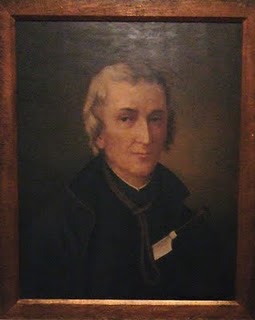
For the devotee of St David Lewis, this church is a must visit! Inside the church is a shrine in memory of St David Lewis with his portrait, painted by Soldatiez from the engraving by Alex Vost. Relics of the martyr, a piece of the rope with which he was hanged and a piece of cloth stained with his blood, are also kept in the church.

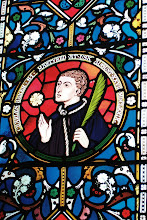
A stained glass window in the Baptistery depicts the two Patron Saints of the church, St David Lewis and St Francis Xavier. This window is, of course, modern and its colours are exhilarating, vibrant, and beautiful.

Outside, and to the left of the church, is a cracked and nondescript rectangular stone. The stone is plain, with no visible writing or markings. However, this stone is very important as it is the original grave stone of St David Lewis. It marked his grave in the churchyard of the Anglican Priory Church where the saint is buried on the north side of the pathway to the west door. In 1979, the 300th anniversary of St David Lewis’s martyrdom, a new and fitting stone was placed on his grave and the original was removed to its present home beside the Catholic Church which bears his name.


Friday, 16 October 2009

THE PRAYER OF A SAINT

Saint David Lewis was martyred at Usk on 27th August 1679. The place of execution is situated within the grounds of Porth-Y-Carn House, opposite the Catholic Church of St David Lewis and St Francis Xavier. From the gallows he made a beautiful farewell speech and his final prayer was indeed the prayer of a saint.
“Sovereign Lord God, Eternal Father of Heaven, Creator of all, Conserver of all, Sole Author of grace and glory, with prostrate heart I adore Thee and Thee only I adore as God; the giving of divine honour to any creature of highest degree, I abhor and detest as damnable idolatry.

Incarnate Son of God, true God, Thou hast purchased a Church here upon earth with Thy Sacred Blood and planted it with Thy Sacred labours, a Church, one, holy, Catholick and Apostolick, a Church to continue to the consummation of the world. Whatever that Church of Thine hath by Revelation from Thee, whatever that Church of Thine hath taught me, and commanded me to believe, I believe it to an iota.

God Holy Ghost, who maketh Thy Sun to shine on good and bad, Thy rain to fall on the just and unjust, I praise Thy Holy Name and thank Thee for the innumerable benefits Thou hast been pleased to bestow and confer upon me, Thy unworthy Servant, the three score and three years I now have lived on earth. The grace of Our Lord Jesus Christ, and the charity of God, and the Communication of the Holy Ghost, be with you all. Amen.

The peace of God that passeth all understanding, keep your hearts and minds in the knowledge and love of God, and of His Son Jesus Christ our Lord, and the blessings of God Almighty, Father, Son and Holy Ghost, be among you, and remain with you always. Amen

O Holy Trinity, three persons and one God, from the bottom of my heart, I am sorry that ever I have offended Thee my good God, even to an idle word; yet through the mercy of Thee, my God, and the merits of my Redeemer, I strongly hope for an eternal salvation.

Sweet Jesus, receive my soul.”

The rope was placed around the priest’s neck and the support was removed. A Protestant man held Fr Lewis’s hand as he was dying and prevented the hangman from cutting him down until he was dead. The bystanders, Protestant as well as Catholic, were greatly moved and, although Fr Lewis was disembowelled and decapitated, they would not allow his body to be quartered. The body was then taken in procession to the Priory Church where it was respectfully buried.

Thursday, 15 October 2009

THE ONLY PROTESTANT


St David Lewis was one of nine children of Margaret Pritchard and Morgan Lewis. Margaret was a devout Catholic and Morgan, the Headmaster of Abergavenny Grammar School, was a Protestant. Morgan Lewis brought David up in the Protestant religion. Other than Morgan Lewis, David was the only Protestant in that household. All David’s siblings, four brothers and four sisters, had been brought up as Catholics.

As a Protestant, David would have attended services in St Mary’s Priory Church, Abergavenny. The Priory was established at the end of the eleventh century by Hamelin de Ballon. It supported a prior and twelve monks. The present church dates from about the 14th century. By the time of the Dissolution of the Monasteries, the Priory had only four monks and a prior. The Lords of Abergavenny had close connections with the Tudors and so this Benedictine Priory was spared. Up to that time, St John’s had been the Parish church but at the Dissolution, the Priory became the Parish Church and St John’s became King Henry VIII Grammar School. King Henry VIII Grammar School, though on a different site, exists to this very day.

St Mary’s has many beautiful and historic treasures, not least its Jesse. Its Baptismal font is located at the back of the church, near the entrance. David Lewis would, as a Protestant, have been baptised in this font, the bowl of which dates from the 12th century. The bowl, with its 12th century rope design around the base, was discovered buried in the churchyard during restoration in the late 1800s. It is thought to have been buried during the Commonwealth, sometime between 1649 and 1660. At this time infant Baptism was objectionable and, in 1652, a five hour public debate on the subject took place in St Mary’s.

As a young man David Lewis spent some time in Paris. While there he converted to Catholicism and, eventually, became a Jesuit priest and a Catholic Martyr – the last Welsh Martyr.

Wednesday, 14 October 2009

HE DIED FOR THE MASS


In March 1679, Fr David Lewis was taken to Monmouth to be tried at the Spring assizes. The Judge was Sir Robert Atkins. In the official Calendar of Assizes the charge against him is "David Lewis pro Sacerd' Roman", that is, "David Lewis, for being a Roman priest". At his trial he was indicted under Statute 27 Elizabeth which made it a capital crime for a Catholic priest to be ordained abroad and to return to England. The Clerk of Assize read the charge against him thus: "Here thou standest indicted of High Treason by the name of David Lewis, for that thou being a natural subject of the King of England, hast passed beyond the seas and taken Orders from the Church and See of Rome, and hast returned again into England and continued upwards of forty days, contrary to the Statute 27, Eliz., which by the said Statute is High Treason." The Popish Plot was merely the opportunity for his arrest! There was no mention of involvement in any plot and Judge Atkins made it abundantly clear that the priest would die for the Mass. Atkins said, "It is enough that you have exercised the functions of a priest in copes and vestments used in your Church, and that you shall have read Mass and taken Confessions. He that uses to read Mass commits treason."

The jury did, as expected, find Fr Lewis guilty of treason. Judge Atkins put on his cap and sentenced the priest to death. Saint David Lewis, priest and martyr, died for the Mass.

Saint David Lewis himself had said, "No priest no Mass". We should be very grateful for our priests and keep them in our prayrs.

A PRAYER FOR PRIESTS
You have appointed your Son Jesus Christ eternal High Priest. Guide those he has chosen to be ministers of word and sacrament and help them to be faithful in fulfilling the ministry they have received. We ask this through Christ our Lord. Amen.

Tuesday, 13 October 2009

JOHN ARNOLD, FANATICAL PRIEST HUNTER

Henry VIII’s break with Rome set off a chain of persecution that continued for generations and resulted in the deaths of many loyal subjects, both Catholic and Protestant. In the blood-soaked 144 years from the first martyr, St John Houghton in May 1535, to the martyrdom of St David Lewis in 1679, there were five kings, three queens and the Commonwealth. Under all of them, except Queen Mary, Catholics were persecuted. Catholic Mary wasn’t idle either! In her five year reign, nearly 300 Protestants were burnt at the stake for heresy!

John Arnold, of Llanvihangel Court, was born in 1634. He led the Whig and ultra-Protestant faction in Monmouthshire against the Tory and moderate-Protestant Marquis of Worcester, Henry Herbert. In 1677, at Worcester’s instigation, Arnold was removed from the Commission of the Peace for misbehaviour in office. He was also dismissed as Commander of the horse in the county Militia – an appointment that was in the gift of Worcester as Lord Lieutenant. At one time, Arnold had seemed sympathetic to Catholics and he appeared to be a friend of the Jesuit, Fr David Lewis. It is said by some that he had even provided a room in the Skirrid Mountain Inn for use as a Catholic chapel! Worcester, though a Protestant, had Catholic relatives, friends and sympathies. Whether Arnold’s fanatical anti-Catholicism originated as opposition to Worcester or had other causes, we may never know, but he did indeed become a dangerous enemy and an uncompromising persecutor of Catholics. He was notorious as the chief instrument in enforcing the full weight of the Penal Laws against Catholics.

In 1670, John Arnold and John Scudamore informed the House of Lords that “at Llantarnam, an eminent papist’s house in Monmouthshire, there is a room fitted up chapel wise for saying Mass where Fr David Lewis, a popish priest, hath said Mass for many years past” and that there were still six Jesuit priests at the Cwm which “had been a shelter for such popish priests near forty years”. These reports led to the eventual arrest of the priests at the Cwm and the seizure of two thirds of the lands of all lay Catholics. There was still sufficient support among local magistrates to prevent these urgent orders being obeyed and nothing was done. Arnold and Scudamore tried again! In 1678, they laid new information before Parliament of “several popish priests and the persons that do countenance them in the county of Monmouth". Arnold’s anti-Catholic campaign had been under way for some time when the King, Charles II, was informed of details of an alleged Jesuit plot to kill him and place his Catholic brother, James, Duke of York, on the throne. The King was sceptical but he referred it to the Privy Council and the plotters, Titus Oates and Israel Tonge, appeared before the council. In October, the body of Sir Edmund Berry Godfrey, the London Magistrate investigating the Plot, was found on Primrose Hill. His death is a mystery, but it generated a wave of national hysteria and paranoia which was exploited by the enemies of Catholicism and of the tolerant Protestant King. The Government offered a reward of £20 for the capture of any priest. To this, John Arnold added the huge sum of £200 from his own pocket. Such was his hatred of Catholics!

On 20th November 1678, the King, under pressure, reluctantly issued a proclamation for the immediate arrest of all priests and Jesuits, who were to be imprisoned “in order to their trial”. Fr David Lewis was one of the many priests who were arrested, tried, convicted of the treason of being Catholic priests and saying Mass, and sentenced to be hanged, drawn and quartered. However, on the King’s instructions, the executions were halted until further orders. Charles delayed signing the death warrants in the hope that the Plot would blow over but he was eventually forced into a corner and on 11th July 1679, Parliament issued an order that the Judges were to confirm the death sentences and see that they were carried out. The High Sheriff, James Herbert, who had shown himself a friend to Fr Lewis, delayed his execution for three months in the hope that the King, who knew the Plot to be untrue, would grant a reprieve. The merciless John Arnold put an end to it. He went to Lord Shaftsbury and got a warrant for the immediate execution of Fr David Lewis and a fine for the obstinate Sheriff! Fr David Lewis was martyred at Usk on 27th August 1679.

The search for fresh evidence continued but the Plot was beginni
ng to lose momentum. Perhaps in an effort to breathe new life into it, in April 1680, Arnold claimed to have been beaten up in Jackanapes Lane, off Fleet Street. Of his three assailants, he said he recognised one as John Giles. Historians consider his wounds to be self-inflicted but John Giles was arrested. A Catholic, Giles, and several others, had been “very active at the execution, dipping cloths in Lewis’s blood”. This, and the fact that Giles had gone around Usk denying the existence of the Popish Plot, may have brought the anger of Arnold upon him. Tried by Judge Jeffreys and found guilty, John Giles was fined £500, which was beyond his means, so he was imprisoned.

By 1681, Arnold’s mental state was questionable and he was assaulting strangers in the street and accusing all and sundry of popery. This didn’t prevent him from being re-elected for Monmouth that year. In 1684 he was successfully sued by the Duke of Beaufort for Scandalum Magnatum, libel against a peer. He was fined £10,000 but, unable to pay, he was imprisoned for several years. After his release, he was again re-elected to Parliament. Although his influence was declining, his Parliamentary career continued until 1698. He maintained his contact with Oates and continued his anti-Catholic campaign. He died in 1703 and, after his death, his heir, a Nicholas Arnold, sold Llanvihangel Court. John Arnold’s fanaticism and hatred of Catholics and those who tolerated Catholicism had caused untold suffering and the deaths of many innocent people, including the last Welsh martyr, St David Lewis.

(The photographs are of Llanvihangel Court and a relic of St David Lewis, i.e. a piece of cloth stained with his blood)

Monday, 12 October 2009

HYMN IN HONOUR OF SAINT DAVID LEWIS


On 17th November 2007, a plaque was unveiled at the Old Post Office, Llantarnam, in memory of St David Lewis. The Post Office, now a private house, is the site of the old Blacksmith's shop and the spot where, on 17th November 1678, Fr David Lewis was arrested. The plaque was unveiled by the Vicar General of Cardiff Archdiocese, Canon Robert Reardon and blessed by Fr John Meredith, Parish Priest of Cwmbran. The hymn being sung is the Hymn in Honour of Saint David Lewis. The words were written by Sr Canisius S S J A, of Llantarnam Abbey.

This is a very nice video which I am pleased to share.   However, I should point out that there is a MISTAKE in it.  St David Lewis was the last WELSH martyr.  He was NOT the last Catholic martyr in "mainstream Britain" as stated in the video.  ST OLIVER PLUNKETT, Bishop of Armagh, was the last Catholic executed for his faith in Britain.  He was martyred at Tyburn, London, in 1681.


HYMN IN HONOUR OF SAINT DAVID LEWIS

Holy Martyr, David Lewis,
Monmouth County's glorious Saint.
Father of the Poor they named you,
When you lived and toiled in Gwent.
Priestly work was undertaken,
Danger-fraught from dawn till dusk.
Gladly still you served your people,
Till you died for them at Usk.

From your capture at Llantarnam,
Through your time in Monmouth Gaol,
Threats and tortures could not shake you,
For your faith would never fail.
Bravely then you faced the gallows,
Crudely fashioned for your death,
Further torment someone spared you,
Till you drew your latest breath.

Great and glorious David Lewis,
Staunch and steadfast in the strife,
Bless your people here in Monmouth,
Those for whom you gave your life.
Help us to be strong, courageous,
Loyal to our loving God,
To Him then will glory flourish,
In the places you have trod.

Related Posts with Thumbnails