Tuesday, 29 June 2010

VIRTUAL PILGRIMAGE

Usk, in South East Wales, is a pretty and historic little market town of about 2,500 people. As the sunshine encourages us to head off on holidays or day trips, a visit to Usk would definitely prove to be enjoyable. For the pilgrim, in this 40th Anniversary year of the canonisation of St David Lewis, a visit to the places associated with the martyred Welsh Jesuit should be seriously considered. But for you bloggers who are unable to do this in person, come with me on a virtual pilgrimage in the final footsteps of the Last Welsh Martyr, St David Lewis. (MOST OF THE PHOTOS WILL ENLARGE IF YOU CLICK ON THEM.)


On 13th January 1679, Jesuit priest, Fr David Lewis (alias Charles Baker) was transferred from Monmouth Gaol to the Gaol at Usk, ‘The Old Bridewell’ or ‘House of Correction’. This was on the north side of Bridge Street and, at that time, many of the Catholics to whom Fr Lewis ministered were also incarcerated at Usk for refusing the Oaths of Allegiance and Supremacy. Ironically, this Old Bridewell had originally been a Friary, a house of the Grey Friars. The first two photos show the site of the old Gaol.


On 27th August 1679, Fr David Lewis was taken from Usk Gaol and bound to a hurdle, feet uppermost and his head to the ground. He was carried along the path by the river to the place of execution, the Island or the Coniger. The photos are of the river path today and of a sign along the path which directs one to the plaque marking the place of execution.


Fr David Lewis had the love and respect of many and it was a Protestant man who prevented the priest from being mutilated while still alive. On or near this spot, the priest was hanged but this unnamed Protestant held his hand until he was dead, thus ensuring that Fr Lewis was not cut down while still alive to suffer the agony of disembowelling. The body was decapitated and mutilated but not quartered. The plaque in this photo is in the grounds of Porth-Y-Carne House. Porth-Y-Carne House is a private residence but the plaque is visible from the roadway beside it.


This group of photographs shows:
1) The Catholic Church of St David Lewis and St Francis Xavier which is opposite Porth-Y-Carne House. The church was originally dedicated to St Francis Xavier but in 1974 it was rededicated and now honours the Jesuit who was martyred near the spot in 1679.
2 & 3) The broken and cracked gravestone, believed to be the original, which was removed from the Saint’s grave at Usk Priory Church. This old stone is outside and to the right of the Catholic Church.
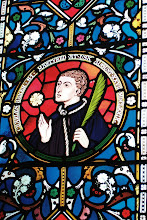
4, 5 & 6) Inside the Catholic Church, an explanatory notice, the Martyr’s Shrine and the colourful, modern stained glass window depicting the church’s two Jesuit patrons, St Francis Xavier and St David Lewis.


The Jesuit’s body was taken in procession to Usk’s Priory Church of St Mary and respectfully buried in the churchyard. His grave is the one nearest the door of the west porch and just to the left of the path as you approach the church. The stone marking the grave is relatively new, having been placed there after the canonisation of St David Lewis. It replaces an old and broken stone generally believed to be the original gravestone. The Priory Church West porch and the Martyr’s gravestone are in the next photographs.


In Penal Times, Mass was celebrated whenever and wherever possible. This could mean in a private house, an inn, a barn, in a field, or in the woods. After the execution of Fr David Lewis in 1679, a house in Usk where he used to say Mass was confiscated. The popular Pub, Cross Keys, is thought to be that house. It is located on Bridge Street, not far from the site of the former Usk Gaol.

Fr David Lewis was beatified in 1929 and on 25th October 1970, he was canonised by Pope Paul VI as one of the Forty Martyrs of England and Wales. His feast day is kept on 27th August. Every year on the Sunday nearest to the 27th August, there is a pilgrimage to the grave of St David Lewis.

ST DAVID LEWIS, PRAY FOR US

Friday, 25 June 2010

CAN ANYONE SOLVE THE MYSTERY?

This interesting fragment of stone bears the inscription "DAVID LEWIS 1679". It was found in the churchyard of the Catholic Church in Usk but no one seems to know anything about its history. Knowledge of its age, origin, etc, seems to be lost in the mists of time. The stone, which has a small cross embedded in it, appears to be the remains of some sort of memorial to the martyred Welsh Jesuit. This stone may or may not be of any significance but, since the only purpose of this blog is to make St David Lewis better known, anything that has even a remote connection to our wonderful Saint is worth investigating, in so far as we are able. Not being professional historians or archaeologists, we are at a decided disadvantage. However, we are devoted to St David Lewis so we do our best with our limited talents. Whatever this curious artifact is, it must have a story and, important or not, it would be nice to know that story. Therefore, I am asking if anyone out there in Blog land has any knowledge of this object? I would be more than delighted to hear from you if you do. (FOR A BETTER VIEW OF THE STONE, CLICK ON THE PICTURE TO ENLARGE IT.)

Sunday, 20 June 2010

'JESUITS POWDER'

Year in and year out, thousands of people died from Malaria, the “ague” mentioned in nine of Shakespeare’s plays. Then, about 1630, Jesuit missionaries working in Peru learned that the bark of a certain tree cured malaria. This bark was known to the natives as “quinquina”. (From “quinquina” comes the word “quinine”.) Jesuit missionaries sent this bark to Rome and Jesuit Cardinal, John de Lugo, was convinced of its value and became a strong supporter and promoter of quinine. Through the Jesuits, this “bark of barks” was distributed through much of Europe. Because the Jesuits were largely responsible for popularising this remedy, it became widely known as “Jesuits Powder”. In 17th century England, hatred and mistrust of Catholics was such that people would even refuse treatment for illness. As one writer put it, “The Protestants scented a Jesuit plot; the bark was an insidious poison which the Jesuits had brought to Europe for the purpose of exterminating all those who had thrown off their allegiance to Rome.”

Dean of Medicine Emeritus at Brown University, Stanley Aronson, wrote an article entitled “Religious Bigotry Got In The Way of Controlling Malaria”. In this article he states, “The arrival of quinine to Britain was delayed by religious prejudice, since quinine had been so closely affiliated historically with the Jesuits.” While fighting in Ireland, Oliver Cromwell became ill with malaria. He recovered from this initial attack but in 1658, in southern England, he suffered another attack. This attack was so severe that his physicians recommended that he be treated with an herbal medicine derived from the mysterious bark. Cromwell’s Protestant religion, with its resolutely anti-Catholic fervour, obliged him to refuse any ‘papist’ medication. Alas, on 3rd September 1658, at the age of 59, the Lord Protector died of - bigotry?
In 1678, the same year that the odious Titus Oates dispensed his venom, a malaria epidemic struck London and the King, Charles II, was stricken. A man named Robert Talbor had enjoyed a certain amount of success in the cure of malaria and the King insisted that he treat him. With his secret mixture, Talbor did cure the King and, when the French Royal Family was afflicted with the disease, Charles sent Talbor to Paris to serve Louis XIV. Again, Talbor’s secret mixture was successful. In gratitude, Louis offered Talbor 3,000 gold crowns and a generous pension for the right to publish the ‘secret’ upon Talbor’s death. Talbor agreed.

In 1681, at the age of 42, Robert Talbor died. King Louis immediately released Talbor’s secret formula. In 1682 it was published in London and there must have been shock in medical circles there. Robert Talbor had once written a widely read document in which he stated, “Beware of all palliative cures and especially of that known as ‘Jesuits Powder’." What was the secret of Talbor’s successful medicine? All along, the cunning Talbor had been mixing opium and various wines with ‘Jesuits Powder’! As Aronson wrote, “More than 350 years have intervened since quinine was introduced as an effective therapy for the intermittent fevers known as ague or malaria. The lengthy span makes it difficult, therefore, for historians to determine which 17th century fever was more intense, religious bigotry or malaria.”

Friday, 18 June 2010

BLESSED JAMES BELL, MARIAN PRIEST AND MARTYR

The term, "Marian Priests", is applied to those English priests who were ordained in or before the reign of Queen Mary (1553-1558) and who survived into the reign of Queen Elizabeth I.

Blessed James Bell was born at Warrington, Lancashire about 1520. He studied at Oxford and was ordained a Catholic priest in Mary's reign. In the reign of Queen Elizabeth I, he gave in to the pressures and threats put upon Catholic priests and conformed to the established Church. Referring to Bell’s defection to the Church of England, a manuscript at Douai states that Bell, "ministered their bare few sacraments about 20 years in diverse places of England".


He returned to Lancashire in 1579. A Catholic lady persuaded him to return to the Church and, in 1581, he was reconciled to the Faith. Eventually, he was allowed to resume priestly functions, and for two years Bell devoted himself unstintingly to the gruelling and dangerous missionary work among his fellow Catholics.

In January 1584, James Bell was apprehended and, admitting to being a Catholic priest, he was arraigned at Manchester Quarter-Sessions held during January. He was then sent for trial at Lancaster Assizes in March. Unsurprisingly, the priest was condemned and when sentence was passed, he said to the Judge: "I beg your Lordship would add to the sentence that my lips and the tops of my fingers may be cut off, for having sworn and subscribed to the articles of heretics contrary both to my conscience and to God's Truth". He spent that night in prayer and on the following day, 10th April, 1584, he was hanged and quartered. The only known Marian Priest to have suffered martyrdom, Fr James Bell was beatified by Pope Pius XI in 1929.

Thursday, 17 June 2010

WHY THEY DIED (CONCLUDED)

These excerpts from the Act show how Catholics, and any who wished to assist them, would find themselves in grave trouble and have to suffer the severe consequences. The aim was to stamp out Catholicism in England. However, Her Majesty and her advisers reckoned without the courage of many Catholics and their deep commitment to the Old Faith
ACT AGAINST JESUITS AND SEMINARISTS (1585)

27 ELIZABETH, CAP 2

"And be it further enacted by the authority aforesaid, that it shall not be lawful for any person of or under her highness's obedience, at any time after the said forty days, during her majesty's life (which God long preserve) to send his or her child, or other person, being under his or her government, into any the parts beyond the seas out of her highness's obedience, without the special licence of her majesty, or of four of her highness's privy council, under their hands in that behalf first had or obtained (except merchants, for such only as they or any of them shall send over the seas only for or about his, her, or their trade of merchandise, or to serve as mariners, and not otherwise) upon pain to forfeit and lose for every such their offence the sum of one hundred pounds.

And be it also further enacted by authority aforesaid, that every person or persons, being subjects of this realm which after the said forty days shall know and understand that any such Jesuit, seminary priest, or other priest above said, shall abide, stay, tarry, or be within this realm or other the queen's dominions and countries, contrary to the true meaning of this Act, and shall not discover the same unto some justice of peace or other higher officer, within twelve days next after his said knowledge, but willingly conceal his knowledge therein; that every such offender shall make fine, and be imprisoned at the queen's pleasure. And that if such justice of peace, or other such officer to whom such matter shall be so discovered, do not within eight and twenty days then next following give information thereof to some of the queen's privy council, or to the president or vice-president of the queen's council established in the north, or in the marches of Wales, for the time being; that then he or they
so offending shall, for every such offence, forfeit the sum of two hundred marks."

Tuesday, 15 June 2010

WHY THEY DIED (PART 3)

This part of the Act makes clear the dangers facing any layperson who dared to assist a priest in any way.

ACT AGAINST JESUITS AND SEMINARISTS (1585)

27 ELIZABETHM CAP 2

And every person which after the end of the same forty days, and after such time of departure as is before limited and appointed, shall wittingly and willingly receive, relieve, comfort, aid, or maintain any such Jesuit, seminary priest, or other priest, deacon, or religious or ecclesiastical person, as is aforesaid, being at liberty, or out of hold, knowing him to be a Jesuit, seminary priest, or other such priest, deacon, or religious or ecclesiastical person, as is aforesaid, shall also for such offence be adjudged a felon, without benefit of clergy, and suffer death, lose, and forfeit, as in case of one attainted of felony.

And be it further enacted by the authority aforesaid, if any of her majesty's subjects (not being a Jesuit, seminary priest, or other such priest, deacon, or religious or ecclesiastical person, as is before mentioned) now being, or which hereafter shall be of, or brought up in, any college of Jesuits, or seminary already erected or ordained, or hereafter to be erected or ordained, in the parts beyond the seas, or out of this realm in any foreign parts, shall not within six months next after proclamation in that behalf to be made in the city of London, under the great seal of England, return into this realm, and thereupon within two days next after such return, before the bishop of the diocese, or two justices of peace of the county where he shall arrive, submit himself to her majesty and her laws, and take the oath set forth by Act in the first year of her reign; that then every such person which shall otherwise return, come into, or be in this realm or any other her highness's dominions, for such offence of returning or being in this realm or any other her highness's dominions, without submission, as aforesaid, shall also be adjudged a traitor, and suffer, lose and forfeit, as in case of high treason.

And be it further enacted by the authority aforesaid, if any person under her majesty's subjection or obedience shall at any time after the end of the said forty days, by way of exchange, or by any other shift, way, or means whatsoever, wittingly and willingly, either directly or indirectly, convey, deliver or send, or cause or procure to be conveyed or delivered, to be sent over the seas, or out of this realm, or out of any other her majesty's dominions or territories, into any foreign parts, or shall otherwise wittingly or willingly yield, give, or contribute any money or other relief to or for any Jesuit, seminary priest, or such other priest, deacon, or religious or ecclesiastical person, as is aforesaid, or to or for the maintenance or relief of any college of Jesuits, or seminary already erected or ordained, or hereafter to be erected or ordained, in any the parts beyond the seas, or out of this realm in any foreign parts, or of any person then being of or in any the same colleges or seminaries, and not returned into this realm with submission, as in this Act is expressed, and continuing in the same realm: that then every such person so offending, for the same offence shall incur the danger and penalty of a Praemunire, mentioned in the Statute of Praemunire, made in the sixteenth year of the reign of King Richard II.


***
In English history, Praemunire or Praemunire facias was a law that prohibited the assertion or maintenance of papal jurisdiction in England, against the supremacy of the Monarch. This law was enforced by the Writ of Praemunire facias, a writ of summons, from which the law takes its name. The name Praemunire may denote the statute, the writ, or the offence.

PRO-LIFE IMAGES


THIS IS JUST A SHORT POST TO LET YOU KNOW THAT THERE IS A GREAT SITE WHERE YOU CAN GET FREE PRO-LIFE IMAGES FOR YOUR BLOG OR WEBSITE. IT IS CALLED FREE PRO-LIFE IMAGES AND JUST CLICKING ON THE NAME HERE WILL TAKE YOU STRAIGHT TO IT. HERE IS AN EXAMPLE OF WHAT YOU WILL FIND THERE.

Monday, 14 June 2010

SAVE ME!


For a post about today's martyrs, have a look at this post on Fallible Blogma - I think it is well worth passing on. I owe thanks to Miss Ellen E over at A Miscellany of Musings where I spotted it.

WHY THEY DIED (PART 2)

The Act Against Jesuits and Seminarists (1585) was long and comprehensive, covering every Catholic in the realm. It was truly designed to stamp out Catholicism. I have quoted some passages from the Act in the hope of showing why the Martyrs were put to death. However, not being of a legal bent, I admit to finding it just a trifle difficult to “pick the bones out of it”, so to speak. Nonetheless, I hope these posts will shed some light on the legal difficulties and horrific dangers Catholics faced in the 16th and 17th centuries. This posts deals specifically with priests.

Act Against Jesuits and Seminarists (1585)
27 Elizabeth, Cap. 2


"For reformation whereof be it ordained, established, and enacted by the queen's most excellent majesty, and the Lords spiritual and temporal, and the Commons, in this present Parliament assembled, and by the authority of the same Parliament, that all and every Jesuits, seminary priests, and other priests whatsoever made or ordained out of the realm of England or other her highness's dominions, or within any of her majesty's realms or dominions, by any authority, power, or jurisdiction derived, challenged, or pretended from the see of Rome, since the feast of the Nativity of St. John Baptist in the first year of her highness's reign, shall within forty days next after the end of this present session of Parliament depart out of this realm of England, and out of all other her highness's realms and dominions, if the wind, weather, and passage shall serve for the same, or else so soon after the end of the said forty days as the wind, weather, and passage shall so serve.

And be it further enacted by the authority aforesaid, that it shall not be lawful to or for any Jesuit, seminary priest, or other such priest, deacon, or religious or ecclesiastical person whatsoever, being born within this realm, or any other her highness's dominions, and heretofore since the said feast of the Nativity of St. John Baptist, in the first year of her majesty's reign, made, ordained, or professed, or here after to be made, ordained, or professed, by any authority or jurisdiction derived, challenged, or pretended from the see of Rome, by or of what name, title, or degree soever the same shall be called or known, to come into, be, or remain in any part of this realm, or any other her highness's dominions, after the end of the same forty days, other than in such special cases, and upon such special occasions only, and for such time only, as is expressed in this Act; and if he do, that then every such offence shall be taken and adjudged to be high treason; and every person so offending shall for his offence be adjudged a traitor, and shall suffer, lose, and forfeit, as in case of high treason."

***High Treason, treason perpetrated by somebody against his or her own sovereign or country, was formerly distinguished from petty treason, a treason committed against a subject of the sovereign, the scope of which was limited by statute to the murder of a legal superior. Petty treason comprised the murder of a master by his servant, of a husband by his wife, or of a bishop. Petty treason ceased to be a distinct offence from murder in 1828. Considered to be the most serious of offences, high treason was often met with extraordinary punishment, because it threatened the security of the state. A particularly horrific manner of execution known as hanging, drawing and quartering was employed.

Sunday, 13 June 2010

WHY THEY DIED (PART 1)

The Reformation saw much blood spilled (Protestant as well as Catholic) as many brave men and women were martyred for their faith. The purpose of this Blog, LAST WELSH MARTYR, is to promote devotion to the martyred Welsh Jesuit, St David Lewis. In attempting to achieve this aim, we have posted much about St David Lewis, some of his fellow martyrs, and the circumstances of their lives and deaths. We have never really looked at WHY they died so I will endeavour to show briefly the laws and regulations which placed Catholics in such danger. We will begin with the "Marian Priests" and in a future post, move on to the "Seminary Priests", of which St David Lewis was one.

The term, "Marian Priests", is applied to those English priests who were ordained in or before the reign of Queen Mary (1553-1558) and who survived into the reign of Queen Elizabeth I. The term is used to distinguish them from "Seminary Priests”, that is, priests ordained at Douai, Rome, or other English seminaries abroad. Shortly after Elizabeth's accession, ordinations ceased altogether in England because of the imprisonment of the surviving bishops. Without the Seminary Priests to take the place of the older priests who were dying off, the Catholic Priesthood would have become extinct in England. Without priests there would be no Mass and eventually, it was planned, the Catholic Faith would die out entirely in England.

There was an important difference between the Marian priests and the Seminary priests in the fact that the Penal legislation of the brutal statute 27 Eliz. c. 2 only applied to the Seminary Priests, who were forbidden to enter or remain in the realm under pain of high treason. The Marian priests came under the earlier statutes, e.g. 1 Elizabeth c. 1, which inflicted penalties on all who maintained the spiritual or ecclesiastical authority of any foreign prelate, or
5 Eliz. c. 1, which made it high treason to maintain the authority of the Bishop of Rome, or to refuse the Oath of Supremacy.

Many Marian Priests accepted, all be it unwillingly, the new state of things under Elizabeth, and some of them were in the habit of celebrating Mass early and then conducting the Church of England service later on Sunday morning. But the number of Marian priests who refused outright to conform was very large.

As years went on, death reduced the number of these faithful priests. However, as late as 1596, there were about fifty of them still working on the English mission. Because of their marginally less severe legal position, they escaped some of the bloody persecution endured by the Seminary priests. Only one Marian Priest, Blessed James Bell, is known to have suffered martyrdom.

Friday, 11 June 2010

THANKS "PEDRO"


On Sunday morning, 17th November 1678, Fr David Lewis S J, was preparing to celebrate Holy Mass. Just before daybreak, six of John Arnold’s dragoons arrived at his cottage in Llantarnam. The dragoons were led by Roger Seys, William Bedloe and William James, and they had been sent by the arch priest hunter, Arnold, to arrest the priest. The ultimate destination was Monmouth Gaol but first the party was to stop at the house of Charles Price of Llanfoist. Price was another Justice of the Peace and one of Arnold’s henchmen.

When Fr Lewis was taken from his cottage, those who had arrested him also took away all the altar furnishings, vestments, and anything considered “popish”! A report sent to the Privy Council asked for instructions as to what should be done with “all his robes, crucifixes, wafers, books and several other things”. The reply was that they should proceed according to the law, and all objects were to be burnt, “if they shall find the same to be popish or superstitious.”

The following is a list of items confiscated and kept by Charles Price of Llanfoist;
One large silver and gilt chalice and paten,
One pair of small silver flower pots,
One small thurible and cover,
One small silver plate for cruets,
One silver cruet,
One silver bell for the altar,
One small pair of silver candlesticks,
Several small pieces of silver belonging to a crucifix,
One picture of the Virgin Mary, with a silver and gilt inner frame

Charles Price was a rapacious man, hungry for power and wealth. Despite orders from the Privy Council, he was very loath to part with the plate taken from the home of Fr Lewis. In April 1860, the Treasury ordered Thomas Morgan, the Sheriff of Monmouth, to take delivery of this collection of plate from Price and give it to the constables as a reward for their diligence in priest hunting! However, Price still clung to his booty and, when an enquiry into the matter was conducted after the accession of King James II in 1685, the stolen articles were still in the possession of Charles Price.

*In 1686 the Commissioners appointed by James II discovered the altar plate of Fr. David Lewis in the possession of Charles Price of Llanfoist, and they handed it over to Edward Lewis, of Abergavenny, "to be kept for His Majestyes use”. *
This Edward Lewis was very likely a relative of the martyr.

If this post seems familiar to some of you, it is because it was originally posted on 11th March 2010. I reposted it because ‘Pedro’ very kindly gave me a little *snippet of information I had not known* and I want to get as much information as possible out there about St David Lewis, the LAST WELSH MARTYR. Thank you, Pedro. I wonder where the plate is now. Could it be the chalice, etc, which is kept at the Catholic Church in Abergavenny?

Tuesday, 8 June 2010

In this month of June Catholics traditionally honour the Sacred Heart of Jesus. I found this video on the Apostleship of Prayer site. Although today isn't the feast day of St Justin Martyr (1June is) I think it is appropriate to post this video here. I hope you find it interesting and uplifting.

Saturday, 29 May 2010

AN AWARD FOR LAST WELSH MARTYR!

Sr Ann Marie, FRANCISCAN LIFE, has presented this Blog with a Sunshine Award. I am very pleased to receive an award - it's my first - and I thank Sr Ann Marie for her kindness. The reward comes with a few simple rules.

The rules are as follows:

1. Post the logo on your blog and/or within the post.

2. Pass it on to 12 other bloggers.

3. Add links to these 12 bloggers within your blog.

4. Let them know they are receiving the award.

5. Share the link of the person from whom you received the award.


I follow and enjoy many blogs and I have found it difficult to pick twelve but here are the ones I have chosen. Take a look at them and I think you will find them interesting and informative too.


Thank you, Sr Ann Marie. You have given me a great boost! God bless you.

Friday, 28 May 2010

A THANK YOU AND A TRIBUTE


This Blog is dedicated to the last Welsh martyr, St David Lewis, so I don't want it to stray far from our beloved Saint or to become personal. However, as you all know, I have been away for two months because several members of my close family were seriously ill. You have all been so kind and given me so much support that this post is to say "THANK YOU" to all of you and to pay tribute to my dear brothers and my wonderful family.

Even though I thought that the pride and love I felt for my large family could not be greater, I was wrong. It has increased with every day of the last two months as I watched them all, from the oldest to the youngest, support and help each other as two brothers were travelling their final journeys at the same time. At first, they were both in the same hospital and the family made its way between fourth and seventh floors to visit and comfort them. Later, as one brother was moved to Palliative care in another hospital, the love was carried back and forth between the two hospitals. Finally, on the morning of Friday, 14th May, my eldest brother, Bill, went to God with the prayers and blessings of the Church, and with his wife and children at his side. The next afternoon, Saturday, 15th May, my second eldest brother, John, also with the Church's prayers and blessings and his family at his side, went to meet his Lord. They had never moved far from the family home and for most of their married lives the two brothers lived next door to each other, one at number 19 and the other at number 21. Years ago, when any reluctance was shown at 'Family Rosary' time, my dear Dad was fond of quoting Fr Peyton, "The family that prays together stays together". I suppose that living so close together and then dying so close together proves my Dad right!

The neighbours made sure that everyone was well fed and sandwiches, cakes, cooked hams and turkeys were in abundance. The support of friends, neighbours and childhood friends, some of whom we hadn't seen since school days, was overwhelming. They turned out for the wakes and funerals in their hundreds!

And you, my loyal Blogging friends, you have been marvellous! Your supportive comments and your prayers have been a great blessing and I am grateful to all of you.

My eldest brother, Bill, made Rosary Beads and donated them all around the world. He sent them to Missions in Africa, India and South America, as well as to Primary Schools and Prisons in Wales. John also had a great devotion to the Rosary and his favourite hymn was "Hail Mary, Gentle Woman". As a small "THANK YOU" to everyone and as a tribute to my gorgeous big brothers, (who probably spoiled me rotten!) I am posting this lovely song. To all of you, family, friends, neighbours and blogging friends, I say a heartfelt thank you and wish you blessings galore. May your kindness be returned a hundred fold!

Wednesday, 5 May 2010

PENAL LAWS IN ENGLISH CANADA

IT IS TIME I DID ANOTHER POST SO, SINCE I AM STILL IN NEWFOUNDLAND, I THOUGHT YOU MIGHT BE INTERESTED IN THE EARLY DAYS OF CATHOLICISM IN ENGLISH CANADA, PARTICULARLY IN NEWFOUNDLAND. THERE WERE NO MARTYRS BUT CERTAINLY PLENTY OF HARDSHIP!

Catholics who settled in Newfoundland suffered under the harsh Penal Laws, that body of discriminatory and oppressive legislation focused chiefly against Roman Catholics, but also against Protestant nonconformists.

Followers of Catholicism in English Canada faced great adversities in their efforts to establish their faith in the new country. This was partly due to the religious disdain of the English majority towards those who refused to conform to the tenets of the Protestant Reformation but also from animosity towards the ethnicity of those who professed Catholicism, particularly to the Irish. This antagonism was most intensely found in Newfoundland where, unlike in Canada, the Penal Laws were strictly applied. However, in spite of the influence the Irish had in English-speaking Canada, it is in Newfoundland that Irish Catholic mores run deepest.

Newfoundland’s rich resources of fish needed people to work in the expanding industry. In the seventeenth century, people from many parts of Ireland, especially Waterford, Wexford, Kilkenny and Tipperary, rose to the challenge and became seasonal visitors to the Island, working in the fisheries during the summer and returning home at the end of the fishing season in the Autumn. The English Merchants, who reaped the immense profits of the Newfoundland fishery, seldom paid these Irish workers so their financial lot was not improved. However, the fishery did provide them with cheap passage to America and the opportunity of eventually migrating to the American Colonies, where they hoped to find better conditions! Nonetheless, many Irish stayed and created a large and permanent Catholic presence in the Colony of Newfoundland. Under the Penal Laws, the Irish settlers stood little or no chance of either justice or mercy when accused of a crime. Irish Catholics were denied a defence counsel and had no way of knowing an indictment until it was read in court.

In Newfoundland at that time, the Catholic Church was an illegal institution and had great difficulty assisting the Irish in the Colony. Since it operated as an underground organization, its spiritual and religious role was restricted. Under the English Penal Laws, enacted from the reign of Queen Elizabeth I to that of King George III, when they were repealed in 1783, it was hoped to eliminate "Popery" by rendering it impossible for a Catholic to exist, except in the most degraded conditions imaginable. Catholics were barred from holding public office, from operating schools or sitting in parliament. Neither could they own property nor own a horse worth more than $5 and the practice of their religion was forbidden. As well as the Penal Laws, local orders were applied. Catholics could not bury their dead; only an Anglican minister was permitted to read the service of burial and collect a fee for doing so.

Rome was not unaware of its responsibility to the Catholic population and from 1535 to 1784, Newfoundland was under the administration of the Bishop of Rouen, then the Bishop of Quebec and then under the Vicariate of London. A number of itinerant priests were sent to Newfoundland and, at considerable risk, they traversed the rough terrain, covertly said Mass, and then moved on. Aware that Catholics were practising their religion by stealth, the local authorities hunted the itinerant priests who came to the Island disguised as fishermen. These priests hid, said Mass and fled. Punishment for participation in the Mass was severe. One account refers to a Michael Keating of Harbour Main who, in 1755, was fined $50 for allowing Mass to be celebrated in his fish store; his house was demolished, his goods were seized, and he was deported from the Colony. These men were under the constant threat of surveillance by Protestants who felt obliged to report their activities. One example, documented in 1755, stated: “ I am informed that a Roman Catholic priest is at this time at Harbour Grace, and that he publicly read mass which is contrary to the law and against the peace of our sovereign Lord, the King.”

Conditions for Newfoundland's Catholics, predominantly Irish, gradually improved as the laws changed. In 1784, "liberty of conscience" was proclaimed in Newfoundland, the first Catholic chapel was built, and an Irish Franciscan, James Louis O'Donel, was appointed the first Roman Catholic Bishop of St. John's, Newfoundland. More priests came from Ireland and, in 1833, the Presentation Sisters arrived from Galway. The Presentation Sisters were followed by The Sisters of Mercy in 1842 and the Irish Christian Brothers in 1857. Advantages were gained when Catholics received the vote and were able to sit in the assembly and on the Legislative Council. For these early Catholic settlers to the Colony of Newfoundland, the struggle to obtain their religious rights was long and difficult. Be that as it may, the Newfoundland Irish expressed a unique culture in various dialects, crafts, and traditions which are still identifiable. The Irish language was commonly spoken among the Newfoundland Irish until the beginning of the nineteenth century, creating an Irish pattern of speech and vocabulary that is evident even today in Newfoundland English. The Catholic Faith, which was sown in suffering, perseverance and faithfulness, flourishes today and the many churches built with the pennies and free labour of poor Irish fishermen are their memorials.
Related Posts with Thumbnails