Tuesday, 4 June 2013

MAPLEDURHAM HOUSE


Mapledurham Gurney was the larger of two Manors mentioned in the Domesday Book.  In 1490, the Manor was purchased by Richard Blount.   Descendants of Richard Blount still live in Mapledurham House. 

About 1588 Sir Michael Blount felt the four hundred year old house was not befitting a man of his status so he set about replacing the old Manor with the present house.  Little remains of the old Manor House now.
 
Inside the oldest part of the Manor
The oldest part of the Manor


These were difficult and dangerous times for Catholics.  Priests and laypeople alike were in danger of losing property, liberty, and life itself.  Priests conducted their mission in secret and many were assisted by Catholic gentry who gave them shelter.  The priests would say Mass and administer the sacraments to Catholics in the secret chapels which these recusant gentry provided in their homes.  Catholic Sir Michael had two secret hiding places, priest holes, constructed off a first floor bedroom.  Located in Oxfordshire, Mapledurham was on the River Thames and thus an ideal location for a Catholic Safe House.  Priests could approach the house from the river thereby avoiding the danger of being spotted as a stranger entering the village on horseback or on foot.  All recusant houses had a secret sign and at the back of this house is a gable covered with oyster shells.  This could be seen from the River and it was a sign to Catholics that this was a Catholic house and a safe refuge where Mass was celebrated.  
 
Oyster Shells on the gable


The gable with the secret sign,
Oyster Shells on the gable

With something to interest everyone, this historic old Manor House is a delight to visit.  The pleasant grounds, the beautiful Anglican Church and the ancient watermill add to the enjoyment of a visit to Mapledurham.  It is also of interest to film buffs as it has often been used in films and television.  Perhaps the best know film is the 1970s classic, ‘The Eagle Has Landed’.    

 
I was particularly interested in its Catholic history which, in my opinion, wasn’t emphasized enough by the guides who were otherwise very informative and obliging.  However, Mapledurham is an important and interesting part of English history and definitely isn’t just for Catholics!

 
An interesting fact imparted to us by one of the guides is that the owners of Mapledurham House are descendants of St Thomas More, one of the early Reformation Martyrs.  In 1814, Charles Eyston married Maria Teresa Metcalfe who, through her mother, was a descendant of St Thomas More.  Mapledurham’s present owner, John Joseph Eyston, is the great-great-grandson of Charles and Maria.   Pictures of St Thomas More, his father, John More, and his son, hang in the passage which takes one to what is known as the Staircase Hall.

 
The library at Mapledurham House holds a vast collection of antique books, some written by the Antiquary, Charles Eyston.  Many of these valuable books are Catholic Recusant books, written in Latin.  These 16th and 17th century books would have been printed on the continent and smuggled into the country.  At that time, it was against the law to own Catholic literature so those who smuggled them into the country, if caught, faced the death penalty!   There are, too, some of Alexander Pope’s books which he bequeathed to a family member in 1744.  A beautifully restored portable altar, disguised as a writing desk, can also be seen in the library.

 
Among the many paintings at Mapledurham House is a curious painting of flowers on a black background.  The roses and peonies used in the painting symbolise mortality.  In the middle of the flowers is an arched black panel.  The guide book tells us that, originally, the Deposition of Christ was depicted in this panel but it was painted out in the 1600s when Catholicism was prohibited in England.


Soon after the Second Catholic Relief Act was passed in 1791 the family built a chapel onto the back of Mapledurham House.  This was one of the first Catholic Chapels legally built in England since the Reformation.  Like others of the time, it was built in the Strawberry Hill Gothic style and designed to seat about fifty people.  We noticed two small statues of the family martyr, St Thomas More, in the chapel. The Chapel was dedicated to St Michael in 1797 and Mass is still celebrated there today.  The Chapel faces the Anglican Parish Church of St Margaret and is separated from it by a courtyard.    
The Chapel Entrance
Inside the chapel
There has been a church on the site since Norman times but the present church was begun in the late 13th century by William Bardolf and his wife, Juliana de Gournay.  Apart from its Norman font, not much of the original church is evident today.  The beautiful Parish Church of St Margaret is an Anglican church with a Catholic aisle, the Bardolf Aisle.  Curious?  Unusual?  Perhaps there are others in the country but I have not encountered this arrangement before and I find it a very interesting one. 
The Anglican Church of St Margaret, Mapledurham
Sometime between 1381 and 1395, the south aisle was added as a chantry chapel and family burial place with an altar at its east end.  When the Blounts bought the Manor in the late 15th century, the aisle became their property and their burial place.    There are some interesting monuments in the Bardolf Aisle, including the hatchment of Michael Henry Blount.  A hatchment is a large heraldic painting, originally displayed over the front door of the house of a nobleman upon his death.  After twelve months, the period of mourning, the hatchment was taken down and brought to the church and hung above his tomb.  (“No trophy, sword or hatchment o’er his bones” Hamlet, Act 4, Scene 5)
Some monuments in the Bardolf Aisle
 
The 14th century Bardolf Aisle
Michael Henry Blount's Hatchment
 
The Bardolf Aisle is separated from the Church and there has been no direct access between aisle and church for almost five hundred years.  Nonetheless, the Bardolf Aisle remains a privately owned Catholic aisle within an Anglican Parish Church.   
The Bardolf Aisle taken from the Church
The Bardolf Aisle & the Parish Church of St Margaret
 
On the outside south east wall of the church, there is a Mass Dial.  Mass Dials, or scratch dials, were usually located near the main door or the priest door.  A mediaeval device, their main function was to indicate the times of church services.
 
 
Then there is Mapledurham Watermill.  This mill, mentioned in the Domesday Book, has had a chequered history but it is now restored.   It is the oldest working watermill on the Thames. Tours  of the mill are available and it is possible to purchase superb flour from its little shop.  I hasten to add that you have not tasted Semolina Pudding unless you have used Mapledurham Watermill semolina!    
Mapledurham Watermill, the oldest working
watermill on the Thames
 
For a great day out, a visit to Mapledurham House in Oxfordshire is one that will surely please and delight you.

Saturday, 30 March 2013

“PRO SACERD ROMAN”


Site of the arrest of St David Lewis
Fr David Lewis S J had been arrested at Llantarnam on 17th November 1678 and imprisoned in Monmouth gaol.  On 13th January 1679 he was transferred to the gaol at Usk.  On 28th March he was again back in Monmouth to be tried at the spring assizes which was presided over by Sir Robert Atkins. 

The Monnow Bridge
 
Fr Lewis was indicted under Statute 27 Elizabeth which deemed it a capital crime to be ordained abroad and return to England for more than forty days.  The charge against him was “David Lewis pro Sacerd Roman”, that is “David Lewis for being a Roman Priest”!  The charge against the priest was read by the Clerk of the Assizes; “Here thou standest indicted of High Treason by the name of David Lewis, for thou being a natural subject of the King of England, hast passed beyond the seas and taken Orders from the Church and See of Rome”.

Fr Lewis pointed out that it was necessary for the prosecution to prove him guilty of the charge of being ordained overseas and taken Orders from the See of Rome.  Judge Atkins responded to this with a curt rebuff but his words made it clear for all time exactly why the priest was condemned.  “What do you expect?  Shall we search the records at Rome, or bring persons to prove that they saw you ordained?  It is enough that you have exercised the functions of a priest in copes and vestments used in your Church, and that you shall have read Mass and taken Confessions.  HE THAT USES TO READ MASS COMMITS TREASON!”
 
The priest hunter, John Arnold, was allowed to sit next to the Judge and permitted to challenge the jurors one by one until he had achieved his goal – a jury that was anything but impartial and certain to convict the priest! This manipulation of the jury did not go unnoticed and the High Sheriff of Monmouthshire protested that Arnold was guilty of “packing the jury”.  His protestations came to naught when Judge Atkins reprimanded him for being “saucy”.  John Arnold was now secure in the knowledge that his handpicked jury would seal the fate of the hapless Fr David Lewis.
 
At about 10 o’clock the following morning, 29th March 1679, the trial of Fr David Lewis began.  Several witnesses were called who swore that they had seen him celebrate Mass.  Chief among them were William and Dorothy James.  However, two of the Crown’s other witnesses heroically refused to give evidence against Fr Lewis.  The defendant challenged the character of some of the witnesses brought against him and exposed the sheer malice of Dorothy James.   With John Arnold’s influence, there was no chance of the accused getting anything even resembling a fair trial and the verdict was a foregone conclusion.  It was sufficient that Dorothy and William James had sworn they had seen the Jesuit say Mass and on this evidence the jury was directed that “If you believe what the witnesses swore you must find the prisoner guilty”.  As expected, the jury found him guilty of treason!


Usk Gaol where St David Lewis awaited his execution

Judge Atkins then put on his cap and pronounced the sentence:  “David Lewis, thou shalt be led from this place to a place whence thou camest, and shalt be put upon a hurdle and drawn with thy heels forward to the place of execution where thou shalt be hanged by the neck and be cut down alive; thy body to be ripped open and thy bowels plucked out; thou shalt be dismembered and thy members burnt before thy face.  So the Lord have mercy on thy soul.”
 
Upon hearing the sentence Fr Lewis made a low bow toward the judge and was led away.  He was returned to Usk Gaol where he was to await his gruesome fate.  On 27th August 1679 Fr David Lewis, the last Welsh martyr, was executed for the crime of being a Catholic Priest and saying Mass.  


St David Lewis was martyred near this site


Friday, 25 January 2013

NOT THE LAST!

I have read several books, written by local authors, stating that St David Lewis was the last Catholic martyr in Britain.  This has also been said in an otherwise excellent video available on youtube.  I don't wish to engender any controversy but I feel I should point out that this is incorrect. 
 
Fr David Lewis S J (alias Charles Baker) was executed at Usk on 27th August 1679.  He, along with 39 others, was canonised in 1970 by Pope Paul VI as one of the Forty Martyrs of England and Wales.  ST DAVID LEWIS was the LAST WELSH MARTYR.  
 
 
St David Lewis, the Last Welsh Martyr
 
On 1st July 1681 Oliver Plunkett, the Archbishop of Armagh, was hanged, drawn and quartered at Tyburn, London.  He was beatified in 1920 and canonised in 1975 by Pope  Paul VI.  ST OLIVER PLUNKETT was the LAST CATHOLIC MARTYR in this country.
 
 
St Oliver Plunkett, the last Catholic martyr
in Britain


Follow this link for more information on St Oliver Plunket.
 

Sunday, 13 January 2013

TRANSFERRED TO USK GAOL


On Monday, 18th November 1678, Fr David Lewis, a Jesuit priest, was incarcerated in Monmouth Gaol.  His false friend, John Arnold, who was a Justice of the Peace and  Member of Parliament, had promised that he would not allow him to be treated with “any incivility or severity” but had secretly ordered that a strict watch be kept on the priest.  Hence, Fr Lewis was kept a close prisoner and not allowed to leave his cell.   However, the Under Keeper, a more reasonable man, allowed friends to visit the priest during the day.  Through these visits the priest learned of the fate of his friends and fellow priests.  He would also have learned of the sacking of the Jesuit College of St Francis Xavier at a place called the Cwm.  Fr Lewis had served as Superior of the College and would feel great distress at its devastation.

Monmouth's Ancient Bridge
In the New Year, the new High Sheriff, James Herbert, decided to move the County Gaol from Monmouth to Usk.  So it was that on 13th January 1679, the Deputy Sheriff and the Head Gaoler rode with Fr David Lewis to Usk.   The weather was atrocious, bitterly cold and snowing.  When the group reached Raglan they stopped at an Inn to warm themselves.  While there a messenger arrived with sad news for Fr Lewis.  A friend and colleague from the Cwm, Fr Ignatius Price, lay dying in a barn about half a mile away.  The dying priest wished to see Fr Lewis.  As he was himself a prisoner in the custody of the Deputy Sheriff and the Head Gaoler, Fr Lewis was unable to comply with this heart-rending request.    Fr Lewis wrote; “Whilst I was in Raglan, a messenger came to the door of the Inn, desiring to speak with me on urgent business.  A very good friend of mine, one Mr Ignatius (alias Walter) Price, lay dying about half a mile away.  He had undergone much hardship from hunger and cold and lay dying.  He desired to see me.  But I was quite unable to perform the friendly duty, as I was under the actual custody of the officers.  So I only sent him my true and best wishes for his soul’s happy passage out of this turbulent world to an eternity of rest.”  Three days later, Fr Lewis learned of the death of his friend.
Site of Usk Gaol where St David Lewis was imprisoned

Usk Gaol, also known as the House of Correction or Old Bridewell, was situated on the north side of Bridge Street.  The Gaol, at 28 Bridge St, had originally been a Friary, a house of the Grey Friars. It became a House of Correction in the mid 1600s and served until Usk Prison was built about 1842.  When Fr David Lewis was imprisoned there it was crowded with Catholics who had refused to take the Oaths of Allegiance and Supremacy.  One prisoner was a widow, Jane Harris, who had given refuge to a priest.  She was betrayed by her butcher when he noticed her buying extra meat!  Fr Lewis would have known most, if not all, of these people for he had spent his priestly life toiling among the persecuted Catholics of the area, travelling mostly at night and probably on foot, to bring them what help and comfort he could.

St David Lewis was martyred on or near this spot in 1679

On 27th August 1679, this good man whose kindness had earned him the name of “Father of the Poor” was taken from Usk Gaol and dragged on a hurdle to a place known as the Coniger where he was executed for the “crime” of being a Catholic Priest.  The actual site of his death is believed to be within the grounds of Porth-Y-Carne House, opposite the Catholic Church of St Francis Xavier and St David Lewis.  The martyred Fr David Lewis was permitted a decent burial.  Reverently carried in procession to the Priory Church of St Mary, he was interred in the Churchyard.   The grave of St David Lewis is the nearest one to the main entrance of the church and every year on the Sunday nearest to 27th August pilgrims flock to this holy site to pay their respects to the Last Welsh Martyr.  
The Grave of St David Lewis
 

Wednesday, 26 December 2012

CHRISTMAS 1678


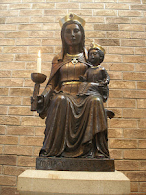
17th century icon, Madonna and Child
 
Christmas of 1678 couldn’t have been a joyful one for Fr David Lewis S J.  Details of that Christmas are scant but we do know for certain that it was the priest’s last Christmas on earth!  As he prepared to celebrate Mass on Sunday morning, 17th November, Fr Lewis was arrested at Llantarnam.  He was incarcerated in Monmouth Gaol.  The Justice of the Peace, John Arnold, who had feigned friendship with Fr Lewis, promised that he would not allow him to be treated with “any incivility or severity”.  Alas, the promise proved to be as false as the friendship.  That very same day, the perfidious Arnold had ordered that a strict watch should be kept over the prisoner, who was guilty of high treason, i.e., he was a Catholic priest!

Christmas found Fr Lewis in Monmouth Gaol, where a friend of the Jesuit had paid 14/ a week to provide him with a good lower room, a bed, linen, fire and a candle.  Officially, Fr Lewis was in Solitary Confinement but the Under keeper of the Gaol allowed friends to visit him in his cell by day.

Early in December, the Lords ordered an investigation of the Jesuit College of St Francis Xavier at the Cwm, where Fr Lewis had been Superior.  Just before Christmas, the Bishop of Hereford, Herbert Croft, led a raid on the Cwm.  He had the enthusiastic help of John Arnold, John Scudamore and Charles Price.  The buildings were ransacked and all books, papers and property confiscated.  Some of the books stolen from the Cwm are today in the library of Hereford Cathedral.  Croft reported that he had found “two horse-loads of books in an adjoining Pig Cot covered with straw, also a great store of divinity books (but they are not yet brought to me, it being Christmas holy days, but they remain in a safe hand) many whereof are written by the principal learned Jesuits”.

On 4th December, Fr Philip Evans, the youngest of the Jesuit missioners in South Wales, was arrested.  He was imprisoned in Cardiff Castle where he was kept in Solitary Confinement for three weeks.  After this time, the Governor was persuaded to allow Fr Evans and a secular priest, Fr John Lloyd, to share a cell.  Other priests had been arrested and some had died of hardship and exposure. 

All of this distressing news would have been conveyed to Fr Lewis by the friends who visited him in Monmouth Gaol.

On the Sunday morning of Christmas week, Fr Lewis was visited in his cell by several magistrates who questioned him about William Bedloe’s allegation that he had supplied information about the Marquis of Worcester’s Agent’s complicity in the Popish Plot.  Fr Lewis deposed that he had neither spoken to nor corresponded with the informer.  He further testified that he had never even heard of the Plot until it became common knowledge throughout the land.  His deposition was sent to London but no more was heard of it.

So passed what was to be the last Christmas of Fr David Lewis.  Early in 1679, the new High Sheriff, James Herbert, decided to move the County Gaol from Monmouth to Usk.  On 13th January, a bitterly cold and miserable day, Fr Lewis was transferred to Usk Gaol to await his fate.  Later that year, in the lovely month of August, Fr David Lewis was martyred at Usk.  On 25thOctober 1970 he was canonised by Pope Paul VI  as one of the Forty Martyrs of England and Wales .

Tuesday, 18 December 2012

FR JOHN EDWARDS S J, REST IN PEACE


Many people are sad today at the news of the death of Fr John Edwards S J.   

Fr John, who had been ill for several months, passed away shortly after hearing Mass on 12th December, the Feast of Our Lady of Guadalupe. 

The privilege of knowing Fr John was ours through the many retreats he conducted at Llantarnam Abbey.  The Annual Day in memory of the Holy Souls on 2nd November was always a touching and moving experience. 

It was also our great good fortune to have Fr John with us at the Abbey on the days held in honour of St David Lewis, the Welsh Jesuit who was martyred in 1679.  Fr John’s saintly presence was an inspiration to all in attendance on those occasions.  Fr John Edwards, who counted his lung cancer a gift from God, will surely be remembered with affection and gratitude whenever we gather at Llantarnam Abbey.  

Fr John Edwards S J, conducting a service at
the site of the arrest of St David Lewis
at Llantarnam, Cwmbran
 

Fr John’s Requiem Mass will take place at Farm St Church, London, at 11 am on Thursday, 20th December.   Fr John, we were honoured to know you.  May your gentle soul rest in peace.

Saturday, 17 November 2012

THE POPISH PLOT AND THE ARREST OF ST DAVID LEWIS


In the summer of 1678, the contemptible Titus Oates and his friend Israel Tonge hatched the fictitious Popish Plot.  Near the end of September, Sir Edmund Berry Godfrey (sometimes spelled Edmundbury Godfrey) became involved when he took the depositions of the two plotters.  On 17th October Godfrey was found face down in a ditch on Primrose Hill.  He was impaled on his own sword.  Marks on his body indicated foul play.   But, was it murder or was it suicide?  At the time, two committees investigated Godfrey’s death, and many theories have since been expounded, but the mystery has never been solved.  Godfrey’s mysterious death was a boon to the anti-Catholic faction who immediately put the blame on Catholic conspirators.  As Macaulay wrote; “The capital and the whole nation went mad with hatred and fear.  The Penal Laws, which had begun to lose something of their edge, were sharpened anew.  Everywhere, Justices were busied in searching houses and seizing papers.  All the gaols were filled with Papists.  London had the aspect of a city in a state of siege”. 
 
Sir Edmund Berry Godfrey
It wasn’t long before the venomous tentacles of the Plot reached into Wales.  The Government had offered a reward of £20 for information leading to the apprehension of any priest.  To this sum John Arnold of Llanvihangel Court added a reward of £200 for information regarding any priest in Herefordshire or Monmouthshire.
 
John Arnold was born in 1634.  A Justice of the Peace and Member of Parliament, Arnold was also a zealous priest hunter and foremost in enforcing the full weight of the Penal Laws against Catholics.  In 1670, John Arnold and John Scudamore informed the House of Lords that “at Llantarnam, an eminent papist’s house in Monmouthshire, there is a room fitted up chapel wise for saying Mass where Fr David Lewis, a popish priest, hath said Mass for many years past” and that there were still six Jesuit priests at the Cwm which “had been a shelter for such popish priests near forty years”.   In 1678 they placed new information before Parliament of “several popish priests and the persons that do countenance them in the county of Monmouth”.   On 20th November 1668 King Charles II, under pressure from Parliament, reluctantly issued a proclamation for the immediate arrest of all priests and Jesuits, who were to be imprisoned “in order to their trial”.
 
Fr David Lewis, alias Charles Baker, was an Abergavenny born Jesuit.  He was Superior of the Jesuit College of St Francis Xavier at the Cwm on the border of Herefordshire and Monmouthshire.  He spent more than thirty years ministering to the harassed Catholics of the area.  As was the practice in such dangerous times, priests often found shelter in the homes of Catholic recusants and from such safe houses they celebrated Mass and the Sacraments and tended to the many needs of their fellow Catholics.   It is well documented that Fr Lewis stayed in the home of Thomas Gunter of Abergavenny and also at the home of his aunt, Lady Frances Morgan, at Llantarnam.

 
For some time, Fr David Lewis had stayed with his relatives, the Morgans, at what is now Llantarnam Abbey.   When the storm of the Oates Plot broke, the priest, not wishing to endanger the Morgans, moved into a nearby cottage at Llantarnam.   This cottage, adjoining the blacksmith’s, was opposite the Parish Church of St Michael and All Angels. 
Parish Church of St Michael and All Angels, Llantarnam
Early on Sunday morning, 17th November 1678, Fr Lewis was preparing to celebrate Mass when a party of six armed dragoons burst in.  They were led to the priest by William James, a Catholic who had formerly worked for him.  For this foul act of betrayal, James received the grand sum of £220, the Government reward of £20 plus the additional £200 offered by John Arnold.   It was a cruel betrayal indeed for Fr Lewis considered John Arnold a close friend because Arnold had always feigned friendship for the priest.  Of his arrest, Fr Lewis wrote; “After my full thirty years poor missionary labours in South Wales, on Sunday morning, a little before day, being the 17th November 1678, I was taken by six armed men sent by Mr John Arnold and Mr Charles Price, until then my two very good friends and acquaintances.  I was taken in a little house in the parish of St Michael-Llantarnam in the County of Monmouth.  From thence by the soldiers, together with such church stuff of mine they there found, carried I was to the house of Mr Charles Price in Llanfoist”.
 
Plaque at the site of the arrest of St David Lewis at Llantarnam
Three Justices of the Peace, Charles Price, John Arnold and Thomas Lewis awaited Fr Lewis at Llanfoist.  The priest was to be taken to Monmouth Gaol and at about 2 o’clock that afternoon, he was led away from Llanfoist by Arnold and his henchmen.   Guarded by twelve armed men, Fr Lewis was taken to his hometown, Abergavenny.  The contingent entered the Golden Lion on Frogmore Street where, in a guarded upper room, Fr David Lewis was examined by the Recorder of Abergavenny, William Jones.   William James swore that he had seen Fr Lewis say Mass at least twenty times.   Asked if he had played any part in the Titus Oates Plot, the priest swore on oath that he had no knowledge of or part in any plot.  Arnold, showing his contempt for all things Catholic, sarcastically remarked that with Catholics it was no oath to swear on the Bible.   
 
The Site of the Golden Lion, Abergavenny
The little group adjourned to the dining room where they had supper together.  Fr Lewis, committed on a charge of Treason, was given the choice of spending the night in a guarded room at the Golden Lion or of being the guest of Arnold at his home in Llanvihangel.  Arnold assured the priest that he would be “most civilly entertained”.   Fr Lewis left the decision to the others and it was arranged that he should spend the night at Llanvihangel Court.  It was a moonlit night when the party left the Golden Lion at about 10 o’clock.  It would have been between 11 o’clock and midnight when they reached Llanvihangel Court, a fine Elizabethan mansion that had been home to several generations of Arnolds.   The defenceless priest spent the night in a room guarded by two “strong men”. 

The next morning, Fr Lewis arose at 7 o’clock and Arnold paid him a short visit in his room where the two exchanged a few civil words.  When he had finished his breakfast, Fr Lewis came downstairs to find the Magistrate and several constables loading guns in the Great Hall.  Then they set out on the final leg of their journey to Monmouth Gaol. 
John Arnold's Home, Llanvihangel Court
 Upon reaching Monmouth, Fr David Lewis was incarcerated in the town’s gaol.  A friend paid 14/ a week for Fr Lewis to have a good room with a fire, candle, bed and linen!  That morning John Arnold had assured Fr Lewis that he would not allow the gaoler to subject him to “any incivility or severity”.  It must have been a sad shattering of all illusion regarding Arnold’s friendship for him when the gaoler showed Fr Lewis a letter written that very day by Arnold.  The letter, dated 18th November, ordered that a strict watch be kept on the prisoner who was guilty of High Treason!

 
Fr Lewis was kept a close prisoner and his confinement was so strict that he never left his cell.  However, the Under Keeper allowed friends to visit him during the day.  For almost two months, Fr Lewis was a prisoner in Monmouth Gaol.  On 13th January 1679 he was transferred to the new County Gaol at Usk.  Here, in the Gaol on Bridge Street, this kind and gentle Jesuit awaited his martyrdom.   

Thursday, 25 October 2012

HYMN IN HONOUR OF THE SIX WELSH MARTYRS

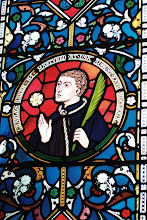
ST STEPHEN & THREE WELSH MARTYRS DEPICTED IN A STAINED
GLASS WINDOW IN THE CATHOLIC  CHURCH, TENBY


Today we celebrate the Feast of The Six Welsh Martyrs of the Reformation.  The Six Welsh Martyrs, who were canonised by Pope Paul VI on 25th October 1970, are:
 
St Richard Gwyn was born about 1537 in Llanidloes, Montgomeryshire. He was a teacher and a married man. He and his wife, Catherine, had six children. He was executed at Wrexham on 15th October 1584. St Richard Gwyn is the protomartyr of Wales.
 
St John Jones O F M was born at Clynog Fawr, Caernarvonshire around the year 1530. He entered the Franciscan Convent at Greenwich and, at its dissolution in 1559, he went to the Continent and was professed at Pontoise, France. He died for the Faith at Southwark on 12th July 1598. At his execution, he had to wait an hour because the hangman had forgotten to bring the rope!

 
St John Roberts O S B born at Trawsfynydd, Merionethshire, was the first prior of St Gregory’s, Douai. He was sent upon the English Mission in December 1602, arriving in England in April 1603. He was probably the first monastic to enter England since the Reformation. He was executed at Tyburn on 10th December 1610.
 

St Philip Evans S J was born in Monmouth in 1645. He entered the Society of Jesus on 7th September 1665. He was ordained at Liege and sent upon the English Mission in 1675. He diligently and joyfully served the area of South Wales for four years before his arrest at the house of Christopher Turberville at Sker, Glamorganshire on 4th December 1678. He was martyred at Cardiff on 22nd July 1679. He was thirty-four years old.
 
St John Lloyd was Brecon born and studied at Ghent and Valladolid. He was ordained a priest at Valladolid in 1653. He returned to Wales and laboured in Brecon and Monmouthshire for 24 years. In November of 1678, he was captured at a house at Penllyn, Glamorganshire. He and St Philip Evans shared a cell at Cardiff Castle until their martyrdom at Cardiff on 22nd July 1679.

St David Lewis S J was born in 1616 at Abergavenny, Monmouthshire. He attended the local Grammar school where his father, Morgan Lewis, was headmaster. Ordained in 1642, David entered the Jesuit novitiate in 1645. He returned to Wales and, based at the Cwm, he served the Catholics of the area for 34 years. He was arrested at Llantarnam on 17th November 1678 and martyred at Usk on 27th August 1679. St David Lewis was the last Welsh martyr.

HYMN OF THE WELSH REFORMATION MARTYRS

(Tune Hyfrydol or Blaenwern)
Came a time upon our nation
when the faith of Rome was banned.
Christians found their hearts were broken,
torn apart throughout our land.
Thus a traitor to the nation
anyone who loved the Pope.
Christians stood in condemnation.
Who could bring them any hope?
 
Men who trained  as priests for Cymru
came from Europe’s shores ere long.
Traversed far and wide our nation,
come to keep the Old Faith strong.
Saying Mass and heard confession,
priests of God , their only crime
was that laws of England’s kingdom
made such treason, at that time.
 
David Lewis, priest of Monmouth
gladly in Usk met his end.
As at Cardiff, Philip Evans
with John Lloyd, his holy friend.
From the north did Saint John Roberts
die for Christ, a Martyr true,
and Franciscan, Saint John Jones,
from the noose to heaven flew.
 
With these priests, to Rome so loyal,
one more Saint of Wales did die.
Richard Gwyn, the edict Royal
did at first its ways comply.
But this man, of Wales a teacher,
taught us now the better way.
He renounced the Royal churches,
chose with Rome alone to pray.
 
Time hath passed upon our nation,
the Old Faith no longer banned.
Other Christians, once oppressive,
now as friends beside us stand.
*This is not a day for gloating,
Or for raising ancient wrong,
but a day for celebrating
loyal Saints whose faith proved strong.*


Related Posts with Thumbnails